Jump to Content
Marine Lubricant Market - Size, Share, Industry Trends, and Forecasts - (2025 - 2035)
Marine Lubricant Market:
Marine Lubricant Market size is estimated to reach over USD 10.10 Billion by 2035 from a value of USD 7.21 Billion in 2024 and is projected to grow by USD 7.46 Billion in 2025, growing at a CAGR of 3.08% from 2025 to 2035
Marine Lubricant Market Scope & Overview:
Marine lubricant is a specialized formulation that offers friction reduction properties, wear protection, corrosion resistance, and the ability to enhance engine efficiency in marine vessels. Marine lubricants are manufactured using modern blending technologies such as base oil refining, additive integration, and advanced quality optimization techniques. The overall production process includes formulation development, stringent performance testing, and regulatory compliance measures, which ensure the required operational reliability.
The key factors driving the marine lubricant market include the growing demand from commercial shipping and offshore industries. Moreover, the need for high-performance and cost-efficient lubrication solutions in marine engines and auxiliary equipment further drives growth of the market. Furthermore, marine lubricants offer several benefits, such as improved fuel efficiency, extended equipment life, and enhanced thermal stability. The marine lubricant market is experiencing growth as a result of the aforementioned factors.
Marine Lubricant Market Size & Forecast
- 2024 Market Size : USD 7.21 Billion
- 2025 Market Size :USD 7.46 Billion
- 2035 Estimated Market Size : USD 10.10 Billion
- CAGR (2025-2035) : 3.08%
- Largest Market in 2025 : Asia Pacific

Marine Lubricant Market Dynamics - (DRO):
Key Drivers:
Increasing demand from global maritime trade activities drives the market growth
The increasing expansion of global maritime trade activities is considered to be one of the major drivers that is contributing to the adoption of marine lubricants. Maritime operators are increasingly choosing high-performance marine lubricants for enhancing engine efficiency and reducing operational wear in vessels engaged in international trade. Marine lubricants enable the benefits of effective friction reduction, extended equipment life, and enhanced operational reliability in main engines, auxiliary engines, and onboard machinery.
- According to the World Trade Organization, in 2025, the volume of world merchandise trade measured by the average of exports and imports, recorded a 5.5% year-on-year increase. This growth in trade volume drives the demand for marine lubricants.
Therefore, the marine lubricant market is experiencing growth as a result of the increasing utilization of marine lubricants in maritime trade activities.
Key Restraints:
Stringent environmental regulations limit market expansion
The stringent environmental regulations associated with marine lubricant usage, such as emission control standards and biodegradable lubricant requirements, are slowing down adoption among certain vessel operators. Additionally, the concerns related to marine pollution and rising preference for eco-friendly alternatives contribute to cautious product selection strategies. Manufacturers are also facing challenges that include compliance costs, product reformulation, and certification requirements, which are hindering expansion among small and medium-sized producers.
Therefore, the marine lubricant market is impacted by strict environmental frameworks and regulatory compliance challenges.
Future Opportunities:
Rising adoption of eco-friendly & bio-based lubricants to create growth opportunities for the market
The increasing global focus on sustainability and marine environmental protection is anticipated to generate significant growth opportunities for the marine lubricant market. The shipping sector is investing heavily in environmentally acceptable lubricants and advanced engine technologies to comply with international standards. Moreover, the implementation of regulations aimed at reducing marine pollution is creating new demand for biodegradable and low-toxicity lubricants, thereby contributing to the growth of the marine lubricant market.
- For instance, the International Maritime Organization aims to reduce green-house gas emission from ships by 40% by 2030. This regulatory push towards decarbonization is encouraging ship operators to adopt environmentally acceptable lubricants, thereby creating significant growth opportunities for bio-based marine lubricants.
Hence, the increasing focus on bio based marine lubricants is anticipated to promote future opportunities for the marine lubricant market during the forecast period.
Marine Lubricant Market Segmental Analysis:
By Type:
On the basis of type, the marine lubricant market is segmented into mineral oil, synthetic oil, bio-based oil, and greases.
Trends in type:
- The growing demand for marine lubricants across commercial shipping, naval fleets, and cargo transportation is fueling the adoption of different lubricant types based on performance and environmental requirements.
- The increasing need for engine protection, fuel efficiency, and regulatory compliance is driving the demand across various marine lubricant types.
The mineral oil segment held the highest revenue share in 2024.
- Mineral oil helps in providing cost-effective lubrication, reliable engine protection, and stable performance in conventional marine engines, which is increasing its adoption.
- Also, the growing use of mineral oil in bulk carriers, tankers, and container vessels is driving segment dominance.
- Moreover, its wide availability and compatibility with existing marine engine systems is supporting its widespread use.
- Furthermore, the increasing fleet size of commercial vessels is contributing to higher consumption.
- Therefore, the dominance of the mineral oil segment is being fueled by its extensive use in marine transportation and shipping applications.
It is anticipated that the bio-based oil segment will exhibit the highest compound annual growth rate (CAGR) during the forecast period.
- Bio-based oil helps in providing enhanced biodegradability, reduced environmental impact, and compliance with marine environmental regulations, which is increasing its adoption in sensitive marine zones.
- Also, the rising demand from offshore platforms and vessels operating in environmentally regulated areas is fueling segment growth.
- Moreover, its sustainable properties and regulatory acceptance is supporting adoption.
- Therefore, the growing preference for environmentally acceptable lubricants is accelerating the growth of the bio-based oil segment during the forecast period.

By Application:
On the basis of application, the market is divided into engine oil, gear- box oil, turbine oil, hydraulic oil, and compressor oil.
Trends in application:
- The growing demand for marine lubricants across propulsion systems, auxiliary machinery, and onboard equipment is increasing its adoption across major application segments.
- The increasing focus on improving engine durability, operational efficiency, and maintenance intervals is fueling the demand across various vessel systems.
The engine oil segment held the highest revenue share of 35.71% in 2024.
- Marine engine oil is widely used in main engines and auxiliary engines of commercial vessels, which is driving its demand.
- Also, the increasing operating hours of ships engaged in international trade is fueling the adoption of engine oil.
- Moreover, the growing demand for fuel-efficient and high-performance engines is supporting segment growth.
- Furthermore, the rising expansion of global maritime trade routes is contributing to increased lubricant consumption.
- Hence, the dominance of the engine oil segment is being fueled by the extensive use of marine engine oil in shipping and transportation activities.
It is anticipated that the hydraulic oil segment will exhibit the highest compound annual growth rate (CAGR) during the forecast period
- Marine hydraulic oil is increasingly used in steering systems, deck machinery, and cargo handling equipment, which is increasing its adoption in vessel operations.
- Also, the rising demand for efficient power transmission systems onboard ships is driving segment growth.
- Furthermore, the growing installation of advanced hydraulic systems in modern vessels is supporting the use of hydraulic oil.
- Therefore, the increasing modernization of marine vessels and demand for operational efficiency are accelerating the growth of the hydraulic oil segment.
Regional Analysis:
North America, Europe, Asia Pacific, the Middle East and Africa, and Latin America are the regions of coverage.
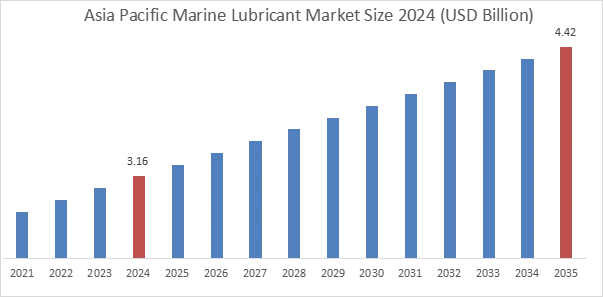
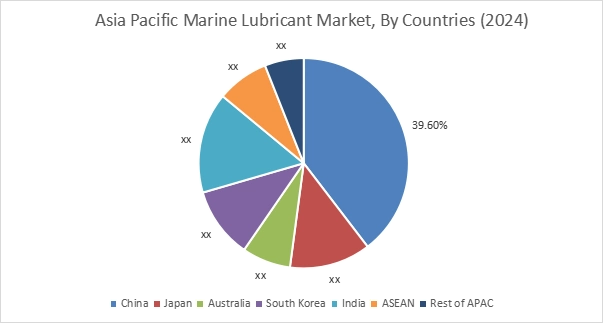
In 2024, Asia Pacific accounted for the highest market share at 43.80% and was valued at USD 3.16 Billion, and is expected to reach USD 4.42 Billion by 2035. In Asia Pacific, China accounted for the highest market share of 39.60% during the base year of 2024. Market growth is mainly fueled by the rapid expansion of maritime trade activities, large-scale shipbuilding production, which contributes to the region’s market dominance. Furthermore, the growing commercial fleet size in major economies such as China, Japan, and South Korea is propelling market adoption. Although other regions are expected to fuel market demand, Asia Pacific is anticipated to remain the dominant revenue contributor during the forecast period.
- For instance, according to the government of China, the nation’s total goods import and export rose to USD 6.1 trillion in 2024, with a 5% year-on-year growth. This growth in maritime trade activities is driving the demand for marine lubricants, thereby supporting the market growth.
In the North American region, the marine lubricant market is expected to register the fastest growth during the forecast period 2025–2035. The growth in this region is driven by increasing offshore exploration activities and expanding commercial shipping operations. Moreover, vessel operators are increasingly adopting high-performance lubrication solutions in cargo vessels to improve engine efficiency and equipment durability, thereby contributing to the growth of the market.
- For instance, according to the U.S. Government, the total U.S. imports crossed over USD 4.3 trillion in 2025. This growth in trade volume creates demand for marine lubricants, further driving the growth of the market.
Europe marine lubricant market is the second largest market after Asia Pacific and is growing owing to the increasing demand from commercial shipping, offshore energy, and naval sectors. The expansion of maritime trade routes and large-scale vessel modernization activities are fueling the demand for marine lubricants, hence driving the growth of the marine lubricant market.
Market growth in the Middle East & Africa is expanding due to the rising investments in offshore oil & gas exploration activities, as well as the increasing use of marine lubricants in tankers, bulk carriers, and offshore support vessels. Moreover, the increasing crude oil exports are driving demand in this region, supported by ongoing maritime expansion programs.
Latin America marine lubricant market is driven by rising demand from offshore and commercial shipping sectors. Additionally, the growing adoption of marine lubricants in fishing fleets, and coastal transportation vessels is driving demand in this region, thereby supporting growth of the market.
Top Key Players & Market Share Insights:
The marine lubricant market is highly competitive, with major oil companies and lubricant manufacturers providing products for developed and developing economies. The companies operating in the market are offering a wide range of products for commercial shipping, offshore operations, and other marine applications. In addition, companies are adopting strategies such as capacity expansion, strategic partnerships, product innovation, and geographic expansion to strengthen their market presence and gain a competitive advantage. The key players operating in the marine lubricant market include:
- Sinopec Corp – China
- ENEOS Holdings, Inc. – Japan
- Indian Oil Corporation Ltd.– India
- Gulf Oil International Ltd. – UK
- Exxon Mobil Corporation – U.S.
- Total Energies SE – France
- BP plc – UK
- Kluber Lubrication – Germany
- Quaker Chemical Corp. – U.S.
- Chevron Corporation – U.S.
Recent Industry Developments:
- In December 2025, TotalEnergies launched Aurelia NGX 40, a low-ash lubricant, developed to offer extended service life of four stroke marine engines operating on gas and ULS fuels.
- In August 2025, Chevron Corporation partnered with Close link to automate and modernize the procurement process of marine lubricants. This will enable near-instant order handling and a first-of-its-kind real-time automated ordering solution in the marine lubricants sector.
Marine Lubricant Market Report Insights:
| Report Attributes | Report Details |
|---|---|
| Study Timeline | 2024-2035 |
| Market Size in 2035 (USD Billion) | USD 10.10 Billion |
| CAGR (2025-2035) | 3.08% |
| By Type |
|
| By Application |
|
| By Region |
|
| Key Players |
|
| Report Coverage |
|
Key Questions Answered in the Report
How big is the marine lubricant market? −
Marine lubricant market size is estimated to reach over USD 10.10 Billion by 2035 from a value of USD 7.21 Billion in 2024 and is projected to grow by USD 7.46 Billion in 2025, growing at a CAGR of 3.08% from 2025 to 2035.
Which segmentation details are covered in the marine lubricant report? +
The marine lubricant report includes specific segmentation details for type, application, and region.
Which is the fastest segment anticipated to impact the market growth? +
In the marine lubricant market, the hydraulic oil segment is the fastest-growing segment during the forecast period, driven by the rising demand for efficient power transmission systems onboard ships.
Who are the major players in the marine lubricant market? +
The key participants in the marine lubricant market are Sinopec Corp (China), ENEOS Holdings, Inc. (Japan), Indian Oil Corporation Ltd. (India), Gulf Oil International Ltd. (UK), Exxon Mobil Corporation (US), TotalEnergies SE (France), BP plc (UK), Klüber Lubrication (Germany), Quaker Chemical Corporation (US), and Chevron Corporation (US), and others.
What are the key trends in the marine lubricant market? +
The marine lubricant market is shaped by key trends including the expansion of global maritime trade activities.
Overview
Reputation & Certifications


Our Services
- Market Intelligence & Forecasting
- Custom Research Solutions
- Market Entry Strategy
- Competitive Intelligence
- Customer Insights
- Industry Innovation Analysis
- Investment Advisory