Jump to Content
Metallized Flexible Packaging Market - Size, Share, Industry Trends, and Forecasts (2025-2035)
Metallized Flexible Packaging Market Scope & Overview
The global metallized flexible packaging market is a complex and highly dynamic market in the packaging industry and involves the use of high-performance barrier films that are produced by vacuum metallization procedures that coated ultra-thin layers of aluminum (usually 30-50 nanometers thick) onto flexible polymer base materials such as polyester (PET), polypropylene (PP), polyethylene (PE), and polyamide (PA) to provide excellent moisture, oxygen, and light barrier properties and which result in excellent brand positioning and protracted shelf life, product safety, and high The market is estimated at USD 18,400 Million in the year 2024 and USD 19,200 Million in the year 2025 (base year) with the market expected to grow at a rapid rate to USD 31,100 Million in the year 2035. This growth trend is showing a compound annual growth rate (CAGR) of 4.9 per cent within the forecast period of 2026 through 2035 due to the growing consumer demand of convenient packaging with a long shelf life, the growing popularity of lightweight packaging and sustainable packaging options that are substitutes of rigid packaging materials, additional growth in snack food and confectionery segments, and technological advancement in barrier coating technologies, rising online shopping trends that need protective packaging solutions and the growing use in pharmaceutical application that needs the moisture-sensitive product protection.
Metallized flexible packaging offers the functionality of aluminum foil that includes high barrier properties, such as high resistance to moisture vapor transmission rates of less than 0.5 g/m2/day and to oxygen transmission rates of less than 1-3 cc/m2/day, with the processing flexibility, economy and reduction of materials of polymer films. The vacuum metallization technique produces microscopically thin metallization of aluminum layers that constitute 2-3 percent of the mass of equal structures of aluminum foil, which allows achieving significant savings in material and preserving the functionality of critical barriers. The technology is also used as cornerstone solution in packaging where the product is required to last a long time on shelves without any refrigeration, withstand degradation caused by light to a level of 99% UV and visible light blocking and high-quality metallic appearance that informs the consumer on quality and freshness of the product in various product categories.
Key Insights
- Global CAGR (2026-2035): 4.9%
- Global Market Size (2025): USD 19,200 Million
- Global Market Size (2035): USD 31,100 Million
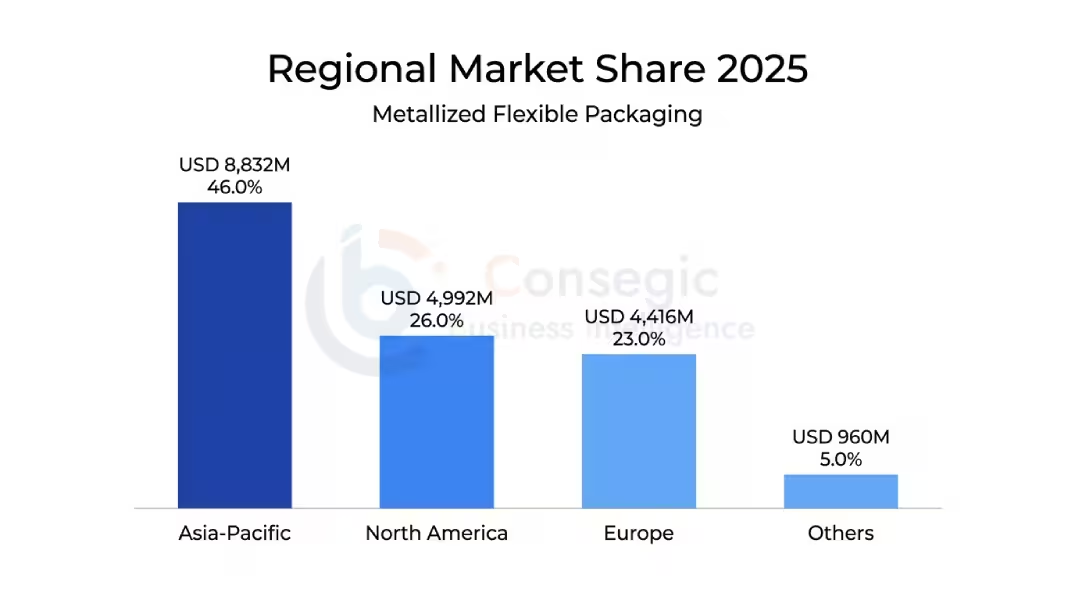
- Asia-Pacific Market Value (2025): USD 8,832 Million
- Europe Market Value (2025): USD 4,416 Million
- North America Market Value (2025): USD 4,992 Million

The total market value of the global flexible packaging industry is more than USD 285,000 Million in 2024 with metallized films forming a specialized high-performance segment market of about 6.7% of total flexible packaging value but fetching premium price of USD 2.80-5.50 per kilogram as opposed to USD 1.40-2.80 per kilogram conventional printed films. In 2024, the world production of metallized films amounted to around 1.85 million metric tons, and metallized films are used in snack food (potato chips, extruded snacks), confectionery (chocolate bars, candy), coffee and tea packaging, bakery products, pharmaceutical blister packs and sachets, pet food pouches, and in industry (insulation materials, decorative laminates, etc.).
Market Channel Distribution Analysis
The metallized flexible packaging market has four different channels of end-use applications that are showing particular performance requirements, barrier specifications, and value propositions. Overall distribution of the market revenue shows that it varies considerably by the sector of application, package type and the regional consumption patterns:
Application Channel Breakdown (2025):
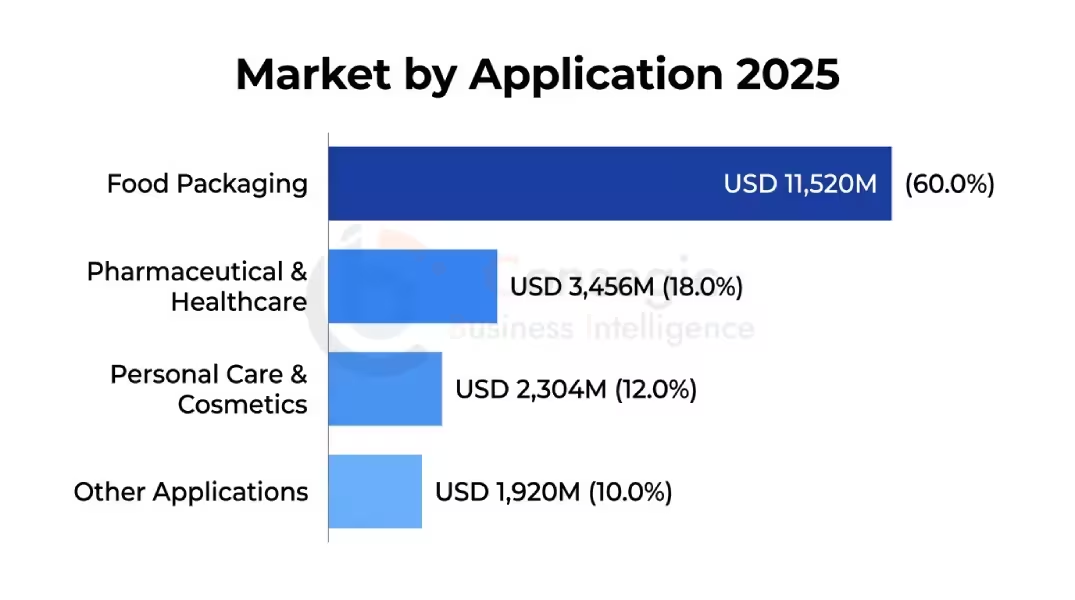
- Food and Beverage Applications: USD 11,520 Million (60.0% of the total market value)
- Pharmaceutical, Healthcare Packaging: USD 3,456 Million (18.0% market revenue)
- Personal Care and Cosmetics Packaging: USD 2,304 Million (12.0% of market share)
- Other Applications (Pet Food, Industrial, Agriculture): USD 1,920 Million (10.0% of the total market value)
In 2024, global investment in expansion of metallized film production capacity, development of advanced coating technology, sustainable metallization processes, and quality control system had reached USD 780 Million, of which major film converters and packaging manufacturers had allocated an average of 4.2-4.8% of revenues to development of next-generation metallization technology including plasma-enhanced deposition, transparent barrier coating development, recyclability-enhanced structures, and digital printing compatible substrates which could be mass-customized without compromising barrier integrity.
The sector is undergoing paradigm shift in the direction of sustainable packaging solutions, where increased focus on recyclable single material structures and clear high-barrier coating options in place of metallization and bio-based substrate materials to the issue of packaging waste, consumer, and regulatory concerns are being pursued. The main converters are creating metallized films that can be recycled in polyethylene and polypropylene streams, transparent oxide films (silicon oxide, aluminum oxide) which offer barrier properties comparable to those of metallization, but still remain transparent, and compostable metallized films wherein particular applications can be targeted in response to circular economy efforts and extended producer responsibility policies in key markets.
Metallized Flexible Packaging Market Dynamics (DRO)
Key Drivers:
Increasing the Demand on the Long Shelf Life and the Minimization of Food Wastes.
The greatest structural force is the increasing consumer and retailer need to find packaging solutions that will provide longer shelf life without refrigeration, but allow distribution to cover wider regions, minimize food waste, and maintain product quality during supply chains. Moisture-sensitive foods such as potato chip, crackers, and powdered pharmaceuticals require water vapor transmission rates less than 0.5-1.0 g/m 2/day to meet quality requirements, and oxygen-sensitive foods such as coffee, nuts, and some pharmaceuticals require oxygen transmission rates of less than 1-3 cc/m 2/day to avoid oxidative spoilage.
Metallized films provide almost identical barrier performance to foil made of aluminum at a material cost of 30-50% lower and package weight of 40-60% lower, providing brand owners with interesting economic value propositions. The market of the world in the global savory snacks industry, which is projected to reach USD 158,000 Million in 2024 and is increasing at a rate of 5.2 per annum, has seen especially high adoption with 78 percent of potato chips and 65 percent of extrusive snacks having been packaged in metallized structures worldwide, indicating the dominance of the technology in applications that require the maintenance of crispness by the exclusion of moisture.
Rigid Packaging and Material Substitution and Efficiency.
The owners of the brands are actively moving away the rigid packaging (cans, glass, rigid plastic) and heavy aluminum foil laminates to metallized flexible pouches to minimize materials use and logistics expense. Metallized films have much lower weight, and a rigid canister can be substituted by a metallized stand-up pouch and the weight of packaging can be lowered by 70-85. Also a metallized layer is only 0.04 microns in thickness, which is a 99% reduction in metal content and a metallized layer still has virtually identical barrier characteristics in most applications.
High End and Branding With Metallic Beauty.
The high shelf impact and high brand positioning so that the metallized packaging is designed to provide are due to its metallic appearance, which has been shown in consumer surveys to produce 28-35 higher perceived product quality rating than plain printed films in blind tests in the food and personal care product categories. Such aesthetic superiority is especially beneficial when the product is sold in a competitive retail setting where package appearance is a major determinant of purchase decision and research has shown that 63-72% of purchase decisions are made at the point of sale depending on the visual appearance of the package.
Key Restraints:
Recyclability Problems and Sustainability issues.
A major market restraint is seen in the form of recycling constraints relating to multi-layer metallized structures which combine materials which are not compatible like polyester, polyethylene, polypropylene, adhesives and aluminum posing a challenge to the mechanical recycling process which requires homogeneity in materials. The existing municipal recycling systems exhibit a low degree of flexibility in the recovery of flexible packaging and the average collection rates of flexible packaging are 12-18% in developed countries versus 65-75% in rigid plastic containers, leading to large volumes of flexible packaging being discarded in landfills or burned.
Although the ultra-thin layer of aluminum in metallized films provides its own benefits of material efficiency, it makes recycling more complex since the aluminum does not lend itself to economic recovery using traditional separation technologies. The European Union regulations such as the Packaging and Packaging Waste Directive revision and other measures may exert regulatory force on the improvement of recyclability, enhanced producer responsibility schemes are more likely to punish the hard-to-recycle packaging by imposing higher penalties.
Flex-Cracking Susceptibility and Barrier Degradation Susceptibility.
Although metallized films provide excellent barrier properties in the planar state, the thin metal layer is fragile and prone to flex-cracking during the handling, shipping, or packaging of the product. Following form-fill-seal operations or during consumer-handling, the film is bent and folded, which may result in pinholing to the metal layer, greatly impairing barrier performance. Extreme flexing is likely to cause a rise of the Oxygen Transmission rate (OTR) by 50-200 percent, which may damage the product within. This is because the standard metallized films cannot be used in applications where there is need to handle or vacuum pack irregular shapes rigorously.
Barrier technology alternatives Competition.
Metallized films are confronted with the growing competition in the form of alternative barrier technologies such as transparent oxide coatings (aluminum oxide, silicon oxide), EVOH (ethylene vinyl alcohol) barrier layers, and PVDC (polyvinylidene chloride) coating having similar barrier performance but meeting certain application needs or sustainability goals. Transparent barrier coatings have shown to be especially competitive in applications that need visibility of the product, with oxide-coated films recording water vapor transmission rates of 0.3-0.8 g/m2/day and oxygen transmission rates of 0.5-2.0 cc/m2/day, being almost as fast as metallized film but being transparent.
Future Opportunities:
Recyclable Monomaterial Structures Development.
There is a large market potential to create metallized packaging structures that can be recycled using the current recycling systems especially polyethylene-based laminates and polypropylene-based mono-material laminates that contain metallized PE or PP model laminates. These structures allow recycling of established polyolefin collection streams with acceptable barrier functionality which can be used in numerous applications and initial commercial adoptions have proved successful market acceptance in snack foods and confectionery applications.
High-tech Surface Finishes and Glass windows.
The system of transparent high barrier coatings based on Aluminum Oxide (AlOx) and Silicon Oxide (SiOx) is a potential opportunity in the application where it is necessary to know the appearance of the product. Such technologies have been shown to have a high transparency in addition to metallized films, and provide excellent barrier properties with flexibility to design packages and possible recycling advantages. With better coating life and the reduction of cost, transparent barriers are likely to gain a considerable market in fresh food, meat and cheese industries with the growth forecast at 8.5 percent CAGR.
E-Commerce Packaging and Direct -to-Consumer Applications.
A dramatic increase in the e-commerce activity opens up a huge potential on the use of protective packaging solutions as the global e-commerce sales volume is projected to be USD 6,300,000 Million in 2024 and is projected to rise at 9.5% per annum. Metallized flexible packaging contains attractive features such as lightweight manufacturing that reduces the shipping expenses, cushioning qualities that help in the transportation of products, maintain the moisture, avoiding any damage due to the exposure of the products to the environmental conditions, and the high appearance that improves the unboxing experience.
Market Segmentation Analysis
By Material Type: Substrate Analysis
Metallized Polypropylene (BOPP): Volume Leader.
In 2025, there will be commanding market leadership of USD 7,680 Million or 40.0 per cent of the total market value in metallized BOPP, which will grow to USD 12,440 Million by 2035, at 4.9 per cent CAGR. Metallized BOPP has displayed high level of combination of properties such as high level of moisture barrier, cost effective, high level of sealability allowing high speed packaging process, strong adoption in snack food, confectionery, and bakery applications. The content prevails in the high-volume applications where the moisture protection is necessary to preserve the crispness and texture of the product.
Metallized Polyester (PET): Leader in Performance.
Metallized PET corresponds to USD 5760 Million (30.0% of market value), which has a high oxygen barrier properties, thermal stability and tensile strength than metallized PP and is primarily used in markets that need maximum barrier protection such as coffee packaging, pharmaceutical blister lidding and high-end confectionery wrappers.
Polymers Metallized Polymers.
Metallized PE and other substrates such as polyamide constitute USD 5,760 Million (30.0% of market value) with the metallized PE making inroads as important constituent in recyclable mono-material structures to meet sustainability demands whilst providing reasonable barrier properties on moderate protection uses.
By Application: End-Use Market Analysis
Food Packaging: Preeminent Usage Division.
The biggest use is food packaging of USD 11,520 Million (60.0% of overall market value) that will involve a wide array of product types and barrier specifications. The greatest subgroup would be snack foods, which must have potato chips, extruded snacks, and crackers; here, an outstanding moisture barrier should be essential to avoid texture loss. Metallized wrappers which offer moisture and oxygen protection and used in confectionery applications such as chocolate bars and candy are used to provide high metal appearance and the chocolate confectionery market in the world is more than USD 142,000 Million in 2024.
Pharmaceutically and Healthcare Packaging: Premium Applications.
The Pharmaceutical packaging covers USD 3,456 Million (18.0% of market value), which also has vital product protection functions regarding moisture sensitive drugs and light sensitive drugs. The biggest pharmaceutical use is blister packaging where metallized films are used as the lidding materials which provide unit-dose protection, tamper evidence, and compliance packaging properties.
Personal Care and Cosmetics: Premium Positioning.
Personal care and cosmetics packaging is USD 2,304 Million (12.0% of market value) which uses metallized films to present high quality products and safeguard them against moisture in use in such products as facial mask sachets, cosmetic sample packages, and wet wipe package.
By Packaging Format
Pouches and Bags: Preeminent Form.
Pouches (stand-up, flat, retort) have 52.0% of the market value, with metallized stand-up pouches showing especially good growth at 7.2% CAGR due to both replacing rigid containers and added convenience.
Wrappers and Overwraps
Wrappers represent 28.0% of market value with the main usage being in confectionery, bakery items and in individual portioning wrappers.
Lidding Films as well as Other Formats.
The Lidding films take up 15.0% of market value followed by other types of films such as labels and specialty applications with 5.0%.
Regional Market Analysis
Asia-Pacific: Leader in the Market and the manufacturing center.The Asia-Pacific metallized flexible packaging market is projected to grow to USD 8,832 Million in 2025, which is equivalent to 46.0% of the entire world market value, with a growth of USD 14,912 Million in 2035 at 5.4% CAGR a fair aspect since it has the highest growth rate of the region. China leads in regional demand of 48.5% market value which is the key consuming region due to the booming snacks food and confectionary as well as the pharmaceutical industries and the leading producer of metallized film with about 52% of the world production capacity.
India has a maximum market value of 18.5% of Asian-Pacific showing extreme growth due to the increasing FMCG sector, growing penetration of organized retail and the growing pharmaceutical production industry. Countries such as Southeast Asian countries such as Indonesia, Thailand, Vietnam and Philippines have a combined contribution of 22.0 percent of regional market value and their growth is very high due to their young population, urbanization and the increasing number of middle-class population consumption.
North America: Leadership and Innovation in technology.
The metallized flexible packaging in the North American market is USD 4,992 Million, equivalent to 26.0 of the global market value, and it is expected to grow further to USD 7780 Million in 2035. The US controls most of the regional demand up to 89.5% of the market value and run advanced packaging industries in which high technology has been adopted and consumers have greatly favored convenience format of packaging.
The market shows growing interest in sustainable packaging solutions and most brands declare the intention to transition to recyclable packaging by 2025-2030 periods, which leads to the growth of the recyclable metallized structure and other barrier materials. The U.S. metallized film consumption is characterized by some notable success in snack foods, confectionery, coffee, and pharmaceutical products.
Europe: Regulatory Leadership and Focus on sustainability.In 2025, the European metallized flexible packaging will be valued at USD 4,416 Million, which is a percentage of 23.0 of the global market value, and it will grow to USD 6,531 Million in 2035. Germany, France, United Kingdom and Italy all sum up to 68 percent of the regional demand and they have mature packaging industries that are highly environmentally regulated featuring extended producer responsibility programs and use of packaging waste recycling requirements.
The sustainable packaging innovation by Europe has led the world, with large converters coming up with recyclable metallized structures, transparent barrier coatings, and bio-based substrate materials that will meet the goals of the circular economy. The moderate growth rates in the region indicate that the market is already mature and that it continues to be substituted to more sustainable packaging solutions but at the same time produces relatively large volumes in its application where metallized films offer the best performance.
Other RegionsLatin America is USD 672 Million (3.5% of world market) with Brazil and Mexico to lead the growth in snack food and confectionery consumption with potential growth and development as the countries urbanize, developing modern retail stores, and as people consume more packaged food.
Competitive Landscape and Key Market Players
Market Leadership and Strategic Positioning
Amcor plc (Switzerland/Australia) - International Packaging Powerhouse.
Amcor has maintained its market dominance by its full range of high-barrier metallized laminates such as its AmLite(r) line that uses ultra-high-barrier metallized films and no longer requires aluminum foil that provide 40 percent carbon footprint savings. The strategic positioning of the company is its commitment to the recycling or reuse of all packaging in its 2025 Pledge, which is promoting innovation of solutions that are sustainable in metallizing.
Jindal Poly Films Limited (India) - Film Manufacturing Leader.
Jindal is one of the largest manufacturers of BOPP and BOPET films in the world and plays an important role as an upstream player in the world by supplying the converters with metallized base films. Their purchase of the film business of ExxonMobil broadened their product range into high barrier, water based coated metallized films, which enhanced their presence in the high-end markets.
Mondi Group (United Kingdom/Austria) Sustainable Innovation.
Mondi also concentrates on sustainable packaging by their BarrierPack Recyclable which is a metallized PE laminate that has high barrier properties but can be recycled completely in current PE streams. The innovation strategy of the company is based on principles of paper where possible, plastic when useful.
Other Major Market Players:
- Constantia Flexibles (Austria) - Pharmaceutical and food Specialty supplier of high barrier metallized flexible packaging.
- Uflex Limited (India) - Converting equipment, films, and metallization producer that is vertically integrated.
- Cosmo Films Limited (India) - Specialized producer of BOPP films including strong metallized films.
- Toray plastics (America), Inc. (Japan/United States) - Metallized metallized PET and BOPP films with precision engineering.
- Huhtamaki Oyj (Finland) - good footprint in the emerging markets with flexible laminates.
- Polyplex Corporation Limited (India/Thailand) -Large-scale BOPET and metallization plants.
Recent Industry Developments
Recyclable Mono-Material Structures Breakthrough (2024-2025).
Several major converters introduced commercially viable recyclable metallized polyethylene films that could be added to the existing LDPE recycling streams with large branded owners taking part in being announced to convert specific product lines to recyclable metallized forms, such as Mondelez International, and PepsiCo. All these developments confirm that barrier performance is maintained successfully and the ability to allow compatibility with recycling infrastructure.
Advancement of Transparent Barrier Coating Technology (2024).
The production capacity of transparent oxide-coated films (aluminum oxide, silicon oxide) was extended by leading manufacturers of films as an alternative to metallization when film visibility was needed in the product. New line coating developments in Asia and Europe have barrier properties of about 0.3-0.8 g/m 2/day of water vapor (metallization) without being opaque.
Digital Watermarking to Improved Recycling (2025).
European pilot projects started experimenting with digital watermarks on metallized packaging, such that sorting plants could differentiate between the standard metallized films and new recyclable mono-material metallized films. This technology is used to solve the bottlenecks in waste management plants in terms of critical sorting, in favor of the implementation of the circular economy.
Innovation of Advanced Metallization Process (2024).
The industry leaders installed next-generation vacuum metallization equipment with in-line plasma treatment, high uniformity of the thickness, and energy optimization features. These technological advances lead to a low pinhole density, increased coating adhesion and better consistency of the barrier besides having a low impact on the environment.
Metallized Flexible Packaging Market Report Insights
| Report Attributes | Report Details |
|---|---|
| Study Timeline | 2022-2035 |
| Base Year | 2025 |
| Forecast Period | 2026-2035 |
| Market Size in 2025 | USD 19,200 Million |
| Market Size in 2035 | USD 31,100 Million |
| CAGR (2026-2035) | 4.9% |
| By Material Type | Metallized PP (40.0%), Metallized PET (30.0%), Metallized PE & Others (30.0%) |
| By Application | Food Packaging (60.0%), Pharmaceutical (18.0%), Personal Care (12.0%), Others (10.0%) |
| By Format | Pouches & Bags (52.0%), Wrappers (28.0%), Lidding Films (15.0%), Others (5.0%) |
| By Region | Asia-Pacific, Europe, North America, Latin America, Middle East & Africa |
| Key Players | Amcor, Jindal Poly Films, Mondi Group, Constantia Flexibles, Uflex, Cosmo Films, Toray Plastics, Huhtamaki, Polyplex |
| Report Coverage |
|
Key Questions Answered in the Report
What is the size of the Metallized Flexible Packaging market? −
The global metallized flexible packaging market has a steady growth potential with a value of USD 19,200 Million in 2025 with a projected value of USD 31,100 Million in 2035, which indicates sustained growth due to increasing consumer demand of metallized flexible packaging products, demand to use lightweight alternative to rigid format, increasing snack food and confectionery markets especially in developing economies, increasing pharmaceutical packaging needs of moisture sensitive product, increased e-commerce needs of protecting products thus the use of recyclable metallized structures that offer solution to sustain
What is the fastest-gaining market in the Metallized Flexible Packaging market? +
Asia-Pacific is the largest and the fastest growing regional market with 5.4% CAGR due to the dominant role of China as manufacturing centre and major consumption market with a rising snack food and confectioner industries, India with its outstanding growth rate attributable to rising disposable incomes and growing FMCG market, Southeast Asian countries with high consumption growth rates, owing to the role of young population and urbanization, and general growth of production capacity that should support the local consumption and export market in food packaging, pharmaceutical applications, and personal care products.
What are the major issues and opportunities with respect to sustainability? +
The metallized flexible packaging sector is experiencing high levels of sustainability such as lack of recycling infrastructure given that current flexibles collections are at an average rate of 12-18% in advanced markets, inability to recycle through mechanical processes due to multi-layer structure, and stringent sustainability requirements by the extended producer responsibility legislation. Nevertheless, there are considerable opportunities in the areas of development of recyclable mono-material metallized structures that can be used with polyethylene and polypropylene recycling streams, coating alternatives that are transparent oxides that offer barrier properties and have a potential to enhance recyclability, and optimization of lifecycle showing that metallized flexible packaging does have 40-55 times lower carbon footprint than rigid counterparts through material efficiency and transportation savings.
Which new technologies influence the development of the market? +
Important technological advancements also encompass recyclable metallized polyethylene films that allow incorporation into existing LDPE recycling systems, transparent barrier coatings made by using aluminum oxide or silicon oxide that deliver water vapor transmission rates of 0.3-0.8 g/m2/day and product visibility, advanced metallization operation such as plasma-enhanced deposition that enhances coating uniformity and barrier predictability, digital watermarking technology that allows improved sorting in recycling facilities, and smart packaging integration with sensors and authentication functionality that builds on the conductivity properties.
Which of the specific applications has the highest growth potential by 2035? +
Pharmaceutical packaging is an outstanding expansion potential due to the growing generic drug manufacturing, growing use of unit-doses packaging, and moisture-sensitive items protection needs. E-commerce packaging has a high potential since online sales in retail business have surpassed USD 6,300,000 Million worldwide and increasing with a rate of 9.5 percent, which is in need of protection packaging with moisture barrier, lightweight, and quality unboxing experience. Stand-up pouches continue to exhibit vigorous growth as they are replacing rigid packages in a variety of product lines, and high-end pet food packages are experiencing high usage due to humanization trends that are driving the use of high-barrier pouches with close seals, and coffee packages have steady demand due to the increasing popularity of the specialty coffee industry that requires maximum barrier protection to ensure the product maintains the highest possible quality of flavors.
Overview
Reputation & Certifications


Our Services
- Market Intelligence & Forecasting
- Custom Research Solutions
- Market Entry Strategy
- Competitive Intelligence
- Customer Insights
- Industry Innovation Analysis
- Investment Advisory