Jump to Content
Metamaterials Market - Size, Industry Share, Growth Trends and Forecasts (2026 - 2034)
Metamaterials Market Size:
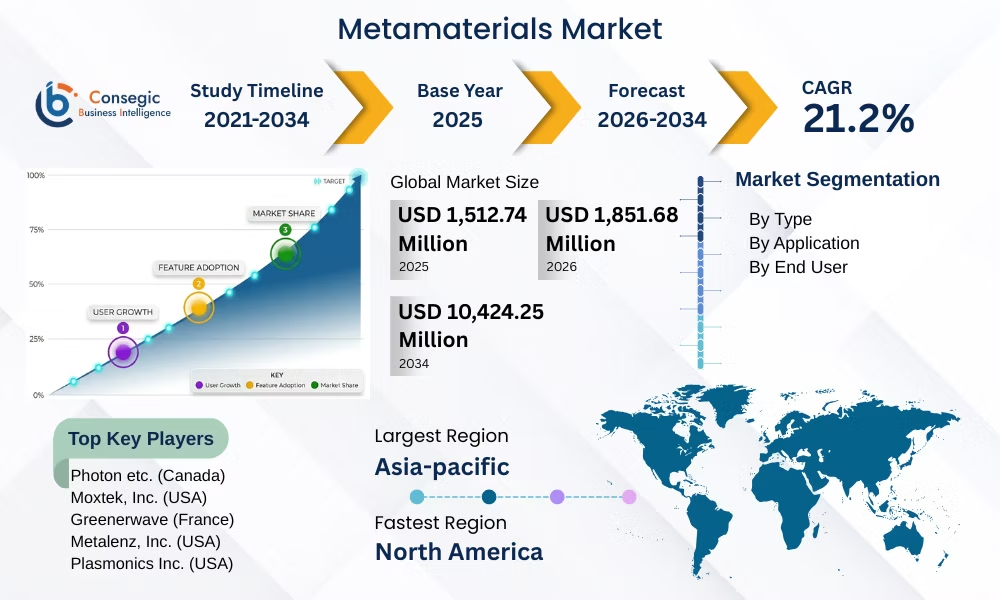
Metamaterials Market size is estimated to reach over USD 10,424.25 Million by 2034 from a value of USD 1,512.74 Million in 2025 and is projected to grow by USD 1,851.68 Million in 2026, growing at a CAGR of 21.2% from 2026 to 2034
Metamaterials Market Key Takeaways
Key Growth Drivers
- Rising deployment of 5G, emerging 6G, and terahertz communication technologies is driving demand for advanced metamaterial-based antennas and lenses.
- Superior electromagnetic wave control offered by metamaterials is improving signal quality, beam steering, and wireless communication performance.
- Growing need for high-gain, low-profile, and energy-efficient communication components is accelerating market adoption.
Market Limitations & Challenges
- High energy absorption and resistive losses reduce the efficiency of metamaterial-based devices and systems.
- Narrow operational bandwidth limits their effectiveness in broadband and multi-frequency communication applications.
Strategic Opportunities
- Increasing integration of metamaterials into medical implants is creating new growth opportunities in the healthcare sector.
- Their ability to support tissue regeneration, wireless diagnostics, and personalized medical solutions is expanding potential applications.
Key Players
- Market Leader: Kymeta Corporation held a significant share of the global Metamaterials Market in 2025, supported by its advanced metamaterial-based antenna technologies, strong focus on satellite communications, and growing adoption of next-generation connectivity solutions across defense, transportation, and telecommunications sectors.
Metamaterials Market Scope & Overview:
Metamaterials are precisely engineered materials that are designed to change light and sound waves, which is not possible with natural substances. Their properties are a combination of periodic or aperiodic arrangements of sub-wavelength structures, allowing for perfect lensing and cloaking. The key advantages driving the metamaterials market growth include unprecedented wave manipulation, electromagnetic cloaking, extreme miniaturization, vibration and noise control, among others. Additionally, the key applications, including antennas and radar, sensors, cloaking devices, super lenses, light and sound filtering, medical devices, and others, are fueling the metamaterials market demand. Further, the need for miniaturized electronic devices is fueling the market progress.
Metamaterials Market Dynamics - (DRO):
Market Drivers:
Proliferation of high-frequency wireless communication is boosting market growth for metamaterials
The rise of high-frequency wireless communications such as 5G, emerging 6G networks, and terahertz (THz) technologies is driving the market growth. Also, the advanced antennas allow for superior signal-to-noise ratios (SNR), tighter beam steering, and improved signal propagation for dense urban environments. Additionally, the market provides unprecedented control over electromagnetic wave propagation, which in turn is fueling the market demand. The unprecedented control offers highly focused, high-gain, and low-profile antennas and lenses that concentrate radiation precisely, which is essential for high-frequency wireless communications.
- For instance, in March 2021, Metamaterial Inc. collaborated with Sekisui Chemical for the development of a radio wave reflection film to improve 5G/6G communications infrastructure. Also, the film can be applied easily, without requiring connection to a power supply.
Therefore, the rise of high-frequency wireless communications is driving the adoption of antennas and lenses, in turn proliferating the growth of the market.
Market Restraints:
Higher energy loss and narrow bandwidth are restraining the market growth
The market is revolutionizing aerospace, communications, and other industries, but the high energy losses and narrow operational bandwidths are hindering the metamaterials market expansion. Additionally, the technology constantly relies on metallic and dielectric resonances to manipulate waves, which frequently leads to high energy absorption and resistive losses. Further, the narrow operating range prevents them from supporting modern broadband communication needs, which in turn is creating challenges for market adoption in broadband or multi-frequency environments.
Therefore, the high energy absorption, resistive losses, and narrow bandwidth of metamaterials are restraining the market expansion.
Future Opportunities:
Integration into medical implants is expected to promote potential opportunities for market growth
The integration of metamaterials into medical implants helps to mimic biological tissues, which in turn significantly improve tissue regeneration, reduce immune rejection, and enable advanced wireless diagnostics. Additionally, the integration is driving the medical industry toward highly personalized, patient-specific regenerative medicine, which in turn is boosting the metamaterials market opportunities.
- For instance, in October 2025, the University of Pittsburgh received a USD 352,213 grant for the development of a self-powered spinal implant incorporated with metamaterials for creating battery-free, electronics-free implants that power themselves.
Hence, the rising integration into medical implants is anticipated to increase the utilization, in turn promoting opportunities for market progress during the forecast period.
Metamaterials Market Segmental Analysis:
By Type:
Based on the type, the market is segmented into electromagnetic, thermal, acoustic, and other.
Trends in the Type:
- The massive need for advanced microchip and data center cooling solutions is driving the adoption of thermal-type materials, fueling the metamaterials market trends.
- The proliferation of AI-integrated material design and 3D printing is driving the production of acoustic structures, which in turn is fueling the market trends.
The electromagnetic segment accounted for the largest revenue share in the year 2025.
- The rising need for creating lightweight radar absorption materials, advanced sensors, and cloaking systems for aerospace and defence and other industries is driving the adoption of the electromagnetic segment.
- Additionally, the rising focus on increasing the performance of electronic devices is fueling the metamaterials market share.
- Further, the key factor driving the adoption of electromagnetic include increasing demand for stealth tech, 5G/6G telecommunications, and miniaturized consumer electronics.
- Furthermore, the demand for miniaturized antennas to improve bandwidth and signal reliability is propelling the metamaterials market size.
- Thus, as per the metamaterials market analysis, the aforementioned factors are driving the market progress.
The thermal segment is anticipated to register the fastest CAGR during the forecast period.
- The thermal type material is designed to control, guide, and manipulate the flow of heat. The material uses unique physical structures and patterning rather than standard chemical composition to manage heat.
- Additionally, the rising demand for advanced thermal management of high-power electronics, next-generation energy harvesting, and thermoelectric devices is driving the adoption of thermal type material.
- Further, the rising need for lightweight, energy-efficient solutions that enhance light absorption in solar cells or safely dissipate heat in consumer electronics and advanced batteries is driving the market progress.
- Furthermore, the increasing focus on creating miniaturized components for sub-wavelength structures to shrink components without losing performance is fueling the market progress.
- Therefore, as per the market analysis, the increasing need for miniaturized components and lightweight, energy-efficient solutions is anticipated to boost the market during the forecast period.
By Application:
Based on the application, the market is segmented into antennas and radars, sensors, cloaking devices, superlens, light and sound filtering, medical devices, and others.
Trends in the Application:
- The trend towards the shift from static, single-frequency cloaks to active, programmable cloaking devices enabled with advanced materials is driving the market adoption.
- The trend towards the proliferation of nanoscale imaging with the help of superlens enabled with advanced materials is driving the market adoption in biomedical diagnostics and optical sensors, among others.
The antennas and radars accounted for the largest revenue share in the year 2025.
- Antennas and radars enabled with advanced materials offer unprecedented control over wave propagation by reducing the size of the antenna and radar.
- Also, the surging need for compact antennas and radars for signal optimization, higher bandwidths, and reduced interference is driving the market progress.
- Further, the growing adoption in collision-avoidance radar systems and LiDAR integrations is driving the need for antennas and radar enabled with advanced materials.
- Furthermore, the integration of miniaturized antennas enabled with advanced materials onto smartphones and IoT devices is propelling the market development.
- Thus, as per the market analysis, the surging need for compact devices for integration onto smartphones and IoT devices is driving the market development.
The medical devices is anticipated to register the fastest CAGR during the forecast period.
- The market is transforming medical devices by replacing rigid components with wireless and bio-based materials, offering improvements in patient safety and diagnostic precision.
- Additionally, various brands are investing to commercialize the adoption of medical devices enabled with advanced materials for biomedical use.
- Further, the miniaturization of diagnostic tools, advancing nanotechnology, and the demand for non-invasive treatments in the healthcare industry are boosting the market development.
- Furthermore, the market is increasingly being used for the manufacturing of smart drug carriers that release therapeutic payloads directly to targeted sites, propelling the market progress.
- Therefore, as per the market analysis, the miniaturization of diagnostic tools and rising investment in the commercialization of products is anticipated to boost the market during the forecast period.
By End User:
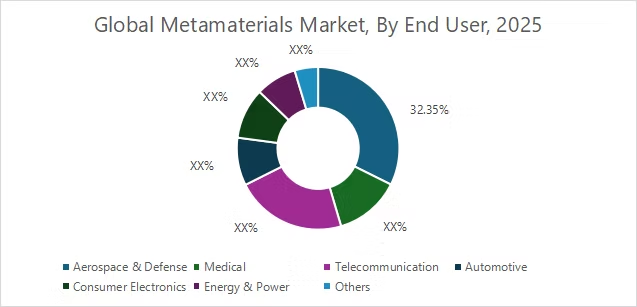
Based on the end user, the market is segmented into aerospace & defense, medical, telecommunication, automotive, consumer electronics, energy & power, and others.
Trends in the End User:
- The trend towards the integration of advanced materials in steering modules and sensor covers for enabling vehicle-to-everything (V2X) communication, LiDAR, and others is driving the market progress.
- The trend towards the focus on improving image resolution and reducing weight of the virtual reality (VR) and augmented reality (AR) headsets with the help of advanced materials is fueling the market development.
The aerospace & defense sector accounted for the largest revenue share of 32.35% in the year 2025.
- The market offers critical advantages in stealth, radar evasion, and communication in the aerospace & defense sector.
- The advanced material is designed to absorb electromagnetic waves, which helps in enabling advanced radar-evading cloaking technologies for the aerospace & defense sector.
- Further, the aerospace & defense sector requires materials that effectively absorb or deflect radar frequencies to reduce detectability of aircraft and missiles.
- Furthermore, the market enables compact, lightweight designs, which are crucial for improving the payload efficiency and agility of aircraft, which in turn is fueling the market progress.
- Furthermore, the defense modernization initiatives are driving the adoption of advanced materials and electromagnetic shielding that perform exceptionally under complex operating environments.
- Thus, as per the market analysis, the defense modernization initiatives are driving the market progress.
The telecommunication sector is anticipated to register the fastest CAGR during the forecast period.
- The market is increasingly being integrated into the telecommunication sector, which in turn is helping companies to design highly efficient, compact, and tunable antennas.
- Additionally, the proliferation of the deployment of advanced 5G networks, satellite communications, and future wireless systems is driving the need for advanced materials.
- Further, the global development of 5G and 6G networks is driving the market need to enhance signal transmission, reduce interference, and improve overall system capacity.
- Furthermore, the market helps in solving coverage blockages without the need to install additional base stations by forcefully directing and reflecting signals in dense urban areas.
- Therefore, as per the market analysis, the global development of 5G and 6G networks is anticipated to boost the market during the forecast period.
Metamaterials Market Regional Analysis:
The regions covered are North America, Europe, Asia Pacific, Middle East and Africa, and Latin America.
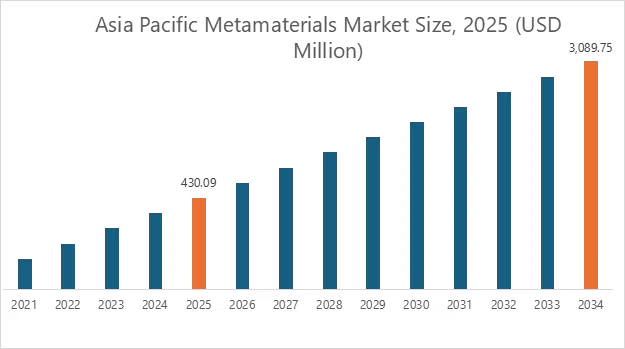
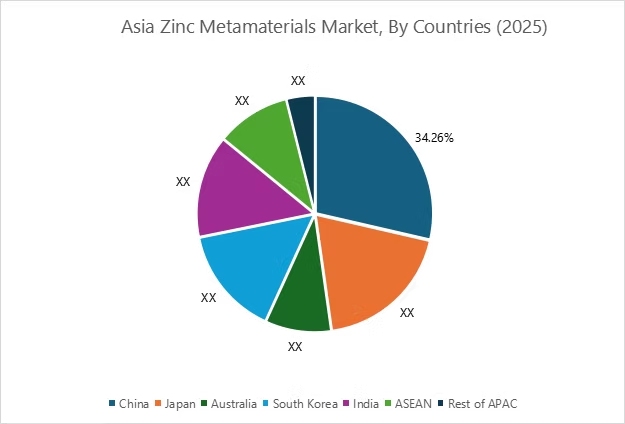
Asia Pacific region was valued at USD 430.09 Million in 2025. Moreover, it is projected to grow by USD 528.94 Million in 2026 and reach over USD 3,089.75 Million by 2034. Out of this, China accounted for the maximum revenue share of 34.26%. The market progress is mainly driven by growing 5G/6G telecommunications infrastructure. Furthermore, factors including the booming consumer electronics and semiconductor industry and rising investments in aerospace and defense technologies are projected to drive the market progress in the Asia Pacific region during the forecast period.
- For instance, in November 2024, IIT Kanpur launched a surface cloaking system enabled with advanced materials for transforming applications in defense, national security, and specialized industries.
North America is estimated to reach over USD 3,775.66 Million by 2034 from a value of USD 548.72 Million in 2025 and is projected to grow by USD 671.56 Million in 2026. The North American region's growing focus on developing advanced medical implants offers lucrative growth prospects for the market. Additionally, the rising funding for nanotechnology and photonic research is driving market adoption.
- For instance, in September 2025, Rice University’s researcher developed a material that can be controlled remotely to rapidly transform its size and shape. The innovation is designed to transform medical implants.
The regional analysis depicts that the accelerating demand for electromagnetic wave control in aerospace and defense is driving the market in Europe. Additionally, the key factor driving the market is the rapid smart city deployment, as well as the expanding energy sector, which is increasing the use of acoustic and thermal-type materials to manage harsh temperatures in oil and gas operations, propelling market adoption in the Middle East and African region. Further, the development of digital connectivity into rural and underserved regions is paving the way for the progress of the market in Latin America region.
Top Key Players & Market Share Insights:
The global metamaterials market is highly competitive with major players providing advanced materials to the national and international markets. Key players are adopting several strategies in research and development (R&D), product innovation, and end user launches to hold a strong position in the metamaterials industry. Key players in the metamaterials market include-
- Photon etc.(Canada)
- Metamaterial Technologies Inc.(Canada)
- Moxtek, Inc. (USA)
- ALCAN Systems (Germany)
- Kymeta Corporation (USA)
- Metalenz, Inc. (USA)
- Greenerwave (France)
- Sintec Optronics (Singapore)
- TeraView Limited (UK)
- Plasmonics Inc. (USA)
Metamaterials Market Ecosystem:
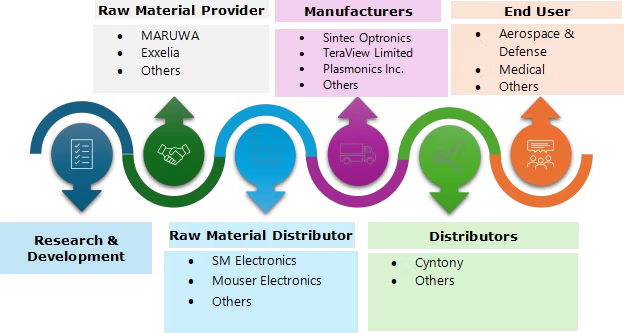
Metamaterials Market Report Insights :
| Report Attributes | Report Details |
| Study Timeline | 2021-2034 |
| Market Size in 2034 | USD 10,424.25 Million |
| CAGR (2026-2034) | 21.2% |
| By Type |
|
| By Application |
|
| By End User |
|
| By Region |
|
| Key Players |
|
| Report Coverage |
|
Key Questions Answered in the Report
How big is the metamaterials market? −
The market size is estimated to reach over USD 10,424.25 Million by 2034 from a value of USD 1,512.74 Million in 2025 and is projected to grow by USD 1,851.68 Million in 2026, growing at a CAGR of 21.2% from 2026 to 2034.
Which segmentation details are covered in the report? +
The report includes specific segmentation details for type, application, end user, and regions.
Which is the fastest segment anticipated to impact the market growth? +
In the market, the thermal type segment is the fastest-growing segment during the forecast period due to increasing need for miniaturized components and lightweight, energy-efficient solutions.
Who are the major players in the market? +
The key participants in the market are Photon etc. (Canada), Metamaterial Technologies Inc. (Canada), Moxtek, Inc. (USA), ALCAN Systems (Germany), Kymeta Corporation (USA), Metalenz, Inc. (USA), Greenerwave (France), Sintec Optronics (Singapore), TeraView Limited (UK), Plasmonics Inc. (USA), and others.
What are the key trends in the market? +
The market is being shaped by several key trends including the rising focus on improving image resolution and reducing weight of the virtual reality (VR) and augmented reality (AR) headsets and the need for advanced microchip and datacenter cooling solutions are the key trends driving the market.
Overview
Reputation & Certifications


Our Services
- Market Intelligence & Forecasting
- Custom Research Solutions
- Market Entry Strategy
- Competitive Intelligence
- Customer Insights
- Industry Innovation Analysis
- Investment Advisory