Jump to Content
Methacrylic Ester Market - Size, Share, Industry Trends, and Forecasts (2025-2032)
Methacrylic Ester Market Size:
The Methacrylic Ester Market size is growing with a CAGR of 6.6% during the forecast period (2025-2032), and the market is projected to be valued at USD 9.25 Billion by 2032 from USD 5.56 Billion in 2024. Additionally, the market value for 2025 is attributed to USD 5.91 Billion.
Methacrylic Ester Market Scope & Overview:
Methacrylic ester refers to the ester of methacrylic acid. It forms when the hydrogen on the carboxylic acid group is replaced by an alkyl or other organic group. This class of organic compounds encompasses several esters of methacrylic acid including methyl methacrylate (MMA), ethyl methacrylate (EMA), butyl methacrylate (BMA), among others. These versatile compounds find extensive use across several sectors due to the unique properties imparted by their polymerization into acrylic polymers and copolymers. Their applications include coatings, adhesives, plastics, paper processing agent, fiber processing agent, lubricants, and others, that are driven by characteristics such as clarity, durability, weather resistance, and bonding capabilities. The methacrylic ester market demand is influenced by trends in key end-use sectors such as automotive, construction, and electronics among others.
How is AI Transforming the Methacrylic Ester Market?
AI is transforming the methacrylic ester market by boosting efficiency in production through predictive maintenance and automated process control, accelerating R&D for new ester formulations, optimizing supply chains via predictive demand forecasting and intelligent inventory management, and enhancing quality control with real-time data analysis and machine vision. Further, AI algorithms analyze extensive datasets on chemical properties and reaction pathways to identify novel methacrylic ester formulations with enhanced properties like durability or adhesion. The technology enables more sustainable practices, drives product innovation for specialized applications, and provides deeper market and consumer insights for data-driven decision-making.

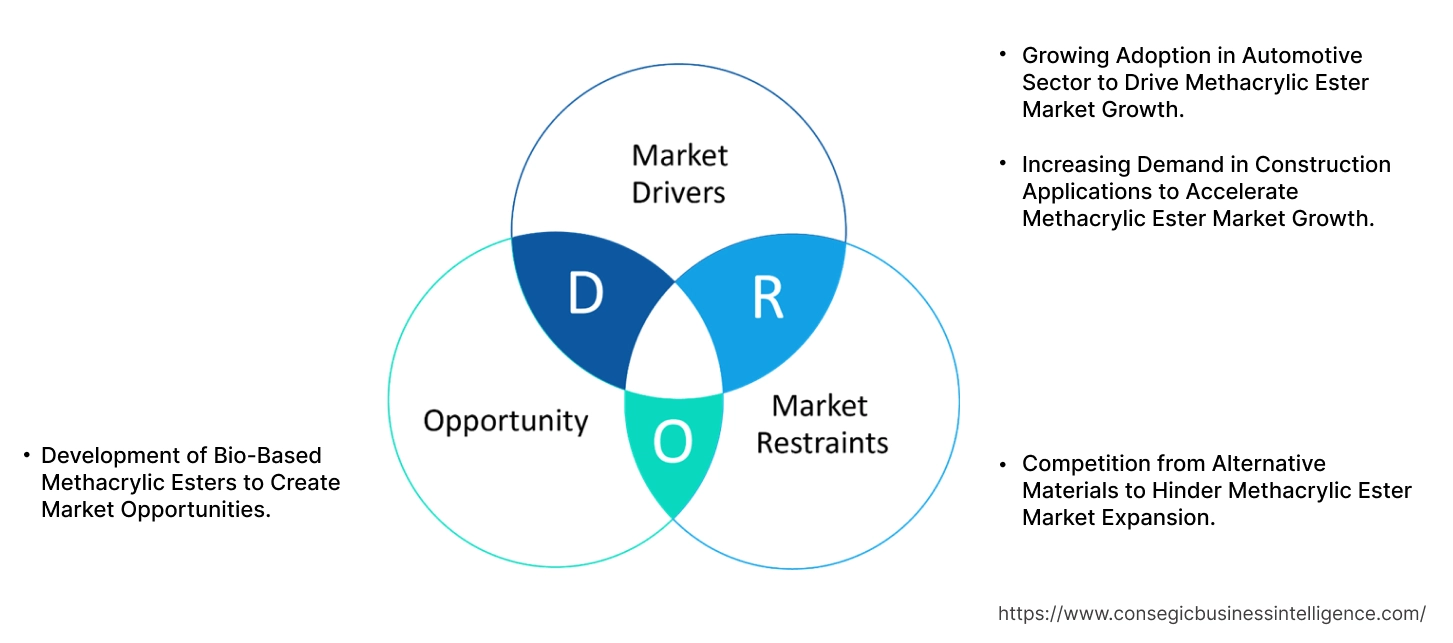
Methacrylic Ester Market Dynamics - (DRO) :
Key Drivers:
Growing Adoption in Automotive Sector to Drive Methacrylic Ester Market Growth.
The increasing integration of methacrylic esters within the automotive sector serves as a substantial factor for the market revenue. This is attributed to the automotive industry's growing need for lightweighting solutions that support the use of methacrylate adhesives for bonding composites, enhancing fuel efficiency. Furthermore, high-performance coatings based on these esters offer superior scratch and UV resistance coupled with aesthetic appeal. The expanding automotive production coupled with the ongoing shift towards electric vehicles is generating requirement for lightweight materials and specialized adhesives and coatings. This, in turn, supports the utilization of esters of methacrylic acid within the automotive sector.
- For instance, according to EVBoosters, China produced around 11 million EVs in 2024, which is 40% increase compared to 2023.
Thus, consumption of these esters in both automotive original equipment manufacturing and aftermarket applications is driving the market revenue.
Increasing Demand in Construction Applications to Accelerate Methacrylic Ester Market Growth.
Methacrylate-based coatings are adopted for their superior durability and resistance, extending the lifespan of various building materials. The need for robust bonding and sealing solutions fuels the use of methacrylate adhesives and acrylic sealants. MMA-based resins are vital for efficient concrete repair, while acrylic sheets offer versatile glazing and facade options. The construction sector’s focus on durability and expanding infrastructure projects worldwide further propels the requirement for these high-performance materials.
- For instance, in 2023, Bostik began manufacturing of FIT30 45, a methyl methacrylate (MMA) adhesive technology designed for structural bonding in diverse applications including construction in North America.
Thus, as per the market analysis, the increasing requirement for these easters in construction applications is contributing to the market revenue.
Key Restraints:
Competition from Alternative Materials to Hinder Methacrylic Ester Market Expansion.
The growth of the market for esters of methacrylic acid faces hindrance in the overall upward trajectory due to the widespread availability and established use of substitute materials across its applications. In coatings, alternatives such as polyurethane, epoxy resins, and vinyl polymers offer similar performance characteristics and cost structure. Similarly, in adhesives, polyurethanes, epoxies, and cyanoacrylates present alternative bonding solutions with varying strengths, cure times, and substrate compatibility. For specific sealant applications demanding extreme temperature resistance, materials like silicones are favored over methacrylate. This abundance of readily available and competitively priced substitutes creates a competitive landscape and supports players to adopt alternatives. As a result, the above-mentioned factors are limiting the methacrylic ester market expansion.
Future Opportunities :
Development of Bio-Based Methacrylic Esters to Create Market Opportunities.
There is an increasing global focus on reducing reliance on fossil fuels and adopting more environmentally friendly materials. Bio-based methacrylate, derived from renewable resources such as plant-based feedstocks or through biotechnological processes, align with this demand. Investing in and commercializing bio-based methyl methacrylate and other esters of methacrylic acid cater to the growing requirement for sustainable chemicals and reduce reliance on fossil fuels. This serves as one of the major factors creating new methacrylic ester market opportunities.
- For instance, Mitsubishi Chemical Corporation has developed manufacturing technology for MMA monomers that uses plant-derived materials and have begun designing a pilot plant focusing on 100% bio-derived carbon MMA production. They aim to apply the technology to commercial-scale plants by 2026.
As a result, this increasing focus on biobased esters of methacrylic acid benefits the market demand.
Methacrylic Ester Market Segmental Analysis :
By Type:
Based on type, the market is categorized into methyl methacrylate (MMA), ethyl methacrylate (EMA), butyl methacrylate (BMA), and others.
Trends in Type:
- Growing focus on recycling and bio-based MMA for more environmentally friendly polymethyl methacrylate (PMMA), production.
- Expanding utilization of EMA in the production of specialized polymers for niche industrial uses.
The methyl methacrylate (MMA) segment accounted for the largest market share in 2024.
- MMA is the methyl ester of methacrylic acid (MAA). It is used as a primary building block for polymethyl methacrylate, also known as acrylic glass or Plexiglas.
- Its versatility drives its widespread use in various applications, including acrylic sheets, molding powders, surface coatings, adhesives, and impact modifiers.
- Additionally, the growing focus on the recycling of methyl methacrylate further fuels the segment's revenue.
- For instance, in March 2025, Sumitomo Chemical announced selling of chemically recycled PMMA using its own MMA recycling technology. LG Display and Nissan will use this sustainable material, prompting Sumitomo Chemical to accelerate its implementation in the MMA supply chain.
- As per the analysis, owing to the high adoption of PMMA, the methyl methacrylate segment dominates the methacrylic ester market demand.
The others segment is expected to grow at the fastest CAGR over the forecast period.
- Others category includes a variety of other esters of methacrylic acid, such as higher alkyl methacrylates including lauryl methacrylate & stearyl methacrylate and specialty methacrylates.
- These monomers are used in niche applications to provide specific properties such as hydrophobicity, oleophobicity, or enhanced reactivity to polymers and coatings.
- The upward trajectory of the segment is due to rising requirements for specialty methacrylates. These tailored monomers meet specific performance needs in applications such as electronics, adhesives, and advanced coatings.
- Continuous innovation in these areas fuels their faster adoption compared to established MMA, EMA, and BMA.
- Hence, owing to the above-mentioned factors, the others segment is expected to grow at the fastest rate over the future years.
By Application:
Based on applications, the market is categorized into plastics & polymers, paint & coatings, adhesives & sealants, paper processing agent, fiber processing agent, lubricants, and others
Trends in the Application:
- Focus on adoption of water-based acrylic paints and coatings driven by stricter environmental regulations is a trend positively impacting the market.
- Growing use of methacrylate polymers in coatings with self-healing, anti-corrosion, or antimicrobial properties.
The paint & coatings segment accounted for the largest methacrylic ester market share in 2024.
- A significant volume of methacrylates such as MMA, EMA, and BMA are utilized as crucial components in various paints and coatings.
- They enhance adhesion, durability, weather resistance, gloss, and flexibility in a wide range of coatings such as architectural coatings, industrial finishes, automotive paints, and specialty coatings.
- The large scale of production within these core sectors necessitates a large and consistent consumption of these esters in paint and coating applications.
- For instance, according to republic of turkey, ministry of trade, annual paint consumption of turkey is 20 kg per capita, showcasing Europe’s one of the biggest paints and coatings market
- Consequently, the paint & coatings segment functions as the dominant segment within the broader market.
The adhesives & sealants segment is expected to grow at the fastest CAGR over the forecast period.
- Methacrylic acid ester monomers are used in the formulation of high-strength and durable adhesives and sealants.
- Their ability to bond various substrates and withstand harsh conditions makes them essential in several sectors.
- The escalating need for high-performance bonding solutions across sectors such as automotive, construction, and electronics is contributing to the growth trajectory.
- Additionally, technological advancements, including the development of novel and enhanced methacrylate formulations such as fast-curing, UV-curable, and multi-substrate adhesives, are broadening their range of applications.
- Hence, owing to the above-mentioned analysis, the adhesives & sealants segment is expected to grow at the fastest rate over the future years, creating methacrylic ester market opportunities.
By End-Use:
The end use segment is categorized into construction, automotive, healthcare, electronics, textile, aerospace, and others.
Trends in the End Use:
- Demand for low-VOC and waterborne acrylic coatings and adhesives derived from esters of methacrylic acid is increasing, driven by stricter environmental regulations and a focus on green building practices.
- The growing requirement for methacrylate-based materials for protecting and bonding sensitive electronic components is a trend positively impacting the market.
The construction segment accounted for the methacrylic ester market share of 45.55% in 2024.
- Methacrylic esters, primarily in the form of MMA, find diverse applications in the construction sector, contributing to enhanced performance, durability, and aesthetics.
- In the construction sector, these esters are used in protective coatings, architectural coatings, paints, adhesives, sealants, acrylic sheets, glazing, and concrete modification among others.
- The increasing requirement for high-performance materials with superior durability and weather resistance is a key factor.
- Additionally, the focus on sustainable and low-VOC materials is driving the popularity of waterborne acrylic coatings.
- Moreover, expanding infrastructure projects and increasing urbanization are boosting the need for durable coatings, adhesives, and sealants.
- Thus, as per the methacrylic ester market analysis, the construction segment is dominating the methacrylic ester market trends.
The electronics segment is expected to grow at the fastest CAGR over the forecast period.
- The focus on smaller, lighter, and more efficient components in the electronics sector is the major factor that is creating lucrative options for esters of methacrylic acid in the market.
- PMMA's high optical clarity and light transmission properties make it suitable in the manufacturing of flat-screen displays. Methacrylic ester polymers are also used in lenses and optical fibers.
- In addition to this, these esters are also crucial in encapsulants and adhesives protecting sensitive electronics, a necessity driven by miniaturization.
- Thus, the growing electronics production is creating significant adoption of these esters.
- For instance, according to IBEF, India has witnessed a significant surge in its domestic electronics production, escalating from USD 29 billion in fiscal year 2015 to USD 101 billion in fiscal year 2023.
- Hence, the continuous innovation within the electronics sector positions the electronics sector as significant growth for consumption in the forecast period.

Regional Analysis:
The regional segment includes North America, Europe, Asia Pacific, the Middle East and Africa, and Latin America.

In 2024, Asia Pacific accounted for the highest market share at 43.56% and was valued at USD 2.42 Billion and is expected to reach USD 3.69 Billion in 2032. In Asia Pacific, China accounted for a market share of 39.21% during the base year of 2024. Asia Pacific's influence on the market is significant due to the region being the dominant consumer of esters of methacrylic acid for several sectors. The growing automotive sector generates significant requirements for high-performance coatings and lightweighting adhesives. Similarly, the expanding construction industry in this region drives the necessity for durable coatings, robust adhesives, and versatile acrylic sheets. The robust electronics manufacturing sector also makes a substantial contribution. Hence, the increasing demand for high-performance materials and the rise in manufacturing activities in this region are key drivers contributing to the growth in this region.
- For instance, according to the China Briefing, in 2024, electronic information manufacturing sector experienced an 11.8% increase in value-added output year-on-year.
These factors create a strong upward trajectory for the Asia Pacific market, positioning it as a key region for players.

In Europe, the methacrylic ester industry is experiencing the fastest growth with a CAGR of 8.9% over the forecast period. One of the key factors contributing to the region’s market revenue is the well-established end-use sectors. Countries like Germany, France, and the UK are key consumers presenting strong manufacturing sector. In addition to this, there is an increase in focus on sustainability and stricter environmental regulations, pushing the demand for waterborne acrylic coatings and other low-VOC methacrylate formulations. Furthermore, the automotive industry's focus on lightweighting solutions is driving the use of methacrylate-based adhesives. These factors collectively present a positive impact on the European market.
The North American market for esters of methacrylic acid is significantly defined by the high adoption of these esters in automotive and construction sectors. The region's need for high-quality building and automotive materials all reliant on the compound is driving market revenue. Moreover, North America's continuous R&D investments support the adoption of advanced acrylic materials. A significant factor in the region is the growing focus on high-performance and sustainable materials. Furthermore, the automotive sector's demand for lightweighting solutions and aesthetically appealing coatings contributes to the region's upward market trajectory over the forecast period.
The Latin American methacrylic ester market trend is driven by the region's focus on infrastructure development. The growing investments in manufacturing sectors, particularly in countries such as Brazil, contribute significantly to this requirement, particularly for methacrylic ester-based high-performance coatings for infrastructure. Furthermore, the growing need for robust adhesives in manufacturing and construction is fueling the consumption of esters of methacrylic acid. Supportive government policies are further contributing to the market need in the region. International investments and expertise are further accelerating these initiatives. As per analysis, these aforementioned factors are contributing to the upward trajectory of the market.
The Middle East and African methacrylic ester market analysis is currently characterized by a limited share. This has led to significant growth potential for the market in the upcoming years. Additionally, increasing investments in the construction sector, particularly large-scale institutional and commercial construction projects in countries like the UAE, Saudi Arabia, and Qatar are expected to positively influence the demand for methacrylate-based adhesives, coatings, and sealants.
Top Key Players and Market Share Insights:
The Global Methacrylic Ester Market is highly competitive with major players providing products to the national and international markets. Key players are adopting several strategies in research and development (R&D) and product innovation to hold a strong position in the global Methacrylic Ester market. Key players in the Methacrylic Ester industry include
- BASF (Germany)
- Dow (U.S.)
- KURARAY CO., LTD. (Japan)
- Trinseo (U.S.)
- Rohm (Germany)
- SABIC (Saudi Arabia)
- Mitsubishi Chemical Group Corporation (Japan)
- NIPPON SHOKUBAI CO., LTD. (Japan)
- Arkema (France)
- Sumitomo Chemical (Japan)
Recent Industry Developments :
Facility Expansion:
- In March 2025, Rohm began production at its new Bay City plant in Texas, USA. This facility is the first to use Rohm's C2-based LIMA technology on an industrial scale, marking a major advancement in methyl methacrylate (MMA) manufacturing.
Methacrylic Ester Market Report Insights:
| Report Attributes | Report Details |
| Study Timeline | 2019-2032 |
| Market Size in 2032 | USD 9.25 Billion |
| CAGR (2025-2032) | 6.6% |
| By Type |
|
| By Application |
|
| By End-Use |
|
| By Region |
|
| Key Players |
|
| North America | U.S. Canada Mexico |
| Europe | U.K. Germany France Spain Italy Russia Benelux Rest of Europe |
| APAC | China South Korea Japan India Australia ASEAN Rest of Asia-Pacific |
| Middle East and Africa | GCC Turkey South Africa Rest of MEA |
| LATAM | Brazil Argentina Chile Rest of LATAM |
| Report Coverage |
|
Key Questions Answered in the Report
How big is the Methacrylic Ester market? −
In 2024, the Methacrylic Ester market is USD 5.56 Billion.
Which is the fastest-growing region in the Methacrylic Ester market? +
Europe is the fastest-growing region in the Methacrylic Ester market.
What specific segmentation details are covered in the Methacrylic Ester market? +
By Type, By Application and End Use segmentation details are covered in the Methacrylic Ester market.
Who are the major players in the Methacrylic Ester market? +
BASF (Germany), Dow (U.S.), SABIC (Saudi Arabia), Mitsubishi Chemical Group Corporation (Japan) are some of the major players in the market.
Overview
Reputation & Certifications


Our Services
- Market Intelligence & Forecasting
- Custom Research Solutions
- Market Entry Strategy
- Competitive Intelligence
- Customer Insights
- Industry Innovation Analysis
- Investment Advisory