Jump to Content
Micro Packaging Market - Size, Share, Industry Trends, and Forecasts (2025-2032)
Micro Packaging Market Size:
Micro Packaging Market size is estimated to reach over USD 22.98 Billion by 2032 from a value of USD 7.20 Billion in 2024 and is projected to grow by USD 8.20 Billion in 2025, growing at a CAGR of 15.6% from 2025 to 2032.
Micro Packaging Market Scope & Overview:
The micro packaging market focuses on advanced packaging solutions that integrate nanotechnology and micro-scale materials to enhance the functionality and performance of packaging across industries. Micro packaging is designed to provide superior barrier properties, extended product shelf life, and advanced features such as active and intelligent packaging for real-time monitoring. Its key characteristics include lightweight construction, high strength, and enhanced protection against environmental factors like moisture, oxygen, and UV radiation. The benefits include improved product safety, reduced food wastage, and enhanced consumer convenience through features like freshness indicators. Applications span food and beverages, pharmaceuticals, electronics, and cosmetics, where precision and product integrity are critical. End-users include food processors, pharmaceutical companies, and consumer goods manufacturers, driven by rising demand for sustainable and innovative packaging solutions, increasing regulatory emphasis on food safety, and advancements in nanotechnology.
How is AI Transforming the Micro Packaging Market?
AI transforms the micro-packaging market by enhancing operational efficiency through predictive maintenance and quality control, enabling optimized packaging design and format optimization for reduced waste and costs, and improving supply chain management with data-driven insights. Further, AI-powered systems also facilitate personalization, enhance brand experiences, and ensure regulatory compliance, ultimately driving greater sustainability and cost-effectiveness in packaging.

Micro Packaging Market Dynamics - (DRO) :
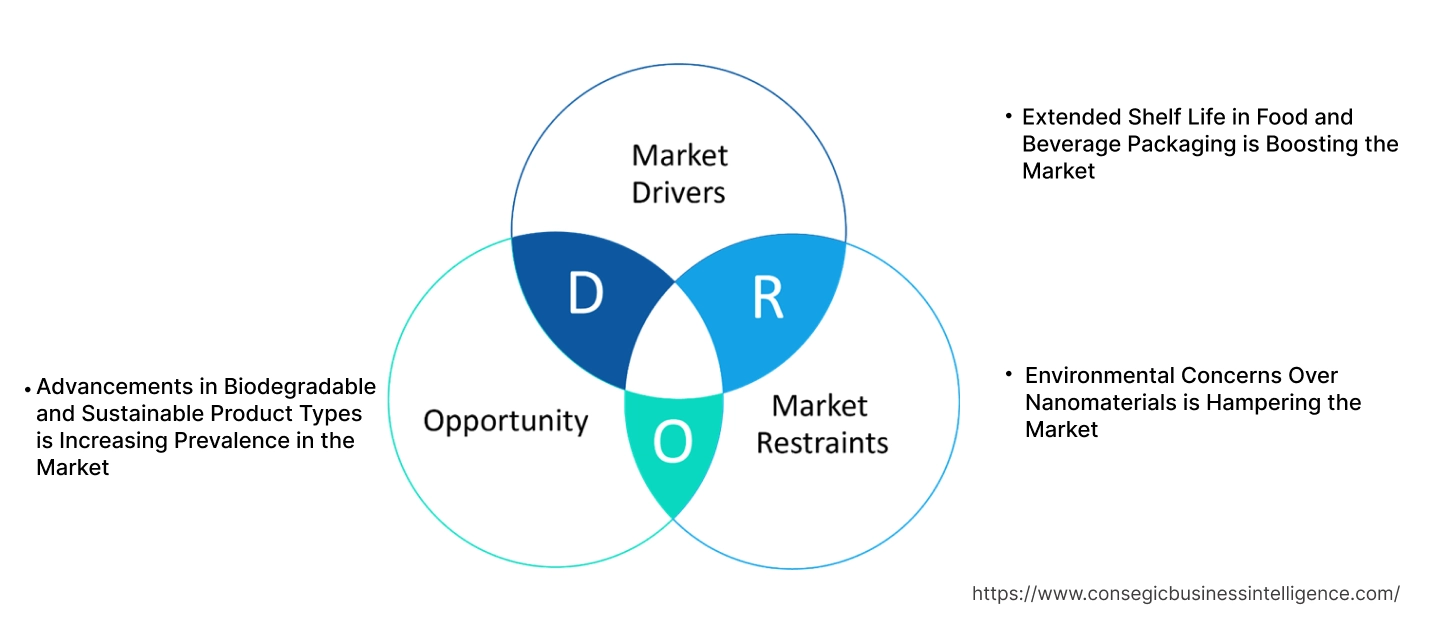
Key Drivers:
Extended Shelf Life in Food and Beverage Packaging is Boosting the Market
The increasing focus on preserving the freshness and quality of food and beverage products is driving trends in micro packaging solutions. These advanced packaging systems utilize nanoscale materials to create high-barrier properties that effectively prevent oxygen, moisture, and light from compromising the product. This capability is critical for extending shelf life, particularly in sectors such as convenience foods, ready-to-eat meals, and beverages, where product longevity is essential for consumer satisfaction and reduced food waste.
It also supports the transportation and storage of perishable goods by maintaining the integrity of the product throughout the supply chain. With analysis highlighting the global emphasis on reducing waste and improving food security, its use in enhancing shelf life is becoming an integral part of modern packaging strategies. As the sector continues to innovate, micro packaging is expected to play a pivotal role in meeting the evolving requirements of food preservation and quality assurance.
Key Restraints:
Environmental Concerns Over Nanomaterials is Hampering the Market
The use of nanomaterials in micro packaging, while beneficial for its functionality, raises significant environmental concerns. Many nanomaterials are non-biodegradable and difficult to recycle due to their complex composition. Additionally, the potential leakage of nanoparticles into the environment during production, usage, or disposal poses risks to ecosystems and human health. These concerns have prompted regulatory bodies to implement stricter guidelines on the use and disposal of nanoscale materials, creating challenges for manufacturers in ensuring compliance while maintaining cost efficiency.
Public perception of nanomaterials also influences the adoption of micro packaging solutions, particularly in markets where environmental sustainability is a priority. Addressing these challenges through the development of safer and more eco-friendly nanotechnologies is essential for mitigating environmental risks and aligning with global sustainability goals.
Future Opportunities:
Advancements in Biodegradable and Sustainable Product Types is Increasing Prevalence in the Market
Innovations in biodegradable and eco-friendly materials are transforming the sector by addressing environmental concerns while maintaining high-barrier performance. The use of bio-based nanomaterials, such as cellulose nanocrystals, chitosan, and polylactic acid composites, offers a sustainable alternative to traditional synthetic options. These materials provide effective protection against contaminants and environmental factors while being compostable or recyclable, reducing their ecological footprint.
The adoption of sustainable alternatives aligns with global trends in green initiatives and corporate responsibility. For instance, industries such as food and pharmaceuticals are increasingly adopting eco-friendly packaging solutions to meet consumer expectations for environmentally responsible products. Analysis suggests that advancements in sustainable materials will continue to gain traction, creating micro packaging market opportunities for manufacturers to address both functional and environmental needs.
Integration of Smart Features is Creating Market Opportunities
The integration of smart technologies into micro packaging is redefining the functionality of packaging systems. Features such as temperature sensors, humidity indicators, and spoilage detectors enhance the safety and reliability of products across industries. These smart elements allow real-time monitoring of storage conditions, ensuring that food, beverages, and pharmaceuticals remain in optimal condition throughout their lifecycle.
In addition to ensuring product quality, smart micro packaging also improves consumer engagement. For example, QR codes and digital indicators integrated into packaging can provide detailed information about product origin, expiration, and handling instructions. Trends in IoT and digital connectivity further support the surge of intelligent packaging solutions, enabling predictive maintenance and supply chain optimization. The incorporation of smart features is a key area of innovation, aligning with the broader push toward connected and intelligent packaging systems.
Micro Packaging Market Segmental Analysis :
By Material Type:
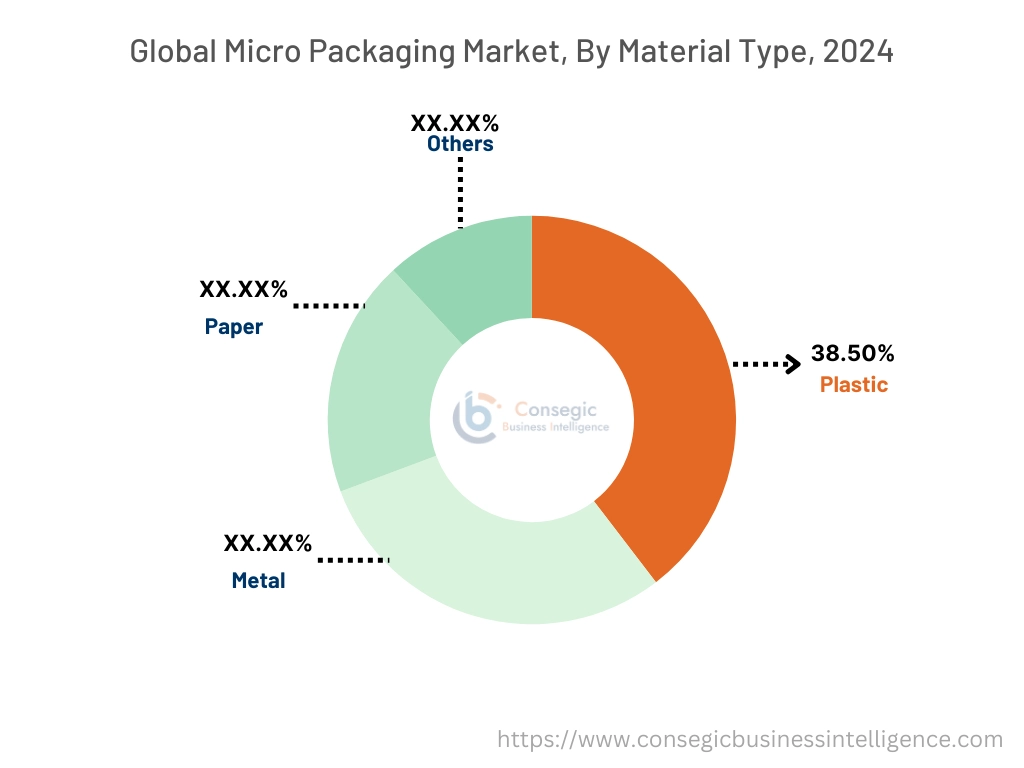
Based on material type, the market is segmented into plastic, metal, paper, and others.
The plastic segment accounted for the largest revenue in micro packaging market share of 38.50% in 2024.
- Plastic is the most widely used material in the packaging sectors due to its versatility, durability, and cost-effectiveness.
- It is extensively utilized in films, pouches, and bottles, providing lightweight and flexible solutions for preserving product freshness and extending shelf life.
- Additionally, advancements in biodegradable and recyclable plastics have mitigated environmental concerns, further supporting the segment’s trends.
- The demand for plastic packaging is particularly high in the food and beverage and pharmaceutical industries due to its superior barrier properties and cost efficiency.
- Plastic analysis leads the market expansion, due to its versatility, cost-effectiveness, and continued advancements in sustainable materials, ensuring its relevance across various applications.
The paper segment is anticipated to register the fastest CAGR during the forecast period.
- Paper packaging is gaining traction due to its eco-friendly nature and increasing consumer demand for sustainable packaging solutions.
- It is widely used in boxes, cartons, and pouches for food, beverages, and personal care products.
- The rise of e-commerce and stricter regulations on single-use plastics are driving the adoption of paper-based alternatives. Innovations in coated and laminated paper materials, offering enhanced durability and moisture resistance, are further boosting micro packaging market growth in this segment.
- Paper packaging is expected to grow rapidly, as per the analysis driven by increasing environmental awareness, regulatory support, and advancements in durable and sustainable paper-based solutions.
By Product Type:
Based on product type, the market is segmented into films, pouches, bottles, boxes & cartons, cans, and others.
The films segment accounted for the largest revenue in micro packaging market share in 2024.
- Films are extensively used in flexible packaging solutions for a wide range of applications, including food, beverages, and pharmaceuticals.
- Their lightweight nature, combined with excellent barrier properties, makes them ideal for preserving product freshness and preventing contamination. With the growing advancement of convenience and single-serve packaging formats, the adoption of films continues to rise.
- Innovations in multi-layered and bio-based films are further enhancing their performance and environmental appeal, supporting their dominant position in the micro packaging market expansion.
- Films dominate the market due to their versatility, lightweight nature, and advancements in multi-layered and sustainable options, making them a preferred choice across industries.
The bottles segment is expected to register the fastest CAGR during the forecast period.
- Bottles are a popular choice for liquid packaging in industries such as food and beverages, pharmaceuticals, and personal care.
- The growing preference for recyclable materials like PET and glass bottles is driving growth in this segment.
- Additionally, the rise of ready-to-drink (RTD) beverages and liquid personal care products is fueling surge for bottles with innovative designs and user-friendly closures.
- The integration of smart features, such as tamper-evident seals and QR codes, is further enhancing the appeal of bottles in modern packaging.
- Bottles are expected to grow rapidly, driven by increasing trends micro packaging market demand in the beverage and personal care industries and advancements in recyclable materials and smart packaging features.
By Technology:
Based on technology, the market is segmented into active packaging, intelligent packaging, and modified atmosphere packaging (MAP).
The modified atmosphere packaging (MAP) segment accounted for the largest revenue share in 2024.
- MAP technology is extensively used in the food and beverage sector to extend the shelf life of perishable products by altering the atmospheric composition inside the packaging.
- This technology is critical for maintaining product freshness, especially for meat, dairy, and ready-to-eat meals.
- The increasing development for convenience foods and growing concerns over food safety and waste reduction are driving the adoption of MAP.
- Continuous advancements in packaging materials and gas control systems are further supporting the growth of this segment.
- MAP dominates the micro packaging market demand due to its effectiveness in extending shelf life and ensuring product freshness, particularly in the food and beverage sector.
The intelligent packaging segment is anticipated to register the fastest CAGR during the forecast period.
- Intelligent packaging integrates advanced technologies such as sensors, indicators, and RFID tags to monitor and communicate real-time information about product quality, temperature, and freshness.
- This technology is gaining popularity in the pharmaceutical and food industries, where maintaining product integrity and safety is critical.
- The rise of IoT and smart supply chain solutions is further propelling the adoption of intelligent packaging.
- Additionally, consumer demand for transparent and traceable packaging is accelerating growth in this segment.
- Intelligent packaging is expected to grow rapidly, driven by micro packaging market trends and the increasing need for real-time monitoring and traceability in the food and pharmaceutical industries, along with advancements in IoT-enabled packaging solutions.
By End-Use Industry:
Based on end-use industry, the market is segmented into food & beverages, pharmaceuticals, personal care, and others.
The food & beverages segment accounted for the largest revenue share in 2024.
- The food and beverage sector is the largest consumer of packaging solutions, driven by the need to ensure product safety, freshness, and convenience.
- Packaging solutions such as films, MAP, and pouches are widely used for preserving the quality of perishable items, including meat, dairy, and ready-to-eat meals.
- The growing advancement for sustainable and recyclable packaging materials in response to environmental concerns is further fueling growth in this segment.
- Additionally, the increasing popularity of convenience foods and e-commerce is expanding the need for innovative food packaging solutions.
- Food and beverages dominate the market trends, driven by the need for quality preservation, convenience, and sustainable packaging solutions.
The pharmaceuticals segment is anticipated to register the fastest CAGR during the forecast period.
- Pharmaceutical packaging requires high levels of precision and security to ensure the safety and efficacy of drugs.
- Advanced technologies, such as intelligent packaging and tamper-evident solutions, are widely used to prevent counterfeiting and ensure compliance with regulatory standards.
- The rising prevalence of chronic diseases, coupled with the growing advancement for biologics and personalized medicines, is driving the adoption of innovative packaging solutions in this segment.
- The increasing use of sustainable materials and digital-enabled features for traceability is further contributing to the segment’s growth.
- Pharmaceuticals are expected to grow rapidly due to the increasing micro packaging market opportunities for secure, innovative, and compliant packaging solutions, particularly for biologics and personalized medicines.
Regional Analysis:
The regions covered are North America, Europe, Asia Pacific, the Middle East and Africa, and Latin America.
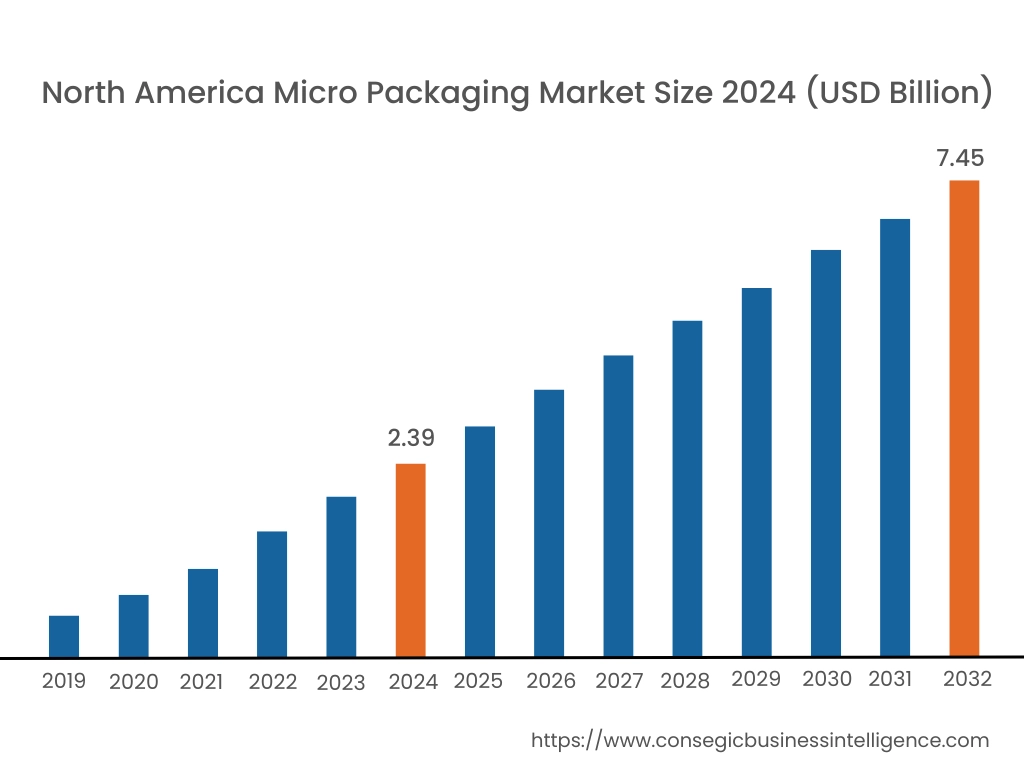
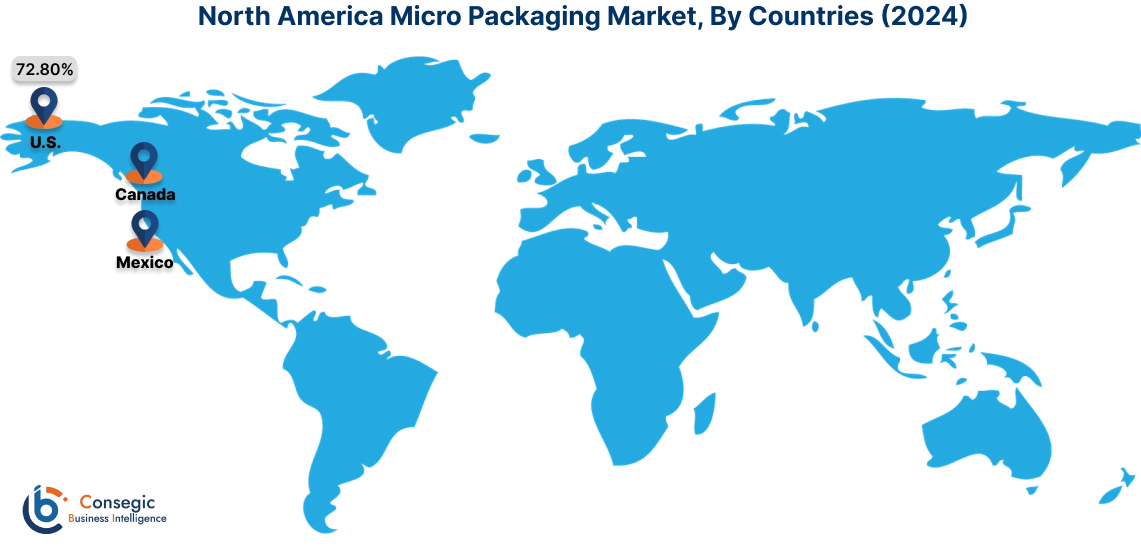
In 2024, North America was valued at USD 2.39 Billion and is expected to reach USD 7.45 Billion in 2032. In North America, the U.S. accounted for the highest share of 72.80% during the base year of 2024.
North America holds a significant stake in the micro packaging market analysis, due to the rising demand for advanced packaging solutions in the food and beverage, pharmaceutical, and electronics industries. The U.S. leads the region, driven by increasing adoption of this technology to enhance product shelf life and ensure safety, especially in perishable food items and sensitive pharmaceutical products. The focus on sustainability and eco-friendly materials further supports innovation and bolsters micro packaging market expansion. Canada contributes to the market with its growing emphasis on high-quality packaging solutions in healthcare and functional foods. However, the high costs of these materials and technologies may limit adoption in certain industries.
In Asia Pacific, the market is experiencing the fastest growth with a CAGR of 16.1% over the forecast period. Asia-Pacific is the fastest-growing region in the micro packaging market analysis, fueled by rapid industrialization, urbanization, and increasing surge for packaged goods in China, India, and Japan. China leads the market with its large-scale manufacturing of food, pharmaceuticals, and electronics, where it is used to improve product quality and shelf life. India’s expanding packaged food industry and rising focus on pharmaceutical exports drive the adoption of advanced packaging technologies. Japan, known for its innovation, utilizes it for high-precision applications in electronics and healthcare. However, limited consumer awareness and cost-sensitive markets in some areas may restrict growth.
Europe is a key player in the micro packaging industry, supported by stringent regulations on food safety, pharmaceutical packaging, and waste management. Countries like Germany, France, and the UK are major contributors. Germany’s robust food and beverage industry and advanced manufacturing capabilities drive its adoption for quality preservation and contamination prevention. France focuses on these technologies for luxury goods and high-end cosmetics, ensuring product integrity and consumer appeal. The UK’s increasing surge for sustainable and innovative packaging solutions further boosts the market. However, compliance with strict EU regulations on material use and recyclability poses challenges for manufacturers.
The Middle East & Africa region is experiencing steady rise in the micro packaging market growth, driven by rising investments in food safety and pharmaceutical industries. Countries like Saudi Arabia and the UAE are adopting such advanced technologies to meet growing consumer demands for quality and safety in packaged products. In Africa, South Africa is an emerging market, with its increasing use in healthcare and food sectors to improve product protection and extend shelf life. However, limited access to advanced manufacturing facilities and reliance on imports for packaging materials may hinder the market’s expansion in the region.
Latin America is witnessing a rise in micro packaging market trends, with Brazil and Mexico leading the region. Brazil’s growing food and beverage industry leverages it for extended shelf life and quality preservation, particularly in exports. Mexico’s expanding pharmaceutical and electronics sectors adopt micro packaging solutions for improved product integrity during transportation and storage. The region is also witnessing interest in sustainable and eco-friendly materials. However, economic instability and inconsistent regulatory frameworks across countries may limit broader market adoption.
Top Key Players and Market Share Insights:
The micro packaging market is highly competitive with major players providing products and services to the national and international markets. Key players are adopting several strategies in research and development (R&D), product innovation, and end-user launches to hold a strong position in the global micro packaging market. Key players in the micro packaging industry include –
- Amcor Plc (Australia)
- Bemis Company, Inc. (U.S.)
- Avery Dennison Corporation (U.S.)
- Tetra Pak International S.A. (Switzerland)
- Bayer AG (Germany)
- 3M Company (U.S.)
- Berry Global, Inc. (U.S.)
- Sealed Air Corporation (U.S.)
- Mondi Group (U.K.)
- DuPont de Nemours, Inc. (U.S.)
Micro Packaging Market Report Insights :
| Report Attributes | Report Details |
| Study Timeline | 2019-2032 |
| Market Size in 2032 | USD 22.98 Billion |
| CAGR (2025-2032) | 15.6% |
| By Product Type |
|
| By Technology |
|
| By End-Use Industry |
|
| By Region |
|
| Key Players |
|
| North America | U.S. Canada Mexico |
| Europe | U.K. Germany France Spain Italy Russia Benelux Rest of Europe |
| APAC | China South Korea Japan India Australia ASEAN Rest of Asia-Pacific |
| Middle East and Africa | GCC Turkey South Africa Rest of MEA |
| LATAM | Brazil Argentina Chile Rest of LATAM |
| Report Coverage |
|
Key Questions Answered in the Report
What is the expected market size of the Micro Packaging Market by 2032? −
Micro Packaging Market size is estimated to reach over USD 22.98 Billion by 2032 from a value of USD 7.20 Billion in 2024 and is projected to grow by USD 8.20 Billion in 2025, growing at a CAGR of 15.6% from 2025 to 2032.
What drives the growth of the Micro Packaging Market? +
The increasing focus on extending product shelf life is driving market growth.
Which material type dominates the market? +
Plastic leads the market due to its versatility, cost-effectiveness, and superior barrier properties. Advancements in biodegradable and recyclable plastics further bolster its demand.
What are the major challenges faced by the market? +
Environmental concerns regarding the use of non-biodegradable nanomaterials and the complex recyclability of micro packaging are significant challenges, alongside regulatory compliance issues.
Overview
Reputation & Certifications


Our Services
- Market Intelligence & Forecasting
- Custom Research Solutions
- Market Entry Strategy
- Competitive Intelligence
- Customer Insights
- Industry Innovation Analysis
- Investment Advisory