Jump to Content
Moringa Ingredients Market - Size, Share, Industry Trends, and Forecasts (2025 - 2035)
Moringa Ingredients Market Scope & Overview
The moringa ingredients business is a dynamic and fast growing segment of the functional foods, dietary supplements and natural cosmetic products businesses, that involves a variety of product forms of Moringa oleifera popularly referred to as the miracle tree and or drumstick tree such as moringa leaf powder, seed oil, protein extracts, standardized bioactive extracts and whole dried leaves, which are used in nutritional supplements, functional beverages, cosmetic and personal care products, animal feeds, pharmaceutical uses and in the development of water purification devices. The current market is estimated at USD 768 Million in 2024, USD 835 Million in 2025 (base year) and is projected to have a significant growth to USD 1,780 Million in 2035. This growth pattern reflects a compounded annual growth rate (CAGR) of 8.0 percent throughout the forecast period of 2026-2035 as a result of rising consumer interest in plant-based superfoods, greater awareness of moringa as an excellent nutrition profile with more than 90 bioactive compounds, rising use in functional food formulations, expanding cultivation in the most advantageous growing areas and increased interest in sustainable and ethically sourced moringa as a botanical ingredient.
Moringa oleifera is a species of the sub-Himalayan areas of India, Pakistan, Bangladesh and Afghanistan, that became a world recognized super food whose cultivation is now practiced in more than 45 countries in Africa, Asia, Latin America and the Caribbean. The nutritional content of the tree is impressive, with the moringa leaves being seven times more nutritious in Vitamin C than oranges, four times more nutritious in calcium than milk, four times more nutritious in vitamin A than carrots, three times more nutritious in potassium than bananas and with all the essential amino acids in complete amount on a gram per gram basis. This nutritional superiority, drought resistance, growth properties that allow the crop to produce more than one harvest in the year, and survive in marginal soils, makes moringa an important crop to meet the goal of malnutrition, food security and sustainable agriculture in the developing and developed market.
Key Market Insights
- The moringa ingredients market is projected to grow from USD 835 million in 2025 to USD 1,780 million by 2035, registering a CAGR of 8.0% (2026–2035)
- Moringa ingredients such as leaf powder, seed oil, protein extracts, and bioactive compounds are widely used in functional foods, dietary supplements, cosmetics, pharmaceuticals, and animal feed
- Growth is driven by increasing consumer demand for plant-based superfoods and natural ingredients with strong nutritional benefits
- India dominates global production with about 78% supply, followed by African and Latin American countries
- Moringa is valued for its rich nutritional profile and sustainable cultivation, supporting applications in nutrition, health products, and food security

World moringa cultivation area of 1.8 million hectares of dedicated farmland in 2024, in India the largest producer, has 78% of the world supply, the African countries with 12% and Latin American countries with 7% of the total production. Moringa biomass is produced on an annual basis in amounts of more than 2.2 million metric tons and that about 65 percent of the annual output is prepared as dried leaf powder, 20 percent is used as fresh leaf in culinary uses, 10 percent is used as oil in seed extraction, and 5 percent are prepared into protein-specific protein concentrates and bioactive extracts used in pharmaceutical and nutraceutical applications.
Market Channel Distribution Analysis:
The market of the moringa ingredients business is guided by four different distribution channels that cater to particular segments of end-users with differentiated product specifications, quality standards and value propositions. The market revenue distribution by the type of application, product form, and consumption pattern per region shows a lot of variance:
Breakdown of the distribution channel (2025):
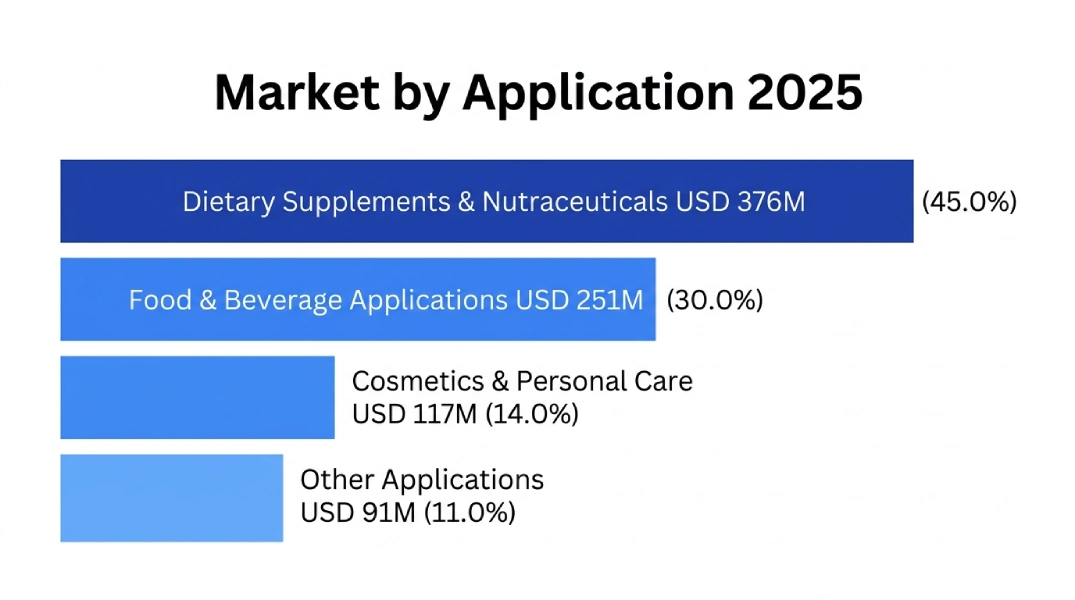
- Dietary Supplements & Nutraceuticals: USD 376 Million (45.0% of the total market value)
- Food and Beverage Applications: USD 251 Millions (30.0% of market revenue)
- Cosmetics & Personal Care Formulations: USD 117 Million (14.0% of market share).
- Other Applications (Animal Feed, Water Treatment, Pharmaceuticals): USD 91 Million (11.0% of total market value)
Investment by global industries in infrastructure development, development of processing technology, quality standardization plans, and supply chain optimization totaled USD 125 Million in 2024, with significant ingredient suppliers, agricultural cooperatives and social enterprise devoting about 15.0 percent of the revenue to development of advanced drying technology to preserve bioactive compounds, development of organic certification programs, development of traceability systems that ensure transparency in the supply chain, and conducting clinical research attesting health benefits. The sector is undergoing a radical change of standardized extracts with assured bioactive content, value-added protein concentrate with specific focus on sports nutrition markets and certified organic production with strict quality standards of the North American and European regulatory frameworks.
Moringa Ingredients Market Dynamics (DRO)
Key Drivers:
Increasing Consumer Demand on Superfoods and Clean-Label Nutrition (Plant-Based).
The biggest structural force continues to be the rapid global move towards plant-based diets, clean-label ingredients, and nutrient-rich super food under the influence of health consciousness, environmental sustainability issues and ethical consumption tastes and preferences. Plant-based food market is projected to USD 29,400 Million in 2024 with a growth rate of 11.2% per annum with moringa taking a prime position in the market with complete protein profiles, excellent micronutrient density, and versatility in its functionality in various food applications.
Consumer research results show that 68% of health-conscious consumers are already targeting products with superfood ingredients and that moringa recognition has increased over the years since 15% consumer awareness in 2019 to 42% awareness in 2024 across developed markets. The ingredient proves to be especially popular with millennials and consumers of Generation Z, 73 percent of 25-40 year-old users of supplements stated they are willing to pay premium price (15-25 percent above substitutes) on products containing moringa as a primary or secondary ingredient.
Widening Usage in Functional Foods and High-end Cosmetics.
The expansion of moringa into commercial food and beverage production is a revolutionary growth vehicle, as large multi-nationals have begun to introduce moringa-enriched energy bars, protein powders, functional teas, and ready-to-drink beverages to the market to cater to the health-conscious demographics. Moringa is used as a botanical ingredient in green smoothies, enhanced waters, plant based protein shakes and as an alternative to functional coffee in the global functional beverage market that is currently estimated to be USD 158,000 Million in 2024.
At the same time, the high-quality cosmetics industry is showing outstanding development in the use of moringa oil, where the cold-pressed moringa seed oil has 68-76% oleic acid and it has outstanding oxidative stability because of the natural antioxidants. Moringa oil sells at USD 45-85 litres in cosmetic specifications, and is used in high-end skincare product formulations, anti-ageing, and hair care treatments in the segment of the natural beauty industries.
Expanding Cultivation facilities and Supply Chain Production.
High increase in the commercial moringa farming in the most favorable growing areas with better farming methods and mechanized harvesting mechanisms and modern processing industries provide good supply bases that lead to the development of the markets. The area of global moringa plantations grew by 89% in 2019-24, with India (Karnataka, Tamil Nadu, Andhra Pradesh states), East African countries (Kenya, Tanzania, Ghana), and Latin American countries (Nicaragua, Guatemala) having had significant growth due to the favorable agro-climatic conditions and the opportunities of exporting the product.
Key Restraints:
Problems of Quality Non-uniformity and Standardization.
Major market inhibition arises due to high-quality difference among the moringa ingredients that are produced in various geographical locations, farming or growing conditions, harvest time and processing, posing problems to manufacturers that need to maintain standard specification of commercial preparation. The content of bioactive compounds changes drastically depending on maturity of a leaf, season and soil conditions, and after harvest management.
Laboratory analysis of commercial samples of moringa leaf powder demonstrated that the coefficients of variation of important nutritional parameters (protein; 18.5-32.8g/100g) (vitamin C; 85-220 mg/100g) (calcium; 1,200-2,850 mg/100g) (polymorphic phenols; total), ranged 28-45%. This discrepancy makes product formulation, accuracy of nutritional labeling and quality controls more difficult, as 42% of food manufacturers identified ingredient standardization as the key impediment to increased moringa use.
Poor Consumer Awareness and Taste Acceptance Dilemmas.
Even with increasing awareness on health-conscious circles of consumers, moringa is still relatively unfamiliar with mainstream consumers in the developed world, with brand awareness research showing that only 25-35 percent of general population consumers in the United States and European Union are familiar with the product. This lack of awareness requires the large-scale marketing of consumer education, which puts smaller brands and suppliers of ingredients at a disadvantage.
The unique flavor profile, of slightly bitter, earthy, and slightly green taste notes, is a formulation challenge in consumer products with a mass-market focus. Sensory assessment research shows that powdered moringa leaf above 3-4 percent in food products produces noticeable flavor influence that 38-52 percent of consumers bestow flavor covering.
Fragmentation and Concerns of Traceability of Supply Chains.
The moringa supply chain in the world is very fragmented and the production is mostly under the control of small holder farmers who have plots of 0.5- 2 hectares and this makes it difficult to accumulate their supply, maintain uniformity in quality, traceability records, and also manage certifications. It has been estimated that 78 percent of all production of moringa in the world is done on farms that are less than 5 hectares in size and have little access to technical extension services, good processing equipment or direct market connections with international buyers.
Future Opportunities:
Standardized Extracts and Bioactive Concentrates Development.
There is also a huge market potential in the advanced moringa extracts that have been standardized to particular bioactive compounds such as: isothiocyanates, quercetin glycosides, kaempferol derivatives, and chlorogenic acid, as they can be used in precise dosing in dietary supplements and pharmaceutical product development. Standardized extracts will fetch high prices of USD 85-145 per kilogram as compared to USD 12-28 per kilogram of the conventional leaf powder and only 15-25 percent of the dosage will result in similar bioactive levels.
Water Purification and Industrial Applications Expansion.
New uses of moringa in the water treatment industry are a radical opportunity given that, moringa seeds are composed of cationic proteins that act as natural coagulants to treat water. Moringa seed cake (oil extraction byproduct) is proven effective as biodegradable alternative to aluminum sulfate in municipal water treatment and could transform industrial markets worth billions of dollars worldwide, as well as sustain the idea of the circular economy.
Asia-Pacific Geographic Expansion and Market Penetration.
There is a high growth potential in Asia-Pacific regions, specifically China, Japan, South Korea and the Southeast Asian countries where consumers are showing interest in traditional botanical ingredients, preventive rather than curative health methods and high quality natural products, which creates a favorable climate in which the moringa can be adopted. The Chinese market of health supplements worth USD 38,500 Million in 2024 with a yearly growth of 8.9 per cent illustrates the rising openness of the country to imported botanical ingredients with proven health-promoting properties.
Market Segmentation Analysis
By Product Type: Ingredient Form Analysis
Moringa Leaf Powder: Leading Market Segment.
Moringa leaf powder keeps dominating the market at USD 459 Million or 55.0% of the entire market value in 2025 and it is projected to reach USD 979 Million in 2035 at the rate of 8.0% CAGR. Moringa leaf powder specifications of premium-grade usually contain minimum 25 percent protein, maximum 10 percent moisture, maximum 12 percent fiber, minimum 2,000 mg/100g calcium, and minimum 25 mg/100g iron on dry weight basis. At the wholesale level, organic-certified powder sells at high prices of USD 18-32 per kilogram in comparison to the conventional grades which are USD 8-16 per kilogram.
Moringa Seed oil: Superior uses.
Moringa seed oil represents USD 150 Million (18.0% market value) with premium use in both cosmetics and personal care as well as specialized nutritional supplements. The oil extraction process gives rise to golden-yellow oil that is highly stable and fatty acid composition of 65-76% oleic acid composition, 5-8% palmitic acid composition, and natural antioxidants such as tocopherols at 150-250 kg/kg.
Moringa Leaf Extracts: Bioactive Ingredients, Concentrated.
Moringa leaf extracts are USD 125 Million (15.0% of market value) of standardized extracts containing assured minimum contents of bioactive markers such as total polyphenols (15-40% as gallic acid equivalents), isothiocyanates (2-8% as glucomoringin equivalents) or flavonoids (8-15% as quercetin equivalents).
Other Moringa Products: Seeds, Pods, and Special Ingredients.
Other products of moringa such as whole dried leaves, fresh pods, dried seeds and protein concentrates have a combined value of USD 100 Million (12.0% of the market value).
By Application: End-Use Market Analysis
Dietary Supplements and Nutraceuticals: The Biggest Application Division.
The dietary supplements and nutraceuticals is the highest application in the market with a USD 376 Million in 2025 (45.0% of total market value) which is expected to increase to USD 801 Million in 2035. This category includes moringa capsules, tablets, powders, and liquid extracts used as nutritional supplements, antioxidant supplements, immune supplements and overall wellness products.
Food and Beverage Applications: The Rapidly Expanding Division.
Food and beverage Applications USD 251 Million (30.0% of market value) This is a booming segment with mainstream adoption in functional foods, plant-based and innovative beverage formulae. This can be used in the form of moringa-enriched protein powders, functional teas and energy bars and as ready-to-drink beverages.
Premium Beauty Applications Cosmetics and Personal Care.
Cosmetics and personal care applications USD 117 Million (14.0% of market value) Cosmetics and personal care applications are the main users of the moringa seed oil, which is used in the premium skincare, hair care, and aromatherapy products. Moringa oil is a natural ingredient oil that is used in the natural cosmetics market as an ingredient in the facial serums, anti-aging creams, and hair conditioning treatments.
Other Applications
All other uses such as animal feed, pharmaceuticals and water treatment have USD 91 Million (11.0% of market value) in total.
By Form: Physical Format Analysis
Dominating Processing Format: Powder Form.
Powder form USD 584 Million (70.0% of market value) is the most versatile form of processing, being the most commonly used format of processing shape in supplements as well as foods and beverages, which allows the product to be stored over time, easily transported, and the doses to be uniform across all products.
Capsule and Tablet: Easy Supplement Formations.
Encapsulated and tabletted forms are USD 167 Million (20.0% of market value), which offers forms of dosage which are convenient to consumers without having to worry about taste and allows them to intake the dosage accurately every day.
Oil and Liquid Extracts
The liquid extracts and oil take USD 84 Million (10.0% of market value) moringa seed oil as a cosmetic ingredient and liquid extract as a beverage ingredient.
Regional Market Analysis
North America: Leadership in the market and high-end positioning.
North American market relating to moringa into ingredients has a base of USD 309 Million in 2025, equivalent to 37.0% to world market value, and is projected to increase to USD 658 Million in 2035 at a CAGR of 8.0%. In the US, the regional demand market is dominated by the US, at 88.5% of the market value, due to advanced supplement market, consumer base is health conscious and well established distribution channels of natural products.
The U.S. dietary supplements market shows steady growth, and moringa has already acquired significant market share among the estimated 6.5 million U.S. consumers that habitually use moringa supplements in 2024. The most popular U.S. brands such as Kuli Kuli have already established full-fledged moringa brands, proving that the strategy of brand development of single botanical ingredient, with the focus on female empowerment by collaborating with women-led agricultural cooperatives, is successful.

Europe: Organic Preference and Quality Standards.
The European market moringa ingredients market valued USD 251 Million 2025 which is equivalent to 30.0% of the world market against USD 534 Million in 2035. The 71 percent of regional demand is comprised of the United Kingdom, Germany, France, and Netherlands and the market is sophisticated in terms of natural products and consumers are inclined to organic and fair-trade certified ingredients.
European consumers are very keen on certified organic moringa and organic products constitute 68-75% of moringa market value in Europe as there is a corroboration of European consumer trends toward organic foods and supplements. The biggest national market is the United Kingdom, and brands have been successful in the country, with Aduna being the brand that has created moringa awareness by building a partnership with retailers and social enterprise positioning.
Asia-Pacific: Both Production Hub and Consumption on the Rise.
The moringa ingredients market in Asia-Pacific is valued USD 184 Million in 2025 and various projections have been projected to grow to USD 392 Million in 2035 by 22.0% of the world market value. India is the biggest national market with the highest 52.5% of the regional value as it is a major production center as well as a major consumption market due to strong cultural familiarity and traditional Ayurvedic medicine practices.
China constitutes 18.5 percent of the Asian-Pacific market worth with increased interest on moringa as imported health ingredient even though it is not grown extensively in the nation. Japanese market exhibits a high level of consumer taste towards scientifically proven health ingredients and high standards of quality.
Other Regions
Latin America is USD 58 Million (7.0% of total market), with Middle East and Africa USD 33 Million (4.0%), both showing growth opportunities due to the developing cultivation facilities and the increasing health-awareness of urban classes of consumers.
Competitive Landscape and Key Market Players
Market Leadership and Strategic Positioning
Ancient Greenfields (India) - Ingredient Supplier, Top Leading.
Ancient Greenfields is one of the largest suppliers of moringa ingredients in India that are estimated to be earning USD 18-22 Million in 2024 which supplies organic certified moringa leaf powder, moringa seed oil, and specialized extracts to foreign markets. The company has vertically integrated supply chain comprising of contracted cultivation with more than 3,500 farmers, centralized processing units and quality control laboratories that ensure that the company meets international requirements.
Kuli Kuli Foods (United States) - Consumer Brand First To Market.
Kuli Kuli will be the top consumer-product based moringa brand in North America with projected 2024 revenue of USD 12-15 Million, the first brand to establish moringa brand identity in the West by choosing innovative products like moringa energy bars, powder supplements, and functional beverages. The differentiation strategy of the company focuses on women empowerment and sustainability sourcing.
India Organic India - Ayurvedic Wellness Brand.
Organic India still has considerable market share in the area of using moringa as part of total Ayurvedic supplement line, where distribution coverage reaches 60+ countries, and marketing messages along with campaign themes focus on Ayurveda in modern life" linking the ancient Indian herbal knowledge with the modern wellness requirements.
Other important Market Competitors:
- Grenera Nutrients (India) - certified processing GMP, standardized extracts, pharmaceutical-grade ingredients.
- Aduna (United Kingdom) - European moringa brand that specializes in African superfoods which is a B-Corp certified business.
- Moringa connect (Ghana) - model of women cooperative, organic certification and export to Europe.
- Sunfood Superfoods (United States) - Raw and organic status in universal portfolio of superfood.
Recent Industry Developments
Standardized Extract Innovation (2024- 2025)
Major ingredient vendors introduced standardized moringa extracts containing guaranteed bioactive components, allowing dietary supplements and pharmaceutical use of moringa extracts. Such developments tackle the issues of quality consistency, in addition to supporting health claim substantiation by controlled clinical trials.
Sustainable Supply Chain Initiatives (2024).
Big brands adopted blockchain-based traceability systems that allow customers to monitor moringa ingredients produced by a particular farmer cooperative during processing and exportation and they offer transparency as well as documentation to support ethical sourcing assertions and quality assurance.
Processing Technology Advancement (2025).
Advanced processing facility installations with spray drying equipment, cold-press extraction equipment, and membrane filtration technology to produce protein concentrates were completed by industry leaders to expand processing capacity, retain bioactive compounds at the same time.
Moringa Ingredients Market Report Insights
| Report Attributes | Report Details |
|---|---|
| Study Timeline | 2022-2035 |
| Base Year | 2025 |
| Forecast Period | 2026-2035 |
| Market Size in 2025 | USD 835 Million |
| Market Size in 2035 | USD 1,780 Million |
| CAGR (2026-2035) | 8.0% |
| By Product Type | Leaf Powder (55.0%), Seed Oil (18.0%), Leaf Extracts (15.0%), Other Products (12.0%) |
| By Application | Dietary Supplements (45.0%), Food & Beverage (30.0%), Cosmetics (14.0%), Others (11.0%) |
| By Form | Powder (70.0%), Capsules & Tablets (20.0%), Oil & Liquid Extracts (10.0%) |
| By Region | Asia-Pacific, Europe, North America, Latin America, Middle East & Africa |
| Key Players | Ancient Greenfields, Kuli Kuli Foods, Organic India, Grenera Nutrients, Aduna, Moringa Connect |
| Report Coverage |
|
Key Questions Answered in the Report
What is the size of Moringa Ingredients market? −
The global market of moringa ingredients is characterized by the high growth potential with USD 835 Million in 2025 and USD 1,780 Million in 2035, which is attributed to the sustained growth, due to increased consumer demand on plant-based superfoods, improved awareness of moringa on its outstanding nutritional profile, extended applications in functional foods and luxury cosmetic products, and the further development of scientific evidence on health benefits as illustrated by clinical research.
What is the fastest growing area of the Moringa Ingredients market? +
North America and Europe are leading because of the high level of sophistication of the consumer market, acceptance of prices and distribution infrastructure whereas all other major regions show strong growth rates close to 8.0 CAGR. Asia-Pacific has a huge growth potential due to the presence of massive population and cultural knowledge of botanical ingredients.
Which are the drivers of growth contributing to the market up to 2035? +
Among the major drivers of growth are the increasing consumer interest in plant-based nutrition and clean-label ingredients, their extension into functional foods and high-end cosmetics, growing scientific support of health benefits, narratives of sustainable agriculture that promote climate-resistant production, the creation of standardized extracts with assured bioactive content and much more developing applications in water purification and industrial uses that generate new revenue and promote circular economy principles and sustainable development goals across the world.
What are the main challenges in the market? +
Major issues are the lack of quality consistency and standardization in fragmented supply chains, the lack of mainstream consumer awareness that requires a significant amount of marketing investment, the difficulty of acceptance of tastes when using foods in mass markets, regulatory issues in new food markets and the issue of supply chain traceability in the context of the smallholder farmer production system that requires an extensive quality control and certification management.
Overview
Reputation & Certifications


Our Services
- Market Intelligence & Forecasting
- Custom Research Solutions
- Market Entry Strategy
- Competitive Intelligence
- Customer Insights
- Industry Innovation Analysis
- Investment Advisory