Jump to Content
Octadecanedioic Acid Market - Size, Share, Industry Trends, and Forecasts (2025-2032)
Octadecanedioic Acid Market Size:
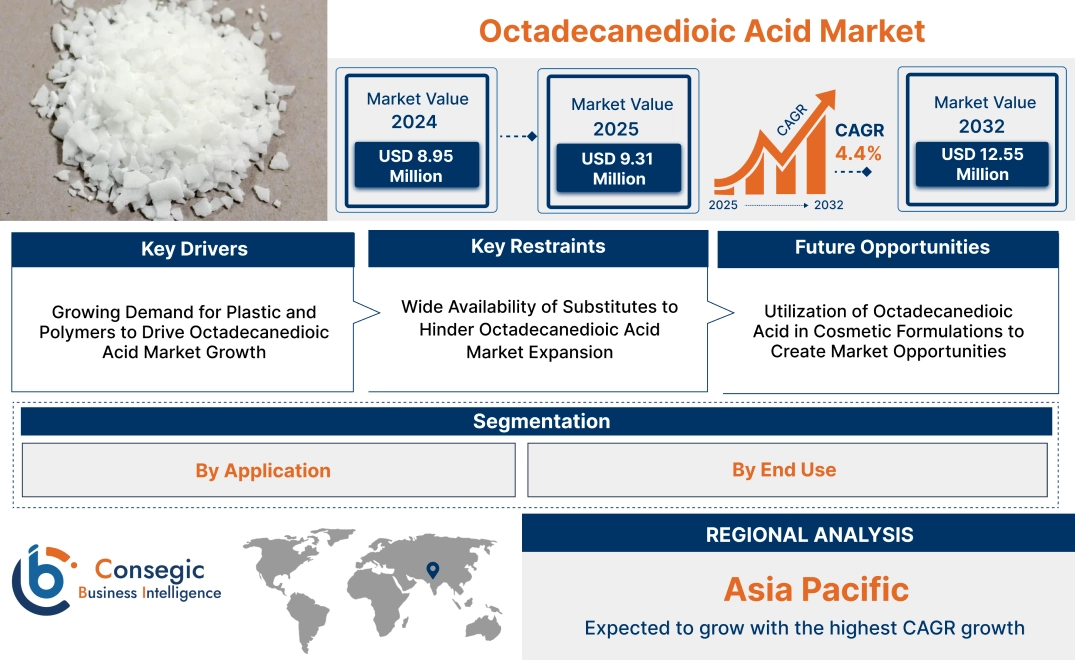
The Octadecanedioic Acid Market size is growing with a CAGR of 4.4% during the forecast period (2025-2032), and the market is projected to be valued at USD 12.55 Million by 2032 from USD 8.95 Million in 2024. Additionally, the market value for 2025 is attributed to USD 9.31 Million.
Octadecanedioic Acid Market Scope & Overview:
Octadecanedioic acid (ODDA), also known as 1,16-Hexadecanedicarboxylic acid is a long-chain dicarboxylic acid comprising eighteen carbon atoms. This organic compound presents as a white crystalline solid at ambient temperatures and exhibits limited solubility in water while readily dissolving in various organic solvents. Within biological systems, it serves as an intermediate in the metabolic pathways of fatty acids. Industrially, the compound finds applications as a monomer in the synthesis of specific polymers, including certain polyamides and polyesters, where its extended hydrocarbon chain contributes to the resulting materials' flexibility and other tailored properties. Additionally, the compound is also employed in lubricants, adhesives, coatings, cosmetic formulations and pharmaceuticals among others.
How is AI Transforming the Octadecanedioic Acid Market?
AI is playing a crucial role in the octadecanedioic acid market, particularly for optimizing production and supply chains, accelerating research and innovation, and enhancing customer experiences through tools such as chatbots and AI-powered research platforms. Smart process controls and automation, often integrated with AI, can optimize yields, ensure quality consistency, and promote sustainability in the manufacturing process. Moreover, AI tools provide real-time monitoring of chemical composition and product quality, ensuring compliance with industry standards and facilitating quick responses to deviations. Therefore, the above factors are expected to positively impact the market growth in upcoming years.
Octadecanedioic Acid Market Dynamics - (DRO) :
Key Drivers:
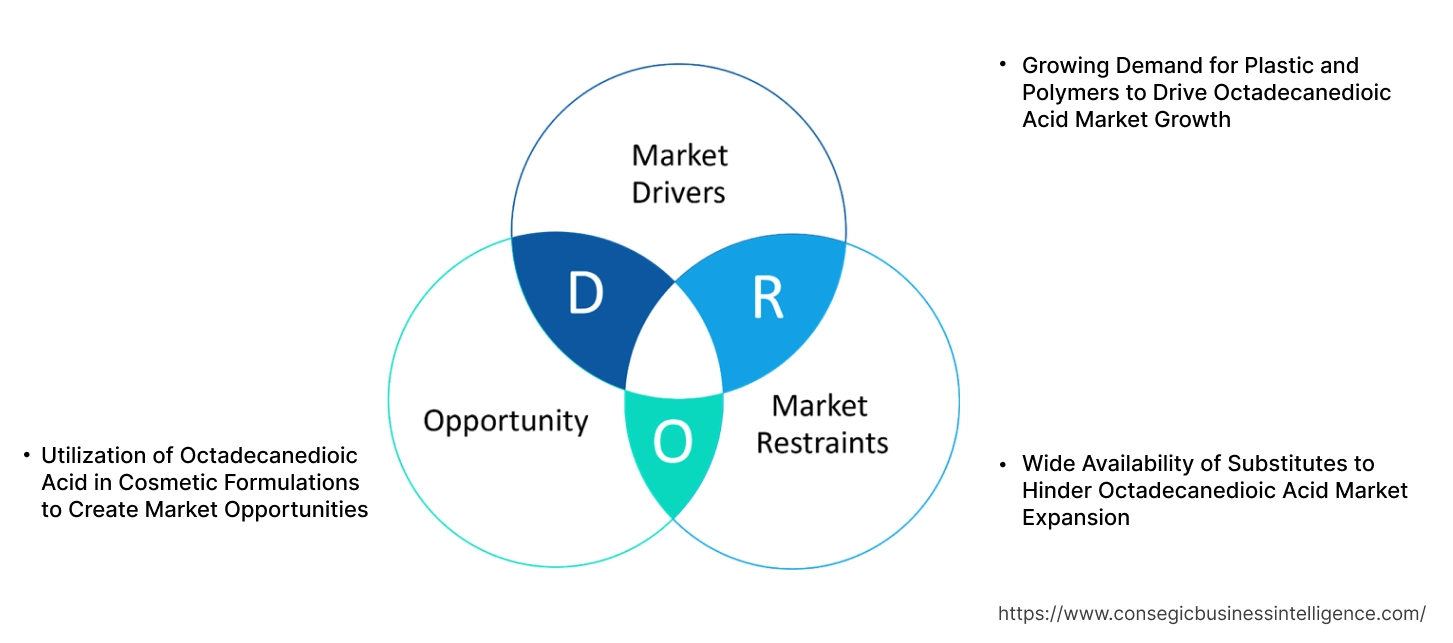
Growing Demand for Plastic and Polymers to Drive Octadecanedioic Acid Market Growth.
Octadecanedioic acid serves as a crucial monomer for high-performance polymers like nylons and polyesters, valued for durability and resistance. These polymers are used in several sectors such as in automotive components, electronics requiring thermal stability, durable packaging films, strong textiles, and weather-resistant construction materials. The global rise in plastic consumption across these sectors consequently increases the requirement for this compound as a vital raw material.
- For instance, according to the American Chemistry Council, Inc., EVs use about 45% more plastic than fuel cars. Vehicle chemistry value is up 31% in a decade, with plastics and polymers increasing 18%, making up 10% of weight but 50% of volume, aiding fuel efficiency.
Thus, the growing adoption of plastics and polymers across several sectors is driving the octadecanedioic acid market growth.
Key Restraints:
Wide Availability of Substitutes to Hinder Octadecanedioic Acid Market Expansion.
The market for octadecanedioic acid faces a constraint in its growth due to the widespread presence and established utilization of substitute materials. Compound faces competition with a range of other chemicals capable of fulfilling similar functions. In polymer production, other dicarboxylic acids such as azelaic, sebacic, and dodecanedioic acids, as well as monomers including adipic and terephthalic acid are employed. For cosmetics, fatty acid esters, synthetic esters, and silicones offer emollient and texture-enhancing properties. Lubricants utilize esters of other dicarboxylic acids, fatty acid esters, and mineral/vegetable oils. Coatings and adhesives also employ other dicarboxylic acids, polymeric resins, and fatty acid derivatives. This abundance of readily available and competitively priced substitutes creates a competitive landscape and supports players to adopt alternatives. Hence, the aforementioned factors are limiting the octadecanedioic acid market expansion.
Future Opportunities :
Utilization of Octadecanedioic Acid in Cosmetic Formulations to Create Market Opportunities.
ODDA derivatives are increasingly utilized in cosmetics and personal care. As an emollient, it softens skin and provides lasting hydration. Its anti-aging potential, enhancing skin elasticity, is highly valued in skincare products. It also acts as an emulsifier, improving product stability. The rising demand for natural and sustainable ingredients further supports its market potential in diverse skincare and hair care formulations globally.
- For instance, as per data published by the American Chemical Society cosmetics industry is increasingly supporting sustainability, mirroring a major shift in consumer behavior where over 40% of shoppers now prioritize natural ingredients in their beauty and personal care choices.
As a result, this adoption in cosmetic formulations benefits the octadecanedioic acid market demand.
Octadecanedioic Acid Market Segmental Analysis :
By Application:
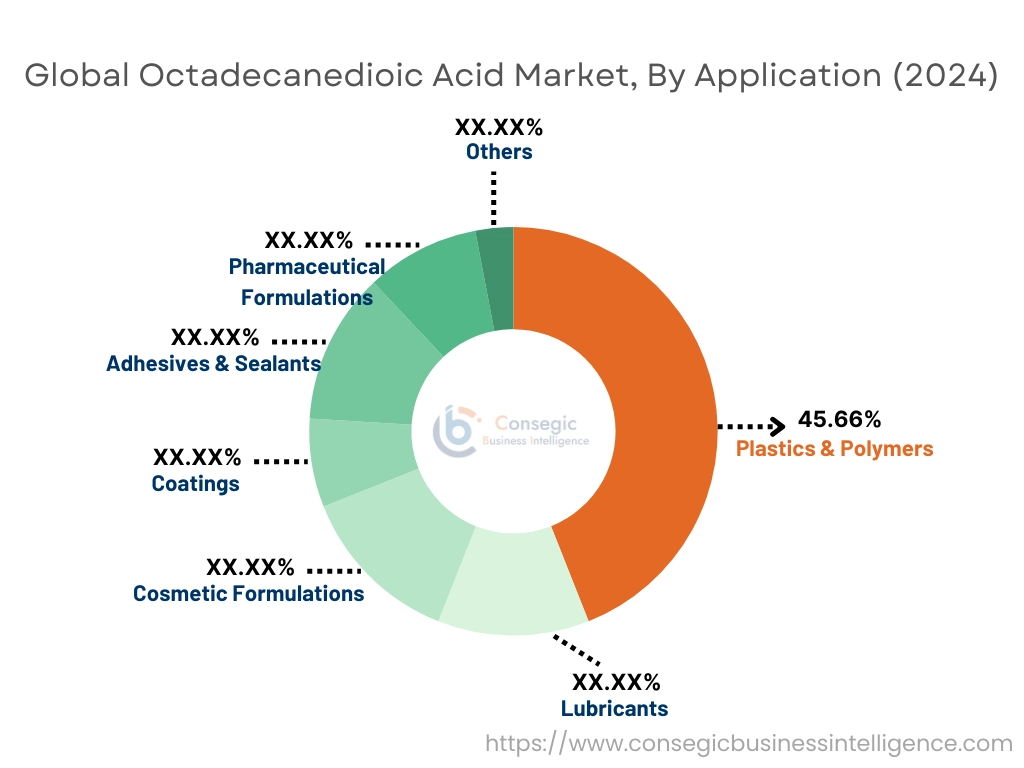
Based on application, the market is categorized into plastics & polymers, lubricants, cosmetic formulations, coatings, adhesives & sealants, pharmaceutical formulations, and others.
Trends in the Application:
- Increasing use of octadecanedioic acid in the production of bio-based and biodegradable polymers as a sustainable alternative is a trend positively impacting the market.
- Rising interest in 1,16-Hexadecanedicarboxylic acid-modified polymers for powder coatings to enhance flexibility and impact resistance.
The plastics & polymers segment accounted for the largest octadecanedioic acid market share of 45.66% in 2024.
- The application of ODDA in the creation of plastics & polymers constitutes a dominant segment within the overall octadecanedioic acid market demand as it serves as a crucial building block for polymers.
- Polyamides and polyesters both utilize this compound as a significant monomer in the creation of high-performance materials.
- The aliphatic chain inherent in the compound imparts enhancements in flexibility, resilience, as well as chemical and thermal resistance to the resultant polymers.
- Consequently, these polymers based on the compound are used as durable, heat-resistant engineering plastics in automotive and electronics. Their strength and elasticity make them suitable for textiles. In packaging and specialty films, they offer durability and barrier properties.
- As a result, the growing necessity for these plastics & polymers in several sectors makes the segment dominant in the market.
The cosmetic formulations segment is expected to grow at the fastest CAGR over the forecast period.
- Octadecanedioic acid is valued in cosmetics formulations for its emollient properties, crucial for maintaining dermal moisture in creams and lotions.
- It imparts softening and conditioning effects in hair care products such as conditioners and masks.
- It also enhances the stability and shelf life of formulations, finding application in moisturizers, anti-aging creams, sunscreens, hair serums, body lotions, and bath products. The cosmetic sector's escalating preference for natural skincare components is propelling this growth.
- For instance, according to the 2023 survey analysis published by CleanHub, 63% of respondents across the U.S. said they prefer cosmetic products with natural ingredients that are good for their skin and the planet.
- Hence, owing to the above-mentioned analysis, the cosmetics formulations segment is expected to grow at the fastest rate over the future years, creating octadecanedioic acid market opportunities.
By End Use:
The end use segment is categorized into automotive & transportation, construction, cosmetics & personal care, pharmaceuticals, and others.
Trends in the End Use:
- Increasing focus on lightweighting in vehicles to improve fuel efficiency and reduce emissions is a trend positively impacting the market.
- Increasing research on adoption of 1,16-Hexadecanedicarboxylic acid in drug delivery systems to improve the stability and bioavailability of certain active pharmaceutical ingredients.
The automotive & transportation segment accounted for the octadecanedioic acid market share in 2024.
- In the automotive & transportation sector ODDA plays a crucial role through contribution to high-performance polymers, coatings, lubricants, and adhesives.
- The compound enhances durability, flexibility, and resistance to heat and chemicals in engineering plastics used for critical components such as engine parts and structural elements.
- Additionally, in automotive coatings, it improves scratch, UV, and chemical resistance, while its esters enhance the performance of lubricants. Additionally, derivatives of the compound strengthen automotive adhesives and sealants, crucial for bonding diverse lightweight materials in modern vehicle designs including electric vehicles.
- For instance, according to S. Department of Energy, reducing vehicle weight by 10% improves fuel economy by 6%-8%. Lightweight materials can cut body/chassis weight by 50%, lowering fuel use.
- As a result, as per the octadecanedioic acid market analysis, the automotive & transportation segment is dominating the octadecanedioic acid market trends.
The cosmetics & personal care segment is expected to grow at the fastest CAGR over the forecast period.
- The cosmetics & personal care end-use sector segment within the market is projected to exhibit the rapid growth rate fueled by the confluence of consumer preferences and the inherent advantages of 1,16-Hexadecanedicarboxylic acid.
- The growing preference for natural and scientifically validated ingredients in personal care formulations aligns with the compound’s emollient, hydrating, and anti-aging properties, especially its bio-based forms.
- Additionally, the growing need for anti-aging skincare products further fuels this segment. Moreover, the increasing preference for organic and sustainable products resonates with the compound’s potential for bio-based production, making it a compound choice for manufacturers.
- Hence, the combination of consumer preferences, product efficacy, and sustainability positions the cosmetics & personal care sector as significant growth for consumption in the forecast period.
Regional Analysis:
The regional segment includes North America, Europe, Asia Pacific, the Middle East and Africa, and Latin America.
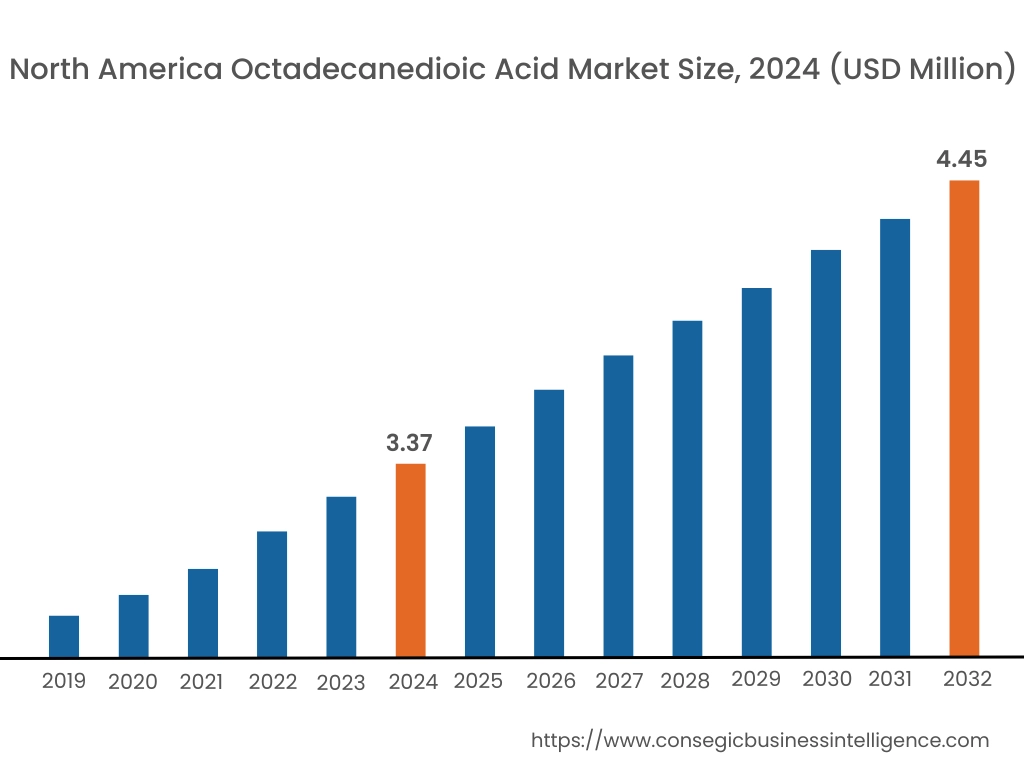
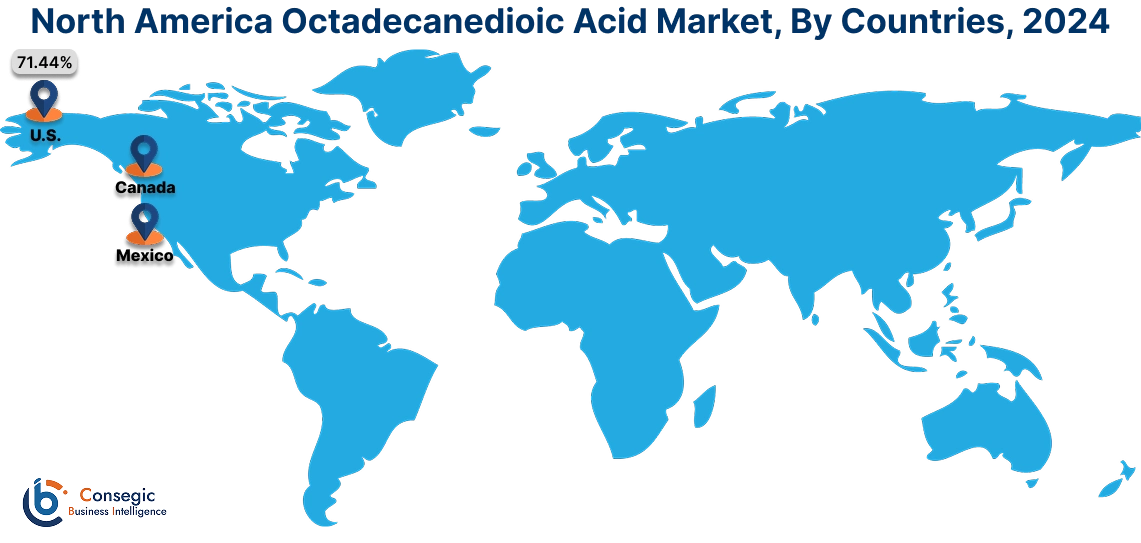
In 2024, North America accounted for the highest market share at 37.64% and was valued at USD 3.37 Million and is expected to reach USD 4.45 Million in 2032. In North America, the U.S. accounted for a market share of 71.44% during the base year of 2024. The North America market demand is significantly defined by a confluence of factors across key end-use sectors. In North America, the well-established automotive industry is a significant consumer of the compound utilizing it in the production of high-performance polymers crucial for vehicle components. The growing focus towards lightweighting in automotive design further propels the adoption of advanced materials, including ODDA-based polymers. The expanding electric vehicle market also generates new demands for thermally stable materials, particularly in battery systems, potentially increasing the compound’s utilization.
- For instance, according to ITA, US new EV registrations increased by 40% from 2022, representing 10% of global EV registrations.
This multifaceted adoption, coupled with a focus on sustainable industrial practices, positions North America as a significant market for the compound.
In Asia Pacific, the octadecanedioic acid industry is experiencing the fastest growth with a CAGR of 5.8% over the forecast period. Asia Pacific serves as a manufacturing hub for a vast array of plastic products, including construction, automotive, and electronics among others. This large production volume inherently requires substantial quantities of various raw materials, including specialized monomers like 1,16-Hexadecanedicarboxylic acid used in high-performance polymers. Moreover, Furthermore, the rapidly expanding share of cosmetics and personal care industry across countries such as China, India, and Southeast Asian nations is fueling substantial requirement as the compound finds increasing applications in skincare and hair care formulations.
In European market analysis, the region's emphasis on natural and organic cosmetics is a primary driver, leading to increased adoption of bio-based ODDA in various personal care product formulations. Moreover, the presence of stringent environmental regulations across the European Union favors the use of bio-based and sustainable chemicals, further influencing the requirement and sourcing of the compound within the region. These factors collectively present a positive impact on the share of European market analysis.
The Latin American octadecanedioic acid market trend is driven by the growing cosmetics & personal care sector benefiting from rising disposable incomes and influential beauty trends, leading to greater requirement for effective skincare ingredients like ODDA for its anti-aging and moisturizing properties. The growing preference for natural and plant-derived ingredients further supports the adoption of this compound. Additionally, the expanding industrial base across Latin America is creating demand for 1,16-Hexadecanedicarboxylic acid in polymer production for the automotive, packaging, and textile sectors, as well as in high-performance lubricants, coatings, and adhesives. Hence, as per analysis, these aforementioned factors are creating octadecanedioic acid market opportunities in the region.
The octadecanedioic acid market analysis in the Middle East and Africa (MEA) is currently witnessing growth driven by increasing investments in infrastructure development and industrial expansion, leading to a greater need for chemicals incorporating ODDA derivatives. Furthermore, the developing manufacturing sector in several MEA nations is anticipated to boost the consumption trend of the compound in applications such as adhesives, paints, and coatings.
Top Key Players and Market Share Insights:
The Global Octadecanedioic Acid Market is highly competitive with major players providing products to the national and international markets. Key players are adopting several strategies in research and development (R&D) and product innovation to hold a strong position in the global Octadecanedioic Acid market. Key players in the Octadecanedioic Acid industry include
- Merck KGaA (Germany)
- TCI (Japan)
- Elevance Renewable Sciences, Inc. (U.S.)
- chengdu Pukang Biological Technology Co., Ltd. (China)
- Larodan AB (Sweden)
- BLDpharm (China)
- Iris Biotech GmbH (Germany)
- Santa Cruz Biotechnology, Inc. (U.S.)
Octadecanedioic Acid Market Report Insights:
| Report Attributes | Report Details |
| Study Timeline | 2019-2032 |
| Market Size in 2032 | USD 12.55 Million |
| CAGR (2025-2032) | 4.4% |
| By Application |
|
| By End User |
|
| By Region |
|
| Key Players |
|
| North America | U.S. Canada Mexico |
| Europe | U.K. Germany France Spain Italy Russia Benelux Rest of Europe |
| APAC | China South Korea Japan India Australia ASEAN Rest of Asia-Pacific |
| Middle East and Africa | GCC Turkey South Africa Rest of MEA |
| LATAM | Brazil Argentina Chile Rest of LATAM |
| Report Coverage |
|
Key Questions Answered in the Report
How big is the Octadecanedioic Acid market? −
In 2024, the Octadecanedioic Acid market is USD 8.95 Million.
Which is the fastest-growing region in the Octadecanedioic Acid market? +
Asia Pacific is the fastest-growing region in the Octadecanedioic Acid market.
What specific segmentation details are covered in the Octadecanedioic Acid market? +
By Application and End Use segmentation details are covered in the Octadecanedioic Acid market.
Who are the major players in the Octadecanedioic Acid market? +
Merck KGaA (Germany), TCI (Japan), Larodan AB (Sweden) are some of the major players in the market.
Overview
Reputation & Certifications


Our Services
- Market Intelligence & Forecasting
- Custom Research Solutions
- Market Entry Strategy
- Competitive Intelligence
- Customer Insights
- Industry Innovation Analysis
- Investment Advisory