Jump to Content
Organic Feed Additives Market - Size, Share, Industry Trends, and Forecasts (2025-2032)
Organic Feed Additives Market Size:
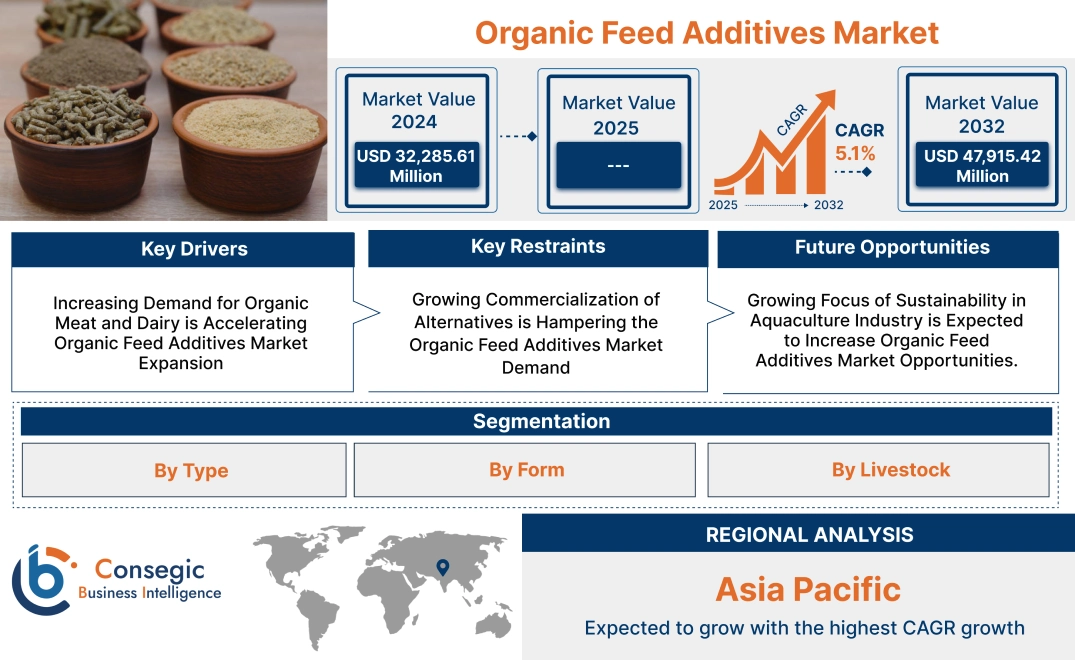
Organic Feed Additives Market size is growing with a CAGR of 5.1% during the forecast period (2025-2032), and the market is projected to be valued at USD 47,915.42 Million by 2032 from USD 32,285.61 Million in 2024.
Organic Feed Additives Market Scope & Overview:
Organic feed additives are natural substances. These natural substances are made using plants, animals, and microbial sources. They are added to animal feed to support their wellbeing. They reduce the need for antibiotics. Farmers also use these additives to produce high-quality meat, milk, and eggs. These additives come in two forms. The dry form is commonly used. It comes in powder or pellet forms. The usage of liquid form is also observed.
There are many types of additives. An example includes probiotics and prebiotics. They are given to livestock to support gut health and digestion. Moreover, herbs are given to strengthen the immune system. Additionally, amino acids are given to support muscle growth. Enzymes are also used to protect animals from harmful bacteria. All these factors ensure that animals health is becoming better.
Organic Feed Additives Market Dynamics - (DRO) :
Key Drivers:
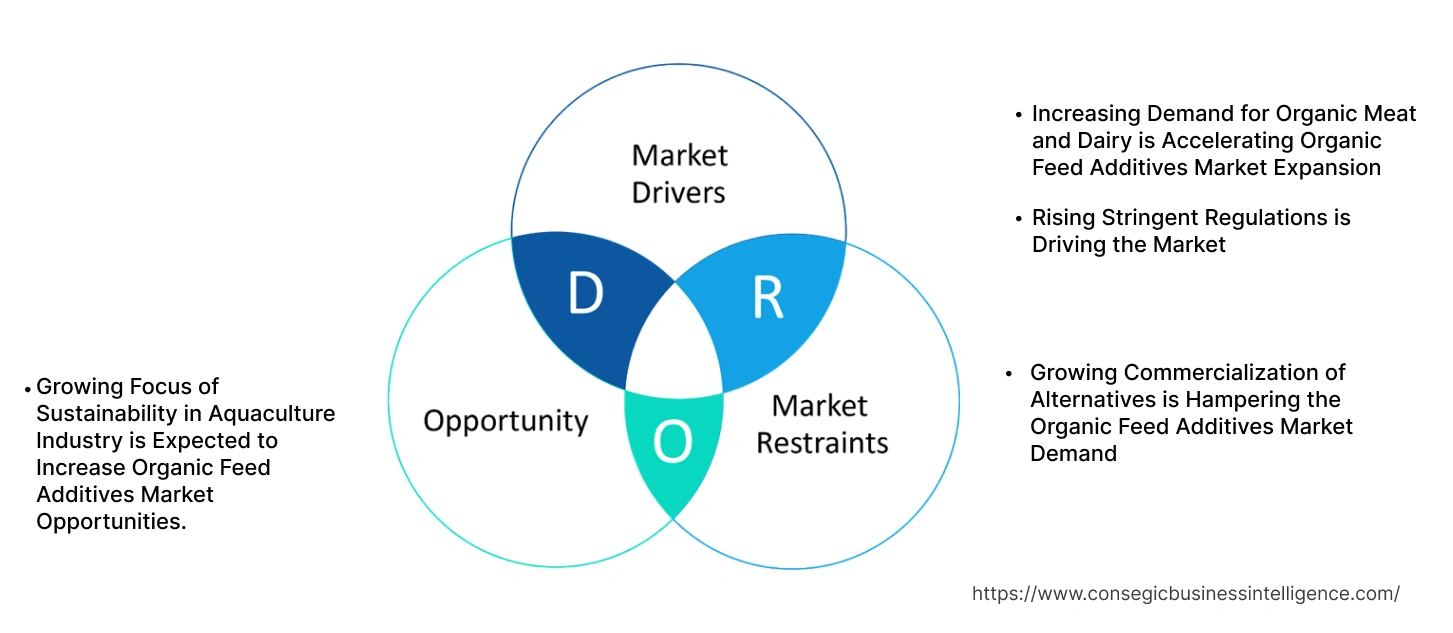
Increasing Demand for Organic Meat and Dairy is Accelerating Organic Feed Additives Market Expansion
To keep livestock healthy without using synthetic hormones is difficult for farmers. So, they use organic feed additives. They are used to improve the digestion of livestock. They are also used to manage stress in them. Moreover, they help in keeping them free from harmful bacteria. This leads to their strong development in a natural way which makes them organic. Individuals are becoming more health conscious. They are choosing more healthier and safer food options. This has led to an increase in the requirements of organic meat and dairy.
For instance,
- According to Organic Trade Association, sales of organic poultry increased by 4.7% in year 2022. This is requiring organic additives to maintain their quality organic.
Overall, the increasing demand for organic meat and dairy is significantly boosting the organic feed additives market expansion.
Rising Stringent Regulations is Driving the Market
Farmers have been using antibiotics in livestock feed for many years. They help them grow faster. This makes production more efficient. However, there is increasing awareness that these livestock are becoming antibiotic resistant. This is leading to many deaths of animals worldwide. In response to this, the governments are banning the use of antibiotics. They are also banning the use of synthetic feed additives to promote development of livestock naturally.
For instance,
- In 2022, the European Commission banned synthetic antioxidant ethoxyquin. This has made farmers to use organic additives to grow livestock healthily without using synthetic products.
Thus, growing rising stringent regulations is accelerating the global accelerating organic feed additives market growth.
Key Restraints:
Growing Commercialization of Alternatives is Hampering the Organic Feed Additives Market Demand
One major hurdle for the market is the availability of synthetic additives. They are also very cheap when compared to organic. This serves as a disadvantage for farmers looking for cost-efficient options as they purchase in bulk volume. Also, the synthetic ones are easy to source. They are readily available when compared to organic. Moreover, another issue is shelf life. Organic additives do not contain artificial preservatives. This makes them expire faster. Farmers need to restock more often. This adds extra costs and effort. In contrast, synthetic additives have longer shelf life. This makes them more convenient for daily farm operations. Additionally, there is a lack of consistency in the market. Hence, the growing commercialization of alternatives is hampering organic feed additives market demand.
Future Opportunities :
Growing Focus of Sustainability in Aquaculture Industry is Expected to Increase Organic Feed Additives Market Opportunities.
Sustainable aquaculture is a method of farming fish and other aquatics in a sustainable way. Farmers in this method are not supposed to use any synthetic products. Organic additives in this method are very important. They help fish in receiving all the nutrients required to grow naturally. This reduces the dependency on artificial chemicals. Vitamins and enzymes are some examples of organic additives. There is an increasing focus on adopting sustainable practices in the aquaculture sector.
For instance,
- According to Tridge, organic fish farming is expected to expand at CAGR of 4.5% from 2023 to 2031. This will require organic feed additives to make aqua species grow healthy without using synthetic products.
Overall, the growing focus of sustainability in aquaculture sector is expected to increase organic feed additives market opportunities.
Organic Feed Additives Market Segmental Analysis :
By Type:
Based on type, the market is categorized into amino acids, vitamins, minerals, prebiotics & probiotics, antioxidants, and others.
Trends in Type:
- Growing use of enzymes to improve feed digestibility, reduce nutrient losses, and enhance overall feed efficiency.
- Rapid growth in demand for prebiotics and probiotics to enhance gut health, improve immune function, and reduce reliance on antibiotics.
The amino acids segment accounted for the largest market share in 2024.
- Amino acids dominate the organic feed additives market trends. Amino acids play an important role in animal feed. They help animals in building proteins. This is crucial for their muscle and body development.
- These natural additives are helping livestock in strengthening their immune system. They are also improving digestion in them and are supporting reproduction.
- They are sourced from plants or through natural fermentation. They are offering a chemical-free option for livestock production.
- Manufacturers are using advanced technology to develop additives with improved efficacy.
- For instance, in 2023, Evonik launched Biolys for animal feed. This additive has a high concentration of L-lysine amino acid. These launches have increased their reach, driving the segment.
- Overall, as per the market analysis, new product launches are driving a segment in organic feed additives market growth.
The prebiotics & probiotics segment is expected to grow at the fastest CAGR over the forecast period.
- Prebiotics and probiotics are an emerging segment in the market. They are important for maintaining animal health.
- Prebiotics are natural fibers that provide good bacteria to animal's guts. They are beneficial in promoting better digestion. They also help with nutrient absorption.
- On the other hand, probiotics are live beneficial bacteria that support gut health. This boost immunity. It also helps in preventing infections.
- According to market analysis, there is growing consumer awareness of animal welfare. It has led to increased preference for naturally raised livestock. This will drive the segment for the upcoming years. Moreover, the awareness of benefits these prebiotics and probiotics provide to animal gut microbiome will further support the market.
By Form:
Based on form, the market is categorized into dry, and liquid.
Trends in the Form
- Encapsulated form is becoming an emerging as a promising delivery method for protecting sensitive ingredients and improving bioavailability.
- Growing use of pelleted forms for improved feed handling, reduced dust, and enhanced palatability.
The dry segment accounted for the largest market share in 2024.
- Dry segment dominated the organic feed additives market trends. Dry form denotes different forms. It includes pellets, crumbles, and powders.
- They are a popular choice for farmers. It is because they are very simple to handle. They mix easily into animal feed. They also have a longer life.
- They are not disturbed by temperature fluctuations. This makes them stable during transport. Also, this form is more cost-effective.
- There is an increasing ban on synthetic products by the government to promote better health of animals.
- For instance, in 2022, European Union banned the use of prophylactic group of antibiotics. This has required farmers to adopt dry organic additives to grow livestock healthy.
- Overall, as per the market analysis, governments worldwide are banning synthetic products. This is driving segmental growth in the organic feed additives industry.
The liquid centers segment is expected to grow at the fastest CAGR over the forecast period.
- Liquid form is an emerging segment in the market. They are becoming easier to apply with precision equipment’s. This involves even smaller and specialized farming operations.
- They dissolve quickly. They are ensuring efficient nutrients distribution in the animals.
- Moreover, liquid formulations are offering farmers with higher bioavailability and delivery. This is making them important for young animals who face digesting dry forms.
- Additionally, liquid provides more flexibility. Farmers adjust dosing according to the age of the animals.
- According to market analysis, there are advancements in stabilization and preservation technologies. These advances are improving the shelf life. It is also stability of liquid formulations. This will drive the segmental growth for the forecasted period.
By Livestock:
Based on livestock, the market is categorized into poultry, swine, ruminants, aquaculture, and others.
Trends in the Livestock
- Increasing focus on improving feed digestibility, rumen health, and milk production in organic ruminant systems.
- Enhancing feed utilization, improving fish health, and minimizing environmental impact in organic aquaculture.
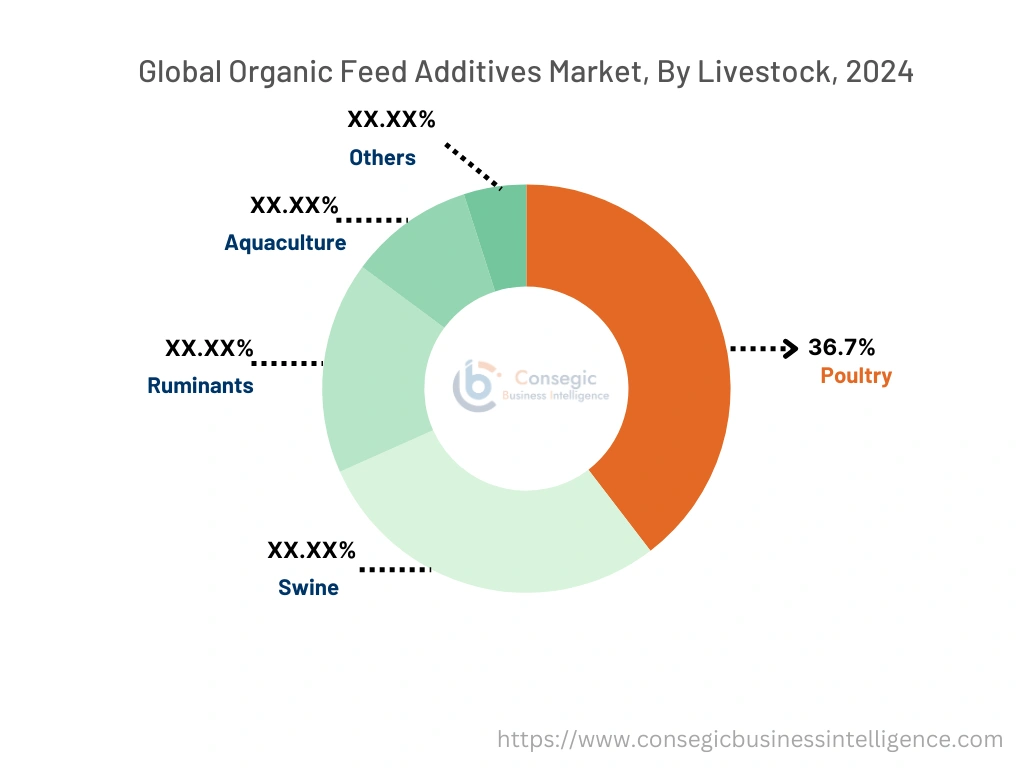
The poultry segment accounted for the largest market share of 37.91% in 2024.
- Poultry farming includes chickens, turkeys, and ducks for meat and eggs. People around the world depend on poultry as a staple protein source. This is leading to constant requirements.
- Organic feed additives help in keeping the animals healthy. They make them strong by improving digestion and gut health.
- They support natural development. This reduces the need for synthetic products.
- Moreover, poultry is exposed to various diseases. These organic additives strengthen the gut microbiome. It improves the way the immune function. This enhances their fighting capacity.
- There are growing concerns about food safety. Many consumers are opting for ethically raised poultry. They are looking for poultry who are free from antibiotics. This has driven the segment.
The aquaculture segment is expected to grow at the fastest CAGR over the forecast period.
- Aquaculture is also known as fish or seafood farming. Organic additives play a crucial role in this sector.
- They help fish to grow stronger. Moreover, they help fish in getting their food digest in a more superior way.
- In addition, they help in keeping them away from multiple diseases. They support natural development. This reduces the reliance on antibiotics or synthetic chemicals.
- Manufacturers are constantly developing new organic additives to improve fish health in farming practices.
- For instance, in 2024, Skretting launched an AmiNova additive. This product contains a unique blend of amino acids which are easy to digest. These product launches will increase their applications. This will drive the segment for the upcoming years.
Regional Analysis:
The regions covered are North America, Europe, Asia Pacific, the Middle East and Africa, and Latin America.
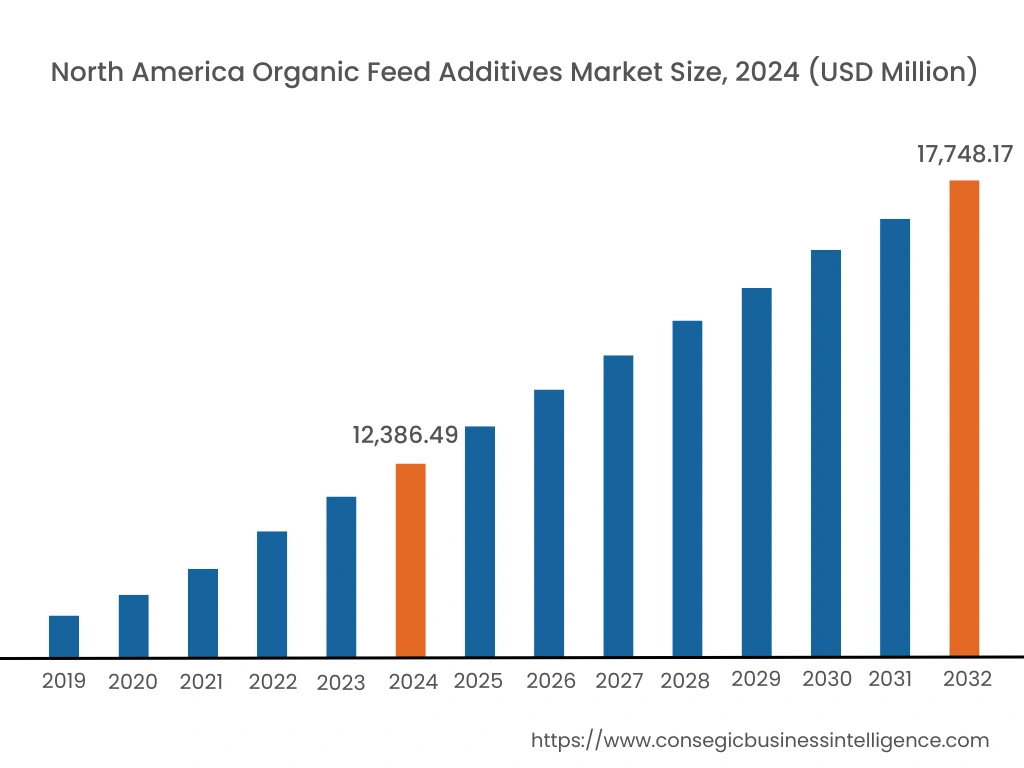
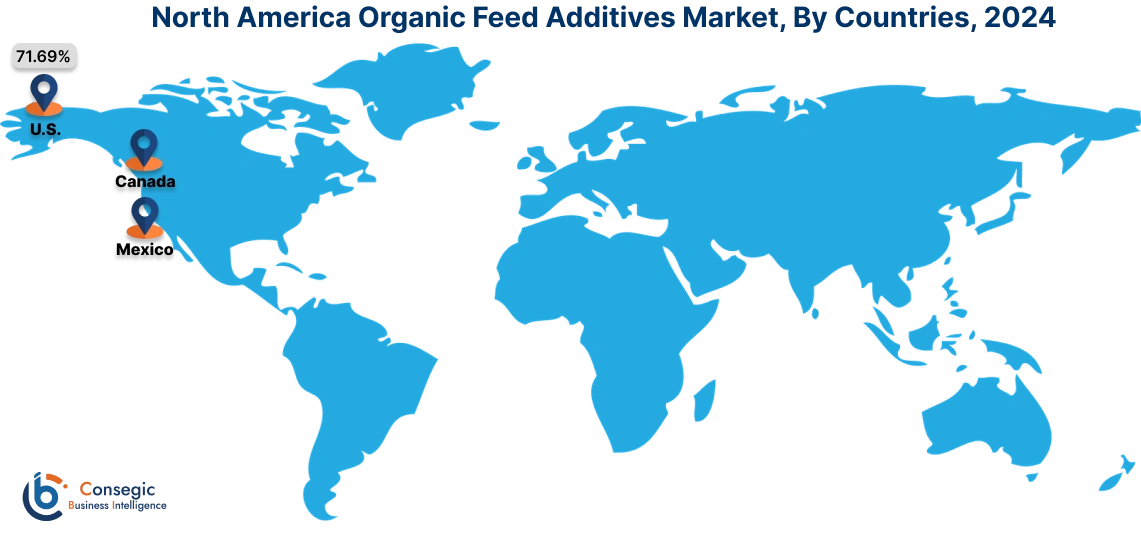
In 2024, North America accounted for the highest organic feed additives market share at 38.37% and was valued at USD 12,386.49 Million and is expected to reach USD 17,748.17 Million in 2032. In North America, the U.S. accounted for the organic feed additives market share of 71.69% during the base year of 2024. Consumers in the region are looking for products free from antibiotics, synthetic hormones, and GMOs. They believe these choices are better for their health and the environment. Grocery stores, restaurants, and even fast-food chains are responding by offering more organic options. This has increased the pressure on farmers to switch to organic practices. To meet this need, livestock producers are turning to organic additives, driving market in region.
- According to United States Department of Agriculture, in 2021, the United States sold USD 1.51 billion in organic broiler chickens. This is a 35% increase from 2019. This has led to increased need for organic additives to maintain livestock health and improve their functions.
Moreover, farmers are becoming more focused on animal health. With tighter restrictions on antibiotics and growing concerns over drug resistance, many are looking for natural ways to keep their animals strong and disease-free. Overall, the rising consumer demand for organic and antibiotic-free animal products, driven by health and environmental concerns, is driving the market in region.
In Asia Pacific, the organic feed additives market is experiencing the fastest growth with a CAGR of 5.97% over the forecast period. Organic aquaculture is gaining importance in region. Seafood is a staple in many Asian diets, but there are growing concerns about water pollution and antibiotic use in fish farming. This has made consumers more cautious. More people now prefer organic fish and shrimp. This requires clean, high-quality feed. Farmers are responding by using natural additives such as probiotics and plant-based supplements to improve fish health. This reduces disease risks. Moreover, Governments in countries such as China, India, and Japan are also introducing policies and incentives to promote organic farming. With this growing awareness, farmers are turning to organic additives to meet market expectations.
Europe's organic feed additives market analysis states that several trends are responsible for the progress of the market in the region. In Europe, antibiotics, synthetic additives, and GMOs for animal feed are heavily restricted. This means farmers have to find natural alternatives. At the same time, consumers are paying close attention to what they eat. They are looking for organic, chemical-free meat, dairy, and seafood. To keep up with these expectations, farmers are turning to organic additives such as probiotics, prebiotics, and herbal supplements. These natural ingredients help animals stay healthy. They also strengthen their immune systems. Moreover, there is also a lot of investment going into organic farming. Governments, private investors, and big food companies are putting money into research and new organic feed solutions.
The Middle East and Africa (MEA) organic feed additives market analysis states that the region is also witnessing several trends for notable surge. Government in this region are offering subsidies, certification programs, and training to help farmers shift toward sustainable practices. At the same time, stricter rules on antibiotics and synthetic additives in animal feed are pushing the sector towards natural alternatives. As more people look for organic meat, dairy, and seafood, these policies help farmers meet demand. However, many countries in the region do not produce enough organic feed ingredients, so farmers have to rely on expensive imports. This drives up costs and creates supply chain problems. This makes it tough for smaller farmers to afford high-quality organic feed.
Latin America's organic feed additives market size is also emerging and limited retail penetration in rural areas poses challenges. There has been a growing effort to bring together governments, agricultural organizations, and private businesses to boost organic farming. Countries are collaborating with international groups to create certification programs, improve supply chains, and promote sustainable practices. Big agricultural companies are also teaming up with smaller farms to help them transition to organic methods. Through these partnerships, farmers gain access to financial support, training, and knowledge about organic feed additives. Moreover, new trends in feed processing, fermentation, and natural supplement formulations are making organic additives more effective and accessible. Tools such as smart farming technology and precision feeding systems also help optimize feed usage.
Top Key Players and Market Share Insights:
The Organic Feed Additives market is highly competitive with major players providing products to the national and international markets. Key players are adopting several strategies in research and development (R&D) and product innovation to hold a strong position in the global Organic Feed Additives market. Key players in The Organic Feed Additives industry include-
- Evonik Industries (Germany)
- Skretting's (Norway)
- ADM (U.S.)
- BASF SE (Germany)
- Volac International (UK)
- Vitalac (France)
- Alltech (U.S.)
- Adisseo (U.S.)
- DSM (Switzerland)
- Novonesis Group (Denmark)
Recent Industry Developments :
Product Launch:
- In May 2024, Skretting has launched a new aquafeed formulation called AmiNova. It aims to provide more precise fish nutrition by optimizing the digestibility of amino acids, leading to less nutrient release into the environment and improved fish health through efficient nutrient utilization; essentially, the fish can absorb more of the nutrients from the feed, minimizing waste.
- In May 2023, Evonik launched an updated version of its Biolys product, a key source of L-lysine (amino acid) for animal feed, featuring a higher concentration of L-lysine compared to the previous version. This allows for more efficient supplementation of this essential amino acid in livestock diets while maintaining the same level of nutritional benefits derived from the fermentation process.
Organic Feed Additives Market Report Insights :
| Report Attributes | Report Details |
| Study Timeline | 2019 - 2032 |
| Market Size in 2032 | USD 47,915.42 Million |
| CAGR (2025-2032) | 5.1% |
| By Type |
|
| By Form |
|
| By Livestock |
|
| By Region |
|
| Key Players |
|
| North America | U.S. Canada Mexico |
| Europe | U.K. Germany France Spain Italy Russia Benelux Rest of Europe |
| APAC | China South Korea Japan India Australia ASEAN Rest of Asia-Pacific |
| Middle East and Africa | GCC Turkey South Africa Rest of MEA |
| LATAM | Brazil Argentina Chile Rest of LATAM |
| Report Coverage |
|
Key Questions Answered in the Report
How big is the Organic Feed Additives market? −
In 2024, the Organic Feed Additives market is USD 32,285.61 Million.
Which is the fastest-growing region in the Organic Feed Additives market? +
Asia Pacific is the fastest-growing region in the Organic Feed Additives market.
What specific segmentation details are covered in the Organic Feed Additives market? +
Type, Form, and Livestock segmentation details are covered in the Organic Feed Additives market.
Who are the major players in the Organic Feed Additives market? +
Evonik Industries (Germany), Skretting's (Norway), ADM (U.S.), and BASF SE (Germany) are some major players of the market.
Overview
Reputation & Certifications


Our Services
- Market Intelligence & Forecasting
- Custom Research Solutions
- Market Entry Strategy
- Competitive Intelligence
- Customer Insights
- Industry Innovation Analysis
- Investment Advisory