Jump to Content
Perimeter Security Market - Size, Share, Industry Trends, and Forecasts (2025-2032)
Perimeter Security Market Size:
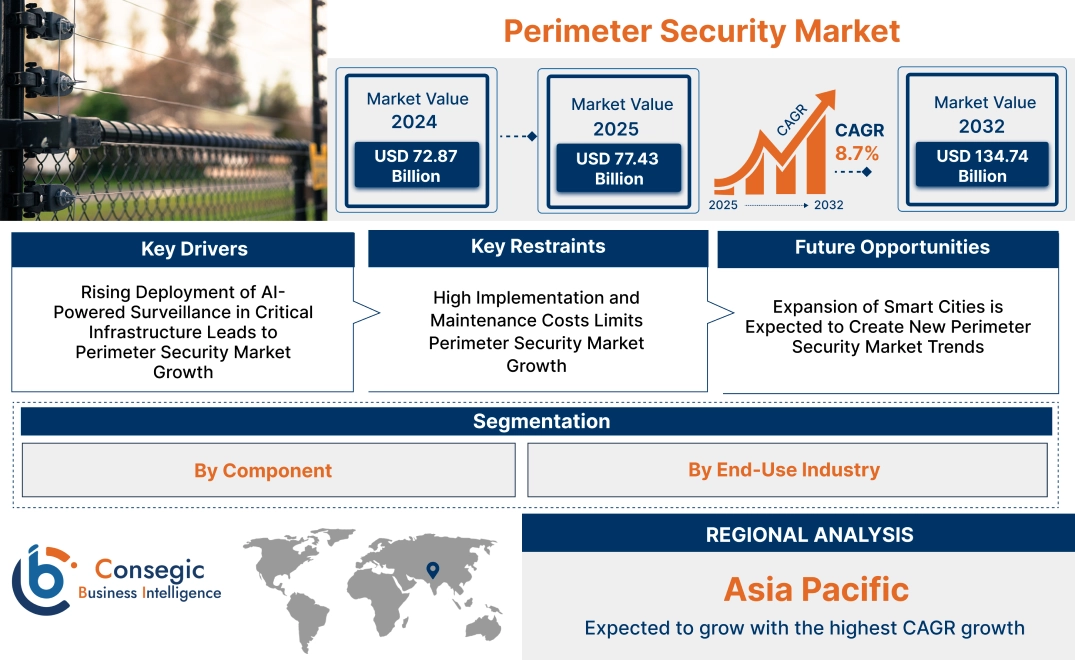
Perimeter Security Market size is estimated to reach over USD 134.74 Billion by 2032 from a value of USD 72.87 Billion in 2024 and is projected to grow by USD 77.43 Billion in 2025, growing at a CAGR of 8.7% from 2025 to 2032.
Perimeter Security Market Scope & Overview:
Perimeter security consists of systems and technologies designed to protect physical boundaries from unauthorized access, intrusions, and security threats. It includes surveillance cameras, access control, intrusion detection, motion sensors, and fencing solutions. These systems enhance security by providing real-time monitoring, automated threat detection, and rapid response capabilities.
The benefits of perimeter security include improved asset protection, reduced security breaches, and increased situational awareness. Advanced technologies, including artificial intelligence and biometric authentication, strengthen security measures. Integration with cloud-based platforms ensures remote access and centralized management.
Perimeter security is widely used in defense, government, transportation, commercial facilities, and industrial sites. It supports critical infrastructure protection, corporate security, and residential safety. Applications include military bases, airports, data centers, and smart cities, ensuring comprehensive threat prevention.
How is AI Transforming the Perimeter Security Market?
The integration of AI is considerably transforming the perimeter security market. AI-powered systems are being used for improving threat detection, automating responses, reducing false alarms, and facilitating smarter, more proactive security measures. Moreover, AI-powered systems can analyze live camera feeds to automatically identify threats, detect unusual behaviors, and classify objects with high precision. This significantly reduces the need for constant human monitoring. Additionally, AI systems can also send real-time alerts, trigger lockdown protocols, and even integrate with emergency response systems for a faster, more effective response to a breach. Consequently, the above factors are anticipated to drive the market growth in upcoming years.
Perimeter Security Market Dynamics - (DRO):
Key Drivers:
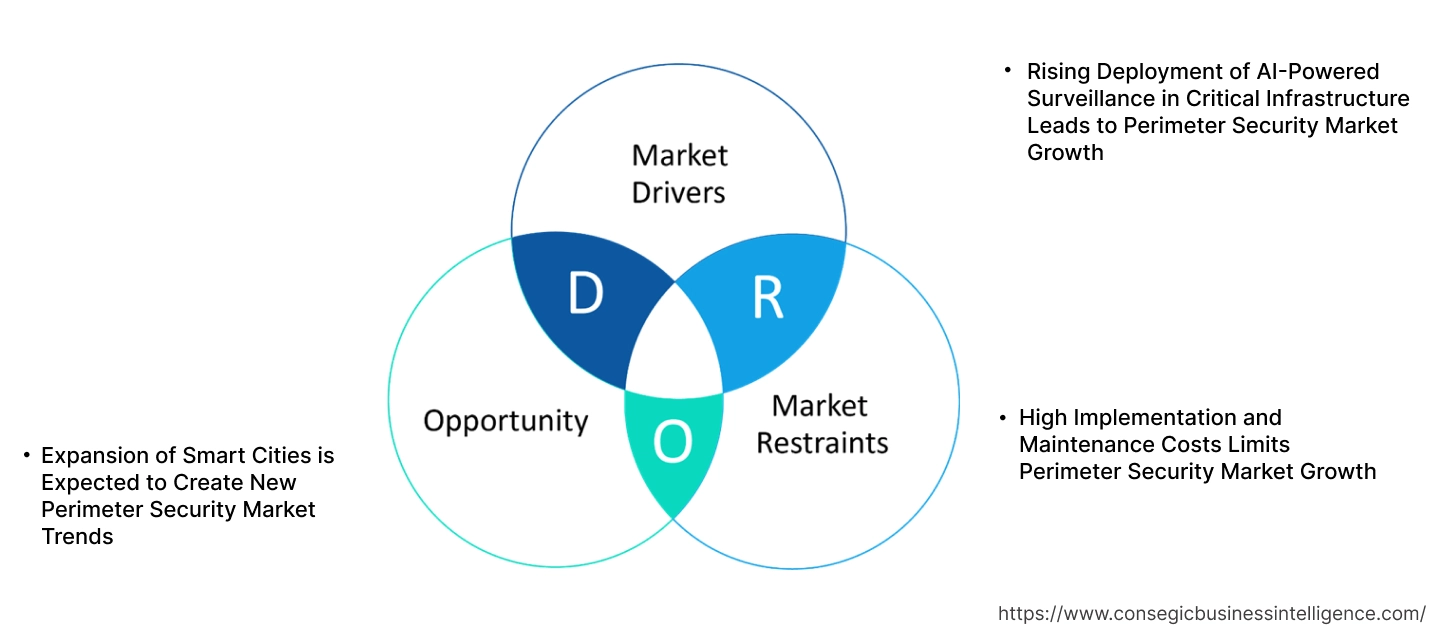
Rising Deployment of AI-Powered Surveillance in Critical Infrastructure Leads to Perimeter Security Market Growth
The integration of artificial intelligence (AI) into perimeter security systems enhances threat detection, real-time monitoring, and automated decision-making. Critical infrastructure facilities, including power plants, airports, and military bases, require robust security solutions to prevent unauthorized access and potential threats. AI-powered surveillance improves perimeter security by analyzing vast amounts of data from cameras and sensors, identifying anomalies, and issuing alerts without human intervention. For instance, AI-driven video analytics can detect unusual movements and differentiate between genuine threats and false alarms, ensuring a swift and effective response.
Thus, the rising deployment of AI-powered surveillance in critical infrastructure is boosting the market.
Key Restraints:
High Implementation and Maintenance Costs Limits Perimeter Security Market Growth
The deployment of advanced perimeter security solutions involves significant costs related to equipment, installation, and ongoing maintenance. Technologies such as thermal imaging cameras, AI-driven surveillance, and radar-based monitoring systems require substantial investments, making them less accessible to small and medium-sized enterprises (SMEs) and budget-constrained organizations. Additionally, periodic software updates, cybersecurity enhancements, and hardware maintenance add to the operational expenses. For example, large-scale facilities deploying perimeter intrusion detection systems must allocate continuous resources for upkeep and software upgrades to ensure optimal performance.
These high implementation and maintenance costs limit the trend of perimeter security solutions, particularly among SMEs and emerging markets.
Future Opportunities:
Expansion of Smart Cities is Expected to Create New Perimeter Security Market Trends
The increasing development of smart cities is expected to drive perimeter security market demand for advanced perimeter security solutions. Smart city projects integrate IoT-enabled surveillance, intelligent fencing, and automated access control to ensure public safety and urban security. With governments investing in smart infrastructure, the trend for real-time perimeter security solutions is projected to increase. For example, smart traffic management systems with integrated perimeter security solutions can prevent unauthorized access to restricted zones, enhancing public safety.
Therefore, the perimeter security market expansion of smart cities is expected to create new opportunities.
Perimeter Security Market Segmental Analysis :
By Component:
Based on the component, the market is segmented into systems (access control systems, intrusion detection systems, video surveillance systems, barrier systems, alarms and notification systems, and others) and services (system integration and consulting, risk assessment and analysis, managed services, and maintenance and support).
The systems segment accounted for the largest revenue in perimeter security market share in 2024.
- Systems include surveillance cameras, intrusion detection systems, access control systems, and alarms, forming the core infrastructure for perimeter protection.
- These systems are widely deployed across military bases, industrial facilities, airports, and residential complexes due to their effectiveness in real-time threat detection further driving the perimeter security market demand.
- Advanced systems leverage technologies such as infrared sensors, radar-based detection, and thermal imaging to secure perimeters under varying environmental conditions.
- As per perimeter security market analysis, their dominance stems from large-scale government and commercial investments in physical security infrastructure across sensitive and high-value areas.
- Integrated perimeter security systems are often adopted as a centralized solution, supporting long-term operational efficiency and deterrence against unauthorized access.
The services segment is anticipated to register the fastest CAGR during the forecast period.
- Services include system installation, maintenance, integration, and managed security offerings, providing ongoing support for perimeter security infrastructure.
- The rising complexity of multi-layered security networks has increased the need for expert-managed services to ensure seamless system performance and uptime.
- Organizations are outsourcing surveillance monitoring and maintenance to service providers to reduce internal operational burden and benefit from real-time response capabilities which fuels the perimeter security market expansion.
- As per perimeter security market trends, the shift toward security-as-a-service (SECaaS) and remote perimeter monitoring is driving service segment expansion, especially among SMEs and critical infrastructure operators.
- Rapid adoption of cloud-based security management and predictive maintenance solutions is enhancing the scalability and effectiveness of perimeter security services.
By End-Use Industry:
Based on the end-use industry, the market is segmented into commercial, industrial, government, military and defense, infrastructure, residential, education, and others.
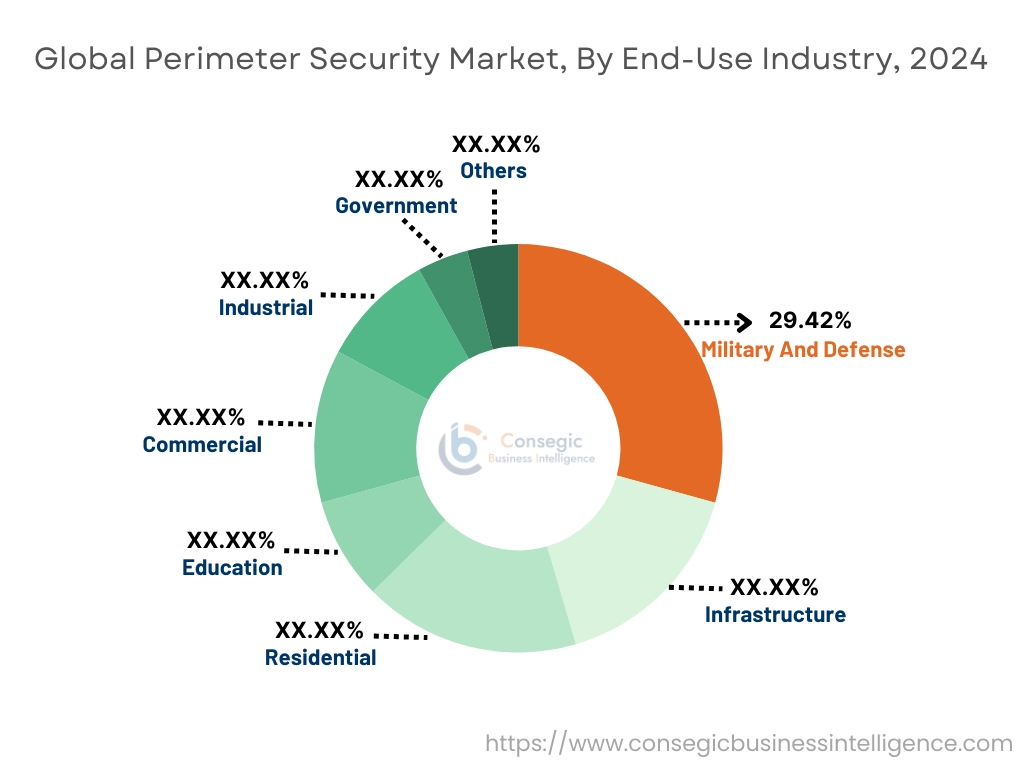
The military and defense sector accounted for the largest revenue in perimeter security market share by 29.42% in 2024.
- The military and defense sector prioritizes high-end security solutions to protect sensitive infrastructure, personnel, and classified information.
- Advanced perimeter security measures such as radar surveillance, thermal imaging, biometric access control, and unmanned aerial surveillance systems enhance security.
- Governments allocate substantial budgets for defense infrastructure protection, further driving the trend for sophisticated perimeter security systems.
- Stringent regulatory requirements and rising geopolitical tensions contribute to increased investment in perimeter security technologies within the defense sector.
- Therefore, according to perimeter security market analysis, perimeter security solutions in military and defense applications play a vital role in ensuring national security and operational safety.
The infrastructure sector is anticipated to register the fastest CAGR during the forecast period.
- Critical infrastructure, including transportation hubs, power plants, water facilities, and communication networks, requires robust perimeter security measures.
- The rising threat of cyber-physical attacks and the need for comprehensive security frameworks are increasing investments in perimeter security for infrastructure protection.
- Governments worldwide are implementing stringent security policies for infrastructure projects, leading to higher growth of perimeter security solutions.
- Trend of AI-based surveillance, remote monitoring, and automated threat detection is enhancing security measures across infrastructure facilities.
- Thus, according to perimeter security market analysis, perimeter security systems in the infrastructure sector are evolving rapidly to address security vulnerabilities and ensure operational continuity.
Regional Analysis:
The regional segment includes North America, Europe, Asia Pacific, Middle East and Africa, and Latin America.
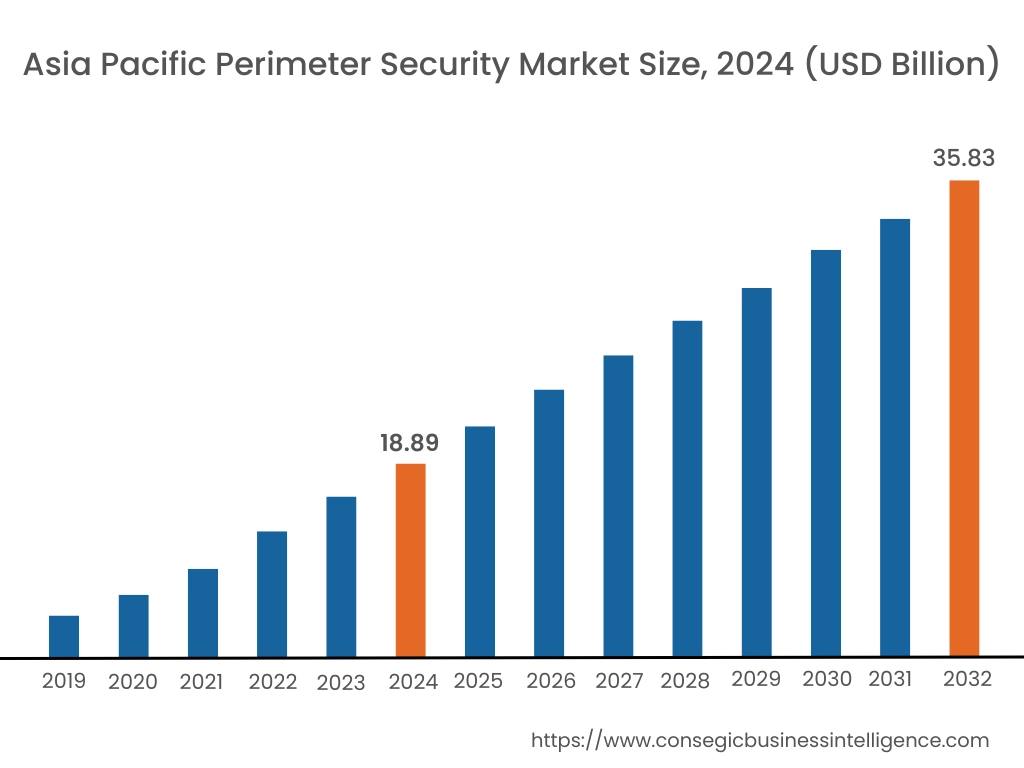
Asia Pacific region was valued at USD 18.89 Million in 2024. Moreover, it is projected to grow by USD 20.11 Million in 2025 and reach over USD 35.83 Million by 2032. Out of this, China accounted for the maximum revenue share of 34.11%. Asia-Pacific is witnessing increased growth of perimeter security due to rapid urbanization, industrial expansion, and geopolitical tensions. Countries like China, India, Japan, and South Korea are implementing security measures to protect critical infrastructure, airports, and defense facilities. The opportunities of smart city projects and the need for secure residential complexes contribute to market growth. Government initiatives to strengthen national security drive investments in advanced surveillance systems, including drones and automated perimeter monitoring.

In 2024, North America was valued at USD 25.53 Billion and is expected to reach USD 47.04 Billion in 2032. North America holds a significant share of the perimeter security market due to increasing concerns about unauthorized access, terrorism, and cyber threats. The United States and Canada have strict regulations that mandate security measures in critical infrastructure, commercial facilities, and government institutions. Investments in advanced surveillance technologies, including AI-powered analytics and biometric authentication, enhance security frameworks. The rising trend of smart city initiatives further supports demand for perimeter security solutions.
Europe remains a key region in the perimeter security market due to strict regulations on infrastructure protection and rising security concerns. The United Kingdom, Germany, France, and Italy are adopting perimeter surveillance solutions to secure transportation hubs, industrial sites, and public spaces. Increased government funding for security modernization and the integration of AI-based security solutions support perimeter security market opportunities. The presence of major security solution providers further strengthens the regional market.
The Middle East and Africa are witnessing increasing demand for perimeter security due to rising concerns over unauthorized access, terrorism, and border security threats. Countries like the UAE, Saudi Arabia, and South Africa are investing in advanced perimeter monitoring solutions, including thermal imaging and intrusion detection systems. Infrastructure development projects, such as smart cities and commercial hubs, are driving demand for advanced security technologies. The oil and gas sector also requires enhanced perimeter protection to safeguard critical assets.
Latin America is experiencing steady demand for perimeter security solutions, driven by rising crime rates and security concerns in countries like Brazil, Mexico, and Argentina. Government agencies and private enterprises are investing in perimeter surveillance systems for residential, commercial, and industrial sites. Increasing growth of AI-driven security analytics and biometric access control supports perimeter security market opportunities. The region’s focus on securing transportation hubs and public infrastructure further strengthens demand for perimeter security solutions.
Top Key Players & Market Share Insights:
The global perimeter security market is highly competitive with major players providing products and services to the national and international markets. Key players are adopting several strategies in research and development (r&d), product innovation, and end-user launches to hold a strong position in the global perimeter security market. Key players in the perimeter security industry include-
- Honeywell International Inc. (United States)
- Dahua Technology Co., Ltd. (China)
- FLIR Systems, Inc. (United States)
- Southwest Microwave, Inc. (United States)
- Senstar Corporation (Canada)
- Bosch Security Systems (Germany)
- Axis Communications AB (Sweden)
- Optex, Inc. (Japan)
- Delta Scientific Corporation (United States)
- RBtec Perimeter Security Systems (United States)
Perimeter Security Market Report Insights:
| Report Attributes | Report Details |
| Study Timeline | 2019-2032 |
| Market Size in 2032 | USD 134.74 Billion |
| CAGR (2025-2032) | 8.7% |
| By Component |
|
| By End-Use Industry |
|
| By Region |
|
| Key Players |
|
| North America | U.S. Canada Mexico |
| Europe | U.K. Germany France Spain Italy Russia Benelux Rest of Europe |
| APAC | China South Korea Japan India Australia ASEAN Rest of Asia-Pacific |
| Middle East and Africa | GCC Turkey South Africa Rest of MEA |
| LATAM | Brazil Argentina Chile Rest of LATAM |
| Report Coverage |
|
Key Questions Answered in the Report
How big is the Perimeter Security Market? −
In 2024, the Perimeter Security Market was USD 72.87 Billion.
What will be the potential market valuation for the Perimeter Security Market by 2032? +
In 2032, the market size of Perimeter Security Market is expected to reach USD 134.74 Billion.
What are the segments covered in the Perimeter Security Market report? +
The component and end-use industry are the segments covered in this report.
Who are the major players in the Perimeter Security Market? +
Honeywell International Inc. (United States), Dahua Technology Co., Ltd. (China), Bosch Security Systems (Germany), Axis Communications AB (Sweden), Optex, Inc. (Japan), Delta Scientific Corporation (United States), RBtec Perimeter Security Systems (United States), FLIR Systems, Inc. (United States), Southwest Microwave, Inc. (United States), Senstar Corporation (Canada) are the major players in the Perimeter Security market.
Overview
Reputation & Certifications


Our Services
- Market Intelligence & Forecasting
- Custom Research Solutions
- Market Entry Strategy
- Competitive Intelligence
- Customer Insights
- Industry Innovation Analysis
- Investment Advisory