Jump to Content
Pigeon Pea Market - Size, Share, Industry Trends, and Forecasts (2025-2032)
Pigeon Pea Market Size:
Pigeon Pea Market size is estimated to reach over USD 24,558.56 Million by 2032 from a value of USD 16,124.95 Million in 2024 and is projected to grow by USD 16,708.38 Million in 2025, growing at a CAGR of 5.4% from 2025 to 2032.
Pigeon Pea Market Scope & Overview:
Pigeon pea is a leguminous crop valued for its high protein content and adaptability to various climatic conditions. It is a key ingredient in traditional diets and offers a rich source of essential nutrients, including dietary fiber, vitamins, and minerals. The crop is known for its drought tolerance, nitrogen-fixing ability, and suitability for intercropping systems. These characteristics make it an environmentally sustainable choice for agricultural practices. Pigeon peas enhance soil fertility and support crop diversity, benefiting farmers globally.
Applications of pigeon peas include their use in culinary preparations, animal feed, and processed food products. They are widely utilized in the production of flour, snacks, and ready-to-eat meals. The primary end-use industries for pigeon peas include food processing, agriculture, and animal nutrition. This versatile crop contributes significantly to food security and sustainable farming initiatives across regions.

Pigeon Pea Market Dynamics - (DRO) :
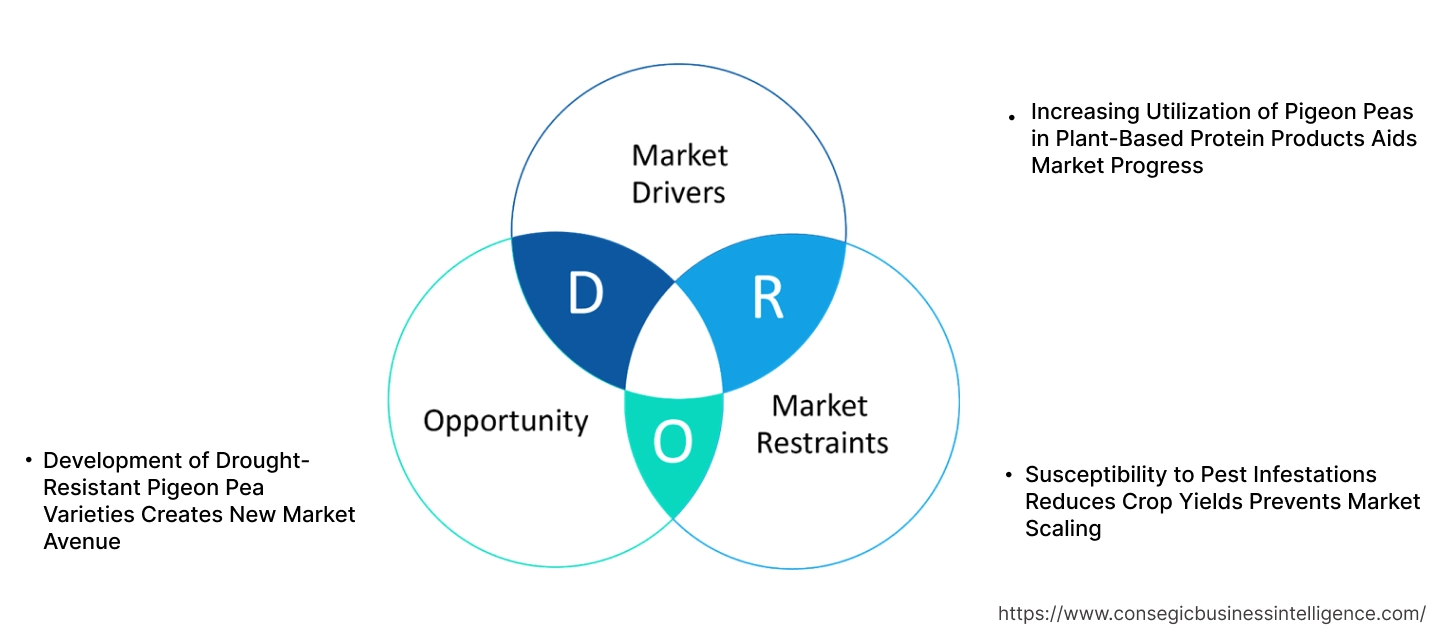
Key Drivers:
Increasing Utilization of Pigeon Peas in Plant-Based Protein Products Aids Market Progress
Pigeon peas are a rich source of plant-based protein, making them a preferred ingredient in protein-rich vegan and vegetarian products. The rising need for alternative protein sources has led to the inclusion of pigeon peas in protein powders, meat substitutes, and health bars. For instance, several manufacturers are using pigeon pea protein isolates to enhance the nutritional profile of their products.
Thus, the increasing application of pigeon peas in plant-based protein products is fostering the pigeon pea market demand.
Key Restraints:
Susceptibility to Pest Infestations Reduces Crop Yields Prevents Market Scaling
Pigeon pea crops are highly vulnerable to pest infestations, particularly pod borers, which significantly reduce yields. Pest outbreaks result in increased costs for pest control measures and reduced profitability for farmers. For example, many small-scale farmers face economic losses due to the high costs associated with chemical pesticides and the lack of effective pest-resistant pigeon pea varieties.
Therefore, the susceptibility of pigeon peas to pests acts as a hindrance to the pigeon pea market growth.
Future Opportunities :
Development of Drought-Resistant Pigeon Pea Varieties Creates New Market Avenue
The introduction of drought-resistant pigeon pea varieties is expected to expand cultivation in arid and semi-arid regions. These advanced varieties will ensure better yields in water-scarce areas, addressing food security concerns. For example, agricultural research centers are working on breeding pigeon peas with enhanced drought tolerance to meet the needs of regions with limited irrigation facilities.
As the adoption of drought-resistant varieties increases, it will create significant pigeon pea market opportunities for growth in the coming years, thus leading to pigeon pea market trend.
Pigeon Pea Market Segmental Analysis :
By Price Range:
Based on price range, the market is segmented into premium, mid, and low price segments.
The premium segment accounted for the largest revenue in pigeon pea market share in 2024 and is anticipated to register the fastest CAGR during the forecast period.
- The premium segment includes high-quality pigeon peas with superior taste, texture, and nutritional value. These products are highly preferred by health-conscious consumers and in specialized markets such as organic food stores.
- This segment is driven by rising consumer demand for high-quality pulses, the increasing awareness of the health benefits of pigeon peas, and the rising popularity of plant-based diets.
- Premium pigeon peas are utilized in gourmet food products, dietary supplements, and premium canned goods, offering enhanced flavor and nutrition.
- Thus, the premium price segment is witnessing growth due to the rising need of organic and health-focused food options.
- The mid and low-price segments are also seeing growth but at a slower pace compared to the premium segment. However, as consumers continue to seek affordable protein sources, the low-price segment is expected to experience steady demand.
- Therefore, according to pigeon pea market analysis, the premium price range is the largest revenue share in the pigeon pea market and is expected to maintain strong pigeon pea market growth driven by the increasing preference for high-quality and health-conscious food products and is expected to register the fastest CAGR due to a shift in consumer preferences toward higher quality and nutrient-rich products.
By Form:
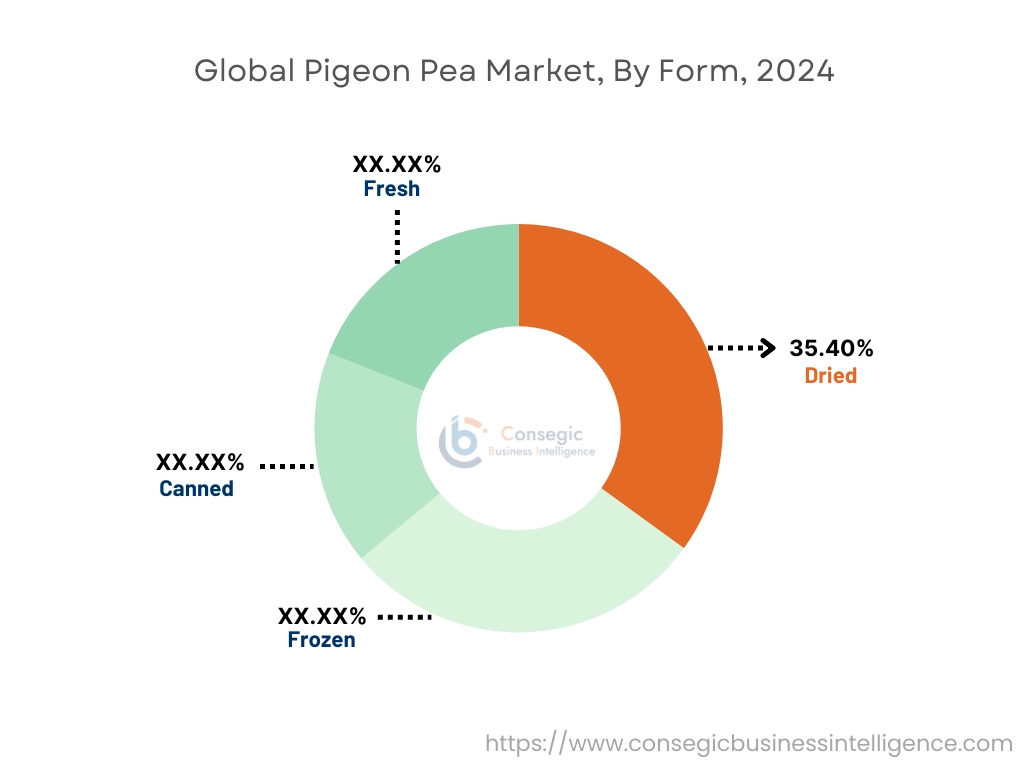
Based on form, the market is segmented into frozen, dried, canned, and fresh forms.
The dried form accounted for the largest revenue in pigeon pea market share by 35.40% in 2024 and is anticipated to register the fastest CAGR during the forecast period.
- Dried pigeon peas are widely used in households and industrial applications due to their long shelf life, ease of storage, and versatile culinary uses.
- This form is especially favored in countries where the consumption of pulses in dried form is a staple.
- Dried pigeon peas can be used in soups, stews, curries, and other traditional dishes, making them popular in both household and restaurant settings.
- The growing trend of home cooking and the increasing popularity of plant-based diets contribute to the trend of the dried segment.
- The canned and frozen segments are also important, particularly in Western markets where convenience foods are growing in demand, but the dried form remains the dominant choice.
- Thus, according to pigeon pea market analysis, the dried form holds the largest revenue share in the pigeon pea market and continues to grow due to its long shelf life, versatility, and increasing popularity in global culinary applications and is projected to see the fastest CAGR, supported by the growing preference for dried pulses in households and food industries worldwide.
By Distribution Channel:
Based on distribution channel, the market is segmented into hypermarket/supermarket, direct selling, and online channels.
The hypermarket/supermarket segment accounted for the largest revenue share in 2024 and is anticipated to register the fastest CAGR during the forecast period.
- Hypermarkets and supermarkets provide wide product assortments, including organic and value-added pigeon pea products.
- These channels benefit from extensive reach, convenience, and the ability to target a broad range of consumers, from regular shoppers to premium segment buyers.
- The growing trend of large retail chains offering specialty food products has contributed to the trend of this segment, making it easier for consumers to access quality pigeon peas.
- The increase in the number of hypermarkets and supermarkets, especially in emerging markets, is also contributing to the growth of this segment.
- The online channel is also experiencing significant trend as e-commerce continues to grow globally. However, hypermarkets and supermarkets remain the leading sales channel for pigeon peas.
- Therefore, according to market analysis, the hypermarket/supermarket segment holds the largest revenue share in the pigeon pea market and is expected to continue its dominance with expanding retail footprints and growing consumer preference for convenient shopping experiences and is anticipated to register the fastest CAGR, driven by the expansion of retail networks and increasing consumer access to pigeon pea products.
By End-Use:
Based on end-use, the market is segmented into pharmaceuticals, food and beverage, dietary supplements, and cosmetics.
The food and beverage segment accounted for the largest revenue share in 2024 and is anticipated to register the fastest CAGR during the forecast period.
- The food and beverage segment includes the use of pigeon peas in various processed foods, including canned products, soups, and ready-to-eat meals.
- Pigeon peas are also used in traditional cuisines worldwide, particularly in regions with high consumption of pulses.
- This segment benefits from growing consumer awareness of the nutritional value of legumes, including high protein and fiber content.
- The increasing popularity of plant-based diets and the rising requirement for healthy, sustainable food options are contributing to the trend of the food and beverage segment.
- The dietary supplements and pharmaceuticals segments are also seeing growth, driven by the health benefits associated with pigeon peas, such as their high antioxidant content and role in managing diabetes.
- Therefore, according to market analysis, the food and beverage segment is the largest revenue share in the pigeon pea market, driven by the increasing requiremet for healthy and plant-based food products and is expected to register the fastest CAGR, reflecting the growing preference for nutritious, plant-based ingredients in modern diets.
Regional Analysis:
The regional segment includes North America, Europe, Asia Pacific, Middle East and Africa, and Latin America.
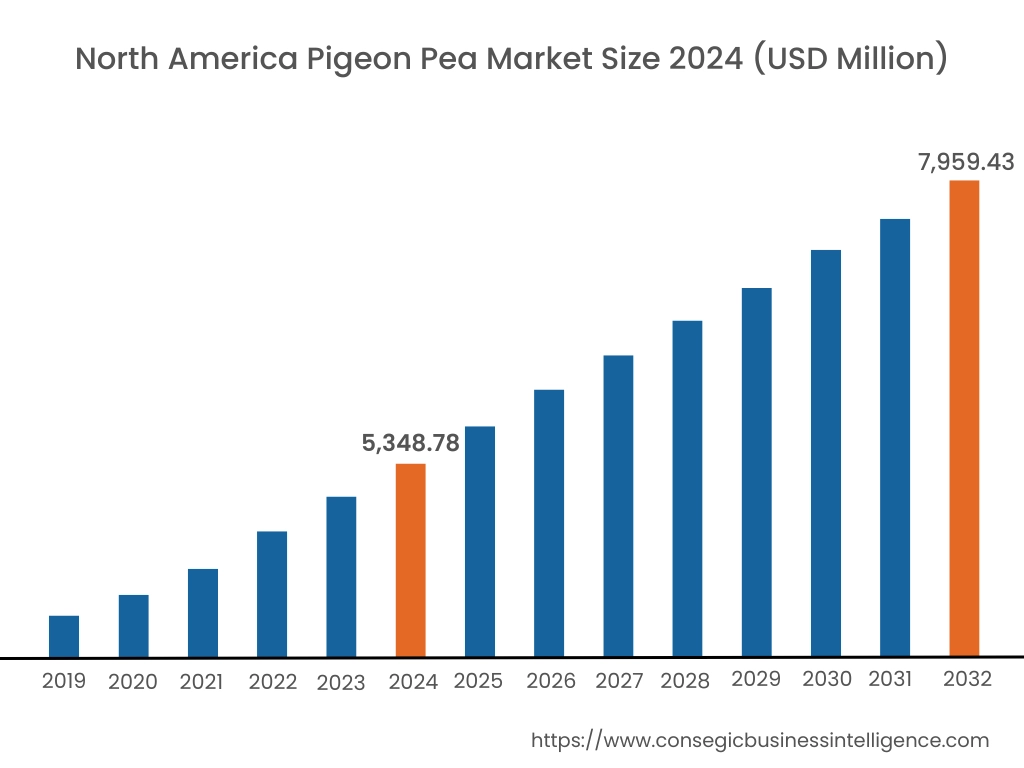
In 2024, North America was valued at USD 5,348.78 Million and is expected to reach USD 7,959.43 Million in 2032. In North America, the U.S. accounted for the highest share of 73.20% during the base year of 2024.
In North America, the pigeon pea market remains relatively niche. The United States and Canada focus on increasing imports to meet the growing market from vegetarian and health-conscious consumers. The market faces competition from other legumes like lentils and beans. However, increasing awareness of plant-based diets supports market development.

In Asia Pacific, the market is experiencing the fastest growth with a CAGR of 5.8% over the forecast period. Asia-Pacific is the largest market for pigeon peas, particularly in India. India is the world's largest producer and consumer of pigeon peas. The pigeon pea market demand is driven by traditional consumption patterns and growing use in plant-based protein products. The region’s focus on improving agricultural practices boosts production.
In Europe, the pigeon pea market is smaller but gradually expanding due to the rising popularity of plant-based foods. The requirement is concentrated in countries like the United Kingdom and Germany, where vegetarian diets are increasingly common. Despite limited production, imports of pigeon peas from Asia and Africa help meet the growing consumer demand.
The Middle East and Africa region shows moderate pigeon pea market expansion, particularly in countries like Nigeria and Ethiopia. These countries use pigeon peas in staple dishes. The region benefits from the crop's adaptability to arid climates, where it is grown as a drought-resistant option. However, challenges in production and infrastructure affect overall pigeon pea market trend.
In Latin America, particularly in Brazil and Guatemala, pigeon peas are cultivated for both domestic consumption and export. The growing interest in healthy eating patterns and protein-rich diets supports the demand for pigeon peas. Additionally, the crop’s suitability for diverse growing conditions helps sustain its market presence in the region.
Top Key Players & Market Share Insights:
The global pigeon pea market is highly competitive with major players providing products and services to the national and international markets. Key players are adopting several strategies in research and development (R&D), product innovation, and end-user launches to hold a strong position in the Global Pigeon Pea Market. Key players in the Pigeon Pea industry include-
- Olam International (Singapore)
- Cargill, Incorporated (United States)
- Simla Grain & Oilseeds (India)
- Kaveri Seed Company (India)
- Trident Limited (India)
- Tata Group (Tata Chemicals) (India)
- Agro-Products and Agencies Pvt. Ltd. (India)
- ADM (Archer Daniels Midland Company) (United States)
- The Soufflet Group (France)
- Tropical Foods (United States)
Recent Industry Developments :
Product Launches:
- In February 2024, the International Crops Research Institute for the Semi-Arid Tropics (ICRISAT), based in Hyderabad, announced the world's first pigeon pea speed breeding protocol. This innovative approach reduces the breeding cycle from the traditional 13 years to just 2 to 4 years by optimizing factors like photoperiod, temperature, and humidity. The protocol aims to accelerate the development of climate-resilient, nutritionally superior, and higher-yielding pigeon pea varieties, bolstering food security in Asia and Africa.
Partnerships & Collaborations:
- In September 2024, Nuziveedu Seeds and Indian Agricultural Research Institute (IARI) announced their collaboration. This collaboration aims to develop and commercialize three high-yielding pigeon pea varieties, targeting improved productivity for farmers.
Pigeon Pea Market Report Insights:
| Report Attributes | Report Details |
| Study Timeline | 2019-2032 |
| Market Size in 2032 | USD 24,558.56 Million |
| CAGR (2025-2032) | 5.4% |
| By Price Range |
|
| By Form |
|
| By Distribution Channel |
|
| By End-Use |
|
| By Region |
|
| Key Players |
|
| North America | U.S. Canada Mexico |
| Europe | U.K. Germany France Spain Italy Russia Benelux Rest of Europe |
| APAC | China South Korea Japan India Australia ASEAN Rest of Asia-Pacific |
| Middle East and Africa | GCC Turkey South Africa Rest of MEA |
| LATAM | Brazil Argentina Chile Rest of LATAM |
| Report Coverage |
|
Key Questions Answered in the Report
How big is the Pigeon Pea Market? −
In 2024, the Pigeon Pea Market was USD 16,124.95 million.
What will be the potential market valuation for the Pigeon Pea Market by 2032? +
In 2032, the market size of Pigeon Pea Market is expected to reach USD 24,558.56 million.
What are the segments covered in the Pigeon Pea Market report? +
The price range, form, distribution channel, and end-user are the segments covered in this report.
Who are the major players in the Pigeon Pea Market? +
Olam International (Singapore), Cargill, Incorporated (United States), Tata Group (Tata Chemicals) (India), Agro-Products and Agencies Pvt. Ltd. (India), ADM (Archer Daniels Midland Company) (United States), The Soufflet Group (France), Tropical Foods (United States), Simla Grain & Oilseeds (India), Kaveri Seed Company (India), Trident Limited (India) are the major players in the Pigeon Pea market.
Overview
Reputation & Certifications


Our Services
- Market Intelligence & Forecasting
- Custom Research Solutions
- Market Entry Strategy
- Competitive Intelligence
- Customer Insights
- Industry Innovation Analysis
- Investment Advisory