Jump to Content
Power Over Ethernet Lighting Market - Size, Share, Industry Trends, and Forecasts (2025 - 2032)
Power Over Ethernet Lighting Market Size:
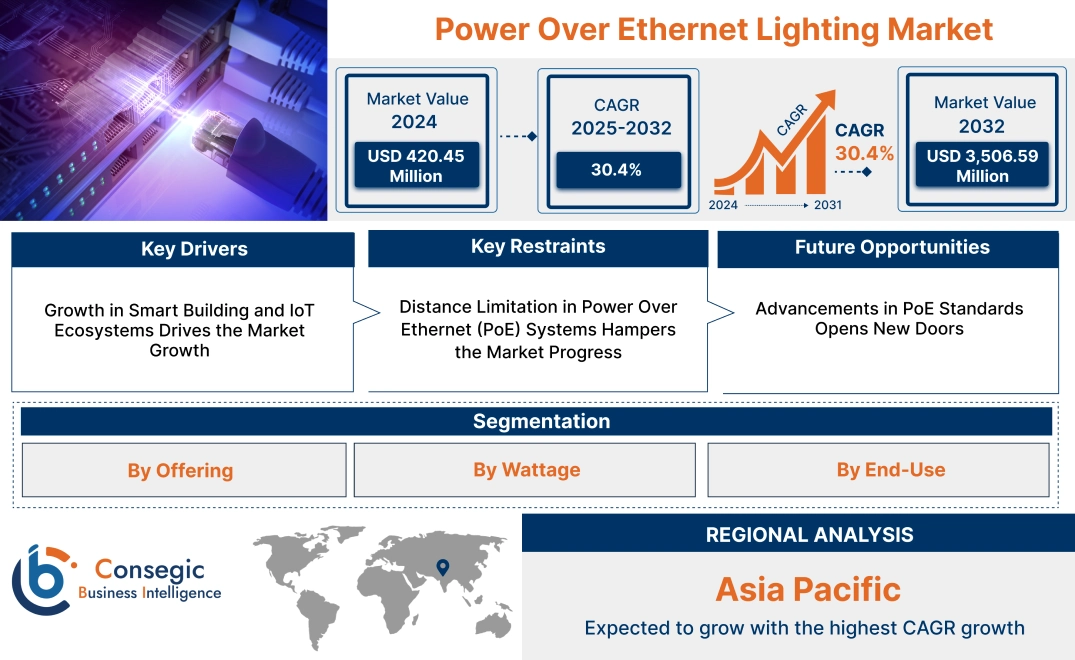
Power Over Ethernet Lighting Market size is estimated to reach over USD 3,506.59 Million by 2032 from a value of USD 420.45 Million in 2024 and is projected to grow by USD 540.61 Million in 2025, growing at a CAGR of 30.4% from 2025 to 2032.
Power Over Ethernet Lighting Market Scope & Overview:
Power over Ethernet (PoE) lighting refers to a system where both power and data are transmitted to lighting fixtures through a single Ethernet cable. This technology simplifies installation, reduces wiring complexity, and enables seamless integration with smart building systems. PoE lighting systems are widely used in commercial buildings, industrial facilities, and residential spaces to enhance operational efficiency and enable advanced control features.
These systems are designed to support energy-efficient LED lighting while providing centralized control for dimming, scheduling, and monitoring. PoE lighting integrates with building management systems to enable real-time data exchange, ensuring optimized lighting performance and energy savings. Additionally, these systems allow scalability and flexibility, making them suitable for retrofitting and new construction projects.
End-users of PoE lighting systems include office spaces, educational institutions, healthcare facilities, and smart homes, where centralized and efficient lighting management is essential. These systems play a critical role in modernizing lighting infrastructure and supporting the development of intelligent building solutions.
Power Over Ethernet Lighting Market Dynamics - (DRO) :
Key Drivers:
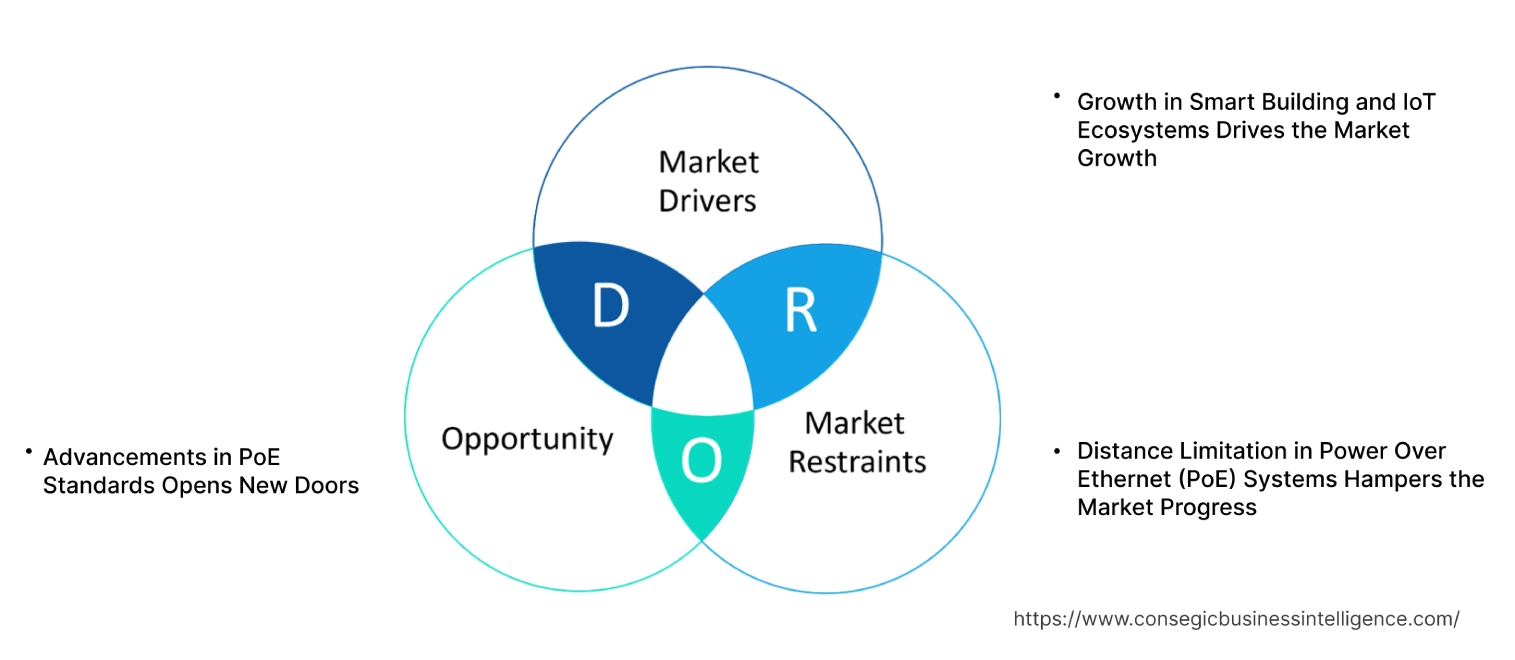
Growth in Smart Building and IoT Ecosystems Drives the Market Growth
The increasing adoption of IoT and smart building systems is a key driver for the market, as these technologies prioritize centralized control and real-time data management. PoE lighting systems seamlessly integrate with IoT-enabled devices, providing advanced functionalities such as automated lighting adjustments, energy usage monitoring, and occupancy-based illumination. These features optimize energy efficiency, enhance user comfort, and improve building management processes. Additionally, the ability to collect and analyze real-time data allows building operators to make informed decisions, reducing operational costs and environmental impact. The trend toward smart infrastructure development, particularly in commercial offices, educational institutions, and residential complexes, further accelerates the demand for PoE lighting systems. As buildings increasingly adopt IoT ecosystems, PoE lighting's compatibility and adaptability make it a vital component of modern smart infrastructure, contributing to the power over ethernet lighting market growth.
Key Restraints:
Distance Limitation in Power Over Ethernet (PoE) Systems Hampers the Market Progress
One significant restraint in the adoption of PoE lighting systems is the inherent distance limitation of Ethernet cables. Standard Ethernet cables, such as Cat5e and Cat6, transmit power and data effectively up to a maximum distance of 100 meters (328 feet). Beyond this range, signal degradation occurs, necessitating the use of repeaters, extenders, or additional switches to maintain performance. These added components not only increase the complexity of the installation but also raise costs, particularly in large-scale projects such as campuses, industrial facilities, or multi-building smart infrastructure setups. This limitation deters adoption in scenarios requiring long-distance connectivity, impacting the scalability and flexibility of PoE solutions in expansive environments. Thus, the above mentioned factors are hindering the power over ethernet lighting market demand.
Future Opportunities :
Advancements in PoE Standards Opens New Doors
The evolution of Power over Ethernet (PoE) standards, particularly IEEE 802.3bt, is revolutionizing the capabilities of PoE lighting systems. This standard significantly increases the power delivery over Ethernet cables, enabling up to 90 watts of power compared to the 30 watts provided by earlier standards like IEEE 802.3at. These advancements support the integration of PoE systems in more demanding environments, including industrial warehouses, healthcare facilities, and large commercial buildings. Higher power capacity allows for the operation of energy-intensive devices, such as high-lumen lighting fixtures, integrated IoT sensors, and advanced control systems. Additionally, the enhanced power delivery eliminates the need for multiple cabling systems, simplifying installations and reducing overall costs. These innovations are expanding the application scope of PoE lighting systems, aligning with trends in smart infrastructure and large-scale industrial automation, creating significant power over ethernet lighting market opportunities.
Power Over Ethernet Lighting Market Segmental Analysis :
By Offering:
Based on offering, the market is segmented into hardware, software, and services.
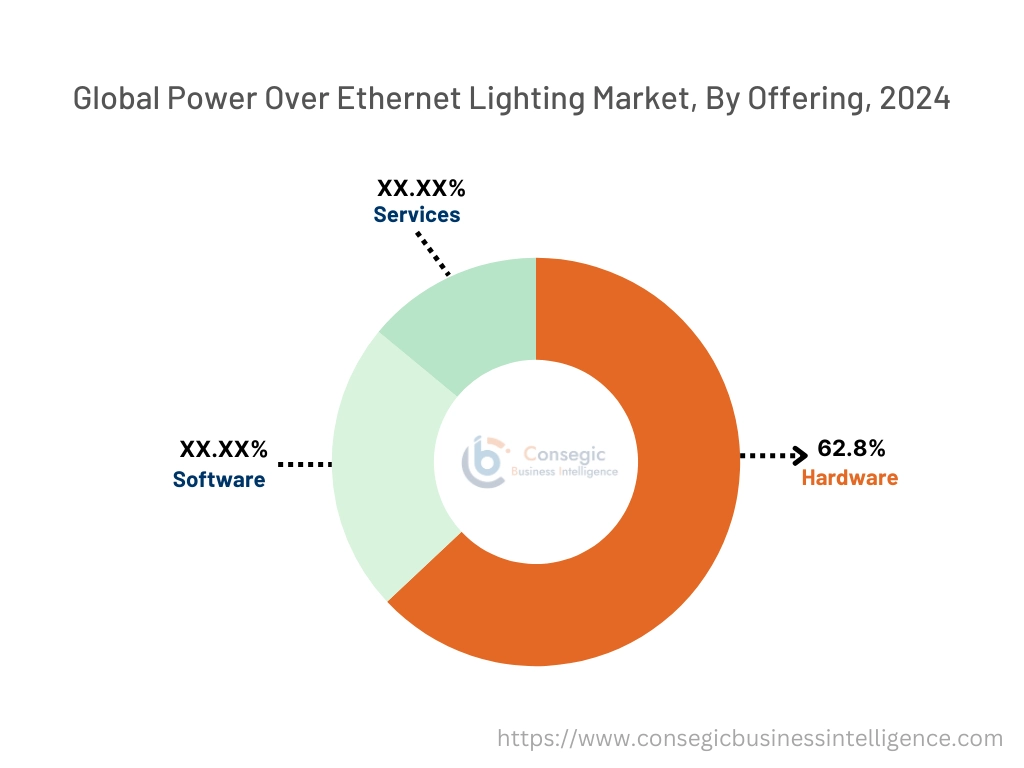
The hardware segment held the largest share of 62.8% of the total Power Over Ethernet Lighting market share in 2023.
- Hardware components, including PoE switches, cables, and LED luminaires, form the foundation of PoE lighting systems.
- Increased adoption of smart building solutions drives the need for reliable hardware to enable seamless connectivity and power delivery.
- The dominance of this segment is attributed to its vital role in establishing energy-efficient and scalable lighting infrastructures.
- As per the power over ethernet lighting market analysis, advancements in hardware technology, such as integrated sensors and enhanced network capabilities, further fuel the segment's expansion.
The services segment is projected to grow at the fastest CAGR during the forecast period.
- Installation and maintenance services ensure efficient deployment and long-term functionality of PoE lighting systems.
- Consulting services assist businesses in designing customized solutions to optimize energy usage and network integration.
- The segment's rapid growth is driven by increasing adoption of professional support services in commercial and industrial sectors.
- As per power over ethernet lighting market trends, growing complexity in smart lighting systems creates a strong demand for specialized expertise, further propelling the services segment.
By Wattage:
Based on wattage, the market is categorized into up to 25 watt and above 25 watt.
The above 25 watt segment held the largest share of the total Power Over Ethernet Lighting market share in 2023.
- PoE lighting systems with higher wattage cater to industrial and commercial applications requiring powerful and extensive illumination.
- Growing adoption of high-power PoE standards, such as PoE++, supports this segment’s dominance in high-energy-demand environments.
- The ability to power advanced fixtures, including multi-functional LED luminaires, strengthens the adoption of higher wattage solutions.
- Increasing investments in smart city infrastructure drive the preference for robust and efficient PoE lighting systems, fueling the power over ethernet lighting market expansion.
The up to 25 watt segment is expected to grow at the fastest CAGR during the forecast period.
- These systems are widely used in residential and small-scale commercial applications due to their energy efficiency and cost-effectiveness.
- The segment's rapid growth is supported by increasing adoption of sustainable lighting solutions in modern residential buildings.
- Lightweight and compact designs make low-wattage systems ideal for seamless integration into smart home environments.
- As per the market analysis, the focus on reducing carbon footprints and energy consumption further supports the segment’s proliferation, which further boosts the power over ethernet lighting market growth.
By End-Use:
Based on end-use, the market is segmented into commercial, residential, industrial, and others.
The commercial segment accounted for the largest revenue share in 2023.
- Offices, retail spaces, and educational institutions are prominent adopters of PoE lighting systems for their cost-saving and energy-efficient benefits.
- Increased deployment of PoE lighting in smart office buildings enhances employee productivity and operational efficiency.
- The dominance of this segment is driven by advancements in IoT-enabled lighting and network management in commercial facilities.
- As per the power over ethernet lighting market analysis, enhanced scalability and centralized control features cater to the diverse needs of commercial applications, boosting adoption.
The residential segment is projected to grow at the fastest CAGR during the forecast period.
- Rising adoption of smart home technologies drives the integration of PoE lighting for connected and customizable solutions.
- Compact and aesthetic designs of PoE luminaires appeal to residential consumers seeking modern lighting setups.
- Increasing awareness about energy conservation in households supports the adoption of low-power PoE lighting systems.
- Advancements in automation and remote control capabilities strengthen the demand for PoE lighting in residential applications, driving the power over ethernet lighting market expansion.
Regional Analysis:
The regions covered are North America, Europe, Asia Pacific, the Middle East and Africa, and Latin America.
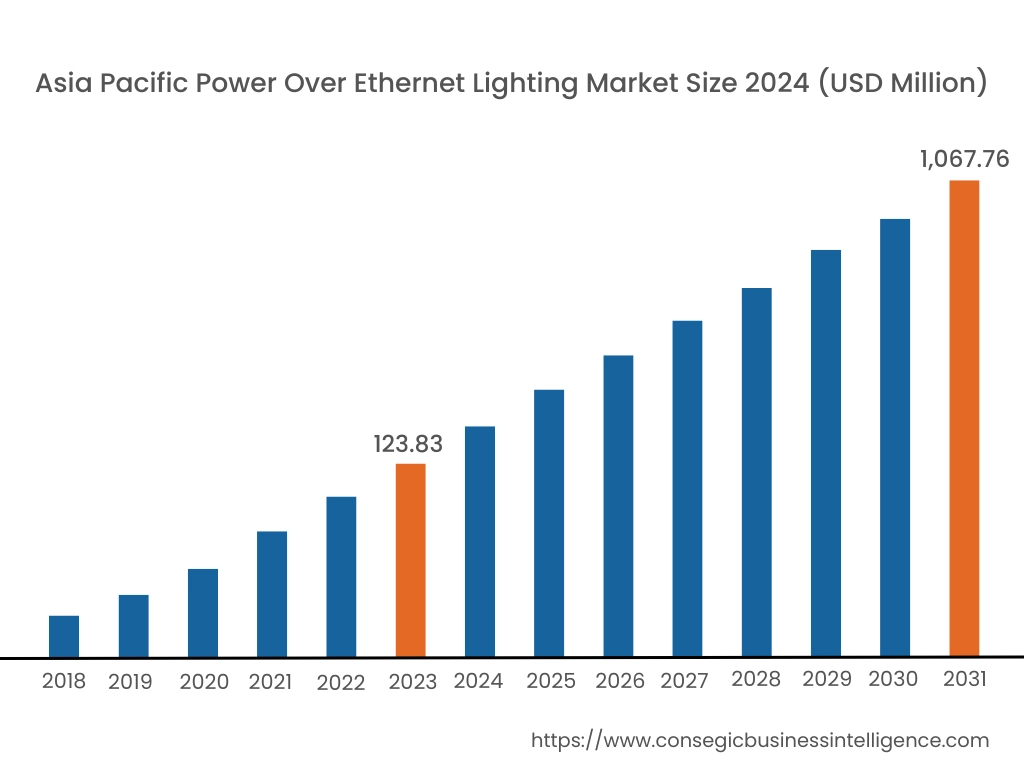
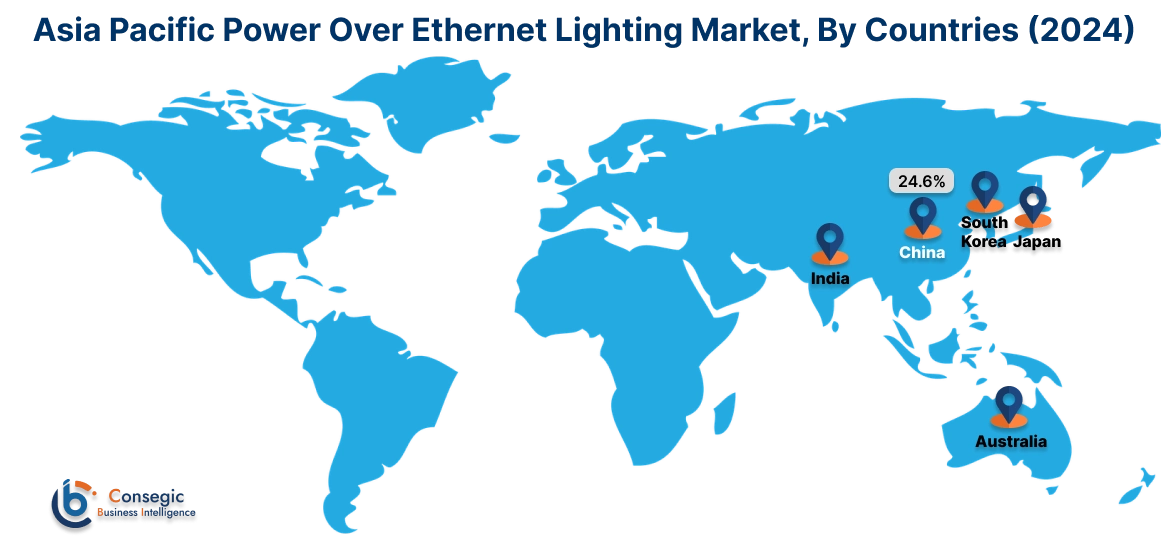
Asia Pacific region was valued at USD 123.83 Million in 2024. Moreover, it is projected to grow by USD 159.66 Million in 2025 and reach over USD 1,067.76 Million by 2032. Out of this, China accounted for the maximum revenue share of 24.6%. The Asia-Pacific region is experiencing rapid development in the PoE lighting market, driven by industrialization and urbanization in countries such as China, Japan, and India. The expansion of the construction industry and the rising need for energy-efficient solutions have intensified the need for advanced lighting systems. Government initiatives promoting smart infrastructure further drives the power over ethernet lighting market demand.
North America is estimated to reach over USD 1,136.49 Million by 2032 from a value of USD 139.47 Million in 2024 and is projected to grow by USD 178.98 Million in 2025. This region is at the forefront of PoE lighting adoption, driven by the integration of smart building technologies and a focus on energy efficiency. The United States, in particular, has seen substantial implementation of PoE systems in commercial spaces, enhancing centralized control and reducing installation costs. A notable trend is the collaboration between lighting manufacturers and IT companies to develop integrated solutions that streamline building management systems. Analysis indicates that the North American market is poised for continued growth, supported by favorable government policies promoting sustainable building practices, facilitating the power over ethernet lighting market opportunities.
Europe represents a substantial portion of the global PoE lighting market, with countries like Germany, France, and the United Kingdom leading in adoption and innovation. The region's emphasis on energy efficiency and sustainability has propelled the utilization of eco-friendly lighting solutions. Analysis indicates a growing trend towards the deployment of PoE lighting systems in smart city projects, offering flexibility across various urban applications.
The Middle East & Africa region shows a growing interest in PoE lighting solutions, particularly in the construction and industrial sectors. Countries like Saudi Arabia and South Africa are investing in advanced lighting technologies to enhance energy management and comply with international standards. Analysis suggests an increasing trend towards adopting PoE lighting systems in large-scale industrial operations, enhancing operational efficiency.
Latin America is an emerging market for PoE lighting, with Brazil and Mexico being key contributors. The region's growing focus on energy efficiency and industrial modernization has spurred the adoption of advanced lighting solutions. As per power over ethernet lighting market trends, government policies aimed at enhancing infrastructure influence market trends.
Top Key Players and Market Share Insights:
The Power Over Ethernet Lighting market is highly competitive with major players providing products and services to the national and international markets. Key players are adopting several strategies in research and development (R&D), product innovation, and end-user launches to hold a strong position in the global Power Over Ethernet Lighting market. Key players in the Power Over Ethernet Lighting industry include -
- Signify Holding (Philips Lighting) (Netherlands)
- Hubbell Inc. (USA)
- Silvertel (UK)
- NETGEAR (USA)
- Ideal Industries (Cree) (USA)
- Cisco Systems (USA)
- E. Williams (USA)
- Molex (Koch Industries) (USA)
- Ubiquiti Networks Inc. (USA)
- Siemon (USA)
Recent Industry Developments :
- In January 2024, Ikan unveiled the LBX8-POE and LBX10-POE lights, revolutionizing professional lighting with Power over Ethernet (PoE) technology. These lights simplify installation using a single Ethernet cable for power and connectivity, eliminating extra wiring or permits. Supporting the IEEE 802.3bt Type 4 PoE++ standard, they deliver efficient power while maintaining a clutter-free workspace. With 97 CRI LED chips, a soft panel, and a 110-degree beam angle, they ensure consistent, high-quality lighting. Their 3200K–5600K temperature range adapts to studios, classrooms, and other environments, offering versatility and convenience.
Power Over Ethernet Lighting Market Report Insights :
| Report Attributes | Report Details |
| Study Timeline | 2019-2032 |
| Market Size in 2032 | USD 3,506.59 Million |
| CAGR (2025-2032) | 30.4% |
| By Offering |
|
| By Wattage |
|
| By End-Use |
|
| By Region |
|
| Key Players |
|
| North America | U.S. Canada Mexico |
| Europe | U.K. Germany France Spain Italy Russia Benelux Rest of Europe |
| APAC | China South Korea Japan India Australia ASEAN Rest of Asia-Pacific |
| Middle East and Africa | GCC Turkey South Africa Rest of MEA |
| LATAM | Brazil Argentina Chile Rest of LATAM |
| Report Coverage |
|
Key Questions Answered in the Report
What is the size of the Power Over Ethernet Lighting Market? −
Power Over Ethernet Lighting Market size is estimated to reach over USD 3,506.59 Million by 2032 from a value of USD 420.45 Million in 2024 and is projected to grow by USD 540.61 Million in 2025, growing at a CAGR of 30.4% from 2025 to 2032.
What are the segments and subsegments covered in the Power Over Ethernet Lighting Market report? +
The market is segmented into offering (Hardware, Software, Services), wattage (Up to 25 Watt, Above 25 Watt), and end-use (Commercial, Residential, Industrial, Others).
Which segment is expected to grow the fastest in the Power Over Ethernet Lighting Market? +
The services segment is projected to grow at the fastest CAGR during the forecast period, driven by increasing adoption of professional support services in commercial and industrial sectors.
Who are the key players in the Power Over Ethernet Lighting Market? +
Key players in the Power Over Ethernet Lighting Market include Signify Holding (Philips Lighting) (Netherlands), Hubbell Inc. (USA), Cisco Systems (USA), H.E. Williams (USA), Molex (Koch Industries) (USA), Ubiquiti Networks Inc. (USA), Siemon (USA), Silvertel (UK), NETGEAR (USA), and Ideal Industries (Cree) (USA).
Overview
Reputation & Certifications


Our Services
- Market Intelligence & Forecasting
- Custom Research Solutions
- Market Entry Strategy
- Competitive Intelligence
- Customer Insights
- Industry Innovation Analysis
- Investment Advisory