Jump to Content
Small Language Model Market - Size, Share, Industry Trends, and Forecasts - (2025 - 2035)
Small Language Model Market Size:
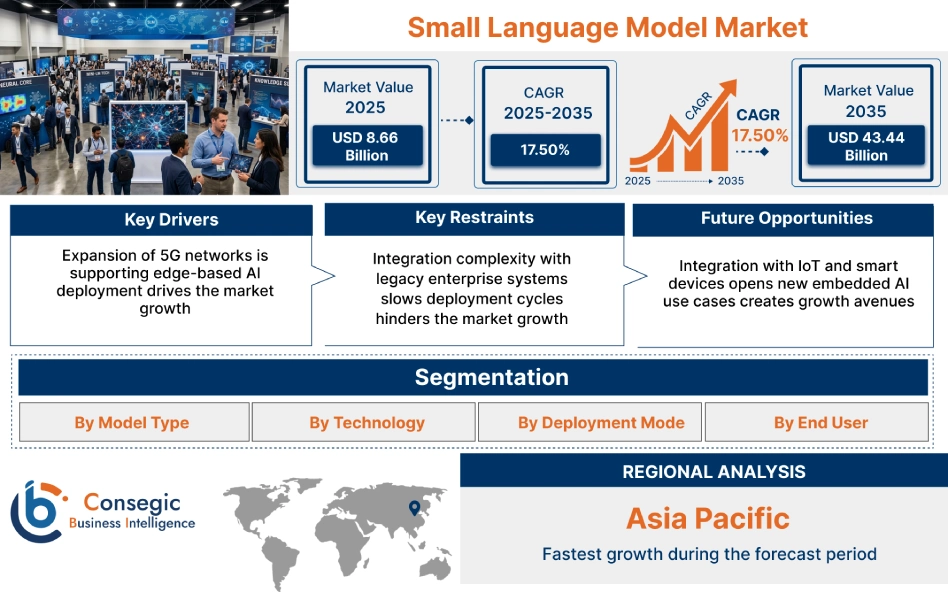
Small Language Model Market size is estimated to reach over USD 43.44 Billion by 2035 from a value of USD 7.37 Billion in 2024 and is projected to grow by USD 8.66 Billion in 2025, growing at a CAGR of 17.50% from 2025 to 2035
Small Language Model Market Scope & Overview:
Small language models refer to compact AI models built to process and generate text with lower computing requirements than large foundation models. The industry covers model design, domain-specific training, optimization for edge and on-premise deployment, API integration, and lifecycle management. The focus is on delivering cost-efficient and task-specific language capabilities with faster response time and better data control. End users include enterprises, software vendors, and device manufacturers across BFSI, healthcare, retail, and manufacturing.
The small language model market is growing due to enterprise focus on reducing infrastructure cost and improving data privacy. Companies are adopting domain-tuned models that operate within private environments. Expansion of edge computing and on-device AI is increasing demand for lightweight architectures. Vendors are introducing distilled and fine-tuned models to improve performance at lower compute intensity. Adoption across the US, Europe, and Asia Pacific is supporting deployment in customer service, document automation, and internal knowledge systems.
Market Size & Forecast
- 2024 Market Size : USD 7.37 Billion
- 2025 Market Size : UUSD 8.66 Billion
- 2035 Evaluate Market Size : USD 43.44 Billion
- CAGR (2025-2035) : 17.50%
- Largest growing region : North America
- Fastest growing region : Asia Pacific
How is the Small Language Model Market Affected by AI?
AI advancements are improving small language model development through model compression, knowledge distillation, and parameter-efficient fine-tuning techniques. These methods reduce model size while maintaining task accuracy. This lowers training cost and improves deployment efficiency across cloud and edge environments. Optimized architectures also reduce latency and improve response time in enterprise applications.
Research in AI is also helping to achieve domain adaptation and retrieval-based generation in smaller models. The algorithms are fine-tuning the models using structured enterprise data and controlled datasets. This is helping to achieve better performance control with low computational overhead, as compared to large models.
Small Language Model Market Dynamics - (DRO):
Key Drivers:
Expansion of 5G networks is supporting edge-based AI deployment drives the market growth
Telecom operators are expanding their 5G infrastructure in both developed and emerging markets. Higher bandwidth and latency are helping to process real-time data at the edge. Enterprises are deploying compact language models on edge servers and connected devices to reduce cloud dependency. This improves response speed and supports localized data processing across distributed environments.
- For instance, in March 2025, 5G Americas stated that global 5G connections reached 2.25 billion in 2024, averaging nearly 1.5 wireless connections per person. With increased penetration rates of 5G networks, there is an improvement in the connectivity of the edge, and this will support the increased adoption of small language models in real-time and distributed enterprise applications.
Therefore, expansion of 5G networks will increase the adoption of small language models in AI deployment at the edge.
Key Restraints:
Integration complexity with legacy enterprise systems slows deployment cycles hinders the market growth
Many enterprises use legacy IT architectures that are not API-compatible. There is a requirement to customize and test the small language models with the existing databases, workflow applications, and security systems, which takes time and makes the implementation more costly due to internal IT constraints.
Thus, complexity of integrating small language models with legacy enterprise systems is restricting the adoption of small language models in enterprises.
Future Opportunities:
Integration with IoT and smart devices opens new embedded AI use cases creates growth avenues
The rise of connected devices in manufacturing, healthcare, automotive, and consumer electronics is leading to increased volumes of real-time data flows. The small language model is also favorable for integration into connected devices because of lower computational requirements compared to other AI systems. This is creating new avenues for AI integration into connected devices. Manufacturers of connected devices are also considering bundling AI as part of product offerings.
- According to GSMA, the number of IoT connections worldwide is expected to rise from 15.1 billion in 2021 to 23.3 billion in 2025, showing a growth rate of 54 percent in just five years. This increase in the number of connected devices is also expected to fuel the demand for small language models, as these models can be more easily deployed in IoT environments.
Thus, the integration of IoT and smart devices is providing new avenues for the growth of AI in the small language model market.
Small Language Model Market Segmental Analysis:
By Model Type:
On the basis of model type, the small language model market is segmented into pre-trained, fine-tuned, and open source.
Trends in the Model type:
- Growing enterprise demand for domain-specific accuracy is increasing adoption of fine-tuned models.
- Rising developer ecosystem participation is strengthening open-source experimentation.
The pre-trained was responsible for the highest revenue share in 2024.
- Pre-trained models offer faster deployment across standard enterprise tasks.
- Moreover, lower customization requirements reduce initial implementation timelines.
- In addition, vendors provide API-ready frameworks that simplify integration.
- Further, stable performance benchmarks support adoption among mid-sized enterprises.
- Therefore, faster deployment cycles are supporting dominance of the pre-trained segment.
It is anticipated that the fine-tuned will exhibit the highest compound annual growth rate (CAGR) during the forecast period.
- Enterprises require industry-specific outputs aligned with internal datasets.
- Furthermore, regulatory environments demand controlled and contextual responses.
- In addition, fine-tuning improves accuracy in sector-focused applications.
- Also, higher willingness to invest in customization is increasing segment revenue.
- Therefore, rising demand for domain-adapted AI models is driving growth of the fine-tuned segment.
By Technology:
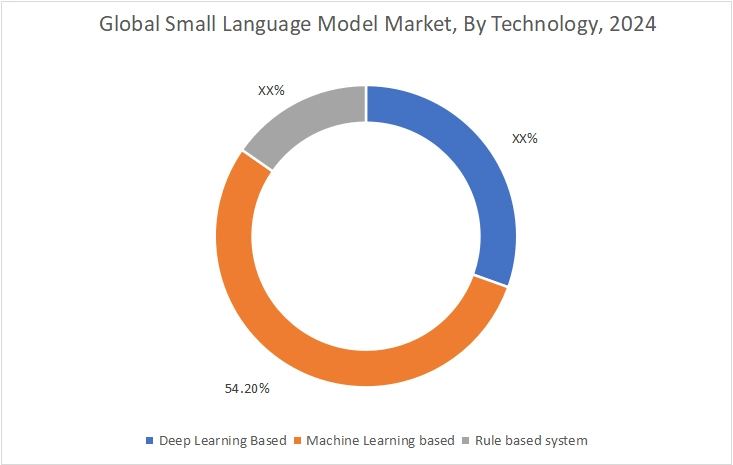
On the basis of technology, the small language model market is segmented into deep learning based, machine learning based, and rule-based systems.
Trends in the Technology:
- Rising enterprise focus on cost-efficient AI models is increasing preference for structured learning systems.
- Ongoing research in neural architecture optimization is improving performance of compact deep learning
The machine learning was responsible for the highest revenue share of 54.2% in 2024.
- Machine learning models operate efficiently on structured enterprise datasets.
- Moreover, lower computational requirements reduce infrastructure cost.
- In addition, higher explainability aligns with internal governance policies.
- Furthermore, integration with legacy analytics systems remains comparatively simpler.
- Therefore, operational efficiency and transparency are supporting dominance of the machine learning based segment.
It is anticipated that the deep learning will exhibit the highest compound annual growth rate (CAGR) during the forecast period.
- Deep learning architectures enhance contextual language understanding.
- Furthermore, model compression techniques are reducing compute intensity.
- In addition, transformer-based frameworks improve performance across complex tasks.
- Further, enterprise demand for advanced automation is increasing adoption.
- Therefore, performance improvements in optimized neural networks are driving growth of the deep learning-based segment.
By Deployment Mode:
On the basis of deployment mode, the small language model market is segmented into cloud, on-premise, and hybrid.
Trends in the Deployment Mode:
- Increasing data privacy regulations are influencing infrastructure decisions.
- Enterprises are balancing scalability and control through hybrid environments.
The cloud was responsible for the highest revenue share in 2024.
- Cloud deployment enables scalable processing capacity.
- Moreover, subscription-based pricing reduces upfront investment.
- In addition, integration with SaaS ecosystems simplifies rollout.
- Furthermore, enterprises prefer centralized management for distributed operations.
- Therefore, operational flexibility is supporting dominance of the cloud segment.
It is anticipated that the on-premise will exhibit the highest compound annual growth rate (CAGR) during the forecast period.
- Regulated industries require strict data governance.
- Furthermore, internal hosting reduces exposure to external infrastructure risks.
- In addition, organizations seek greater control over model training datasets.
- Demand is increasing across BFSI and healthcare institutions.
- Therefore, rising focus on data sovereignty is driving growth of the on-premise segment.
By End User:
On the basis of end user, the small language model market is divided into IT and telecommunications, retail and e-commerce, healthcare, BFSI, legal, and others.
Trends in the End User:
- Growing enterprise automation initiatives are increasing cross-industry AI spending.
- Rising demand for workflow optimization is expanding use case adoption.
IT and telecommunications accounted for the largest revenue share in the year 2024.
- Technology firms integrate small language models into software platforms.
- Moreover, telecom providers deploy AI at network edge environments.
- In addition, internal knowledge automation improves operational efficiency.
- Further, continuous product innovation supports recurring deployment.
- Therefore, higher technology readiness is supporting dominance of the IT and telecommunications segment.
Healthcare is anticipated to register the fastest CAGR during the forecast period.
- Healthcare institutions require domain-focused language processing.
- Furthermore, documentation automation reduces administrative workload.
- In addition, regulatory compliance encourages controlled AI environments.
- Moreover, digital health expansion is increasing structured data usage.
- Therefore, rising healthcare digitization is driving growth of the healthcare segment.
Regional Analysis:
North America, Europe, Asia Pacific, the Middle East and Africa, and Latin America are the regions of coverage.
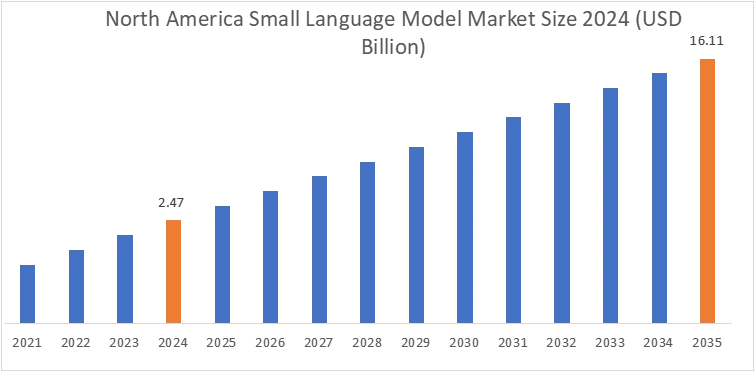
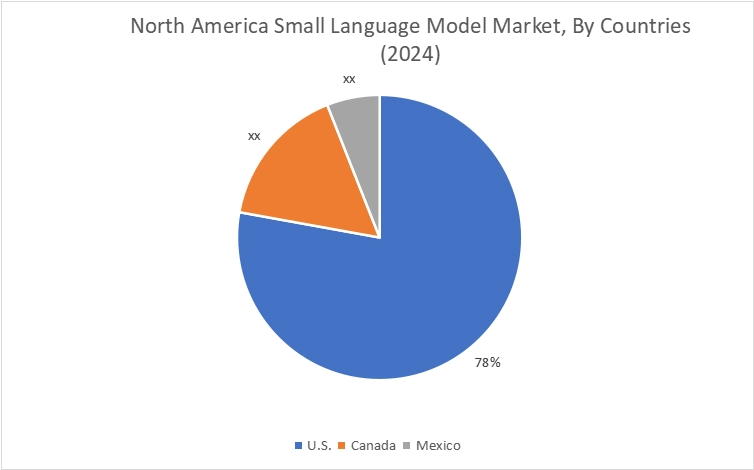
In 2024, North America accounted for the highest market share at 33.5% and was valued at USD 2.47 Billion, and is expected to reach USD 16.11 Billion by 2035. In North America, the U.S. accounted for the highest market share of 78% during the base year of 2024. Market growth in the region is supported by strong enterprise AI spending and early adoption of private AI infrastructure. Large technology firms and cloud service providers are investing in compact model development to reduce inference cost. In addition, rising demand for domain-specific automation across BFSI and healthcare is sustaining deployment across the US market.
- For example, in February 2026, Google, Microsoft, Meta, and Amazon announced to spend nearly USD 650–700 billion in 2026, largely toward AI data centers and advanced chips. This expansion of AI infrastructure is expected to improve compute availability and support scaling of small language model deployment across enterprise environments.
Asia Pacific is expected to witness the fastest growth during the forecast period. China is expanding domestic AI capabilities through sovereign AI initiatives and enterprise digitization programs. Japan and South Korea are investing in edge computing infrastructure, which will aid in the deployment of light-weight language models. India is experiencing an increase in SaaS startups and IT services exports, which will aid in the adoption of small language models in the region. Expansion of 5G networks in the region will aid in the adoption of edge computing-based AI.
- In June 2025, South Korea pledged to invest more than 11.5 billion USD, which will be done over a period of five years to develop its AI ecosystem. This includes the procurement of GPUs and expansion of public AI infrastructure and tax incentives for AI data centers. This will aid in the development of the small language model market in this region.
The small language model market in Europe will grow due to the presence of strict data protection laws in Germany, France, and the UK. Enterprises are prioritizing on-premise and hybrid deployment to meet data sovereignty requirements. EU research funding is strengthening regional AI development capabilities.
Latin America small language model market growth is supported by rising enterprise digitization in Brazil and Mexico. Expansion of fintech platforms is increasing demand for cost-efficient AI models. Cloud infrastructure growth is improving access for mid-sized enterprises.
The small language model market in the Middle East and Africa is driven by digital transformation initiatives in the UAE and Saudi Arabia. Investments in smart city and telecom projects are also boosting AI adoption in these regions. The growth of the startup ecosystem in South Africa is also boosting small language model adoption in this region.
Top Key Players & Market Share Insights:
The small language model market is moderately fragmented with global tech companies and AI startups competing in this market space. These companies are investing in techniques that optimize the performance efficiency of small language models. Partnerships between tech companies and cloud and enterprise software companies are also impacting market dynamics. The growth of open-source platforms is also boosting competition in this market space. Key participants in the market for small language model include:
- OpenAI – US
- Google LLC – US
- Microsoft Corporation – US
- Meta Platforms, Inc. – US
- Mistral AI SAS – France
- IBM Corporation – US
- Alibaba Cloud – China
- Stability AI Ltd – UK
- DigitalOcean, LLC – US
- Aleph Alpha GmbH – Germany
Recent Industry Developments:
Product Launches
- In March 2026, Alibaba introduced a new Qwen 3.5 Small series is a family of compact 0.8B, 2B, 4B, and 9B‑parameter models designed for on-device and edge use, offering low‑compute deployment, native multimodal support in the 4B model, and reinforced reasoning in the 9B model under the “more intelligence, less compute”design philosophy.
- In November 2025, Microsoft launched Fara-7B, a 7‑billion‑parameter small agentic language model designed as a computer‑use agent that sees screenshots, reasons step‑by‑step, and performs on-screen actions (click, type, scroll) to complete web and desktop tasks autonomously.
Small Language Model Market Report Insights:
| Report Attributes | Report Details |
|---|---|
| Study Timeline | 2019-2035 |
| Market Size in 2035 (USD Trillion) | USD 43.44 Billion |
| CAGR (2025-2035) | 17.50% |
| By Model Type |
|
| By Technology |
|
| By Deployment Mode |
|
| By End User |
|
| By Region |
|
| Key Players |
|
| Report Coverage |
|
Key Questions Answered in the Report
How big is the small language model market? −
The small language model market sizeis estimated to reach over USD 43.44 Billion by 2035 from a value of USD 7.37 Billion in 2024 and is projected to grow by USD 8.66 Billion in 2025, growing at a CAGR of 17.50% from 2025 to 2035.
Which segmentation details are covered in the small language model report? +
The small language model report includes specific segmentation details for model type, technology, deployment mode, end user, and regions.
Which is the fastest segment anticipated to impact the market growth? +
Deep learning based models are the fastest growing segment, driven by demand for advanced and optimized language performance.
Who are the major players in the small language model market? +
The key participants in the small language model marketare OpenAI (US), Google LLC (US), Microsoft Corporation (US), Meta Platforms, Inc. (US), Mistral AI SAS (France), IBM Corporation (US), Alibaba Cloud (China), Stability AI Ltd (UK), DigitalOcean, LLC (US), Aleph Alpha GmbH (Germany), and others.
What are the key trends in the small language model market? +
Growth in fine-tuned enterprise models, rising edge AI deployment, and focus on cost-efficient private infrastructure are shaping the market.
Overview
Reputation & Certifications


Our Services
- Market Intelligence & Forecasting
- Custom Research Solutions
- Market Entry Strategy
- Competitive Intelligence
- Customer Insights
- Industry Innovation Analysis
- Investment Advisory