Jump to Content
Enterprise Application Market - Size, Share, Industry Trends, and Forecasts (2025-2032)
Enterprise Application Market Scope & Overview:
Enterprise applications are software systems designed to integrate and manage core business processes and data across an entire organization. They are complex, scalable, and often customized to meet the specific needs of large enterprises. Unlike smaller, single-purpose applications, enterprise solutions aim to streamline workflows, improve collaboration, and provide a centralized view of business operations.
The enterprise application market is experiencing significant growth, driven by increasing digitization and the need for businesses to streamline operations. The key trends include the rise of cloud-based solutions, which offer scalability and cost-effectiveness, and the integration of advanced technologies like AI and machine learning to enhance functionality and provide valuable insights.
Further, businesses are seeking applications that improve collaboration, offer unified experiences, and empower employees with self-service access. Moreover, the market encompasses various applications such as ERP, CRM, SCM, and HCM, each catering to specific business needs. Furthermore, benefits including increased efficiency, improved decision-making, and enhanced customer satisfaction are contributing significantly in driving enterprise application market.
Enterprise Application Market Size:
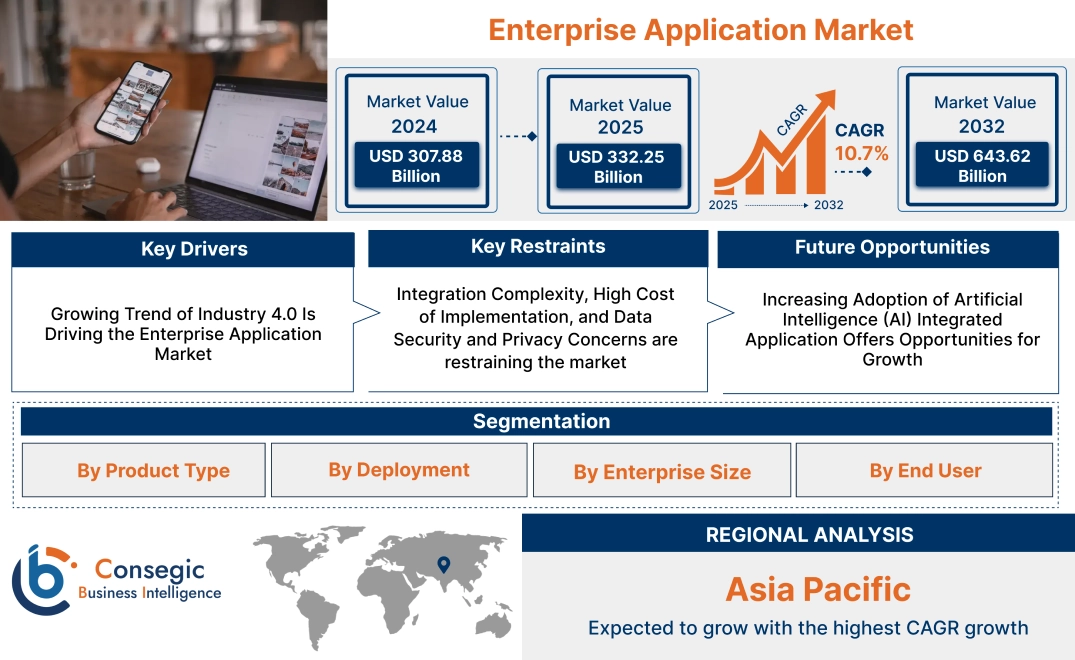
Enterprise Application Market is estimated to reach over USD 643.62 Billion by 2032 from a value of USD 307.88 Billion in 2024 and is projected to grow by USD 332.25 Billion in 2025, growing at a CAGR of 10.7% from 2025 to 2032.
Enterprise Application Market Dynamics - (DRO) :
Key Drivers:
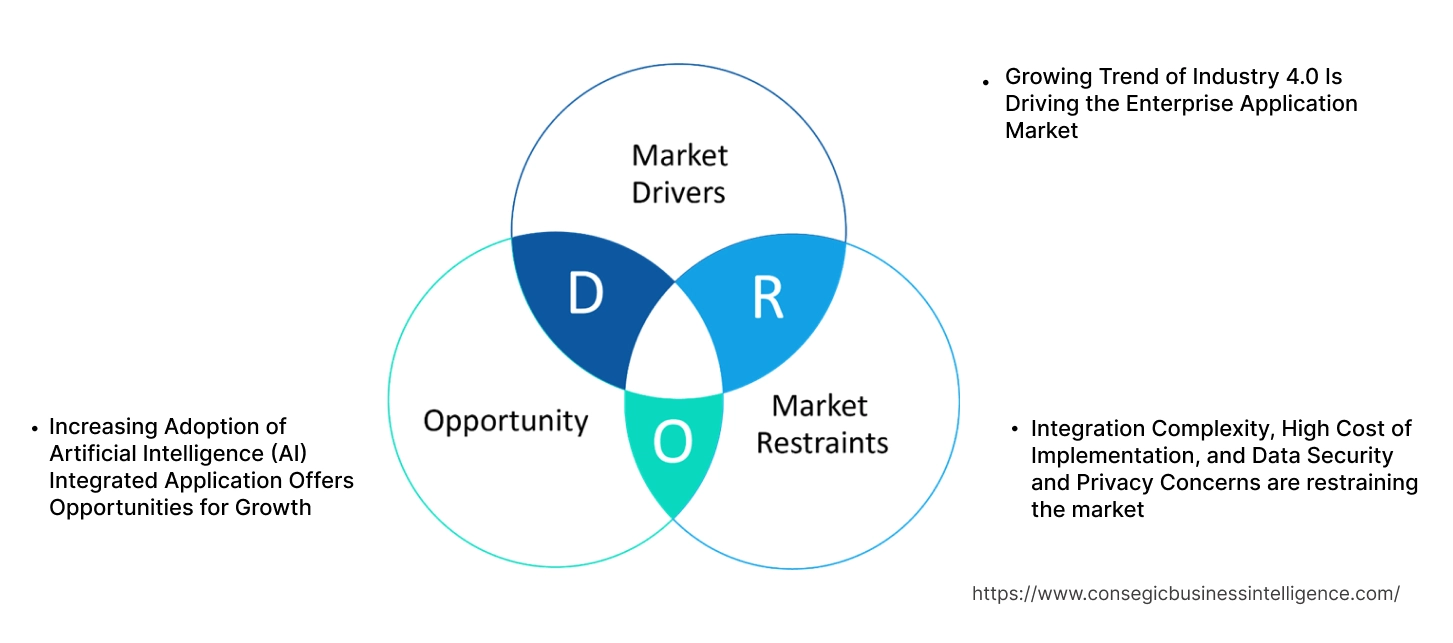
Growing Trend of Industry 4.0 Is Driving the Enterprise Application Market
The rise of Industry 4.0, characterized by interconnected devices, automation, and data exchange, is significantly fueling the adoption of enterprise solutions. Smart factories, powered by IoT sensors, generate massive amounts of data that need to be collected, analyzed, and acted upon.
Enterprise solutions, particularly ERP, SCM, and manufacturing execution systems (MES), are crucial for integrating this data, providing real-time insights into production processes, and enabling predictive maintenance. Industry 4.0 also necessitates agile and flexible systems capable of adapting to rapidly changing market requirements.
Cloud-based enterprise solutions, with their scalability and accessibility, are well-suited to support this dynamic environment. Furthermore, the focus on automation and efficiency within Industry 4.0 drives the need for enterprise solutions that can streamline workflows, optimize resource allocation, and improve overall productivity. This convergence of technology and manufacturing is creating a surge in demand for sophisticated enterprise solutions.
- For instance, in February 2025, Accenture announced the acquisition of Staufen AG. This acquisition is expected to bolster Accenture's capabilities in manufacturing and supply chain optimization, particularly for discrete manufacturing industries like automotive and aerospace.
- Staufen's expertise includes Industry 4.0 solutions, supply chain management, and organizational change, focusing on value chain optimization, digital manufacturing, and business performance improvement.
Thus, increasing demand for industry 4.0 is driving the enterprise application market during the forecast period.
Key Restraints:
Integration Complexity, High Cost of Implementation, and Data Security and Privacy Concerns are restraining the market
There are several factors that are hindering the expansion of enterprise application market. Integrating new enterprise applications with existing legacy systems can be incredibly complex, often requiring significant customization and specialized expertise, leading to project delays and cost overruns.
The high cost of implementation, encompassing software licenses, hardware upgrades, consulting fees, and training, can be a major barrier, especially for smaller businesses. Furthermore, growing data security and privacy concerns, particularly with increasing cyber threats and stricter regulations like GDPR, are making organizations hesitant to adopt new applications, especially cloud-based solutions.
Businesses require robust security measures and assurances of data protection before entrusting their sensitive information to third-party vendors. Thus challenges including integration complexity, high costs, and security concerns are restraining market.
Future Opportunities :
Increasing Adoption of Artificial Intelligence (AI) Integrated Application Offers Opportunities for Growth
The increasing adoption of Artificial Intelligence (AI) within enterprise applications presents a significant opportunity. AI is transforming how businesses operate by automating tasks, providing predictive insights, and enhancing decision-making.
AI-powered enterprise solutions can analyze vast amounts of data to identify patterns, predict future trends, and optimize processes in real-time. This leads to improved efficiency, reduced costs, and better customer experience. For example, AI-driven CRM can personalize marketing campaigns and predict customer churn, while AI-enabled ERP can optimize supply chain management and predict equipment failures.
As AI technology matures and becomes more accessible, its integration into enterprise applications will become increasingly prevalent, driving further innovation and creating new opportunities for vendors and businesses alike. This trend is expected to significantly boost the market's trajectory.
- For instance, Microsoft Corporation offers Dynamics 365 AI-powered ERP systems for retail sector by integrating inventory and customer data from channels including physical stores, online platforms, mobile apps into one unified system.
Thus, increasing adoption of AI integrated applications in enterprises offers opportunities for the market.
Top Key Players & Market Share Insights:
The global enterprise application market is highly competitive with major players providing solutions to the national and international markets. Key players are adopting several strategies in research and development (R&D), product innovation, and end-user launches to hold a strong position in the software industry. Key players in the enterprise application market include-
- SAP SE (Germany)
- Oracle Corporation (US)
- Zoho Corporation (India)
- Accenture (Ireland)
- Fujitsu (Japan)
- Microsoft Corporation (US)
- Infor (US)
- Salesforce (US)
- Adobe Inc. (US)
- IBM (US)
Enterprise Application Market Segmental Analysis :
By Product Type:
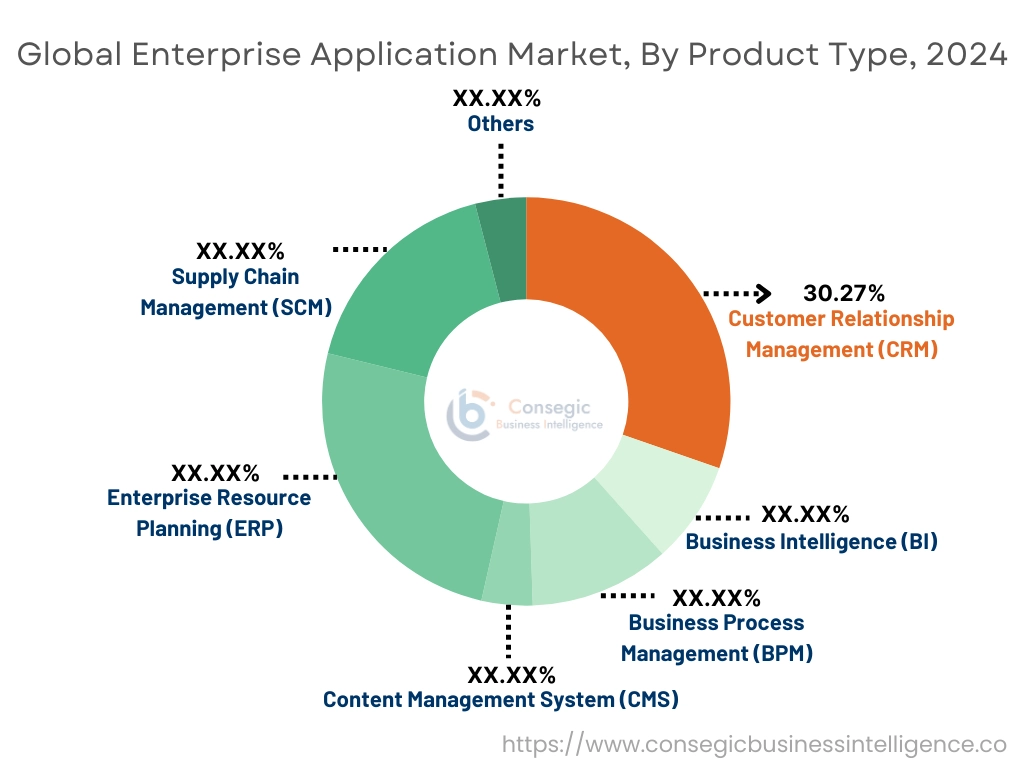
Based on the product type, the market is segmented into Enterprise Resource Planning (ERP), Supply Chain Management (SCM), Customer Relationship Management (CRM), Business Intelligence (BI), Business Process Management (BPM), Content Management System (CMS), and Others.
Trends in the Product Type:
- Increasing trend in shift towards cloud-based ERP system for scalability, cost-effectiveness, and accessibility is driving the enterprise application market.
- Growing need for market specific solutions is driving the market growth of enterprise application market.
Customer Relationship Management (CRM) accounted for the largest revenue share of 30.27% in the year 2024.
- Increasing adoption of AI for predictive analytics, sentiment analysis, and personalized marketing campaigns.
- Further, growing retail sector is driving the adoption of customer relationship management software for storing and managing the customer data.
- Furthermore, growing use of CRM for understanding and optimizing the entire customer journey to improve engagement and loyalty which in turn fuel the enterprise application market.
- For instance, in September 2023, Genesys and Salesforce have deepened their partnership to create CX Cloud, a unified, AI-powered customer experience and relationship management solution integrating Genesys Cloud and Salesforce Service Cloud. This solution aims to improve customer and employee experiences by combining data, agents, bots, and channels.
- Thus, as per analysis, increasing adoption of AI and growing retail sector is driving the need for Customer Relationship Management (CRM) software
Business Intelligence (BI) is anticipated to register the fastest CAGR during the forecast period.
- Growing demand for real-time dashboards and insights to enable faster decision-making is driving the market
- Further, increasing use of machine learning and artificial intelligence to automate data analysis and provide deeper insights.
- Furthermore, growing focus on interactive and visually appealing dashboards to communicate data insights effectively.
- Therefore, based on analysis, need for real-time insight and increasing use of machine learning and artificial intelligence is anticipated to boost the growth of the market during the forecast period.
By Deployment:
Based on the deployment, the market is bifurcated into on premise and cloud.
Trends in the Deployment:
- Security remains a top priority for both on-premises and cloud deployments, with organizations investing in advanced security tools and practices which in turn are expected to drive enterprise application market.
- Increasing development of on-premises and cloud applications that offer flexibility and scalability.
On premise accounted for the largest revenue share in the year 2024.
- Benefits including enhanced data security, full control & ownership, and easier regulatory compliances are driving the enterprise application market growth during the forecast period.
- Increasing focus towards developing cloud-native enterprise solutions specifically designed for cloud environments, leveraging microservices and containerization.
- Thus, aforementioned factors are expected to boost the growth of the market during the forecast period.
Cloud deployment is anticipated to register the fastest CAGR during the forecast period.
- Benefits including cost effectiveness, scalability, and flexibility are driving the enterprise application market growth during the forecast period
- The rise of hybrid and remote work models requires cloud services and enterprise solutions for effective communication between teams which in turn drives the enterprise application market.
- For instance, Oracle offers Oracle Supply Chain Management (SCM) which helps organizations adapt to changing market conditions. Oracle emphasizes AI-powered solutions, offering webinars and resources on AI's impact on operations, logistics, and smart decision-making. Their cloud offerings, Oracle Fusion Cloud Supply Chain & Manufacturing, cover various aspects of the supply chain, including planning, inventory management, manufacturing, maintenance, order management, logistics, and product lifecycle management.
- Therefore, benefits including cost effectiveness, scalability, and flexibility are expected to boost the growth of the market during the forecast period.
By Enterprise Size:
Based on the enterprise size, the market is bifurcated into small & medium enterprise and large enterprise.
Trends in the Enterprise Size:
- Increasing adoption of automation to streamline complex processes, improve decision-making, and enhance customer experience.
- Growing focuses on improving the user experience to drive adoption and productivity is driving the enterprise application market.
Large Enterprise accounted for the largest revenue share in the year 2024.
- Large enterprises are investing in AI and automation capabilities to streamline complex processes, improve decision-making, and enhance customer experience.
- Further, with increasing data breaches and regulatory requirements, large enterprises are prioritizing security and compliance features to protect sensitive information and maintain business continuity.
- Thus, rising investment in AI and automation capabilities and growing prioritization for cybersecurity is driving the market.
Small & Medium Size Enterprise is anticipated to register the fastest CAGR during the forecast period.
- SMEs are increasingly adopting cloud-based solutions due to their affordability, scalability, and ease of deployment. This allows them to access enterprise-grade solutions without significant upfront investment in infrastructure.
- Further, SMEs often prefer integrated application suites that combine various functionalities like CRM, ERP, and HR into a single platform. This simplifies management and reduces the cost of dealing with multiple vendors.
- For instance, in October 2024, Sage acquired Anvyl, a supply chain software company, to enhance its supply chain technology solutions for small and mid-sized businesses. This acquisition will allow Sage to offer a cost-effective Supply Chain Execution (SCE) solution, giving SMBs complete supply chain visibility from purchase order to delivery.
- Therefore, increasing adoption of cloud-based services and growing demand for integrated solutions is anticipated to boost the market during the forecast period.
By End-User:
Based on the end user, the market is segmented into manufacturing, BFSI, IT & telecommunication, retail, government, energy & utilities, and others.
Trends in the end user:
- Enterprise solutions are being integrated with shop floor systems and IoT devices to create smart factories, enabling real-time monitoring, predictive maintenance, and optimized production processes.
- Increasing focus on enhancing customer experience through personalized services, omnichannel engagement, and real-time insights in BFSI sector is driving the enterprise application market
IT & Telecommunication accounted for the largest revenue share in the year 2024 and is anticipated to register the fastest CAGR during the forecast period.
- Enterprise applications are being used to automate network operations, optimize resource allocation, and improve service delivery in the telecom sector.
- Further, telecom companies are embracing cloud-native architectures and microservices to develop and deploy enterprise solutions faster and more efficiently.
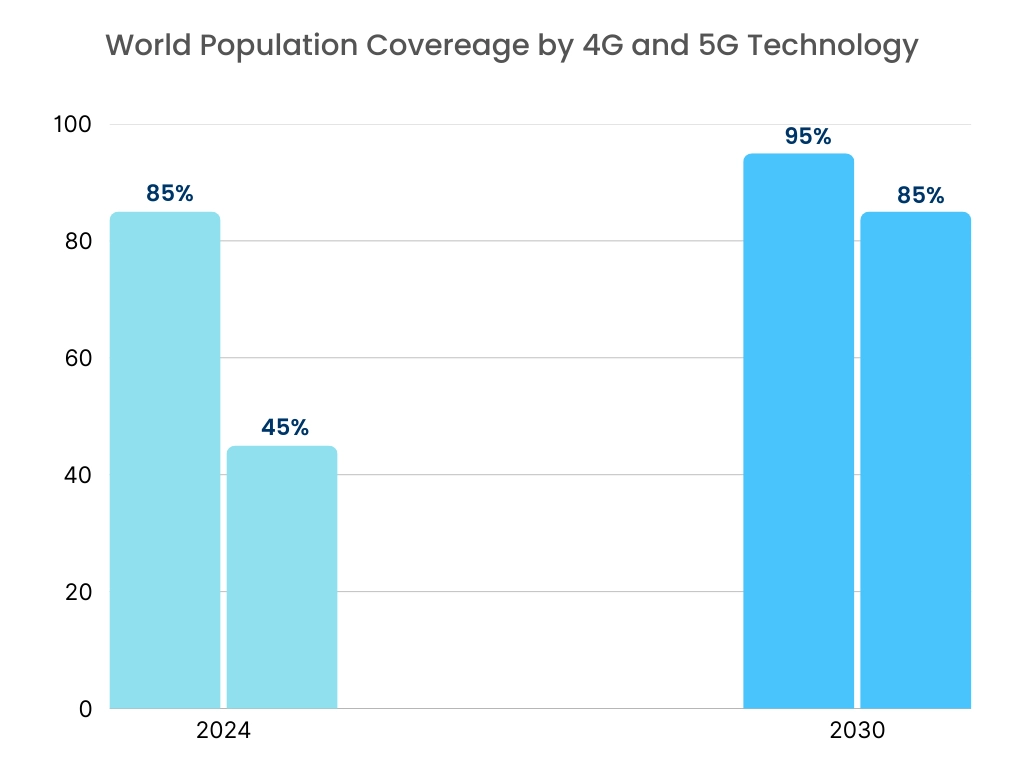
- Furthermore, with the rollout of 5G networks, enterprise solutions are playing a crucial role in managing network infrastructure, optimizing performance, and enabling new 5G services.
- For instance, ELINEXT offers ERP solutions for the telecom sector, focusing on process optimization and overall improvement. These systems are complex due to rapid technological advancements and evolving customer demand. Elinext's ERP solutions for telecom include features like resource scheduling, service parts planning, finance and regulatory systems, sales and distribution modules, and total quality management.
- Thus, as per analysis, increasing use of enterprise software to automate network operations and optimize resources in telecom sector is driving the market.
Enterprise Application Market Report Insights :
| Report Attributes | Report Details |
| Study Timeline | 2019-2032 |
| Market Size in 2032 | USD 643.62 Billion |
| CAGR (2025-2032) | 10.7% |
| By Product Type |
|
| By Deployment |
|
| By Enterprise Size |
|
| By End-User |
|
| By Region |
|
| Key Players |
|
| North America | U.S. Canada Mexico |
| Europe | U.K. Germany France Spain Italy Russia Benelux Rest of Europe |
| APAC | China South Korea Japan India Australia ASEAN Rest of Asia-Pacific |
| Middle East and Africa | GCC Turkey South Africa Rest of MEA |
| LATAM | Brazil Argentina Chile Rest of LATAM |
| Report Coverage |
|
Regional Analysis:
The regions covered are North America, Europe, Asia Pacific, Middle East and Africa, and Latin America.
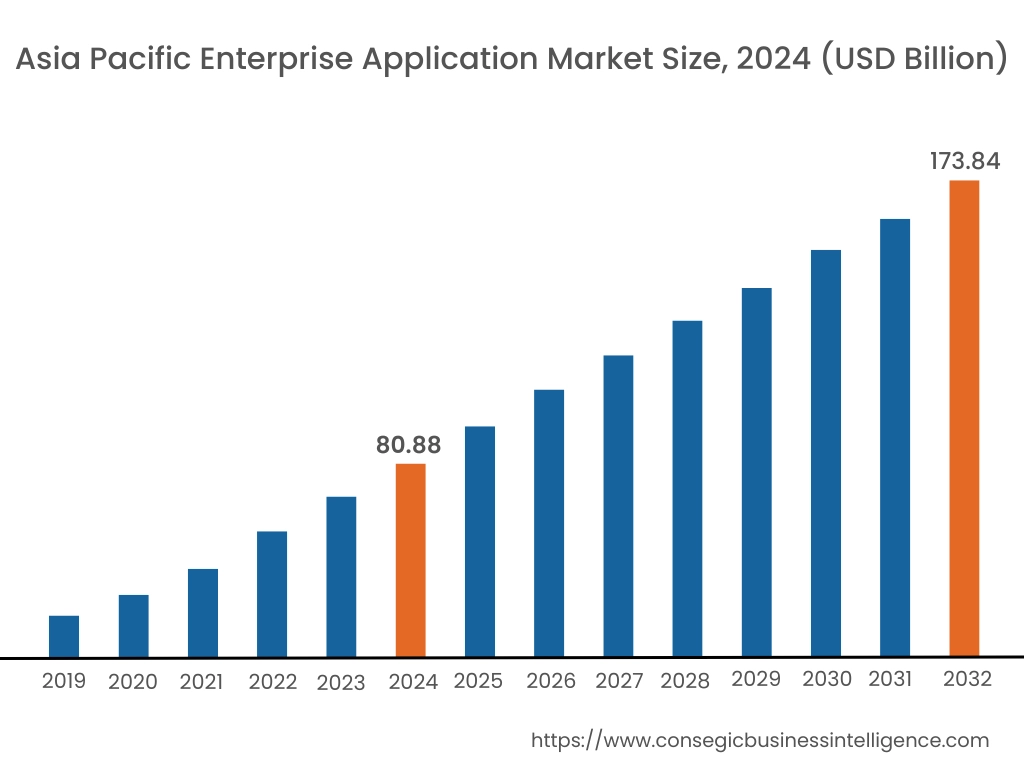
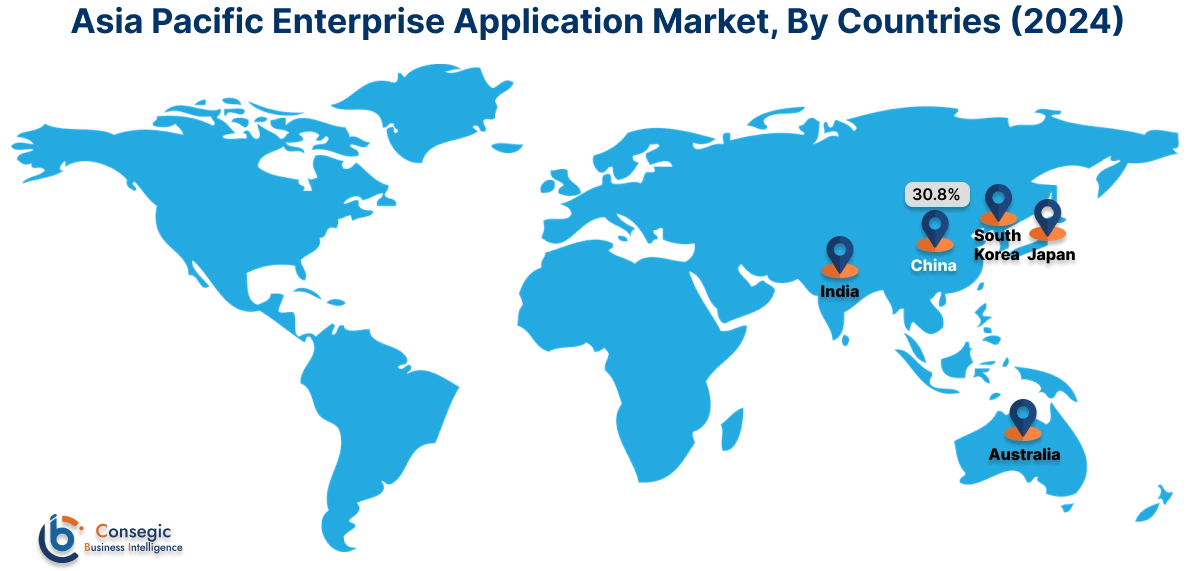
Asia Pacific region was valued at USD 80.88 Billion in 2024. Moreover, it is projected to grow by USD 87.49 Billion in 2025 and reach over USD 173.84 Billion by 2032. Out of this, China accounted for the maximum revenue share of 30.8%. The enterprise application market in Asia Pacific is mainly driven by rapid economic rise, increasing digitalization across industries, a large and growing SME base, government initiatives promoting digital transformation, and the rising adoption of cloud computing and mobile technologies. Furthermore, the increasing demand for data-driven insights and improved operational efficiency fuels the need for sophisticated enterprise application solutions.
- For instance, in February 2025, SAP SE a major global player in enterprise software announced “SAP ERP, private edition, transition option," a cloud subscription service to help large customers with complex SAP ERP installations transition to SAP cloud ERP as part of their RISE with SAP journey.
North America enterprise application market is estimated to reach over USD 212.40 Billion by 2032 from a value of USD 102.17 Billion in 2024 and is projected to grow by USD 110.21 Billion in 2025. The North American region's strong technological infrastructure, high adoption rate of cloud computing and mobile technologies, and the presence of numerous large enterprises across various sectors offer lucrative prospects for the market expansion.
- For instance, in March 2023, SYSPRO launched SYSPRO 8 2023, a new ERP platform release focused on organizational efficiency and supply chain optimization. The enhancements aim to improve quality, automate processes, provide better insights, and optimize warehouse operations.
The regional analysis depicts that the increasing digitalization across industries, a growing focus on data privacy and security, and government initiatives promoting digital transformation in Europe is driving the enterprise application market. Additionally, the primary factor driving the market in the Middle East and African region is rapid economic diversification, increasing government focus on digital transformation, and rising internet and mobile penetration. Further, increasing digitalization, growing middle class, and rising internet penetration are paving the way for the progress of enterprise application market trends in Latin America region.
Recent Industry Developments :
Acquisitions:
- In November 2024, Salesforce completed the acquisition of Own Company, a data protection and management solutions provider. This acquisition aims to bolster Salesforce's data security offerings, addressing the increasing need for robust data protection and compliance, especially with the rise of AI.
- In June 2024, Epicor acquired KYKLO to boost its AI-driven ERP vision. KYKLO's PIM and content tools will enhance Epicor Commerce, enabling better product information management, lead generation, and online buying experiences for B2B customers.
Key Questions Answered in the Report
How big is the Enterprise Application Market? −
The enterprise application market is estimated to reach over USD 643.62 Billion by 2032 from a value of USD 307.88 Billion in 2024 and is projected to grow by USD 332.25 Billion in 2025, growing at a CAGR of 10.7% from 2025 to 2032.
What specific segmentation details are covered in the enterprise application report? +
The enterprise application report includes specific segmentation details for product type, deployment, enterprise size, end user, and regions.
Which is the fastest segment anticipated to impact the market growth? +
In the enterprise application market, cloud deployment is the fastest-growing segment during the forecast period due to benefits including cost effectiveness and scalability and rise of AI and IoT applications
Who are the major players in the Enterprise Application Market? +
The key participants in the Enterprise Application Market are SAP SE (Germany), Oracle Corporation (US), Microsoft Corporation (US), Infor (US), Salesforce (US), Adobe Inc. (US), IBM (US), Zoho Corporation (India), Accenture (Ireland), Fujitsu (Japan), and others.
What are the key trends in the Enterprise Application Market? +
The enterprise application market is being shaped by several key trends including shift towards cloud-based solutions, integration of AI and machine learning, need for integration and interoperability, emphasis on user experience, and increasing focus on data security and privacy.
Overview
Reputation & Certifications


Our Services
- Market Intelligence & Forecasting
- Custom Research Solutions
- Market Entry Strategy
- Competitive Intelligence
- Customer Insights
- Industry Innovation Analysis
- Investment Advisory