Jump to Content
Smart Warehousing Market - Size, Share, Industry Trends, and Forecasts (2025-2035)
Smart Warehousing Market 2025 - 2035:
- In 2025, the Global Smart Warehousing Market was estimated at USD 31.20 billion.
- The market is projected to record a CAGR of 10.30% during 2025 to 2035.
- The global market valuation is expected to reach USD 83.17 billion by 2035.
- North America held the largest share of the Smart Warehousing Market in 2024.
Market Scope & Overview:
Smart warehousing is the term used for the application of automation, technology, and data platforms in the management of warehouse activities and the flow of goods within the warehouse. The smart warehousing industry includes automated storage systems, warehouse management systems, robots, sensors, and real-time monitoring systems. These solutions support inventory tracking, order picking, goods movement, and storage management across distribution centers. Major end users include e commerce firms, retail companies, manufacturing enterprises, and third-party logistics providers.
The smart warehousing industry is expanding due to rising e commerce shipments and the need for faster order fulfillment. Companies are adopting robotics, automated storage systems, and digital warehouse platforms to improve operational efficiency and reduce manual handling. Investment in supply chain automation across the US, Europe, and Asia is supporting technology adoption in logistics facilities. Collaboration between technology vendors and logistics operators is also supporting deployment of smart warehouse solutions.
Market Size & Forecast
- 2024 Market Size: USD 28.29 Billion
- 2025 Market Size: USD 31.20 Billion
- 2035 Projected Market Size: USD 83.17 Billion
- CAGR (2025–2035): 10.30%
- Largest Market in 2025: North America
How is the Smart Warehousing Market Affected by AI?
Artificial intelligence is improving warehouse operations through demand forecasting, inventory optimization, and automated order processing. AI systems analyze operational data to optimize storage allocation, picking routes, and workforce planning. The integration of AI technology with robots and vision systems is helping automate picking, sorting, and movement of goods within the warehouse.
The AI-based analytics platforms also provide real-time monitoring of activities within the warehouse. The platforms analyze the operational data within the warehouse and identify the gaps within the workflow, helping predict the need for maintenance activities. The integration of AI-based analytics platforms with warehouse management systems is helping improve the overall operational activities within the warehouse.

Market Dynamics - (DRO):
Key Drivers:
Growth in global e-commerce order volumes is increasing demand for automated warehouse operations
Global e-commerce sites are witnessing increasing order volumes in the US, China, India, and Europe. Retailers and logistics services are adding distribution capacity to meet the high order processing needs. Smart warehouses, like automated storage systems, robotics, and software, are used to increase pick rates and accuracy. Logistics firms are investing in automated warehouses to support same day and next day delivery services.
- For instance, the International Trade Administration said that the global B2C e-commerce revenue is projected to reach about USD 5.5 trillion by 2027, with a CAGR of 14.4%.
Therefore, rising global e-commerce order volumes are increasing demand for smart warehouse technologies.
Key Restraints:
High initial investment for warehouse automation systems restrains the market growth
Smart warehouse infrastructure requires substantial investment in robotics, automated storage systems, and digital warehouse platforms. The installation of systems, system integration, and upgrading of infrastructure also contribute to increased capital costs for logistics companies. Smaller and mid-sized warehouse companies face financial constraints in implementing large-scale automation systems.
Therefore, high initial investment costs act as a major constraint for the adoption of smart warehouse systems among small-scale logistics companies.
Future Opportunities:
Expansion of micro-fulfillment centers in urban areas creates growth avenues
Retail and e-business organizations are developing micro fulfillment centers that are closer to consumers in urban regions in order to reduce the delivery time. Micro fulfillment centers demand compact automated storage systems and robotics to support a high density of orders in a limited space. Smart warehouses play a vital role in increasing the order fulfillment process in urban distribution centers.
- For instance, in March 2026, Armlogi Holding Corp. introduced its AI-based Smart Fulfillment Network, which optimizes the order fulfillment route across its 10-warehouse network in the U.S. network (3.9M sq ft), reducing shipping costs and improving delivery efficiency for e-commerce merchants.
Hence, expansion of micro-fulfillment centers in urban areas is creating growth opportunities for smart warehouse solutions.
Market Segmental Analysis:
By Component:
On the basis of component, the smart warehousing market is segmented into hardware, software, and services.
Trends in the Component:
- Rising adoption of warehouse automation systems is increasing demand for robotics and automated storage hardware.
- Growing use of warehouse management platforms is expanding deployment of cloud-based warehouse software.
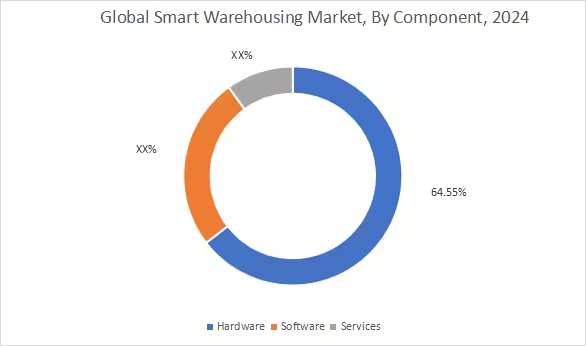
The hardware was responsible for the highest revenue share of 64.55% in 2024.
- Hardware also includes robotics, automated storage systems, sensors, and conveyor systems.
- Also, large distribution centers are also investing in automation infrastructure to improve their operational efficiency.
- In addition, expansion of e-commerce fulfillment centers is increasing demand for automated warehouse equipment.
- Further, robotics adoption in goods movement and picking operations is strengthening hardware deployment.
- Therefore, increasing warehouse automation investment is supporting dominance of the hardware segment.
It is anticipated that the software will exhibit the highest compound annual growth rate (CAGR) during the forecast period.
- Warehouse management software improves inventory visibility and workflow coordination.
- Also, cloud-based platforms support real time monitoring of warehouse operations.
- In addition, the integration of AI analytics tools is also improving demand forecasting.
- Moreover, companies are deploying digital platforms to optimize warehouse productivity.
- Therefore, growing demand for data driven warehouse operations is driving growth of the software segment.
By Deployment:
On the basis of deployment, the smart warehousing market is segmented into cloud and on-premises.
Trends in the Deployment:
- Increasing digital supply chain transformation is encouraging adoption of cloud-based warehouse platforms.
- Rising demand for real time operational visibility is supporting integration of cloud warehouse systems.
The on-premises was responsible for the highest revenue share in 2024.
- Large logistics operators use on-premises platforms for operational control and data security.
- Also, established warehouse facilities continue to operate on existing internal IT infrastructure.
- In addition, integration with legacy warehouse management systems supports continued deployment.
- Further, enterprises prefer internal deployment for handling large operational datasets.
- Therefore, strong presence of established warehouse infrastructure is supporting dominance of the on-premises segment.
It is anticipated that the cloud will exhibit the highest compound annual growth rate (CAGR) during the forecast period.
- Cloud platforms enable centralized warehouse monitoring across multiple distribution centers.
- Also, scalable infrastructure supports expanding e-commerce logistics networks.
- In addition, cloud deployment improves data accessibility for supply chain coordination.
- Also, companies are adopting cloud systems to reduce IT infrastructure complexity.
- Therefore, growing digital supply chain operations are driving growth of the cloud segment.
By Technology:
On the basis of technology, the smart warehousing market is segmented into IoT, robotics and automation, AI and analytics, networking and communication, AR and VR, and others.
Trends in the Technology:
- Expansion of automated logistics facilities is increasing deployment of robotics and automation technologies.
- Growing use of data analytics tools is supporting AI driven warehouse optimization.
The robotics and automation was responsible for the highest revenue share in 2024.
- Robotics systems support automated picking, sorting, and goods movement operations.
- Also, automated storage systems improve warehouse space utilization and workflow efficiency.
- In addition, logistics companies are investing in robotics to reduce manual handling operations.
- Further, robotics deployment improves operational speed in high volume fulfillment centers.
- Therefore, increasing warehouse automation investment is supporting dominance of the robotics and automation segment.
It is anticipated that the AI and analytics will exhibit the highest compound annual growth rate (CAGR) during the forecast period.
- AI tools improve demand forecasting and warehouse planning processes.
- Also, analytics platforms enable real time monitoring of warehouse performance.
- In addition, predictive models help detect workflow inefficiencies and operational delays.
- Moreover, logistics companies are adopting AI systems to improve inventory and order management.
- Therefore, rising use of data driven warehouse management is driving growth of the AI and analytics segment.
By Application:
On the basis of application, the smart warehousing market is segmented into inventory management, order fulfillment, asset tracking, predictive analytics, and others.
Trends in the Application:
- Rising demand for accurate inventory visibility is increasing adoption of digital warehouse management systems.
- Expansion of fast delivery models is increasing demand for automated order fulfillment systems.
The inventory management was responsible for the highest revenue share in 2024.
- Smart warehouse systems support real time inventory monitoring across distribution centers.
- Also, automated tracking tools improve stock accuracy and reduce operational errors.
- In addition, retailers and logistics firms rely on digital inventory platforms for supply chain coordination.
- Further, integration with warehouse management systems improves inventory planning.
- Therefore, increasing demand for real time inventory visibility is supporting dominance of the inventory management segment.
It is anticipated that the order fulfillment will exhibit the highest compound annual growth rate (CAGR) during the forecast period.
- E-commerce companies require faster order processing to meet delivery timelines.
- Also, automation systems improve picking and packing efficiency in fulfillment centers.
- In addition, robotics systems support high volume order processing operations.
- Moreover, logistics providers are expanding automated fulfillment infrastructure.
- Therefore, rising demand for rapid delivery models is driving growth of the order fulfillment segment.
By End User:
On the basis of end user, the smart warehousing market is divided into transportation and logistics, retail and e-commerce, manufacturing, healthcare, energy and utilities, automotive, food and beverages, and others.
Trends in the End User:
- Rising global e-commerce trade is increasing demand for automated warehouse facilities.
- Expansion of logistics infrastructure is encouraging adoption of smart warehouse technologies.
Transportation and logistics accounted for the largest revenue share in the year 2024.
- Logistics operators operate large distribution networks that require automated warehouse operations.
- Also, high shipment volumes also require efficient inventory and goods movement systems.
- In addition, logistics firms are investing in robotics and warehouse management software.
- Further, expansion of global distribution hubs is increasing adoption of automation technologies.
- Therefore, rising logistics infrastructure development is supporting dominance of the transportation and logistics segment.
Retail and e-commerce is anticipated to register the fastest CAGR during the forecast period.
- Online retail platforms require efficient fulfillment infrastructure to handle high order volumes.
- Also, automation improves order accuracy and delivery timelines in e-commerce supply chains.
- In addition, retailers are expanding automated distribution centers to support omni-channel operations.
- Moreover, smart warehouse platforms support real time inventory tracking for online orders.
- Therefore, expansion of global e-commerce operations is driving growth of the retail and e-commerce segment.
Regional Analysis:
North America, Europe, Asia Pacific, the Middle East and Africa, and Latin America are the regions of coverage.
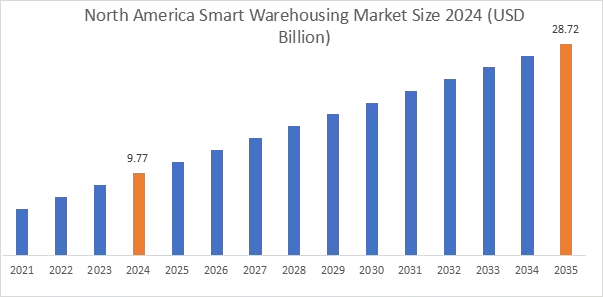
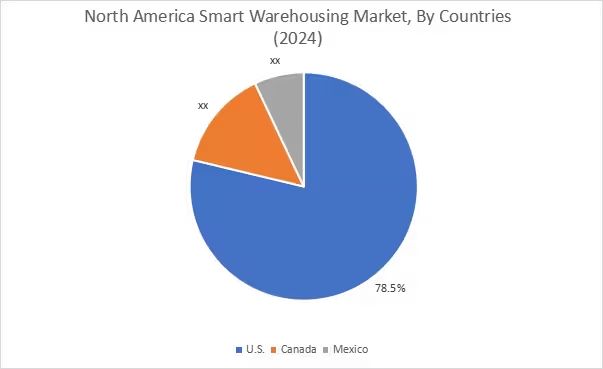
In 2024, North America accounted for the highest market share at 34.53% and was valued at USD 9.77 Billion, and is expected to reach USD 28.72 Billion by 2035. In North America, the U.S. accounted for the highest market share of 78.5% during the base year of 2024. Market growth is driven by advanced logistics infrastructure and strong uptake of warehouse automation technologies. The US is building new automated distribution centers with robotics, automated storage systems, and warehouse management solutions to meet increasing growth rates of e-commerce fulfillment.
- For example, in January 2026, V2X announced a partnership with Amazon to deploy smart warehousing automation, robotics, computer vision AI, and predictive analytics solutions in US government warehouses for optimized inventory, workflows, and mission readiness.
Asia Pacific is expected to witness the fastest growth during the forecast period. China is expanding automated logistics facilities to support large e-commerce platforms. Japan is increasing warehouse robotics adoption to address labor shortages. India is seeing an improvement in modern warehousing infrastructure due to the expansion of e-commerce and third-party logistics operations.
- For example, in September 2025, Huawei introduced the Huawei SMART Logistics & Warehousing Solution, which includes AI-powered platform services, digital operations management, intelligent resource allocation, autonomous relocation, and unmanned transportation for efficient supply chain evolution.
Europe smart warehousing market is growing owing to the rising investments in supply chain automation in Germany, France, and the UK. Retailers and logistics companies are using automated storage solutions and digital warehousing platforms to better manage their inventory and order fulfillment.
Latin America market growth is fueled by logistics infrastructure expansion in Brazil and Mexico. Retail and e-commerce companies are gradually adopting automated warehouse systems to improve fulfillment efficiency.
The Middle East and Africa market is driven by logistics infrastructure investment in the UAE and Saudi Arabia. Regional distribution center expansions are driving demand for automated warehouse solutions, and South Africa is experiencing a slow pace of digital warehouse management system adoption.
Top Key Players & Market Share Insights:
The smart warehousing market is moderately fragmented with players offering hardware solutions for warehouse automation, robots, and warehouse management software solutions. Technology firms are expanding automation solutions and integrating AI driven warehouse platforms to improve operational efficiency. Partnerships between logistics providers and technology vendors are increasing deployment of automated warehouse systems. Key participants in the market for smart warehousing include:
- Daifuku Co., Ltd. – Japan
- KION Group AG – Germany
- Honeywell International Inc. – US
- SSI Schaefer Group – Germany
- Murata Machinery, Ltd. – Japan
- KNAPP AG – Austria
- TGW Logistics Group – Austria
- Swisslog Holding AG – Switzerland
- GreyOrange Inc. – US
- AutoStore Holdings Ltd – Norway
Recent Industry Developments:
- In February 2026, Dexory launched a next-generation autonomous warehouse robot with an extended 60-foot scanning range plus a new AI-powered Storage Health software feature that improves real-time visibility, safety, and operational efficiency in warehouses.
- In January 2026, SSI SCHÄFER is supporting Coop Sweden in operating a 77,000 m² highly automated distribution center in Eskilstuna that supplies over 800 stores with about 95% of picking handled automatically for greater efficiency and sustainability.
Smart Warehousing Market Report Insights:
| Report Attributes | Report Details |
|---|---|
| Study Timeline | 2019-2035 |
| Market Size in 2035(USD Billion) | USD 83.17 Billion |
| CAGR (2025-2035) | 10.30% |
| By Component |
|
| By Deployment |
|
| By Technology |
|
| By Application |
|
| By End User |
|
| By Region |
|
| Key Players |
|
| Report Coverage |
|
Key Questions Answered in the Report
How big is the smart warehousing market? −
The smart warehousing market size is estimated to reach over USD 83.17 Billion by 2035 from a value of USD 28.29 Billion in 2024 and is projected to grow by USD 31.20 Billion in 2025, growing at a CAGR of 10.30% from 2025 to 2035.
Which segmentation details are covered in the smart warehousing report? +
The smart warehousing report includes specific segmentation details for component, deployment, technology, application, end user, and regions.
Which is the fastest segment anticipated to impact the market growth? +
Robotics and automation is the fastest growing segment, driven by rising adoption of automated warehouse systems.
Who are the major players in the smart warehousing market? +
The key participants in the smart warehousing market are Daifuku Co., Ltd. (Japan), KION Group AG (Germany), Honeywell International Inc. (US), SSI Schaefer Group (Germany), Murata Machinery, Ltd. (Japan), KNAPP AG (Austria), TGW Logistics Group (Austria), Swisslog Holding AG (Switzerland), GreyOrange Inc. (US), AutoStore Holdings Ltd (Norway), and others.
What are the key trends in the smart warehousing market? +
Growth of e-commerce fulfillment centers, increasing use of AI and robotics, and rising warehouse automation investment are shaping the market.
Overview
Reputation & Certifications


Our Services
- Market Intelligence & Forecasting
- Custom Research Solutions
- Market Entry Strategy
- Competitive Intelligence
- Customer Insights
- Industry Innovation Analysis
- Investment Advisory