Jump to Content
Sports Technology Market - Size, Share, Industry Trends, and Forecasts (2025 - 2035)
What is Sports Technology and How is it Transforming Athlete Performance and Fan Engagement?
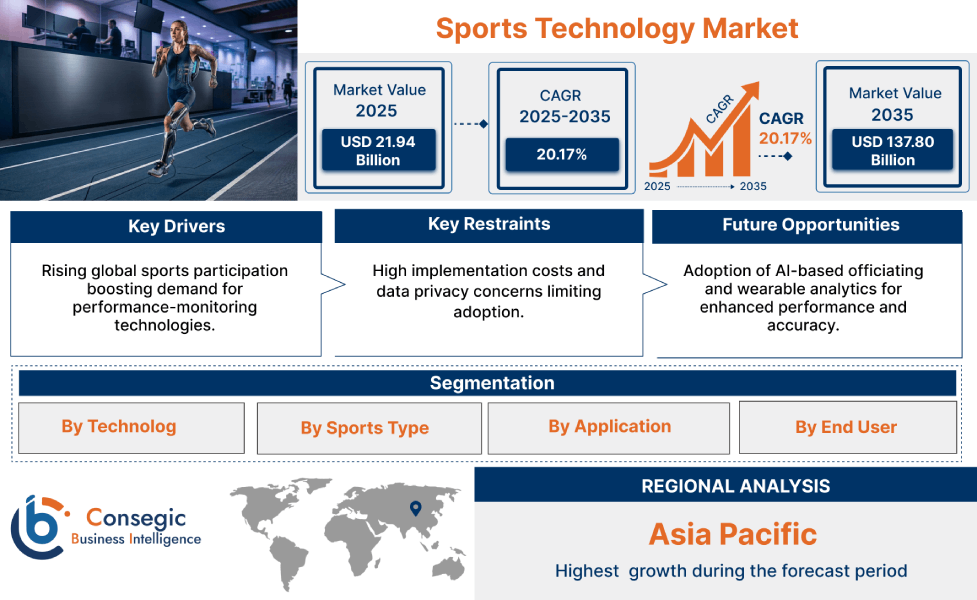
Sports technology comprises digital technology that helps improve athletes’ performance, training, and fans’ engagement. It comprises wearable technology, performance tracking technology, video analysis technology, smart stadium technology, data analytics technology, among others. These technologies are commonly used by various professional teams, sports associations, training academies, fitness centers, among others.
The growth of the market is attributed to the increasing adoption of data analytics technology in sports performance management. The increasing demand for wearable fitness technology is also a major driver of this market. The development of artificial intelligence technology is also enhancing the growth of this market.
Market Statistics
- Largest Market in 2025: North America
- 2024 Market Size: USD 18.26 Billion
- 2025 Market Size: USD 21.94 Billion
- 2035 projected Market Size: USD 137.80 Billion
- CAGR (2025-2035): 20.17%
Key Pointers
- Player performance monitoring segment dominated with 31.48% share in 2024, driven by data-based performance tracking.
- Rising global sports participation is increasing demand for sports technology.
- Expansion of wearable devices is supporting real-time performance monitoring.
- Adoption of AI-based officiating systems is creating new growth opportunities.
- Investments in smart stadiums are improving fan engagement and operations.
- Asia Pacific sports technology market is projected to grow at the fastest rate over the forecast period.
Sports Technology Market Trends
Rising Global Sports Participation Driving Adoption of Sports Technology
The sports technology market is increasing due to the increasing participation rate of people in sports activities. The increasing rate of participation is creating a demand for sports technology services. The increasing rate of participation is not only for professional players but also for amateur players. Therefore, sports organizations are increasingly using digital technologies to monitor the performance of players.
For instance, the World Health Organization has stated that 31% of the global adult population is not sufficiently physically active. This is an example of the need for increasing participation rates in sports activities. The increasing global interest in improving participation rates in sports activities is driving the demand for sports technology services. Therefore, the increasing rate of participation is driving the demand for sports technology services.
Expansion of Wearable Devices in Sports Performance
Expansion of wearable devices supports continuous health monitoring and performance optimization across professional and amateur sports. Teams and athletes use sensors and smart wearables to track biometrics such as heart rate, fatigue levels, and movement patterns. In January 2025, Ireland-based sports tech firm Output Sports secured USD 5.22 million in funding to expand its wearable performance technology used by Olympians and National Basketball Association players. This data enables precise training adjustments and reduces injury risks. Sports organizations adopt these technologies to enhance player efficiency and extend career longevity, which drives consistent demand for advanced wearable solutions.
High Implementation Cost and Data Privacy Concerns Are Restraining the Market Growth
Sports technology solutions like wearable technology, performance analytics software, and smart training tools require a lot of investment. However, sports clubs can afford these technologies. On the other hand, sports training centers may face financial constraints. The cost of devices, software, and data services increases the overall cost. Therefore, high implementation cost and data privacy concerns are restraining the sports technology market expansion.
Data Privacy and Cybersecurity Concerns
Data privacy and cybersecurity concerns restrict large-scale deployment of connected sports technologies. Sports platforms gather critical information regarding athletes and users through wearable technology, analysis systems, and connected infrastructure. This creates exposure to data breaches and unauthorized access. Regulatory compliance requirements and rising security costs increase operational complexity. Organizations delay or limit adoption to avoid reputational and financial risks linked to data misuse.
Adoption Of AI-Based Officiating and Decision Review Systems Creates New Growth Opportunities for the Market
The increasing demand for accuracy and transparency in sports officiating is another opportunity for growth for the sports technology market. Various sports leagues have been using video analysis technology and artificial intelligence-based decision technology to ensure fair play in matches.
For instance, in April 2025, FIFA announced its plans for an enhanced semi-automated offside technology system for international matches. It utilizes artificial intelligence technology, sensors, and cameras to allow referees to make quicker decisions. Hence, the use of AI-based officiating technology is expected to contribute to a more accurate match and further investments in advanced sports analysis technology.
Investments in Smart Stadium Infrastructure
Increase in investment in smart stadiums is generating the need for the implementation of digital and automated technologies. The need for the implementation of technologies is realized by the operators of the smart stadiums, and they are using technologies to enhance the efficiency of the operations. In October 2025, Saudi Arabia announced the launch of the first-ever sky stadium, called NEOM Sky Stadium, built 1,150 feet above the ground, and the investment in the infrastructure is expected to be around $1 billion. The technology companies are getting new revenue streams from the infrastructure developed in the global sporting arenas.
Segmental Overview:
By Technology:
The wearable technology segment held the largest market size in 2024, driven by the increasing need for real-time performance tracking and health monitoring. Wearable technology allows for the tracking of heart rates, movements, and fatigue levels in players. This provides better training decisions, which in turn increases the efficiency of the players.
The video analytics segment is expected to witness the highest CAGR during the forecast period, driven by the increasing need for data-driven insights in sports strategy. Video analytics allows for the tracking of movements of the players and the patterns in the matches. The adoption of AI-based analytics solutions and the need for better broadcasting are driving the market.
By Sports Type:
Soccer segment dominated the market in 2024 with a large number of soccer fans worldwide and high technology adoption rates. Teams are increasingly using wearable devices and analytics to monitor and improve their strategies. Adoption of high-end technology and smart stadiums is helping the segment grow.
The cricket segment is expected to record the highest CAGR during the forecast period due to the increasing use of analytics and decision review systems. Wearables and broadcast analytics are helping the segment grow. Growing T20 leagues are helping the segment record a high CAGR.
By Application:
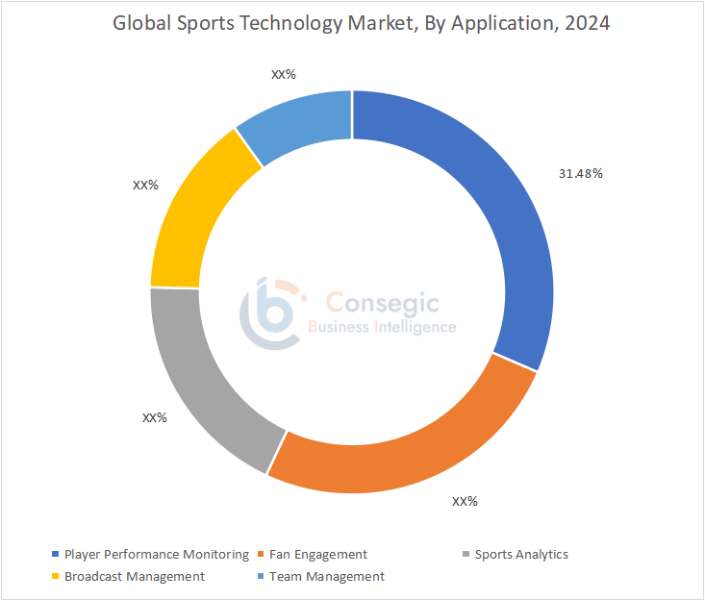
Player performance monitoring dominated the market in 2024 with a 31.48% revenue share due to the increasing need for data-driven training. This system measures the speed of players and the level of fatigue. Growing use of wearable devices and investment in sports science are helping the segment grow.
The fan engagement segment has a high growth rate and its CAGR is predicted to be the fastest during the forecast period. This is due to an increase in demand for interactive viewing experiences, such as receiving real-time data and personalized content through platforms. Growth in streaming and smart stadium adoption also contributes to segment growth.
By End User:
The sports teams segment held a large share in 2024 and its growth is attributed to a rise in focus on performance optimization. Teams use wearable devices and analytics tools to track fitness and optimize strategies. An increase in investment in athlete development also contributes to segment growth.
The media and broadcasting companies’ segment has a high growth rate and its CAGR is predicted to be the fastest during the forecast period. This is due to a rise in demand for advanced broadcasting solutions, such as receiving real-time data and AR tools to enhance viewer experiences. Growth in digital streaming also contributes to segment growth.
Region-wise Breakdown:
The market analysis is done with reference to major regions, namely, North America, Europe, Asia Pacific, Middle East and Africa, and Latin America.
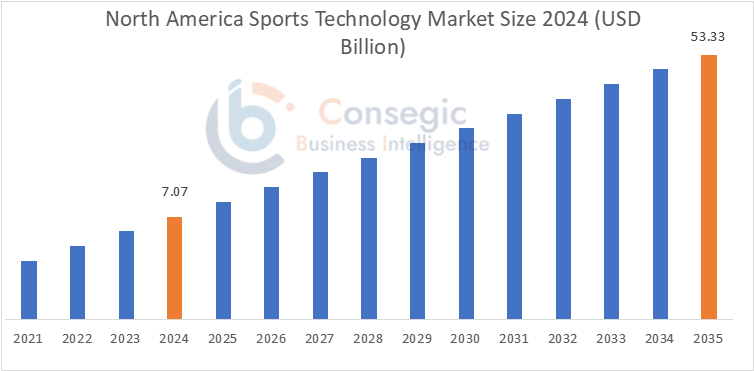
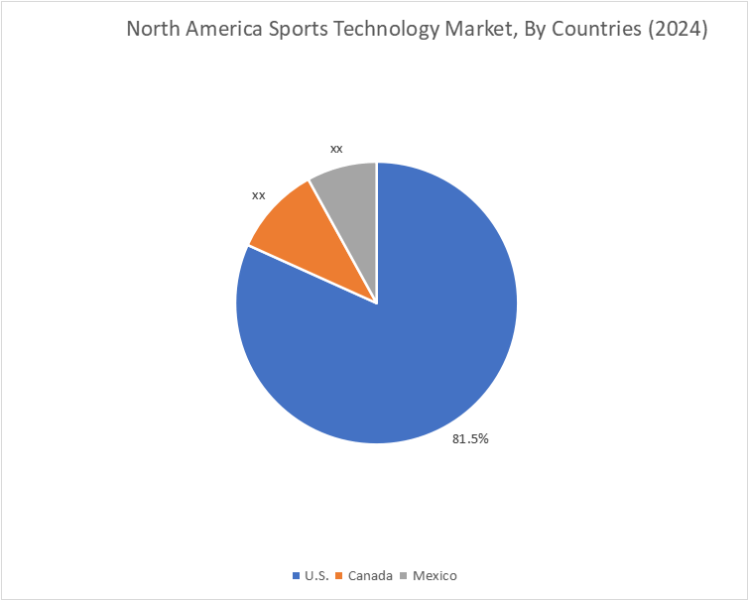
North America accounted for the highest market share in 2024, reaching 38.70%, and was valued at 7.07 billion USD, expected to reach 53.33 billion USD by 2035. The US accounted for 81.50% of the regional share, supported by strong investments in sports analytics and rising adoption of performance monitoring technologies. Professional teams are using wearable sensors, video analytics, and AI-based tools to improve athlete performance and fan engagement. For instance, in July 2025, the National Science Foundation announced an investment of 100 million USD in AI research institutes, thus boosting the growth of predictive analytics and performance monitoring systems in the sports platforms.
Asia Pacific is expected to witness the highest growth rate during the forecast period, owing to the increased investment in sports infrastructure and digital sports technologies in China, India, and Japan. The increased adoption of wearable technologies, smart stadiums, and analytics technologies is boosting the market growth. The governments are also contributing to the growth of the market. For instance, the Indian government allocated around 410 million USD (INR 3,397 crores) to the Ministry of Youth Affairs and Sports in the Union Budget 2024-25, which is utilized in schemes like Khelo India.
Competitive Landscape and Leading Companies:
The global sports technology market has a competitive nature, with prominent players providing analytics, wearable, and data-based management tools for professional sports teams, leagues, and fitness organizations around the world. Industry players are shifting focus to AI-based analytics, innovation, and strategic partnerships to enhance their competitive stance in the market. Constant innovation in wearable and analytics tools has helped industry players differentiate themselves in a competitive environment.
Prominent players in the global sports technology include
- Catapult Group International Ltd.
- Hudl
- Garmin Ltd.
- Polar Electro Oy
- Sony Group Corporation
- SAP SE
- IBM Corporation
- Zebra Technologies Corporation
- Fitbit Inc.
- Technogym S.p.A.
News & Insights:
- In February 2026, Catapult Group International Ltd. has developed a computer vision solution named Perch P2, which facilitates real-time strength training and athlete performance tracking.
- In September 2024, Polar Electro Oy has partnered with Kardi AI in September 2024 to offer arrhythmia detection capabilities in wearable devices, enhancing athlete health monitoring.
Sports Technology Market Report Insights:
| Report Attributes | Report Details |
|---|---|
| Study Timeline | 2019-2035 |
| Market Size in 2035 (USD Billion) | USD 137.80 Billion |
| CAGR (2025-2035) | 20.17% |
| By Technology |
|
| By Sports Type |
|
| By Application |
|
| By End User |
|
| By Region |
|
| Key Players |
|
| Report Coverage |
|
Key Questions Answered in the Report
How big is the sports technology market? −
The sports technology marketsize is estimated to reach over USD 137.80 Billion by 2035 from a value of USD 18.26 Billion in 2024 and is projected to grow by USD 21.94 Billion in 2025, growing at a CAGR of 20.17% from 2025 to 2035.
Which segmentation details are covered in the sports technology report? +
The sports technology report includes specific segmentation details for technology, sports type, application, end user, and regions.
Which is the fastest segment anticipated to impact the market growth? +
In the sports technology market, the fan engagement segment is anticipated to be the fastest-growing segment during the forecast period due to increasing adoption of social media and streaming platforms.
Who are the major players in the sports technology market? +
The key participants in the sports technology marketare Catapult Group International Ltd. (Australia), Hudl (U.S.), Garmin Ltd. (U.S.), Polar Electro Oy (Finland), Sony Group Corporation (Japan), SAP SE (Germany), IBM Corporation (U.S.), Zebra Technologies Corporation (U.S.), Fitbit Inc. (U.S.), Technogym S.p.A. (Italy), and others.
What are the key trends in the sports technology market? +
The sports technology market is shaped by several key trends including increasing adoption of wearable sensors for athlete monitoring, growing use of AI-driven sports analytics platforms.
Overview
Reputation & Certifications


Our Services
- Market Intelligence & Forecasting
- Custom Research Solutions
- Market Entry Strategy
- Competitive Intelligence
- Customer Insights
- Industry Innovation Analysis
- Investment Advisory