Jump to Content
Sports Analytics Market - Size, Share, Industry Trends, and Forecasts (2025-2032)
Sports Analytics Market Size:
Sports analytics market size is estimated to reach over USD 26.31 Billion by 2032 from a value of USD 4.75 Billion in 2024 and is projected to grow by USD 5.80 Billion in 2025, growing at a CAGR of 23.9% from 2025 to 2032.
Sports Analytics Market Scope & Overview:
Sports analytics involves the use of data-driven techniques to assess player performance, optimize team strategies, and enhance overall decision-making in professional and amateur sports. It integrates statistical modeling, machine learning, and real-time data collection to provide actionable insights for coaches, athletes, and management. By leveraging predictive analysis and performance tracking, teams can refine training programs, reduce injury risks, and maximize player efficiency.
Key features include player tracking systems, video analysis, biometric monitoring, and game simulation models. These tools enable precise assessment of in-game performance, tactical planning, and opponent analysis. Enhanced data visualization and AI-driven insights further improve strategic planning and scouting accuracy.
Sports organizations, leagues, and franchises utilize these solutions to gain a competitive edge, refine game strategies, and optimize talent acquisition. The integration of advanced analytics into sports management enhances operational efficiency, improves fan engagement, and drives better performance outcomes across various sporting disciplines.
How is AI Transforming the Sports Analytics Market?
There is an emerging use of AI in the sports analytics market, specifically for providing data-driven insights for improved player performance, which enables smarter strategies through pattern analysis and opponent weakness identification, and improves fan engagement with personalized content and interactive experiences. Moreover, AI-powered solutions can analyze vast datasets, ranging from wearable sensors to track player movements, physical exertion, and skill execution, providing data-backed feedback to improve training and performance. Moreover, AI solutions can also provide real-time player stats, tactical analysis, and personalized game highlights, enriching the viewing experience through interactive AR overlays and tailored content. Thus, the above factors are anticipated to boost the market growth in upcoming years.

Sports Analytics Market Dynamics - (DRO):
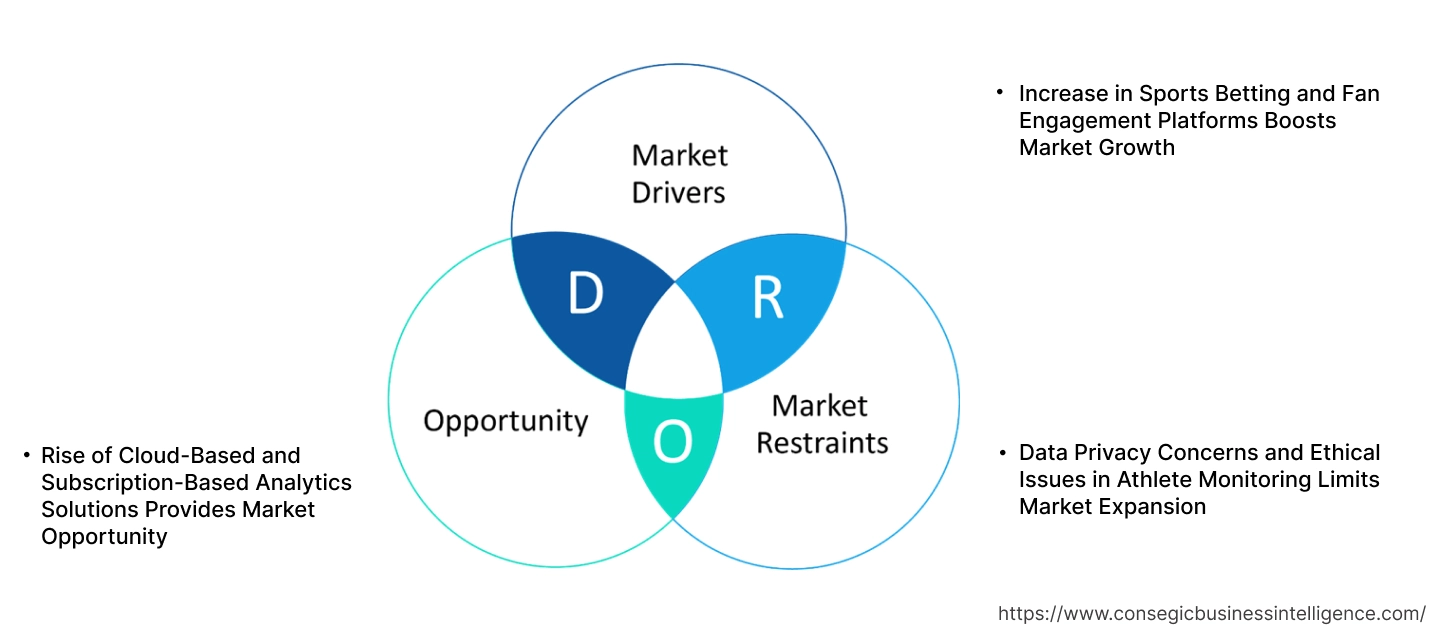
Key Drivers:
Increase in Sports Betting and Fan Engagement Platforms Boosts Market Growth
With the increasing legalization of sports betting across multiple regions, platforms are utilizing real-time player statistics, AI-driven predictive models, and historical performance data to offer accurate odds and informed betting recommendations. The demand for advanced analytics is also increasing as fans seek immersive experiences through interactive features such as live game predictions, AI-powered fantasy sports insights, and augmented reality (AR)-based viewing enhancements. Broadcasters and digital media companies are integrating real-time sports analytics into their platforms, offering customized content and engagement tools to enhance viewer retention. Additionally, the rise of micro-betting, in-game analytics, and blockchain-based wagering systems is revolutionizing fan interaction with sports. As analytics-driven betting and fan engagement solutions evolve, these advancements are expected to accelerate sports analytics market expansion, reinforcing data's role in shaping the future of the industry.
Key Restraints:
Data Privacy Concerns and Ethical Issues in Athlete Monitoring Limits Market Expansion
The growing application of biometric tracking, AI-driven performance analysis, and real-time data monitoring in professional sports has raised serious concerns regarding data privacy and ethical use of athlete information. Teams and organizations collect extensive physiological, medical, and behavioral data to optimize player performance and plan injury prevention strategies. However, the lack of clear regulations on data ownership, consent policies, and third-party access has led to increasing scrutiny. Athletes are demanding greater transparency and control over their personal data, especially as wearable devices and AI-driven analytics become standard in training and competition. Unauthorized data usage, potential exploitation in contract negotiations, and risks of cyberattacks further complicate the landscape. Additionally, variations in global data protection laws create legal uncertainties for analytics providers. As concerns over ethical data usage grow, organizations must address these challenges to balance technological advancements with athlete rights, ensuring sustainable sports market analytics growth while maintaining trust and compliance.
Future Opportunities:
Rise of Cloud-Based and Subscription-Based Analytics Solutions Provides Market Opportunity
Traditional on-premise analytics systems require high initial investments in infrastructure and technical expertise, limiting adoption among smaller teams and leagues whereas cloud-based platforms offer scalability, real-time data processing, and cost efficiency, making advanced analytics available to a broader range of users. The demand for flexible, pay-as-you-go subscription models is increasing, as organizations seek affordable AI-driven insights for player performance analysis, game strategy, and injury prevention. Additionally, cloud integration enables seamless data sharing across multiple devices and remote collaboration among coaching staff, analysts, and medical teams. These solutions also support automated data backups, enhanced security protocols, and AI-driven predictive modeling, improving decision-making capabilities. As cloud and subscription-based models continue to evolve, they are expected to drive the industry, positioning sports analytics market opportunities as a key factor in expanding data-driven strategies across all levels of competition.
Sports Analytics Market Segmental Analysis :
By Component:
By component, the sports analytics market is segmented into solutions and services.
The solutions segment held the largest revenue share in 2024.
- The demand for advanced analytics solutions in professional sports organizations is driving adoption across multiple leagues and teams.
- AI-powered performance tracking, predictive analytics, and real-time data processing are enhancing decision-making in player management.
- Sports analytics market analysis suggests that video-based analytics and biometric tracking are becoming integral to performance optimization.
- In November 2024, Apple partnered with leading conferences (ACC, SEC, and Big Ten) of college football to provide iPad Pro with nano-texture display technology to view any footage, on the field without glare, including in-game video shot from the sidelines and end zone, as well as any broadcast feeds.
- As per segmental trends, the growing focus on injury prevention and tactical planning is fueling investment in software-based solutions.
The services segment is expected to have the fastest CAGR during the forecast period.
- The need for consulting and managed services is rising as sports organizations seek expert guidance on data integration and analytics-driven strategy development.
- Cloud-based analytics services are revolutionizing data accessibility and cross-platform analysis for coaches, analysts, and franchises.
- Sports analytics market trends suggest that third-party service providers are gaining traction in training, scouting, and business intelligence.
- Therefore, the rise of analytics-as-a-service (AAAS) models is accelerating sports analytics market expansion across amateur and professional leagues.
By Deployment Mode:
By deployment mode, the market is segmented into on-premise and cloud-based.
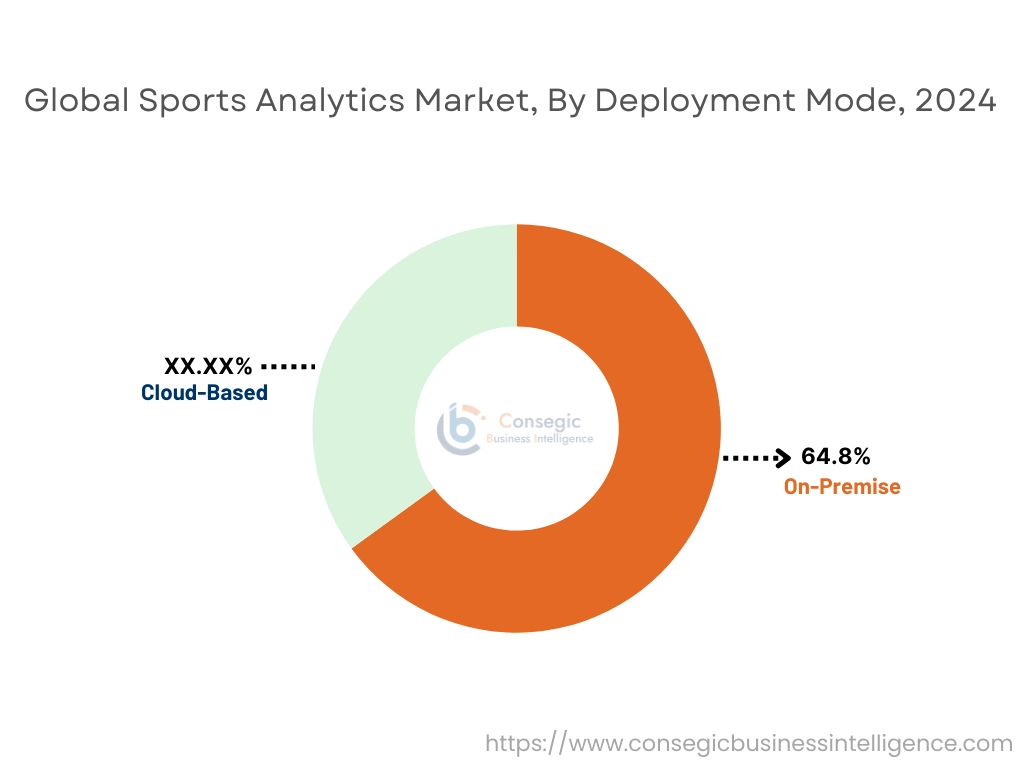
The on-premise segment held the largest sports analytics market share of 64.8% in 2024.
- Major sports organizations and franchises prefer on-premise analytics systems due to data security concerns and the need for full control over proprietary insights.
- Custom-built data centers and in-house performance tracking tools ensure high accuracy in game strategy and player evaluation.
- Sports analytics market analysis highlights the continued preference for dedicated, high-performance infrastructure in elite sports clubs.
- As per segmental trends, leagues investing in private analytics platforms are benefiting from real-time, high-frequency data processing.
The cloud-based segment is anticipated to experience the fastest CAGR during the forecast period.
- Cloud-based analytics solutions enable real-time collaboration across teams, leagues, and media companies.
- The need for scalable, cost-effective analytics platforms is driving widespread cloud adoption among sports organizations with limited IT resources.
- Market trends indicate that AI-driven cloud platforms are enhancing remote scouting, game simulations, and fan engagement.
- For instance, in November 2024, Sportlogiq acquired 8BY8, a pioneer in cloud-based video infrastructure solutions for sports. This will allow Sportlogiq to provide the most comprehensive sports evaluation tools on the market and open new avenues for innovation.
- Thus, with the growing influence of cloud computing in sports technology, cloud-based deployments are expected to drive sports analytics market growth.
By Application:
By application, the sports analytics market is segmented into player & team performance analysis, fan engagement & marketing, health & injury prevention, game strategy & planning, broadcasting & media, and ticketing & merchandise sales.
The player & team performance analysis segment held the largest share in 2024.
- Data-driven training programs, motion tracking, and predictive performance models are transforming athlete development.
- Coaches and analysts rely on AI-powered performance analytics to refine game tactics, enhance player fitness, and reduce injuries.
- The need for real-time biomechanical analysis is increasing, enabling teams to assess player efficiency and workload management.
- As per segmental trends, AI-integrated sports tracking systems are enhancing real-time player analytics in professional leagues.
The fan engagement & marketing segment is expected to experience the fastest CAGR during the forecast period.
- Sports organizations are using big data and AI to deliver personalized fan experiences, targeting audiences with customized content and promotions.
- Sports analytics market trends analysis indicates that real-time fan sentiment examination and engagement tools are reshaping the digital sports experience.
- With the growing requirement for interactive fan platforms, AI-driven analytics are improving sponsorship activations and targeted advertising.
- Therefore, market expansion is being driven by innovations in virtual fan engagement, dynamic pricing, and interactive media strategies.
By End-User:
By end-user, the market is segmented into sports teams & clubs, leagues & sports associations, coaches & analysts, athletes, broadcasting & media companies, and sponsors & advertisers.
The sports teams & clubs segment held the largest sports analytics market share in 2024.
- Professional and collegiate sports teams are integrating data analytics into every aspect of performance, recruitment, and injury prevention.
- Advanced scouting tools and biometric data analysis are helping teams identify top talent and optimize game-day strategies.
- The need for predictive analytics in player contracts and salary cap management is contributing to widespread adoption.
- As per segmental trends analysis, data-driven decision-making is now standard practice for elite sports franchises.
The broadcasting & media companies’ share is expected to experience the fastest CAGR during the forecast period.
- Broadcasters are leveraging AI-driven analytics to provide in-depth game insights, interactive content, and real-time sports statistics.
- Market trends show that media companies are utilizing advanced data visualization tools to enhance fan engagement.
- The rise of sports streaming platforms and second-screen experiences is driving the adoption of data-driven storytelling and AI-enhanced coverage.
- Thus, with the increase in immersive content and next-gen sports broadcasting, data-driven media solutions will play a key role in sports analytics market growth.
Regional Analysis:
The regions covered are North America, Europe, Asia Pacific, the Middle East and Africa, and Latin America.
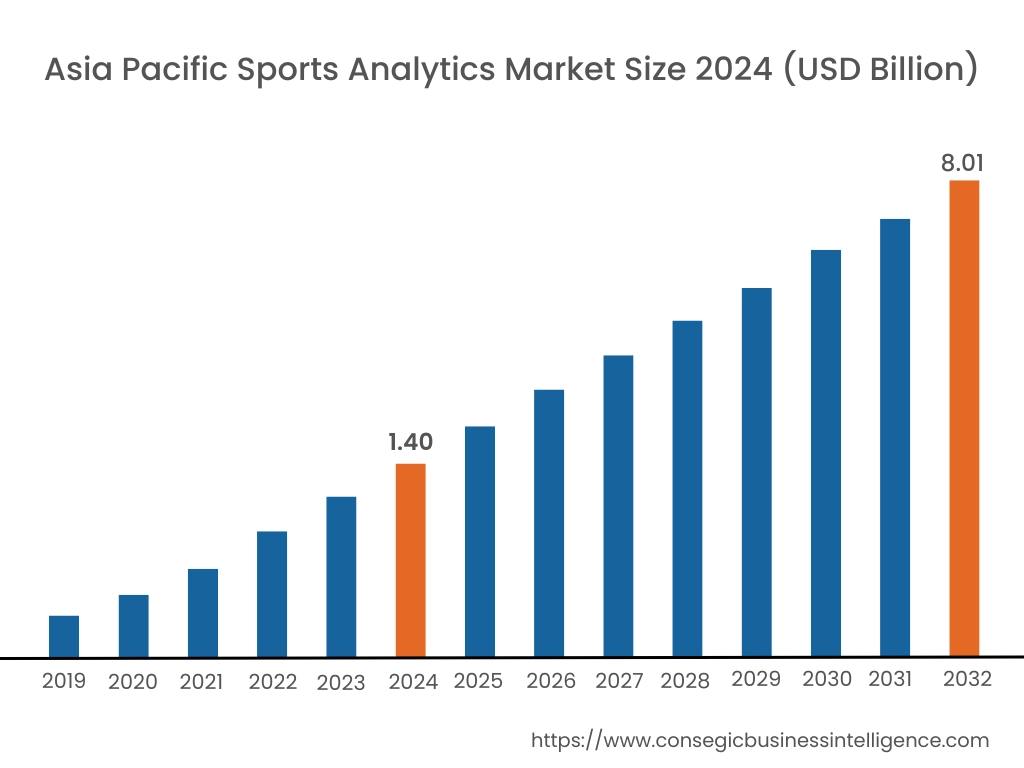
Asia Pacific region was valued at USD 1.40 Billion in 2024. Moreover, it is projected to grow by USD 1.71 Billion in 2025 and reach over USD 8.01 Billion by 2032. Out of this, China accounted for the maximum revenue share of 28.8%. Asia-Pacific is experiencing the fastest growth in the sports analytics market, driven by rapid digital transformation, rising sports investments, and increasing fan engagement initiatives. Countries such as China, India, Japan, and South Korea are leading the adoption of data-driven sports technologies, particularly in cricket, football, basketball, and esports. In India, the Indian Premier League (IPL) has set a global benchmark in utilizing sports analytics for player performance analysis, auction strategy, and fan engagement. Cricket franchises rely on advanced predictive modeling and performance simulation tools to gain strategic advantages. Similarly, China and Japan are integrating AI-based data analytics into their sports infrastructure, particularly in professional leagues and Olympic training programs. Esports analytics is a growing area of focus in Asia-Pacific, where major gaming tournaments and leagues are leveraging real-time data tracking to refine player tactics and enhance viewer experiences. With continued investments in sports technology startups, Asia-Pacific presents significant sports analytics market opportunities, particularly in expanding mobile-based analytics solutions and cloud-driven platforms.

North America is estimated to reach over USD 8.53 Billion by 2032 from a value of USD 1.58 Billion in 2024 and is projected to grow by USD 1.92 Billion in 2025. North America remains the most dominant region in the sports analytics sector, with significant investments from professional sports leagues such as the National Football League (NFL), National Basketball Association (NBA), Major League Baseball (MLB), and National Hockey League (NHL). The rising sports analytics market and in the region is largely driven by the widespread adoption of real-time data tracking, video analysis, and machine learning-based predictive analytics to optimize team performance. In addition to on-field performance improvements, franchises and sports organizations are investing heavily in fan engagement strategies, using data analytics to personalize ticketing, merchandise, and digital content experiences. The integration of artificial intelligence (AI) and cloud-based analytics platforms is further enhancing decision-making across different aspects of sports management. The presence of major technology companies and dedicated analytics firms specializing in sports solutions has positioned North America at the forefront of innovation in this industry.
Europe is another leading market for sports analytics, with a strong emphasis on football (soccer), rugby, tennis, and motorsports. The region is witnessing increasing adoption of data analytics for player scouting, injury prevention, and tactical decision-making. Many elite football clubs, including those in the English Premier League (EPL), La Liga, Bundesliga, and Serie A, have integrated advanced performance tracking systems to gain a competitive edge. A notable trend in Europe is the growing reliance on biomechanics and physiological analytics to monitor player fitness and reduce injury risks. Wearable technology is widely used to collect real-time data on player workload and endurance, enabling coaches to design personalized training regimens. Additionally, clubs are utilizing fan analytics to enhance engagement, optimize ticket pricing, and improve matchday experiences. The expansion of smart stadiums equipped with high-speed connectivity and interactive digital platforms further reflects the rising sports analytics market demand in Europe.
The Middle East & Africa region is gradually integrating sports analytics, with governments and private investors prioritizing digital transformation in sports management. Countries like Saudi Arabia, the UAE, and Qatar are at the forefront, utilizing analytics in football, athletics, and motorsports to improve performance outcomes. The rise of smart stadiums and large-scale investments in hosting global sporting events, such as the FIFA World Cup in Qatar, have driven the adoption of analytics solutions in areas such as fan engagement, player health monitoring, and event management. In Africa, the increasing professionalism of football leagues and athletics is contributing to growth in sports analytics adoption. Data-driven scouting and talent identification systems are helping clubs and national teams discover emerging athletes, while injury prevention technologies are gaining traction in physically demanding sports. However, challenges such as limited access to sports technology and high implementation costs remain barriers to widespread adoption in certain regions.
Latin America has a deeply ingrained sports culture, particularly in football, baseball, and basketball, making it a key region for adoption. Countries such as Brazil, Argentina, and Mexico are investing in player performance analytics, with football clubs at the forefront of implementing tracking technologies and video analytics for tactical planning. The demand in Latin America is also rising due to the increasing importance of fan engagement analytics, as clubs seek to expand their digital reach and maximize revenue through streaming platforms, social media, and targeted advertising. Furthermore, sports organizations are integrating AI-based injury risk assessment tools to reduce player downtime and improve team durability throughout competitive seasons. A rising development in the region is the application of sports betting analytics, where data insights help operators refine odds, predict match outcomes, and personalize user experiences. While the region faces challenges in terms of technological infrastructure and investment, the potential for growth remains strong, particularly with international partnerships and local technology initiatives aimed at enhancing data-driven sports management.
Top Key Players & Market Share Insights:
The sports analytics market is highly competitive with major players providing products and services to the national and international markets. Key players are adopting several strategies in research and development (R&D), product innovation, and end-user launches to hold a strong position in the global sports analytics market. Key players in the sports analytics industry include -
- IBM (USA)
- SAP SE (Germany)
- Kinexon (Germany)
- Sportradar (Switzerland)
- Second Spectrum (USA)
- Catapult Sports (Australia)
- STATS Perform (USA)
- Hudl (USA)
- Sportlogiq (Canada)
- Oracle Corporation (USA)
Recent Industry Developments :
Product Launches:
- In November 2024, Sportradar launched gen AI audio advertising for sportsbook and casino operators. The tool leverages the power of gen AI integrated with Sportradar’s live data, to automate the creation of personalized, real-time audio adverts for sportsbook and casino operators globally.
- In August 2024, Catapult launched live in-game video solutions with the SEC which provides real-time access to video and data to empower coaches to make informed game day decisions instantaneously.
Partnerships:
- In August 2024, Hudl and StatsBomb partnered to transform advanced data analytics by creating the most advanced data and video platform. This aims to provide users extensive data and in-depth insights along with enhanced visualization tools, enabling faster interpretation and presentation of key insights.
Sports Analytics Market Report Insights:
| Report Attributes | Report Details |
| Study Timeline | 2019-2032 |
| Market Size in 2032 | USD 26.31 Billion |
| CAGR (2025-2032) | 23.9% |
| By Component |
|
| By Deployment Mode |
|
| By Application |
|
| By End-User |
|
| By Region |
|
| Key Players |
|
| North America | U.S. Canada Mexico |
| Europe | U.K. Germany France Spain Italy Russia Benelux Rest of Europe |
| APAC | China South Korea Japan India Australia ASEAN Rest of Asia-Pacific |
| Middle East and Africa | GCC Turkey South Africa Rest of MEA |
| LATAM | Brazil Argentina Chile Rest of LATAM |
| Report Coverage |
|
Key Questions Answered in the Report
How big is the Sports Analytics Market? −
Sports analytics market size is estimated to reach over USD 26.31 Billion by 2032 from a value of USD 4.75 Billion in 2024 and is projected to grow by USD 5.80 Billion in 2025, growing at a CAGR of 23.9% from 2025 to 2032.
What specific segmentation details are covered in the Sports Analytics Market report? +
The sports analytics market report includes specific segmentation details for component, deployment mode, application and end-user.
Which is the fastest-growing region in the Sports Analytics Market? +
Asia Pacific is the fastest-growing region in the sports analytics market. These trends are encouraged by rapid digital transformation, rising sports investments, and increasing fan engagement initiatives.
Who are the major players in the Sports Analytics Market? +
The key participants in the sports analytics market are IBM (USA), SAP SE (Germany), Catapult Sports (Australia), STATS Perform (USA), Hudl (USA), Sportlogiq (Canada), Oracle Corporation (USA), Kinexon (Germany), Sportradar (Switzerland) and Second Spectrum (USA).
Overview
Reputation & Certifications


Our Services
- Market Intelligence & Forecasting
- Custom Research Solutions
- Market Entry Strategy
- Competitive Intelligence
- Customer Insights
- Industry Innovation Analysis
- Investment Advisory