Jump to Content
Stem Cell Therapy Market - Size, Industry Share, Growth Trends and Forecasts (2025 - 2035)
Stem Cell Therapy Market 2025 - 2035:
- The Global Stem Cell Therapy Market reached USD 434.96 million in 2025.
- The market is projected to expand at a CAGR of 20.17% during 2025–2035.
- The global market size is forecast to reach USD 2,731.54 million by 2035.
- Asia Pacific is anticipated to witness the highest growth during the forecast period.
Market Scope & Overview:
Stem cell therapy is the application of stem cells for repairing, replacing, or regenerating damaged tissues and organs of the body. These therapies include stem cells derived from tissues such as bone marrow, adipose, and umbilical cord blood, among other sources. They are applied in the treatment of diseases such as blood disorders, orthopedic injuries, neurological disorders, and autoimmune diseases, among other conditions.
The market is driven by factors such as the increasing number of chronic diseases, demand for regenerative medicine, increasing research and development in biotechnology, and improved technology for stem cell processing and applications in personalized medicine.
Market Size & Forecast
- 2024 Market Size : USD 361.95
- 2025 Market Size : USD 434.96 Million
- 2035 Projected Market Size : USD 2731.54 Million
- CAGR (2025-2035) : 17%
- Largest Market in 2025: North America
How is AI Impacting the Stem Cell Therapy Market?
AI uses machine learning to analyze large biological datasets to identify optimal stem cell types and differentiation pathways for regenerative therapies. Moreover, AI also helps researchers observe the pattern of growth, viability, and differentiation of cells during the development of stem cell therapy in the lab and during clinical development, which helps in the quality of treatment. Furthermore, AI helps in the development of stem cell therapy and treatment through the prediction of the behavior of stem cells when they interact with damaged tissues and disease environments. Moreover, AI helps in the analysis of data from the results of clinical trials, which helps in the optimization of treatment and the development of personalized stem cell therapy.

Stem Cell Therapy Market Dynamics - (DRO):
Key Drivers:
Rising global cancer incidence driving demand for stem cell-based treatments
The market for stem cell therapy is also increasing due to the rising incidence of cancer and blood-related disorders worldwide. Stem cell transplantation is commonly used for the treatment of leukemia, lymphoma, and other blood-related disorders. As the incidence of cancer increases, the number of patients requiring advanced treatments also increases, hence the demand for stem cell therapy and transplantation.
- For example, according to the World Health Organization, cancer is one of the major causes of death worldwide, and the number of new cases is expected to increase significantly, reaching 35 million cases by the year 2050.
Thus, the increase in the number of patients suffering from cancer and other blood-related disorders is driving the stem cell therapy market.
Key Restraints:
High treatment cost and strict regulatory requirements are restraining the market growth
Stem cell therapy is a complex research area, and the treatment procedures involve complex research and clinical trials. The cost of stem cell therapy is high due to the advanced procedures involved in the lab and the expertise of the medical professionals involved in the treatment. This limits accessibility for many patients. Regulatory approval for stem cell therapies is also strict. Authorities require extensive clinical evidence for safety and effectiveness. The approval process takes time and increases development costs.
Therefore, high treatment cost and regulatory challenges are restraining the stem cell therapy market expansion.
Future Opportunities:
Approval of allogeneic stem cell therapies for regenerative medicine applications creates new growth opportunities for the market
The increasing approval of stem cell–based regenerative therapies is creating new growth opportunities in the stem cell therapy market. Healthcare practitioners are using sophisticated cell therapies to treat various medical conditions such as blood-related disorders, immune system-related diseases, and tissue-related conditions. Allogeneic stem cell therapies are beneficial in that they are scalable, have standardized treatment methods, and are more accessible to patients. This is helping to increase the business opportunity for regenerative medicine therapies.
- For example, in December 2024, the S. Food and Drug Administration (FDA) approved Ryoncil (Remestemcel-L), an allogeneic mesenchymal stromal cell therapy developed by Mesoblast, for the treatment of steroid-refractory acute graft-versus-host disease in pediatric patients.
Hence, the approval and commercialization of advanced stem cell therapies are expected to accelerate clinical adoption and investment in regenerative medicine technologies.
Stem Cell Therapy Market Segmental Analysis:
By Therapy Type:
Based on therapy type, the stem cell therapy market is segmented into autologous stem cell therapy and allogeneic stem cell therapy.
Trends in the Therapy Type:
- The increasing use of personalized medicine approaches is driving demand for autologous stem cell therapy.
- The increasing availability of off-the-shelf stem cell therapy is also helping the growth of allogeneic therapy.
Autologous Stem Cell Therapy accounted for the largest revenue share in the year 2024.
- Autologous therapy uses the stem cells available in the body of the patient. Therefore, the chances of rejection of the cells are low.
- Autologous therapy is commonly used for the treatment of blood disorders.
- Furthermore, the chances of compatibility and fewer chances of complications also aid the growth.
- Further, increasing clinical research in tissue repair and regenerative treatments is boosting growth.
- Thus, as per the stem cell therapy market analysis, better compatibility and reduced rejection risk are driving dominance of autologous stem cell therapy.
Allogeneic Stem Cell Therapy is anticipated to register the fastest CAGR during the forecast period.
- Allogeneic therapy uses stem cells from a donor. These treatments can be prepared in advance.
- They allow large-scale production of stem cell products. This supports wider clinical use.
- Further, advancements in cell processing and storage technologies are improving treatment availability.
- Therefore, as per the market analysis, increasing development of ready-to-use therapies is expected to boost the allogeneic stem cell therapy segment during the forecast period.
By Cell Source:
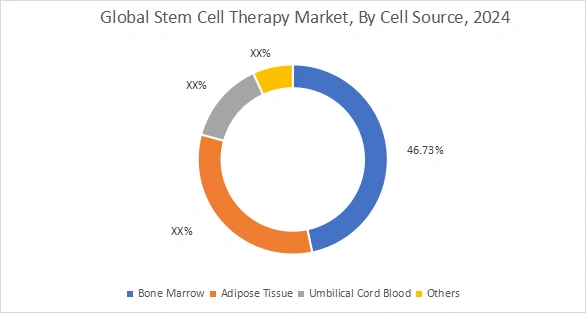
Based on cell source, the stem cell therapy market is segmented into bone marrow, adipose tissue, umbilical cord blood, and others.
Trends in the Cell Source:
- The increasing use of bone marrow-derived stem cells in clinical treatments is driving demand in regenerative medicine.
- The growing interest in minimally invasive stem cell extraction methods is supporting adoption of adipose tissue sources.
Bone Marrow accounted for the largest revenue share of 46.73% in 2024.
- Bone marrow is one of the most widely used sources of stem cells. It is commonly used in transplantation procedures.
- These stem cells are used to treat blood-related disorders and immune system diseases.
- Additionally, long-term clinical research and established treatment protocols support segment growth.
- Further, increasing number of stem cell transplant procedures is boosting demand.
- Thus, as per the stem cell therapy market analysis, strong clinical evidence and widespread use are driving dominance of bone marrow as a cell source.
Umbilical Cord Blood is anticipated to register the fastest CAGR during the forecast period.
- Umbilical cord blood contains a high concentration of stem cells. It offers strong regenerative potential.
- These cells are easier to collect and store compared to other sources.
- Additionally, rising awareness about cord blood banking is supporting segment growth.
- Further, increasing research in regenerative medicine and genetic disorder treatments is accelerating adoption.
- Therefore, as per the market analysis, growing focus on advanced regenerative therapies is expected to boost the umbilical cord blood segment during the forecast period.
By Application:
Based on application, the stem cell therapy market is segmented into oncology, cardiovascular diseases, orthopedic disorders, neurological disorders, autoimmune diseases, and others.
Trends in the Application:
- The increasing prevalence of cancer is driving demand for stem cell therapy in oncology treatments.
- The growing focus on regenerative medicine is supporting research in neurological and cardiovascular disease treatments.
Oncology accounted for the largest revenue share in the year 2024.
- Stem cell therapy is widely used in cancer treatment. It helps restore damaged bone marrow after chemotherapy.
- These therapies are commonly used in leukemia and lymphoma treatment.
- Additionally, increasing number of stem cell transplant procedures is supporting segment growth.
- Further, rising cancer incidence worldwide is boosting demand for advanced treatment options.
- Thus, as per the stem cell therapy market analysis, strong clinical use in cancer treatment is driving dominance of the oncology segment.
Neurological Disorders are anticipated to register the fastest CAGR during the forecast period.
- Stem cell therapy is being studied for treating neurological conditions. These include Parkinson’s disease and spinal cord injuries.
- These therapies aim to repair damaged nerve cells and restore function.
- Additionally, growing research in regenerative neurology is supporting segment growth.
- Further, increasing clinical trials for neurodegenerative diseases are accelerating adoption.
- Therefore, as per the market analysis, expanding research in regenerative treatments is expected to boost the neurological disorders segment during the forecast period.
Regional Analysis:
North America, Europe, Asia Pacific, the Middle East and Africa, and Latin America are the regions of coverage.
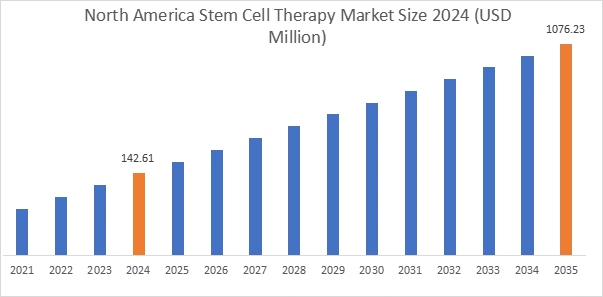
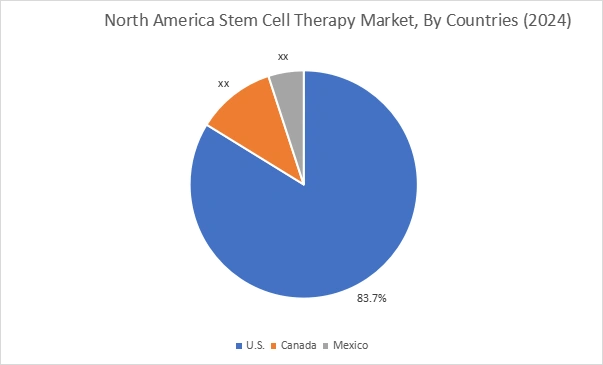
In 2024, North America accounted for the highest market share at 39.40% and was valued at USD 142.61 Million, and is expected to reach USD 1076.23 Million by 2035. In North America, the U.S. accounted for the highest market share of 83.70% during the base year of 2024. The North America stem cell therapy market is driven by robust research infrastructure in the region's biotechnology sector, high clinical trial activity, and the availability of regulatory pathways for stem cell therapies in the US and Canada. Pharmaceutical companies, research organizations, and biotechs are investing in stem cell-based therapies for cancer, autoimmune conditions, and degenerative disorders, hence driving the stem cell therapy market growth in North America.
- For instance, in 2024, the US Food and Drug Administration (FDA) issued several regenerative medicine advanced therapy (RMAT) designations to stem cell-based therapeutic candidates for fast-tracking their development and review. The RMAT designation program enables faster clinical evaluation of regenerative treatments and supports expansion of stem cell therapy research in the region.
The Asia Pacific stem cell therapy market is experiencing the fastest growth over the forecast period. Asia Pacific stem cell therapy market growth is supported by expanding regenerative medicine research programs and increasing clinical trials across China, Japan, and South Korea. Government-backed biomedical innovation initiatives and hospital-based cell therapy programs are strengthening development of stem cell–based treatments for neurological, cardiovascular, and orthopedic disorders, thereby driving market growth.
- For example, in 2024, the National Institutes of Health stated that more than 8,000 stem cell-related clinical studies were registered in the Clinical Trials database worldwide, with a substantial number of studies from Asia, including China, Japan, and South Korea. The growing volume of registered clinical trials reflects accelerating research activity and therapeutic development for stem cell–based treatments across the region.
Europe stem cell therapy market growth is supported by collaborative biomedical research networks and regulatory oversight for advanced therapy medicinal products across Germany, France, and the UK.
Latin America stem cell therapy market growth is supported by expanding clinical research programs and growing biotechnology investments in Brazil and Argentina.
Middle East & Africa stem cell therapy market growth is supported by medical research expansion and specialized treatment centers in the UAE, Saudi Arabia, and South Africa.
Top Key Players & Market Share Insights:
The global stem cell therapy market is highly competitive, with key players in the biotechnology and pharmaceutical industries developing advanced technologies in the field of regenerative medicine for the treatment of various chronic and degenerative conditions. Key players are adopting several strategies in research and development, clinical trial expansion, strategic collaborations, and therapy commercialization to maintain a strong position in the stem cell therapy industry. Key participants in the market for stem cell therapy include:
- Hoffmann-La Roche Ltd. (Switzerland)
- Novartis AG (Switzerland)
- Gilead Sciences, Inc. (U.S.)
- Mesoblast Limited (Australia)
- Astellas Pharma Inc. (Japan)
- Fate Therapeutics, Inc. (U.S.)
- Pluri Inc. (Israel)
- Gamida Cell Ltd. (U.S.)
- Osiris Therapeutics, Inc. (U.S.)
- Takeda Pharmaceutical Company Limited (Japan)
Recent Industry Developments:
- In May 2025, BrainStorm Cell Therapeutics gained U.S. FDA approval to begin a Phase 3b clinical trial for its autologous stem-cell-based therapeutic, NurOwn, for the treatment of amyotrophic lateral sclerosis (ALS). This will help to further evaluate the safety and effectiveness of the treatment for patients with this progressive neurodegenerative disease.
- In August 2025, jCyte Inc. announced that the first patients in the JC02-88 clinical trial to evaluate jCell (famzeretcel) for the treatment of retinitis pigmentosa have been treated. The study investigates a higher-dose stem cell therapy designed to improve retinal function and slow vision loss in patients with the inherited eye disorder.
Stem Cell Therapy Market Report Insights:
| Report Attributes | Report Details |
|---|---|
| Study Timeline | 2019-2035 |
| Market Size in 2035 (USD Million) | USD 2731.54 Million |
| CAGR (2025-2035) | 20.17% |
| By Therapy Type |
|
| By Cell Source |
|
| By Application |
|
| By Region |
|
| Key Players |
|
| Report Coverage |
|
Key Questions Answered in the Report
How big is the stem cell therapy market? −
The stem cell therapy market size is estimated to reach over USD 2731.54 Million by 2035 from a value of USD 361.95 Million in 2024 and is projected to grow by USD 434.96 Million in 2025, growing at a CAGR of 20.17% from 2025 to 2035.
Which segmentation details are covered in the stem cell therapy report? +
The stem cell therapy report includes specific segmentation details for therapy type, cell source, application, and regions.
Which is the fastest segment anticipated to impact the market growth? +
In the stem cell therapy market, the neurological disorders segment is anticipated to be the fastest-growing segment during the forecast period due expanding research in regenerative treatments.
Who are the major players in the stem cell therapy market? +
The key participants in the stem cell therapy market are F. Hoffmann-La Roche Ltd. (Switzerland), Novartis AG (Switzerland), Gilead Sciences, Inc. (U.S.), Mesoblast Limited (Australia), Astellas Pharma Inc. (Japan), Fate Therapeutics, Inc. (U.S.), Pluri Inc. (Israel), Gamida Cell Ltd. (U.S.), Osiris Therapeutics, Inc. (U.S.), Takeda Pharmaceutical Company Limited (Japan), and others.
What are the key trends in the stem cell therapy market? +
The stem cell therapy market is being shaped by several key trends including increasing investment in regenerative medicine research, growing number of clinical trials exploring stem cell-based treatments.
Overview
Reputation & Certifications


Our Services
- Market Intelligence & Forecasting
- Custom Research Solutions
- Market Entry Strategy
- Competitive Intelligence
- Customer Insights
- Industry Innovation Analysis
- Investment Advisory