Jump to Content
Teflon Heat Exchanger Market - Size, Share, Industry Trends, and Forecasts (2025-2032)
Teflon Heat Exchanger Market Size:
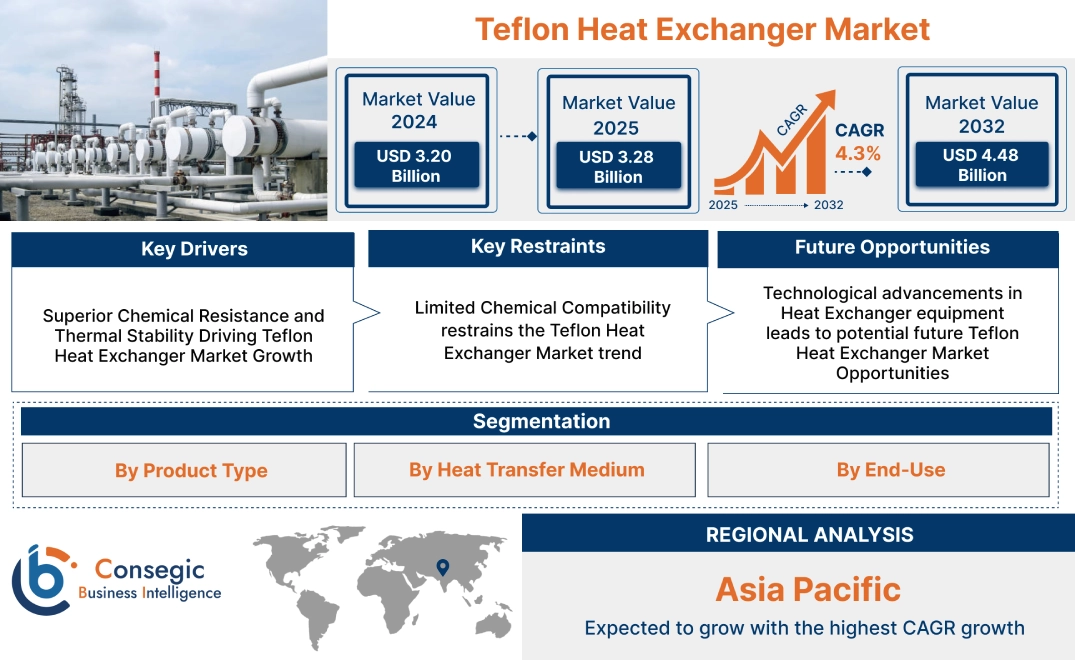
Teflon Heat Exchanger Market size is estimated to reach over USD 4.48 Billion by 2032 from a value of USD 3.20 Billion in 2024 and is projected to grow by USD 3.28 Billion in 2025, growing at a CAGR of 4.3% from 2025 to 2032.
Teflon Heat Exchanger Market Scope & Overview:
A heat exchanger is a device that facilitates the transfer of heat between two fluids without them mixing, used in various applications for heating, cooling, and energy recovery processes. Teflon heat exchangers, utilizing PTFE (Teflon) tubing, are designed for corrosive environments due to PTFE's chemical inertness and high temperature resistance. They offer a robust solution for heating, cooling, and condensing applications.These heat exchangers come in various types, including shell and tube, immersion coil, and plate heat exchangers, designed for applications involving corrosive or high-purity fluids.PTFE is highly resistant to almost all chemicals, making these heat exchangers ideal for applications involving corrosive fluids.Teflon heat exchangers have a compact, lightweight design, making them suitable for various applications such as heating, cooling, condensing, metal finishing, and chemical processing. Their end-user industries include chemical, pickling, electroplating, medicine, anodizing and other industries.
Teflon Heat Exchanger Market Dynamics - (DRO) :
Key Drivers:
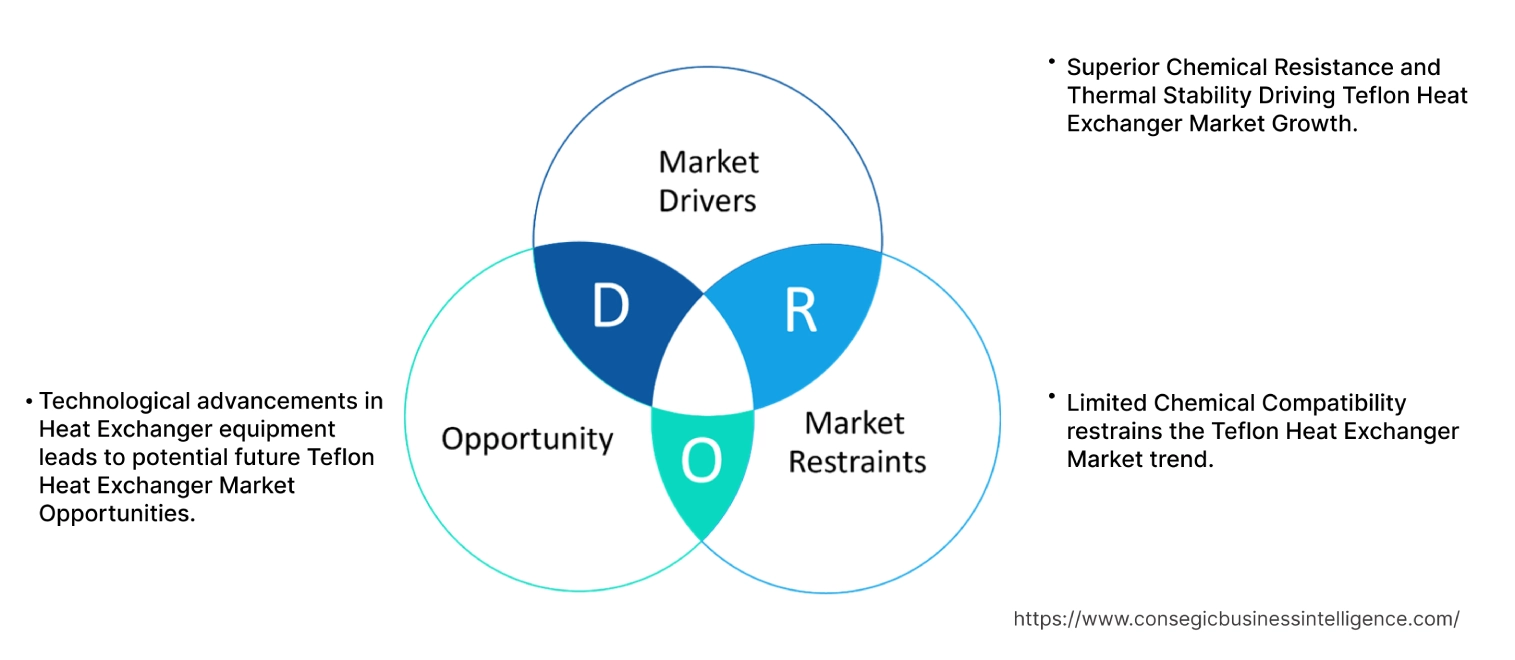
Superior Chemical Resistance and Thermal Stability Driving Teflon Heat Exchanger Market Growth
PTFE is known for its resistance to almost all chemicals, making it a suitable material for applications involving corrosive fluids.Teflon (PTFE) heat exchangers offerexceptional corrosion resistance due to PTFE's chemical inertness, making them ideal for use with a wide range of corrosive fluids and harsh environments, including those with high temperatures.Known for their durability and long service life, especially in corrosive environments they are super resistant to corrosion and aging. As a result, they are suitable for both steam heating and hot water heating.
PTFE is one of the most thermally stable plastic materials. Teflon (PTFE), used in heat exchangers, exhibits excellent thermal stability,withstanding temperatures from -200 to 260°C (-328 to 500°F) and maintaining its properties and chemical inertness across this range.There are no appreciable decompositions at 260°C, so that PTFE, at this temperature, still possesses most part of its properties. Its appreciable decomposition begins at over 400°C.
- For instance, in January 2025, Alfa Laval developed a piece of pioneering, industry-first technology that revolutionized dairy processing by dramatically reducing water, chemical and energy use during pasteurization, increasing uptime and boosting profitability, and protecting the environment as a result. Alfa Laval’s Extend is an easy-to-install add-on to heat exchangers that significantly lowers the build-up of bacteria in the equipment, and in doing so prolongs the operational uptime of pasteurizers by reducing the need for, and associated costs of, cleaning in place (CIP).
Thus, the resistance to corrosion ability and thermal stability makes them excellent materials for heat exchangers, boosting the Teflon heat exchanger market demand.
Key Restraints:
Limited Chemical Compatibility restrains the Teflon Heat Exchanger Market Trend.
Teflon (PTFE) heat exchangers offer advantages like chemical inertness and high temperature resistance, but also have limitations, including potential for creep or compression set, and specific chemical compatibility issues. PTFE can be prone to creep (deformation under sustained load) and compression set (permanent deformation after compression), which can affect the performance of the heat exchanger.While PTFE is generally inert, it is not compatible with all chemicals, especially sodium and alkalis at elevated temperatures. PTFE exhibits incompatibility with molten alkali metals and fluorinating agents as they chemically attack the material. It is only attacked by alkaline metals in the elementary state, by chlorine trifluoride and by elementary fluorine at high temperatures and pressures.
Thus, the limited chemical compatibility of Teflon heat exchangers limits the Teflon heat exchanger market expansion.
Future Opportunities :
Technological advancements in Heat Exchanger equipment leads to potential future Teflon Heat Exchanger Market Opportunities.
Technological advancements in Teflon (PTFE) heat exchangers focus on improving efficiency, durability, and sustainability, including innovations in manufacturing, materials, and design, such as hollow fiber membrane heat exchangers and smart technologies.Researchers are exploring the use of thin, hollow PTFE fibers assembled into shell-and-tube membrane heat exchangers, which exhibit excellent heat transfer coefficients and anti-corrosion performance.The development of new polymer-based materials and composites for heat transfer components is also a key area of innovation and has the potential to impact their growth.
PTFE's inherent chemical inertness makes it a strong choice for applications involving corrosive fluids, ensuring the longevity and reliability of heat exchangers.PTFE coatings can effectively reduce the rate of ion adsorption on metal surfaces, preventing fouling and maintaining heat exchanger performance. Advanced fabrication techniques and material selection enable PTFE heat exchangers to withstand high temperatures and pressures in demanding industrial applications.
- For instance, in November 2024, Alfa Laval, a global leader in heat transfer technology, introduced the T25 semi-welded plate heat exchanger—a compact yet powerful innovation designed to meet the demands of the modern energy system. It plays a vital role in the decarbonisation journey by supporting the scale-up of clean energy sources like green hydrogen, while also delivering benefits to established sectors, including the heating and cooling of buildings, heavy process industries, and power production. It is the first in Alfa Laval’s new line of semi-welded plate heat exchangers, offering a wide range of plate and gasket materials tailored to withstand demanding applications.
Thus, the technological advancements in heat exchangers is expected to boost Teflon heat exchanger market opportunities, ensuring application diversity.
Teflon Heat Exchanger Market Segmental Analysis :
By Product Type:
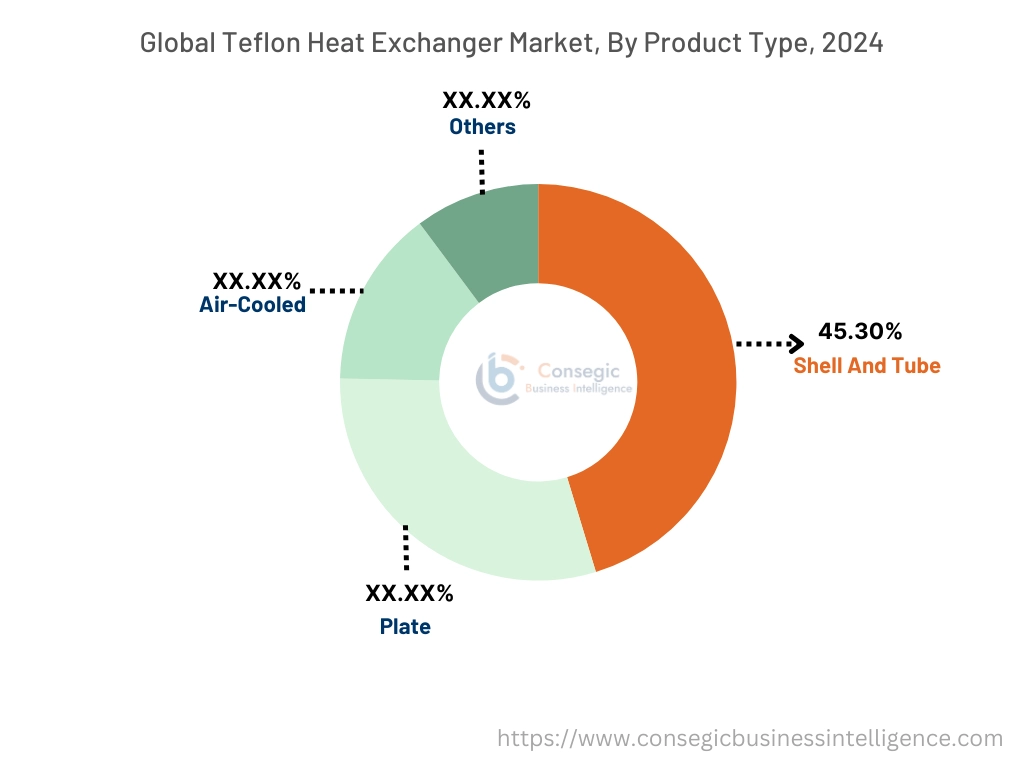
Based on product type, the market is segmented into shell and tube, plate, air-cooled, and others.
The Shell and Tube segment accounted for the largest revenue in the Teflon Heat Exchanger Market share of 45.30% in 2024 and is anticipated to register the fastest CAGR growth during the forecast period.
- Shell and Tube are the leading market trend and are the most widely used heat exchangers. They have the ability to handle high pressures and temperatures, versatility in fluid handling, and large surface area for efficient heat transfer, making them suitable for various industrial applications.
- This design provides a large surface area for heat transfer, crucial for efficient heat exchange between fluids.
- Shell and tube heat exchangers are robust and withstand high pressures and temperatures, making them suitable for demanding industrial processes.
- They handle a variety of fluids, including gases, liquids, and two-phase mixtures, enhancing their versatility.
- For instance, in January 2024, Newark Cylinders launched the Heat Geek Mini Store - a range of super-compact, highly efficient, Shell & Tube Heat Exchangers, designed by leading heating experts, Heat Geek. At around a quarter to a third of the size of conventional hot water cylinders, the Mini Store range offers installers and homeowners a highly viable back up option for decarbonizing homes, in instances where the market leading HG Series/ Super Cylinders (or any other cylinder on the market) simply won’t fit.
- Thus, the shell and tube is the most used segment and accounts for the largest revenue in the Teflon Heat Exchanger Market.
By Heat Transfer Medium:
Based on heat transfer medium, the market is segmented into water, oil, gas and steam.
Water segment is accounted for the largest revenue in the Teflon heat exchanger market in 2024 and is anticipated to have the highest CAGR during the forecast period.
- In a Teflon (PTFE) heat exchanger, water is used as a heat transfer fluid, flowing through the tubes to either heat or cool a chemical bath or process fluid, leveraging PTFE's chemical inertness and non-stick properties.
- Water, or other fluids, circulates through the tubes of the Teflon heat exchanger, acting as the medium for heat transfer.
- Water's superior ability to absorb and release heat makes it the perfect choice for cooling and heating coils, while air, with its lower heat capacity, is ideal for circulating temperature-controlled air throughout a building.
- The heat exchanger is typically submerged in a chemical bath or used to heat or cool a process fluid, allowing the heat to be transferred between the water and the chemical or fluid.
- For instance, in October 2024, Alfa Laval, a global leader in heat transfer technology, and Build to Zero, a developer of Electrothermal Energy Storage (ETES) technology, have taken a significant step forward in their strategic cooperation. The partnership just kicked off the manufacturing of an innovative once-through heat exchanger designed to produce medium-pressure clean steam. Alfa Laval’s contribution to this partnership includes the production of a once-through steam generator, which represents a breakthrough in molten-salt and water heat exchanger technology.
- Thus, water capability to absorb and release heat makes it the largest heat transfer medium in the Teflon Heat Exchanger market.
By End-Use:
Based on end-use, the market is segmented into semiconductor, chemical, pharmaceutical, food and beverage, HVAC industry.
The chemical segment accounted for the largest revenue share in the Teflon Heat Exchanger market in 2024.
- Teflon's chemical inertness and resistance to corrosion make it ideal for handling a wide range of chemicals, including acids, bases, and solvents, which are common in chemical processing.
- Teflon's chemical inertness and resistance to corrosion make it ideal for handling a wide range of chemicals, including acids, bases, and solvents, which are common in chemical processing.
- The non-stick nature of Teflon prevents scaling and fouling on the heat transfer surfaces, maintaining efficient heat transfer and reducing the need for cleaning or maintenance.
- Many chemical baths are designed to hold a host of different chemicals. The need to uniformly heat or cool these chemicals is met by the use of these universal heat exchangers.
- For instance, in November 2023, Alleima completed the expansion of its Mehsana manufacturing facility in India with the formal launch of a new heat exchanger tube factory. This new facility will enhance the capacity and capabilities of the production unit to produce advanced alloys in application tubing like heat exchanger tubes for critical applications in Chemical and Petrochemical as well as the Renewable Energy segment.
- Thus, the analysis highlights that the chemical segment holds the largest revenue share in the Teflon heat exchanger market.
The pharmaceutical segment is expected to register the fastest CAGR growth during the forecast period.
- Teflon (PTFE) heat exchangers are valuable in the pharmaceutical sector due to their high corrosion resistance and ability to maintain product purity, ensuring the integrity of medications and healthcare items.
- Teflon heat exchangers can operate across a wide temperature range, making them suitable for various pharmaceutical processes.
- They are used to heat or cool various fluids and chemical baths used in pharmaceutical manufacturing. They are also used as condensers in distillation or extraction processes to ensure efficient and pure product recovery.
- The non-reactive nature of PTFE prevents interaction between the heat exchanger material and pharmaceutical products.
- For instance, in March 2024, Romaco Tecpharm developed a new energy recovery system (ERS) enabling up to 50% savings in thermal energy consumption during tablet coating. The technology is based on the recovery of waste heat generated during the coating process. This innovative energy recovery system is a landmark development on the road to more sustainability in pharmaceutical production as the energy saving achieved with the ERS can be precisely measured and mapped with the help of the energy monitor.
- Thus, their ability to maintain the purity of the product improves their market trend, making them the fastest growing market trend.
Regional Analysis:
The regions covered are North America, Europe, Asia Pacific, the Middle East and Africa, and Latin America.
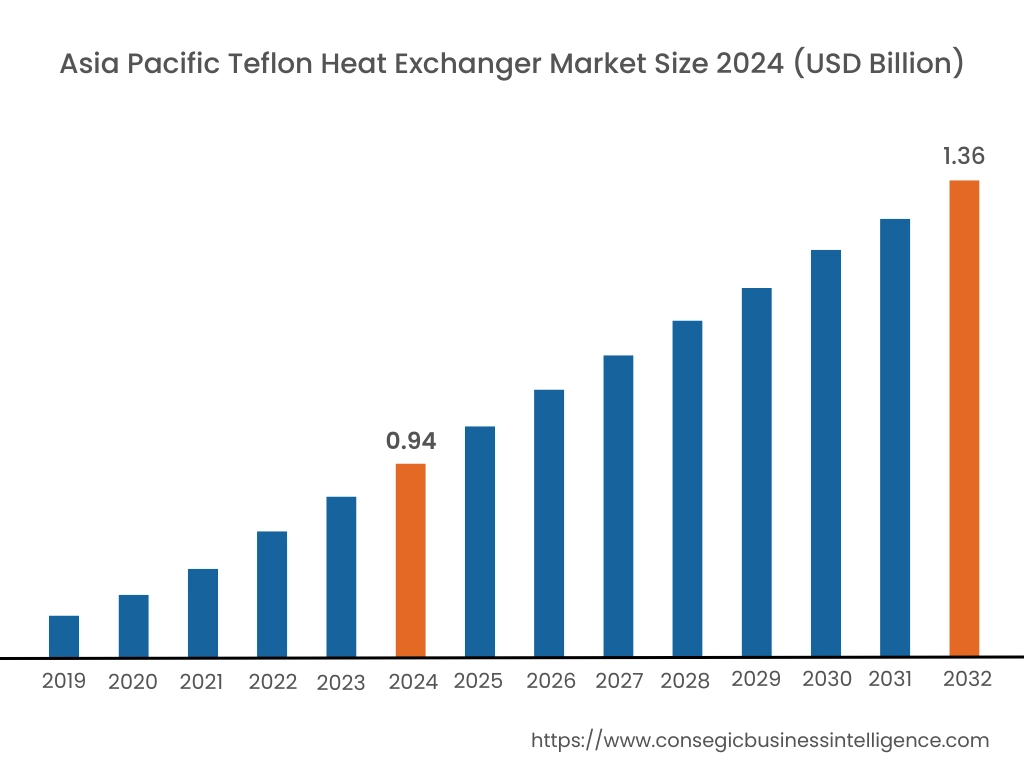
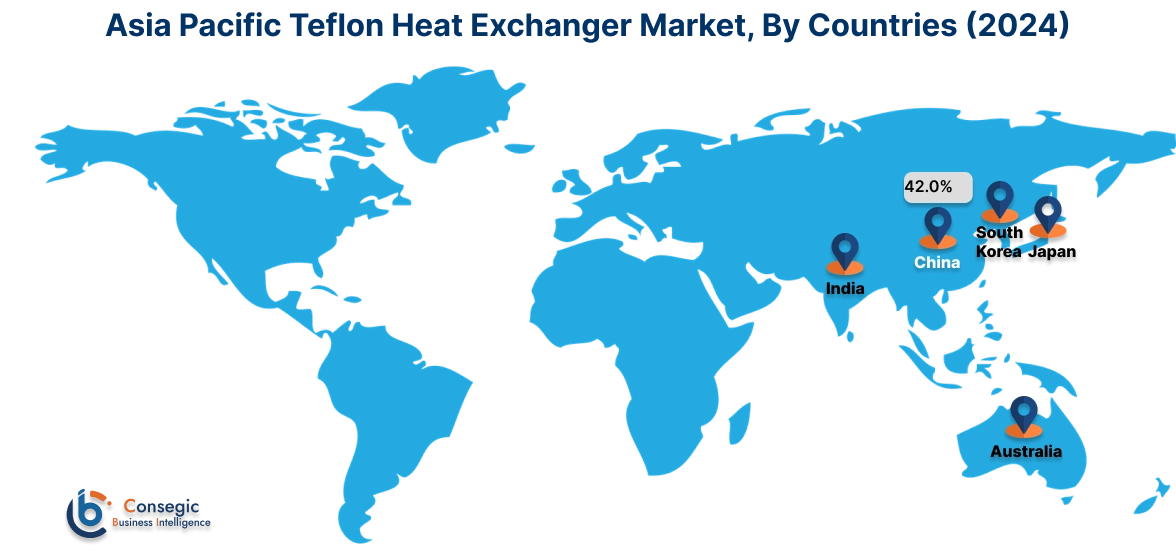
Asia Pacific region was valued at USD 0.94 Billion in 2024. Moreover, it is projected to grow by USD 0.97 Billion in 2025 and reach over USD 1.36 Billion by 2032. Out of this, China accounted for the maximum revenue share of 42.0%.
The Asia-Pacific region has the largest revenue share in the global Teflon Heat Exchanger Market. The Asia-Pacific region is a major market for Teflon heat exchangers, with a significant share of the global market.This is driven by the region's strong industrial base, particularly in chemical, food, and pharmaceutical industries.
The region's industrial growth, particularly in countries like China, India, and Japan, drives the need for durable and corrosion-resistant heat exchangers. They are used in industries requiring superior corrosion resistance and longevity, particularly in applications involving corrosive fluids and high temperatures, such as chemical processing and food processing. Teflon heat exchangers are used in chemical plants for heating, cooling, and heat recovery processes, where the fluids being handled are corrosive.In food and beverage industries, they are used for pasteurization, sterilization, and other processes where maintaining the integrity of the product is crucial.
- For instance, in October 2024, Conflux Technology, a world leading heat transfer and additive manufacturing (AM) company, an Australian company, announced a $11M Series B capital raise for further technology development and increased customer support across the globe. Conflux Technology is solving the world’s heat exchange limitations while helping its customers achieve net zero by manufacturing heat exchangers that are lighter, smaller, and can conform to unique geometries. With additive manufacturing, Conflux has the ability to print a high performance heat exchanger as a single part, saving on time, materials, and energy to produce the products more efficiently and reduce environmental footprint.
Thus, the Teflon Heat Exchanger Market analysis highlights the dominance of Asia-Pacific region in the market growth due to the industrial advancement in the region.
North America is estimated to reach over USD 1.45 Billion by 2032 from a value of USD 1.06 Billion in 2024 and is projected to grow by USD 1.09 Billion in 2025.
In the North American market, Teflon heat exchangers, specifically those made with PTFE (Teflon), are favored for their corrosion resistance and are used in various industries, with companies like Ametek and Allied Plating Supplies offering shell and tube, and immersion heat exchangers. There has been significant growth of PTFE heat exchangers in North America, driven by factors like rising demand for corrosion resistance, increasing applications in chemical industries, and a focus on energy efficiency. In power plants, PTFE heat exchangers with fluoropolymer tubing are used in FGD systems to capture waste energy and clean exhaust gases, improving efficiency and reducing harmful emissions.The use of PTFE heat exchangers helps in energy optimization in modern industrial processes, especially in the face of rising energy prices.PTFE can withstand high temperatures (up to 250°C), making it suitable for applications involving high-temperature vessels and acid substances.
- For instance, in October 2024,Kurita America, part of the leading global provider of industrial water treatment solutions the Kurita Group, today announced the introduction of Kurita Dropwise Condensation Technology in the North American marketplace. Kurita Dropwise Condensation Technology is dosed continuously into the steam line in front of the target heat exchanger to increase the water repellency of surfaces, which greatly enhances heat transfer efficiency. The steam generated from the boiler releases latent heat when condensing on the surface of the heat exchanger and stays in a film form. This is a significant factor inhibiting heat conduction in production processes.
Thus, the Teflon Heat Exchanger Market analysis shows that the trend for PTFE heat exchangers is growing in North America, driven by factors like rising demand for corrosion resistance, increasing applications in chemical industries, and a focus on energy efficiency.
In the European region, Teflon (PTFE) heat exchangers have shown tremendous growth and are used in applications requiring resistance to corrosive chemicals and high temperatures, particularly in chemical processing, metal finishing, and flue gas desulfurization (FGD) in fossil-fueled power plants.The anti-adhesion properties of PTFE prevent clogging of working surfaces, ensuring constant heat transfer.They are used in chemical baths, reactors, and storage tanks for heating and cooling corrosive chemicals.They are also employed in pickling tanks and plating baths for metal strip production and other metalworking processes.
Thus, the market analysis shows the growing trend of PTFE Heat Exchangers in the European region due to the array of benefits offered by them.
Teflon (PTFE) heat exchangers, known for their chemical inertness and high temperature resistance, are used in the Middle East and Africa for applications involving corrosive chemicals, particularly in industries like chemical processing, power generation, and food processing.PTFE heat exchangers are used for cooling and heating processes in petrochemical plants, where corrosive chemicals are common.They are used in oil and gas processing for heat recovery and other applications.
Hence, the market analysis shows the increased use of PTFE Heat exchangers in Middle East and the developing countries of African region.
In Latin America, PTFE heat exchangers are an emerging trend and are used in industries requiring corrosion resistance, such as chemical processing, oil and gas, and food processing. Latin America is well known as the world’s major oil & gas producing region, especially in regard to crude oil production. Several plate heat exchangers are installed on topside facilities of Floating Production Storage and Offloading (FPSO) units, where they are used for various heating and cooling duties. All plate heat exchangers are customized to meet the high standards of the offshore oil & gas sector that place special requirements on the equipment manufacturers.
Thus, the market analysis shows the use of Heat exchangers in the production and storage units in the Latin American region is driving the market growth.
Top Key Players and Market Share Insights:
The Teflon Heat Exchanger market is highly competitive with major players providing products and services to the national and international markets. Key players are adopting several strategies in research and development (R&D), product innovation, and end-user launches to hold a strong position in the global Teflon Heat Exchanger market. Key players in the Teflon Heat Exchanger industry include -
- Parker Hannifin (US)
- Alfa Laval (Sweden)
- API Heat Transfer (US)
- EVERSUPP technology corp. (Taiwan)
- Engiplas (Isreal)
- Fluorotherm (US)
- Unison process solutions (Ireland)
- Boyd (US)
- Tridan International, Inc. (US)
- International Energy Agency (France)
Recent Industry Developments :
- In February 2025, Jebel Ali Free Zone (JAFZA) has signed an agreement with German technology group Allied Heat Exchange AG (A-HEAT) to develop the largest heat exchanger production facility in the GCC. The new facility will serve as a key production and distribution hub, and by localizing production, A-HEAT aims to strengthen its supply chain efficiencies, enabling faster, more flexible deliveries across the GCC, India, China, Africa, and Asia. As part of this expansion, Güntner will manufacture its most advanced heat exchangers, using natural refrigerants such as CO₂ and ammonia for energy-efficient cooling.
Teflon Heat Exchanger Market Report Insights :
| Report Attributes | Report Details |
| Study Timeline | 2019-2032 |
| Market Size in 2032 | USD 4.48 Billion |
| CAGR (2025-2032) | 4.3% |
| By Product Type |
|
| By Heat Transfer Medium |
|
| By End-Use |
|
| By Region |
|
| Key Players |
|
| North America | U.S. Canada Mexico |
| Europe | U.K. Germany France Spain Italy Russia Benelux Rest of Europe |
| APAC | China South Korea Japan India Australia ASEAN Rest of Asia-Pacific |
| Middle East and Africa | GCC Turkey South Africa Rest of MEA |
| LATAM | Brazil Argentina Chile Rest of LATAM |
| Report Coverage |
|
Key Questions Answered in the Report
What are Teflon Heat Exchangers? −
Heat exchangers are the devices that transfers the heat between two fluids without mixing them together, and are used in various heating, cooling and energy recovery processes. Teflon (PTFE) Heat exchangers are used in corrosive environments due to their chemical inertness and high temperature resistance.
What are the drivers covered in the Teflon Heat Exchanger Market report? +
Teflon’s excellent resistance to corrosion from various chemicals and its thermal stability is driving the market growth. Known for its resistance to corrosion, PTFE offers exceptional suitability in applications involving corrosive fluids. They are also known for their durability and long service life.
What are the major segments covered in the Teflon heat exchanger market report? How is the dominating segment impacting market growth? +
The market is segmented on the basis of product type, heat transfer medium and end-use. Further, the sub-segment of product type, shell and tube is the largest and the fastest growing market, due to their it to handle high pressures and temperature, large surface area for efficient heat transfer and are robust. They are able to handle a variety of fluids, including gases, liquids, and two-phase mixtures.
Who are the major players in the Teflon Heat Exchanger Market? +
Parker Hannifin (US), Alfa Laval (Sweden), API Heat Transfer (US), EVERSUPP technology corp. (Taiwan), Engiplas (Isreal), Fluorotherm (US), Unison process solutions (Ireland), Boyd (US), Tridan International, Inc. (US), International Energy Agency (France).
Overview
Reputation & Certifications


Our Services
- Market Intelligence & Forecasting
- Custom Research Solutions
- Market Entry Strategy
- Competitive Intelligence
- Customer Insights
- Industry Innovation Analysis
- Investment Advisory