Jump to Content
Tembotrione Market - Size, Share, Industry Trends, and Forecasts (2025-2032)
Tembotrione Market Size:
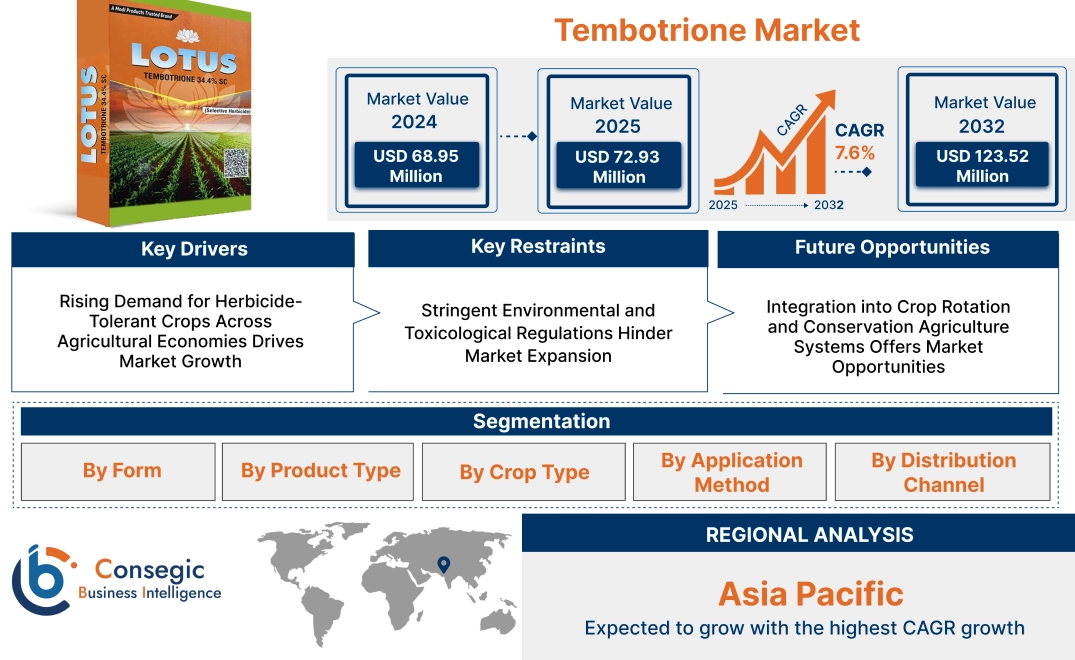
Tembotrione Market size is estimated to reach over USD 123.52 Million by 2032 from a value of USD 68.95 Million in 2024 and is projected to grow by USD 72.93 Million in 2025, growing at a CAGR of 7.6% from 2025 to 2032.
Tembotrione Market Scope & Overview:
Tembotrione, a member of the β-triketone family of herbicides, is a chemical used for controlling the growth of grass and broadleaf weed during the early to late post-emergence of maize. It is formulated as a suspension via a multi-step process involving 2-chloro-3-(2,2,2-trifluoroethoxy) methyl-4-methylsulfonylbenzoic acid, thionyl chloride, 1,3-cyclohexanedione, and acetone cyanohydrin. It appears as a white or beige powder.
Key benefits of the herbicide include rapid and selective weed control for field corn, silage corn, sweet corn and popcorn crops. It does this by binding to and limiting HPPD, resulting in the inhibition of carotene pigment synthesis in the weeds. This causes cell bleaching leading to plant death.
The formulations of the herbicide available are technical grade manufacturing use product (96.2% tembotrione) and liquid end-use product (34.5% tembotrione). It is also formulated with a safener (isoxadifen-ethyl) to ensure high crop tolerance. Its end-use industry is agriculture, specifically corn production.
Tembotrione Market Dynamics - (DRO) :
Key Drivers:
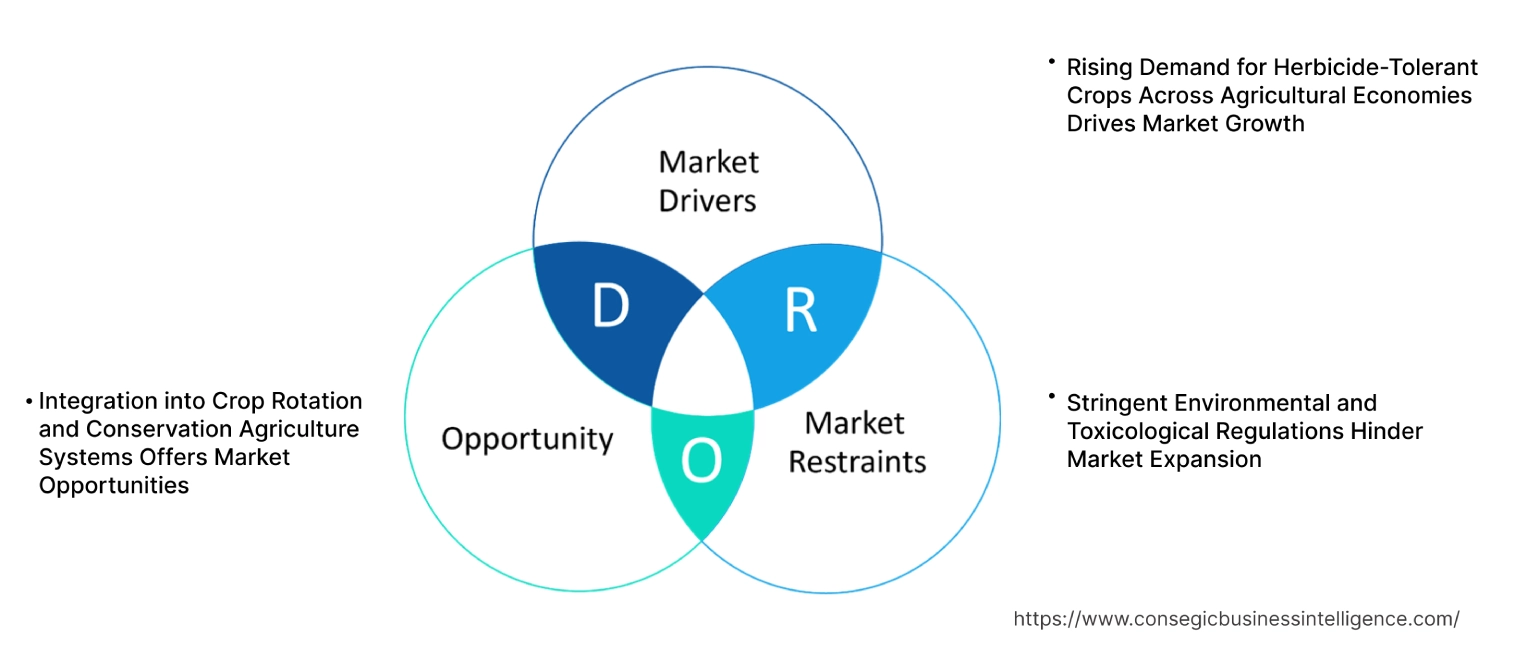
Rising Demand for Herbicide-Tolerant Crops Across Agricultural Economies Drives Market Growth
Farmers across major agricultural regions are relying on advanced post-emergence herbicides to manage weed resistance and maintain crop yields. Tembotrione is widely used in maize and corn production, where herbicide tolerance technologies are gaining traction. As agricultural economies aim to increase output through intensive farming and reduced tillage practices, selective herbicides play a critical role in improving operational efficiency. Its ability to provide broad-spectrum control against both grassy and broadleaf weeds makes it a valuable input in high-value crop systems. With countries in Asia-Pacific, Latin America, and Eastern Europe expanding their maize cultivation areas, the demand for reliable and safe herbicide solutions continues to grow. These trends are expected to significantly contribute to tembotrione market expansion, reinforcing its relevance in modern agronomic practices.
Key Restraints:
Stringent Environmental and Toxicological Regulations Hinder Market Expansion
Regulatory bodies are implementing strict guidelines for herbicide application, limiting permissible residue levels, and evaluating toxicity to non-target species. Tembotrione, like other synthetic herbicides, faces pressure regarding its persistence in soil, potential for groundwater contamination, and impact on biodiversity. These factors restrict its widespread use in ecologically sensitive areas and demand additional investments in safety validation and stewardship programs. Moreover, achieving compliance with global and regional pesticide regulations increases production complexity and costs for manufacturers. In regions with strong environmental advocacy and legislative oversight, these restrictions reduce market accessibility and slow the introduction of new herbicide-based technologies. Addressing regulatory hurdles through sustainable application practices and improved formulations is essential for ensuring long-term tembotrione market growth across diverse agricultural systems.
Future Opportunities :
Integration into Crop Rotation and Conservation Agriculture Systems Offers Market Opportunities
Tembotrione, due to its post-emergent mode of action and crop selectivity, fits well within rotational crop systems that focus on reducing tillage and preserving soil health. The growth of no-till and strip-till farming techniques has created a need for herbicides that provide effective weed control without disrupting soil structure. In crop rotations involving maize, it offers rotational flexibility by allowing selective weed management without compromising subsequent crop cycles. As farmers adopt practices that combine chemical, cultural, and mechanical weed control methods, it becomes a key component in long-term field planning. Moreover, the integration of such herbicides into sustainable frameworks supports compliance with environmental guidelines.
- For instance, in 2023, the ICAR Indian Institute of Maize Research compiled and published the benefits of conservation agriculture techniques for the combination of maize with other crops across India. This included recommendations on useful herbicides.
These evolving agricultural trends are expected to generate new tembotrione market opportunities, particularly in regions prioritizing regenerative and conservation-based crop systems.
Tembotrione Market Segmental Analysis :
By Form:
The tembotrione market is segmented by form into powder and liquid.
The liquid segment held the largest share in 2024.
- Liquid formulations are preferred due to their ease of dilution and application in large-scale field operations.
- The demand for ready-to-use herbicide mixtures in mechanized spraying equipment is boosting the use of liquid formulations.
- Market analysis reveals that liquid products offer faster weed control and uniform field coverage.
- As per tembotrione market trends, liquid variants remain dominant in commercial maize farming regions across North America and Asia-Pacific.
The powder segment is expected to experience the fastest CAGR during the forecast period.
- The powdered form is often used in technical grade production or in custom-mixed herbicide formulations.
- The need for flexible and concentrated herbicide formats is growing among agrochemical manufacturers.
- Market trends indicate increasing adoption of powdered forms in research trials and specialty crop applications.
- Thus, with improved packaging and shelf-life enhancements, powdered products are contributing to tembotrione market expansion.
By Product Type
Based on product type, the market is segmented into herbicide formulation and technical grade.
The herbicide formulation segment accounted for the largest tembotrione market share in 2024.
- Formulated herbicide products dominate usage in post-emergent weed control, particularly in maize cultivation.
- Tembotrione market analysis shows that ready-to-apply formulations are in high requirement among mid- and large-scale farmers.
- Widespread use of premixed formulations with safeners and surfactants is improving field effectiveness.
- As per market trends, the growing preference for branded herbicide products in emerging markets is driving the expansion of this segment.
The technical grade segment is expected to witness the fastest growth during the forecast period.
- Technical grade formulation serves as a raw material in the agrochemical manufacturing industry.
- The need for bulk technical-grade herbicides is increasing among domestic producers and formulators.
- Market analysis indicates that regulatory approvals and rising production capacity are driving this segment.
- Therefore, with rising contract manufacturing activities, technical grade sales are contributing to overall tembotrione market growth.
By Crop Type:
Based on crop type, the market is categorized into maize and others (potato, great millet, pearl millet).
The maize segment held the dominant share in 2024.
- It is a highly effective post-emergence herbicide for broadleaf and grassy weed control in maize cultivation.
- The increasing cultivation of hybrid maize in Asia-Pacific and Latin America is supporting tembotrione market demand.
- Tembotrione market analysis shows that maize is the key revenue-generating crop due to large-scale production and crop protection investment.
- As per the segmental trends, continuous R&D into maize-specific formulations for regional weed control is bolstering the maize segment development.
The others segment is projected to grow at the fastest CAGR.
- Use of tembotrione in great millet and pearl millet is expanding due to improved application safety and growing resistance management needs.
- For instance, in December 2020, researchers at Kansas State University in collaboration with Bayer Crop Science investigated the development of herbicide-resistant sorghum technology to facilitate broad-spectrum postemergence weed control as an economical and viable solution.
- The need for herbicides in non-traditional crops is increasing in Sub-Saharan Africa and India.
- Market trends indicate that off-label or regionally approved applications are gaining attention from agronomists.
- Thus, with a shift toward diversified cropping systems, this segment is a key contributor to market expansion.
By Application Method:
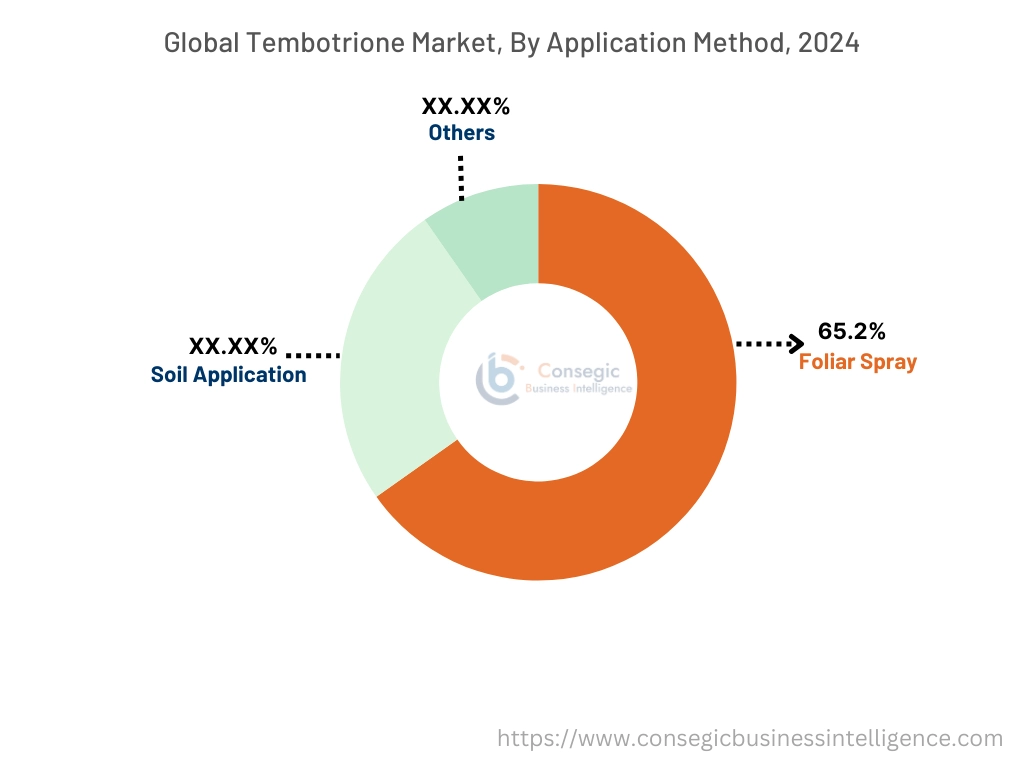
By application method, the market is segmented into foliar spray, soil application, and others.
The foliar spray segment held the dominant share of 65.2% in 2024.
- Foliar application ensures rapid uptake and visible weed suppression in maize and millet crops.
- Segmental analysis highlights that foliar spraying is the most common and efficient mode of delivery on field crops.
- Widespread adoption of foliar spray in mechanized farming systems supports the segment's evolution.
- As per tembotrione market trends, the increased integration with other herbicides in tank-mix foliar programs is boosting foliar spray segment expansion.
The soil application segment is projected to grow at the fastest CAGR.
- Soil-applied formulations offer residual weed control and reduce early weed competition.
- The demand for pre-emergence and dual-purpose application techniques is increasing.
- Segmental market trends reveal rising interest in conservation tillage systems where soil application is beneficial.
- Therefore, the combined usage with safeners allows greater flexibility and adoption in variable soil conditions resulting in segment growth.
By Distribution Channel:
By distribution channel, the market is segmented into direct sales, agrochemical stores, and online retail.
The agrochemical stores segment held the largest tembotrione market share in 2024.
- Regional and local agro-dealers remain the primary sales point for herbicides in rural and semi-urban markets.
- Tembotrione market demand is concentrated in geographies where farmers rely on physical stores for guidance and supply.
- Market analysis shows that agro-dealers play a vital role in promoting proper usage and awareness.
- As per segmental trends, in-store promotions and loyalty programs are influencing purchase decisions.
The online retail segment is expected to expand at the highest CAGR.
- E-commerce and digital platforms are emerging as convenient channels for farm input procurement.
- The need for doorstep delivery of registered agrochemicals is increasing in regions with digital penetration.
- Market trends suggest that online platforms are providing better access to branded and technical-grade products.
- Thus, with integrated logistics and advisory services, online sales are contributing to market growth.
Regional Analysis:
The regions covered are North America, Europe, Asia Pacific, the Middle East and Africa, and Latin America.
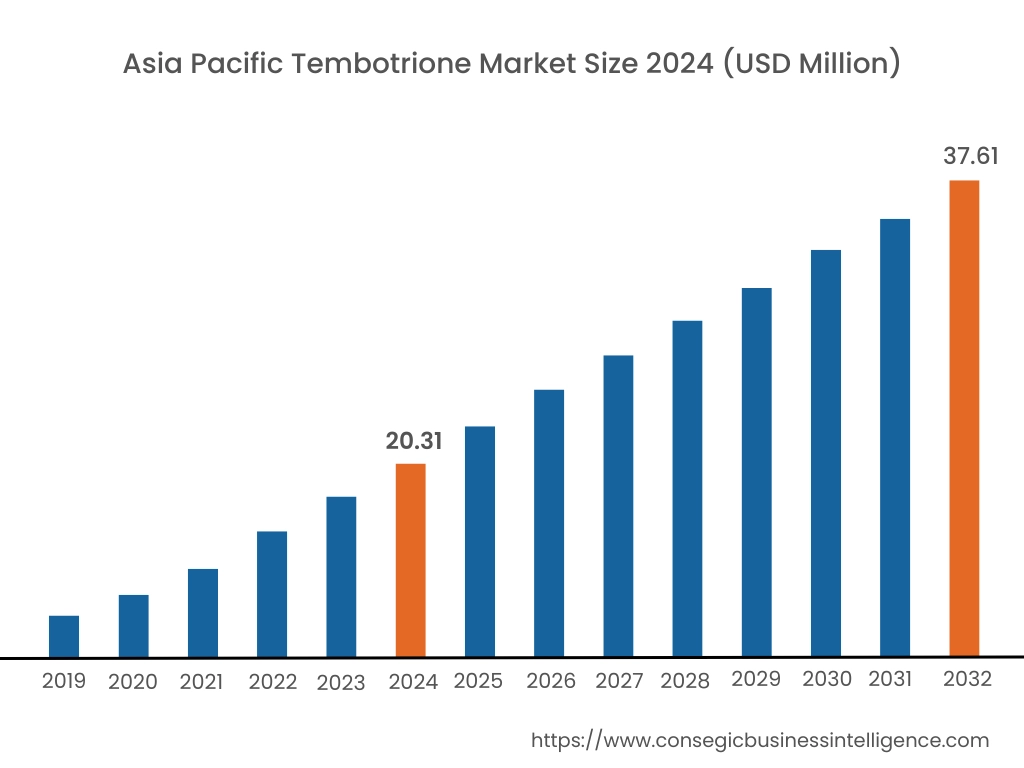
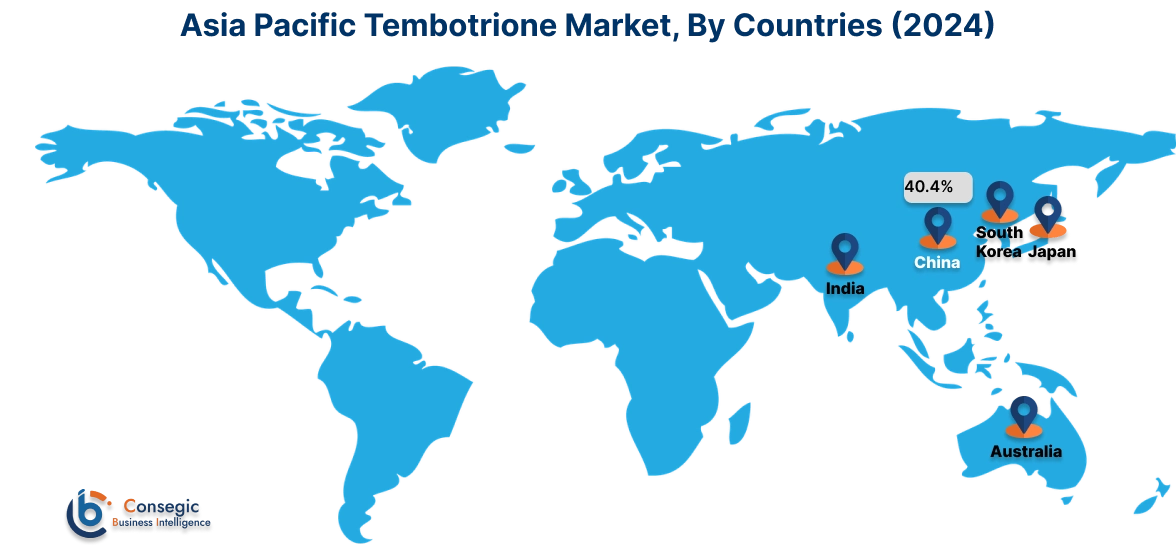
Asia Pacific region was valued at USD 20.31 Million in 2024. Moreover, it is projected to grow by USD 21.54 Million in 2025 and reach over USD 37.61 Million by 2032. Out of this, China accounted for the maximum revenue share of 40.4%. Asia-Pacific is emerging as the fastest-growing region for the tembotrione industry. Agricultural economies such as India and China are shifting towards herbicide-tolerant crops to cope with labor shortages and rising weed resistance. The growing awareness of its efficacy in post-emergence control of broadleaf and grass weeds is driving adoption. Furthermore, the shift towards commercial-scale farming in Southeast Asian nations presents a market opportunity, particularly in regions prioritizing food security and mechanized farming practices.
- In February 2024, Agrow Allied Venture announced the addition of three new technical (actives) to its crop protection range. This includes tembotrione, an herbicide with fast efficacy to control weeds and rapid dissipation. The company aims to register and sell these products in India and global markets.
Market research also reveals a growing preference for combination products that pair it with safeners or complementary active ingredients.
North America is estimated to reach over USD 40.03 Million by 2032 from a value of USD 22.87 Million in 2024 and is projected to grow by USD 24.15 Million in 2025. In North America, the market is well-established, supported by the widespread cultivation of corn and the adoption of post-emergent herbicides. The United States, in particular, has adopted these formulations due to their broad-spectrum weed control and crop safety features. The increasing push for higher crop yield and herbicide rotation to manage resistant weed species strengthens the regional market. A notable tembotrione market opportunity exists in precision agriculture systems that combine targeted herbicide use with yield mapping technologies. This has enhanced adoption rates, especially among commercial farms seeking residue-efficient solutions.
The European market reflects moderate growth, largely influenced by strict regulatory conditions and sustainability-focused agricultural frameworks. Countries such as France and Germany show limited, yet controlled, use of tembotrione in maize production. The region emphasizes integrated pest management systems, where chemical inputs are used in combination with mechanical and biological solutions. Despite regulatory scrutiny, the market is evolving due to the need for selective herbicides with a favorable environmental profile. Analysis of usage trends suggests that adoption is closely tied to resistance management strategies in cereal production, offering long-term stability for suppliers that align with EU standards.
In Latin America, the market is expanding steadily due to increasing maize production and a strong preference for high-efficacy herbicides. Brazil and Argentina are key contributors, where crop rotation practices are intensifying herbicide use patterns. The use of tembotrione is often part of integrated weed management programs aiming to combat herbicide-resistant Amaranthus and grasses. Study of regional agronomy trends indicates an increasing reliance on chemical solutions that deliver quick knockdown and minimal residual effects. Additionally, supportive agricultural extension services are helping raise awareness and build trust among mid-sized growers.
The Middle East & Africa region has an underpenetrated tembotrione market, but it holds potential in countries with expanding maize cultivation and government-backed agricultural modernization plans. In parts of North Africa and East Africa, limited access to selective post-emergent herbicides has restricted adoption, but that is gradually changing. Growth in this market is closely linked to educational initiatives on sustainable herbicide use and subsidy programs that improve access to crop protection technologies. Market analysis suggests that long-term requirement will be supported by rising concerns over invasive weed species and increasing emphasis on food production efficiency.
Top Key Players and Market Share Insights:
The tembotrione market is highly competitive with major players providing products and services to the national and international markets. Key players are adopting several strategies in research and development (R&D), product innovation, and end-user launches to hold a strong position in the global tembotrione market. Key players in the tembotrione industry include -
- Bayer CropScience (Germany)
- SigmaAldrich (USA)
- Jiangsu Aikon Biopharmaceutical R&D co.,Ltd. (China)
- Alta Scientific (China)
- Shanghai Synchem Pharma Co., ltd. (China)
- Dream Field Chemical Private Limited (India)
- Insecticides Limited (India)
- Syngenta (Switzerland)
- BASF SE (Germany)
- DuPont (USA)
Recent Industry Developments :
Product Launches:
- In October 2024, Insecticides (India) Ltd. (IIL) launched Torry Super, a post-emergence herbicide designed to control weeds in maize. The key advantages of this product include fast weed control with visible results within 3-5 days of application and powerful weed control with extended residual activity for up to 15 days beyond conventional herbicides.
Tembotrione Market Report Insights :
| Report Attributes | Report Details |
| Study Timeline | 2019-2032 |
| Market Size in 2032 | USD 123.52 Million |
| CAGR (2025-2032) | 7.6% |
| By Form |
|
| By Product Type |
|
| By Crop Type |
|
| By Application Method |
|
| By Distribution Channel |
|
| By Region |
|
| Key Players |
|
| North America | U.S. Canada Mexico |
| Europe | U.K. Germany France Spain Italy Russia Benelux Rest of Europe |
| APAC | China South Korea Japan India Australia ASEAN Rest of Asia-Pacific |
| Middle East and Africa | GCC Turkey South Africa Rest of MEA |
| LATAM | Brazil Argentina Chile Rest of LATAM |
| Report Coverage |
|
Key Questions Answered in the Report
How big is the Tembotrione Market? −
Tembotrione Market size is estimated to reach over USD 123.52 Million by 2032 from a value of USD 68.95 Million in 2024 and is projected to grow by USD 72.93 Million in 2025, growing at a CAGR of 7.6% from 2025 to 2032.
What specific segmentation details are covered in the Tembotrione Market report? +
The Tembotrione market report includes specific segmentation details for form, product type, crop type, application method and distribution channel.
Which is the fastest-growing region in the Tembotrione Market? +
Asia Pacific is the fastest-growing region in the Tembotrione market. These trends are encouraged by the shift towards herbicide-tolerant crops to cope with labor shortages and rising weed resistance in agricultural economies.
Who are the major players in the Tembotrione Market? +
The key participants in the Tembotrione market are Bayer CropScience (Germany), SigmaAldrich (USA), Jiangsu Aikon Biopharmaceutical R&D co.,Ltd. (China), Alta Scientific (China), Shanghai Synchem Pharma Co., ltd. (China), Dream Field Chemical Private Limited (India), Insecticides Limited (India), Syngenta (Switzerland), BASF SE (Germany) and DuPont (USA).
Overview
Reputation & Certifications


Our Services
- Market Intelligence & Forecasting
- Custom Research Solutions
- Market Entry Strategy
- Competitive Intelligence
- Customer Insights
- Industry Innovation Analysis
- Investment Advisory