Jump to Content
Vacuum Truck Market Size & Industry Share - Growth Trends & Forecasts (2026 - 2034)
Vacuum Truck Market Size:
The Vacuum Truck Market is expected to expand from 2,284.61 (US$M) in 2025 to 2,437.68 (US$M) in 2026, and is forecast to surpass 4,095.36 (US$M) by 2034, growing at a CAGR of 6.7% between 2026 and 2034, according to a recent report from Consegic Business Intelligence.
Vacuum Truck Market Scope & Overview:
Vacuum trucks, also known as vacuum tankers, are a type of vehicles which are designed for sucking, transferring, as well as discharging liquids, sludge, and other debris. The vehicle makes use of a vacuum to draw materials like sewage, industrial waste, or dry solids from a location into its sealed tank for assisting proper disposal or treatment. Vacuum tankers are capable of providing high efficiency in removing and carrying a wide range of materials, while protecting the environment by preventing leaks and offering access to difficult-to-reach areas. Also, it can be used for several applications such as hazardous waste cleanup, utility work, and emergency response, which in turn results in increased safety, environmental protection, and operational efficiency.
How is AI Transforming the Vacuum Truck Market?
The integration of AI is considerably transforming the vacuum truck market. AI incorporation helps in improving efficiency, safety, and maintenance through applications like route optimization, predictive maintenance, along with the development of autonomous and smart trucks. AI-powered systems are also capable of monitoring driver behaviour and environmental conditions, while offering real-time alerts for preventing accidents. Moreover, advanced systems with AI-powered cameras can also be used for automatically recording events.
Additionally, AI plays an essential role in developing autonomous vacuum tankers that can perform tasks with lower human intervention, which is mostly beneficial for hazardous waste disposal. Hence, the above factors are expected to positively impact the market growth in the upcoming years.

Vacuum Truck Market Dynamics - (DRO) :
Key Drivers:
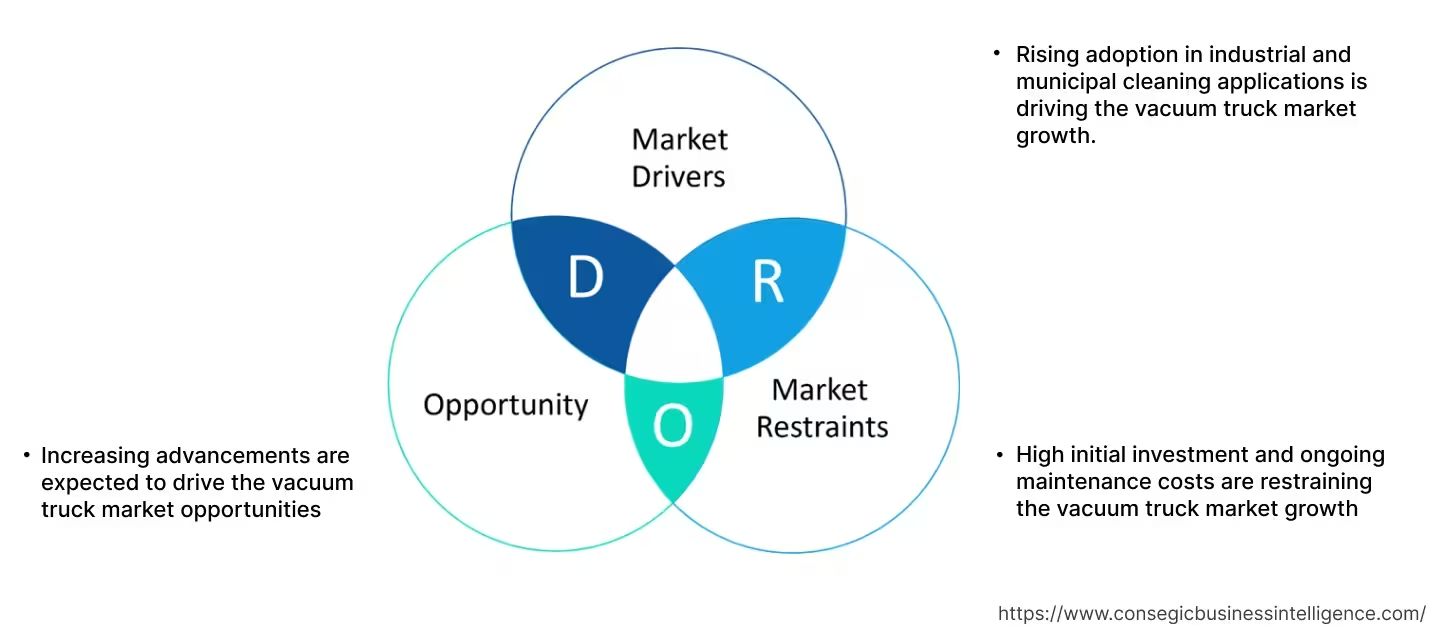
Rising adoption in industrial and municipal cleaning applications is driving the vacuum truck market growth.
Municipalities are responsible for maintaining the cleanliness and maintenance of public areas including streets, sidewalks, and other public spaces. Vacuum tankers are primarily used for removing debris, dirt, litter, and other waste materials from roads and public spaces to ensure a cleaner and safer environment. Moreover, industries such as oil & gas, chemical, and mining also rely on these vehicles for facilitating safe handling and containment of hazardous materials and emergency spill responses to comply with stringent safety and environmental regulations. Additionally, the utilization of vacuum tankers offers a range of benefits, including removal of hazardous debris, improved municipal health, increased safety, improved aesthetics and property values, and others. The aforementioned benefits of vacuum tankers are key determinants for increasing its adoption in industrial and municipal cleaning applications.
- For instance, in June 2025, Rebel Vac Systems launched its new Rebel Renegade model of industrial vacuum truck that is designed to meet the evolving demands of modern excavation as well as utility operations. It is developed with a focus on user-friendly features, operational efficiency, and regulatory compliance, while offering improved maneuverability, enhanced payload capacity, along with reliable performance across various site conditions.
Consequently, the aforementioned factors are driving the vacuum truck market size.
Key Restraints :
High initial investment and ongoing maintenance costs are restraining the vacuum truck market growth
The implementation of vacuum tankers is often associated with high initial investment and ongoing maintenance costs, which are among the primary factors restricting the market. Vacuum tanks, mainly those with advanced features such as hydro-excavation and specialized filtration, require a substantial initial investment, which can act as a barrier for its widespread adoption, particularly for smaller companies operating on limited budget. Moreover, vacuum tankers also require regular maintenance, including replacement parts for pumps, filters, and hoses, for ensuring optimum and safe operation, which can incur additional costs.
In addition to maintenance, high operational costs associated with fuel and labor can limit profit margins, which in turn can prompt some businesses to use traditional, manual cleaning methods as a more cost-effective alternative. Thus, the aforementioned factors are hindering the vacuum truck market expansion.
Future Opportunities :
Increasing advancements are expected to drive the vacuum truck market opportunities
Vacuum tanker manufacturers are frequently investing in the development of new technologies, including AI and IoT (internet of things) integration, automation, and others, to ensure its safe and effective utilization for industrial, municipal, and general cleaning applications. Innovations such as AI and IoT integration, automation, adoption of electric/hybrid models, along with advanced filtration system, play an essential role in making these vehicles more versatile and cost-effective. As a result, vacuum tanker companies are launching new products with updated features, in turn offering lucrative aspects for market growth.
- For instance, in February 2025, Ditch Witch introduced its new W8 model of hydrovac truck for offering contractors an agile solution for slot trenching, potholing, and cleanup tasks in residential and urban environments. The W8 model of hydrovac truck offers improved suction capabilities and performance in a compact design, which makes it ideal for municipalities, underground construction professionals, and utility contractors that are operating in tight urban areas. The truck is also incorporated with user-friendly controls along with modern design, which assists operators in completing tasks quickly and efficiently.
Hence, according to the analysis, the rising advancements associated with vacuum tankers are projected to boost the vacuum truck market opportunities during the forecast period.
Vacuum Truck Market Segmental Analysis :
By Product Type:
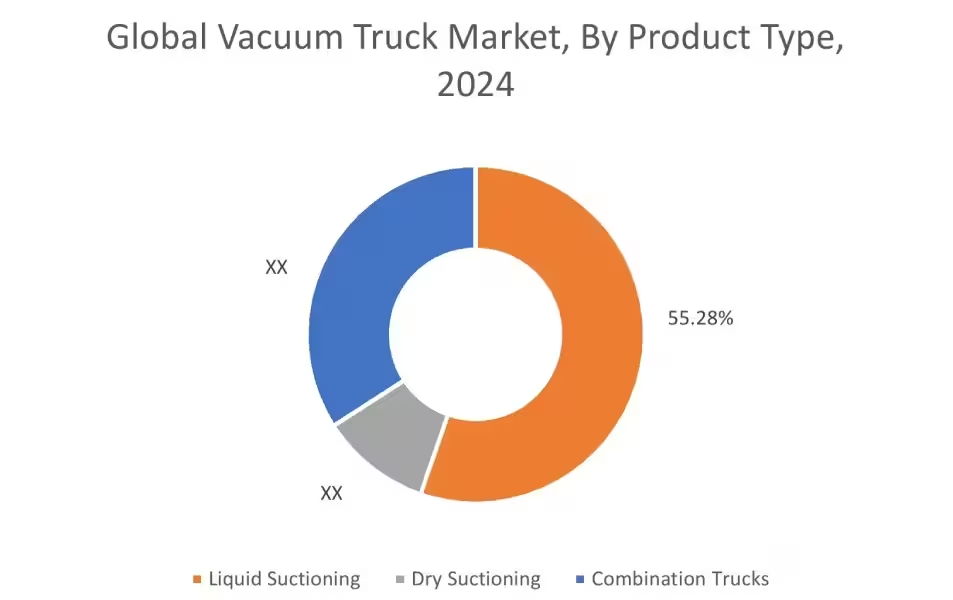
Based on product type, the market is segmented into liquid suctioning, dry suctioning, and combination trucks.
Trends in the Product Type:
- There is an increasing trend in adoption of dry suctioning trucks that are capable of handling a wider range of material densities and abrasiveness.
- Global investments in aging water and wastewater infrastructure are propelling the market.
The liquid suctioning segment accounted for the largest revenue share of 55.28% in the vacuum truck market in 2024.
- Increasing stringent environmental regulations are driving demand for trucks with specialized, chemical-resistant components and advanced filtration systems.
- Moreover, adoption of IoT, GPS, and telematics is rising as it allows fleet managers to monitor tank levels, pump pressure, and route efficiency in real-time, reducing downtime and optimizing collection schedules.
- Additionally, the segment is seeing initial but rapid adoption of electric or hybrid models for municipal and urban applications.
- According to the vacuum truck market analysis, focus on hazardous waste compliance, telematics & real-time monitoring, and electrification are further driving the vacuum truck market size.
The combination trucks segment is anticipated to register a substantial CAGR during the forecast period.
- There is increasing use of combination units for hydro-excavation as they combine powerful vacuum and high-pressure water systems for safely locating and exposing underground utility lines.
- There is rising focus on efficiency, which results in integrating more powerful, yet quieter, positive displacement blowers and water pumps.
- Additionally, manufacturers are shifting towards modular designs where operators can easily adjust component ratios, which in turn drives the market.
- According to the analysis, the aforementioned factors are projected to boost the market during the forecast period.
By Fuel Type:
Based on fuel type, the market is segmented into internal combustion engine (ICE) and electric.
Trends in the Fuel Type:
- Innovation centers are improving battery density to increase all-electric driving and reduce battery weight to maximize the payload capacity, which in turn drives the market.
- Electric power offers quieter operation compared to a diesel/petrol engine and blower system, in turn propelling the market.
Internal combustion engine (ICE) segment accounted for the largest revenue in the overall vacuum truck market share in 2024.
- ICE trucks are integrating sophisticated technologies like Selective Catalytic Reduction (SCR) and Diesel Particulate Filters (DPF) to comply with global standards.
- Companies are increasingly utilizing Renewable Diesel (HVO) and Biodiesel blends for immediately reducing carbon footprint without fleet replacement.
- Further, manufacturers are optimizing engine mapping and integrating SmartPTO system to reduce idling.
- Therefore, advanced emission controls, renewable diesel fuels, and engine optimization are driving the vacuum truck market trends.
Electric segment is anticipated to register the fastest CAGR during the forecast period.
- The biggest driver for electric trucks is government and municipal mandates for zero-emission vehicles in city centers.
- Moreover, lower energy costs, reduced maintenance, and strong government incentives/subsidies are making electric vehicles economically viable.
- Also, the rising focus on sustainability and eco-friendly cleaning solutions is increasing the adoption of electric-operated vacuum tankers.
- Hence, municipal and urban fleet mandates and lower total cost of ownership are projected to boost the market during the forecast period.
By Capacity:
Based on capacity, the market is segmented into small, medium, and large
Trends in the Capacity:
- Large trucks handle hazardous or flammable materials and are integrated with advanced safety features like explosion-proof components, inert systems, specialized venting, and chemical-resistant tanks, which is driving the
- Factors including growth in specialized and utility services and focus on urban accessibility are key trends driving the
The medium segment accounted for the largest revenue share in the vacuum truck market share in 2024, and it is anticipated to register a significant CAGR during the forecast period.
- Medium units are increasingly integrated with telematics, GPS, and onboard diagnostic systems to optimize routing, monitor fluid consumption, and schedule maintenance.
- There is a rising need for integrating water recycling systems into medium-capacity combination trucks, which in turn is boosting the market.
- Further, growing adoption in the maintenance of municipal infrastructure is projected to drive the market.
- Therefore, smart truck integration and increased onboard water recycling of vacuum tankers are driving the market.
By Application:
Based on the application, the market is segmented into industrial, municipal, general cleaning, excavation, and others.
Trends in the Application:
- Municipal fleets are rapidly adopting GPS, IoT, and telematics for optimal route planning and real-time monitoring of sewer conditions and truck performance, which in turn drives the market.
- To conserve water and increase efficiency, especially in drought-prone regions, there is a strong focus on onboard water recycling and filtration systems, which further drive the market.
The industrial segment accounted for the largest revenue share in the market in 2024 and is anticipated to register a substantial CAGR during the forecast period.
- Growing pressure for zero-spill and zero-emission operations drives demand for trucks compliant with safety standards.
- Moreover, there is an increased focus on high-volume, high-density material recovery in refineries and mining, which in turn drives the market.
- In addition, rising focus towards wireless remote controls for boom movement, vacuum power, and dumping are key prospects driving the market.
- Hence, strict environmental & safety compliance and remote operation & automation are driving the market growth.
Regional Analysis:
The regions covered are North America, Europe, Asia Pacific, the Middle East and Africa, and Latin America.
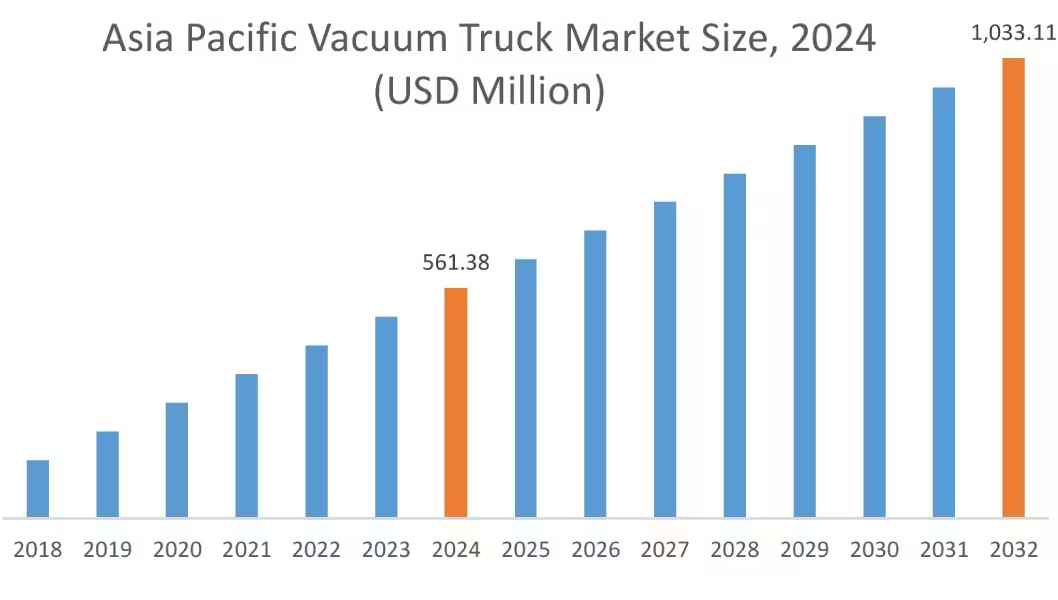
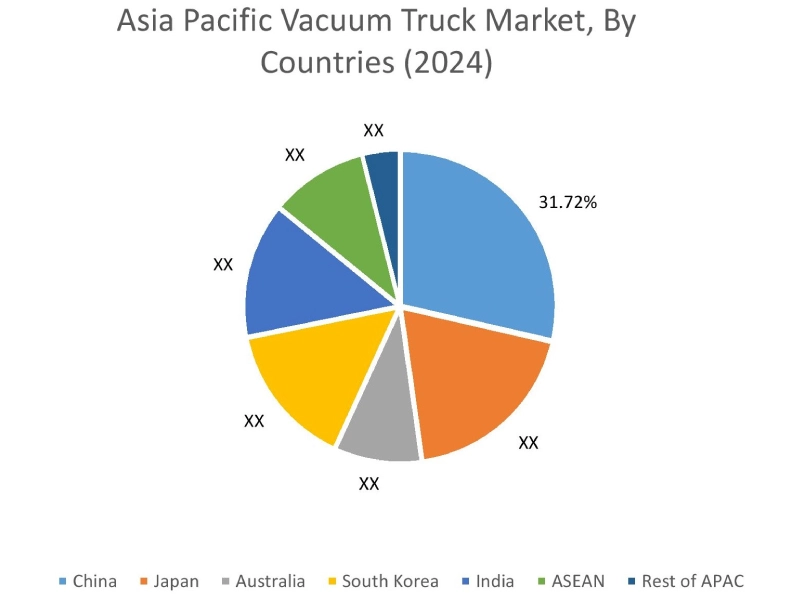
Asia Pacific region was valued at USD 561.38 Million in 2024. Moreover, it is projected to grow by USD 593.21 Million in 2025 and reach over USD 1,033.11 Million by 2032. Out of this, China accounted for the maximum revenue share of 31.72%. As per the vacuum truck market analysis, the adoption of vacuum tankers in the Asia-Pacific region is primarily driven by the rising pace of urbanization and development, particularly in emerging economies such as China, India, and others. Moreover, rising government initiatives and campaigns for street cleaning along with increasing deployment of vacuum tankers for municipal cleaning applications are further accelerating the vacuum truck market expansion.
- For instance, in January 2024, the Government of Maharashtra, India, launched a comprehensive cleanliness campaign in Ulhasnagar and Kalyan cities of Maharashtra. The campaign focuses on cleaning roads, walkways, public playgrounds, and parks, among others. The above factors are increasing the need for vacuum tankers for cleaning applications, in turn driving the industry in the Asia-Pacific region.
North America is estimated to reach over USD 1,179.88 Million by 2032 from a value of USD 671.27 Million in 2024 and is projected to grow by USD 706.59 Million in 2025. In North America, the growth of the vacuum truck industry is driven by several factors, including growing prevalence of street cleaning campaigns and increasing development of industrial manufacturing facilities in the region. Additionally, strict government regulations regarding waste disposal and hazardous materials handling are prompting industries and municipalities to use advanced vacuum tankers, further contributing to the vacuum truck market demand.
- For instance, in March 2022, Kerry Group, a food and beverage company, invested USD 137 million for development of its new food manufacturing facility in Georgia, United States. The above factors are expected to propel the vacuum truck market trends in North America during the forecast period.
Meanwhile, according to the regional analysis, factors including the prevalence of robust environmental legislation, smart city initiatives, developed municipal infrastructure, along with growing need for industrial waste cleaning solutions are driving the vacuum truck market demand in Europe. Furthermore, according to the market analysis, the market demand in Latin America, Middle East, and African regions is expected to grow at a considerable rate due to factors such as expanding industrial sectors, growing environmental awareness, along with increasing investments in urban and sanitation infrastructure, among others.
Top Key Players & Market Share Insights:
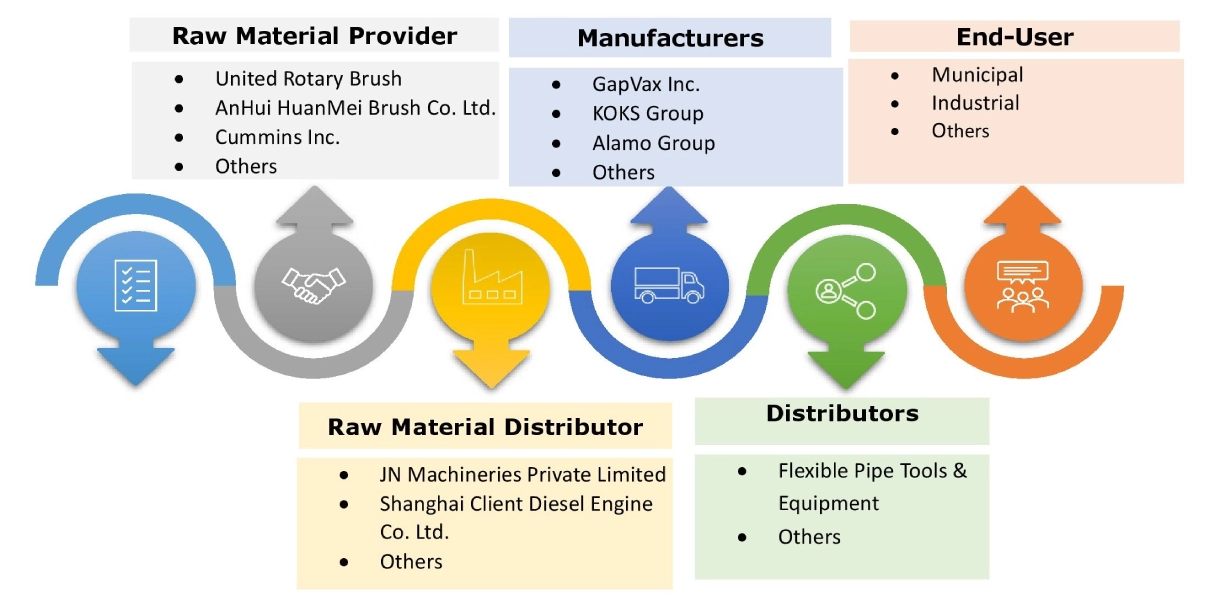
The global vacuum truck market is highly competitive with major players providing products to the national and international markets. Key players are adopting several strategies in research and development (R&D), product innovation, and end-user launches to hold a strong position in the vacuum truck market. Key players in the vacuum truck industry include-
- GapVax Inc. (USA)
- KOKS Group (Netherlands)
- Fulongma Group Co., Ltd. (China)
- DISAB Vacuum Technology AB (Sweden)
- Cappellotto S.p.A. (Italy)
- Alamo Group (USA)
- Vac-Con Inc. (USA)
- Keith Huber Corporation (USA)
- Federal Signal Corporation (USA)
- Vactor Manufacturing (USA)
Recent Industry Developments :
Acquisitions:
- In November 2023, BalowickCapital acquired Rebel Vac Systems, which is a company specializing in hydro-excavation and industrial vacuum tankers. The acquisition aims at unlocking further opportunities that will benefit all stakeholders involved.
Partnerships & Collaborations:
- In November 2025, KOKS Group announced the delivery of its EcoVac model of vacuum truck to its trusted partner REYM Beverwijk. EcoVac is a powerful machine that is designed for facilitating maximum performance and safety in industrial cleaning applications.
Vacuum Truck Market Report Insights :
| Report Attributes | Report Details |
| Study Timeline | 2021-2034 |
| Market Size in 2034 | USD 4,095.36 Million |
| CAGR (2026-2034) | 6.70% |
| Base Year | 2025 |
| By Product Type |
|
| By Fuel Type |
|
| By Capacity |
|
| By Application |
|
| By Region |
|
| Key Players |
|
| North America | U.S. Canada Mexico |
| Europe | U.K. Germany France Spain Italy Russia Benelux Rest of Europe |
| APAC | China South Korea Japan India Australia ASEAN Rest of Asia-Pacific |
| Middle East and Africa | GCC Turkey South Africa Rest of MEA |
| LATAM | Brazil Argentina Chile Rest of LATAM |
| Report Coverage |
|
Key Questions Answered in the Report
How big is the vacuum truck market? −
The vacuum truck market was valued at USD 2,025.80 Million in 2024 and is projected to grow to USD 3,597.19 Million by 2032.
Which is the fastest-growing region in the vacuum truck market? +
Asia-Pacific is the region experiencing the most rapid growth in the vacuum truck market.
What specific segmentation details are covered in the vacuum truck report? +
The vacuum truck report includes specific segmentation details for product type, fuel type, capacity, application, and region.
Who are the major players in the vacuum truck market? +
The key participants in the vacuum truck market are GapVax Inc. (USA), KOKS Group (Netherlands), Alamo Group (USA), Vac-Con Inc. (USA), Keith Huber Corporation (USA), Federal Signal Corporation (USA), Vactor Manufacturing (USA), Fulongma Group Co., Ltd. (China), DISAB Vacuum Technology AB (Sweden), Cappellotto S.p.A. (Italy), and others.
Overview
Reputation & Certifications


Our Services
- Market Intelligence & Forecasting
- Custom Research Solutions
- Market Entry Strategy
- Competitive Intelligence
- Customer Insights
- Industry Innovation Analysis
- Investment Advisory