Jump to Content
Wireless Sensor Market Size & Industry Share - Growth Trends & Forecasts (2026 - 2034)
Wireless Sensor Market Size:
Wireless Sensor Market size is estimated to reach over 176.75 (US$B) by 2034 from a value of 28.04 (US$B) in 2025 and is projected to grow by 34.4 (US$B) in 2026, growing at a CAGR of 22.7% from 2026 to 2034, according to a recent report from Consegic Business Intelligence.
Wireless Sensor Market Scope & Overview:
A wireless sensor is a device equipped with a transducer, microprocessor, and radio transceiver that measures physical or environmental parameters and transmits data without physical cabling. It offers several benefits, including easy setup with no physical wires, real-time monitoring & control, reduced downtime, enhanced product quality, improved safety & productivity, remote accessibility, and increased production efficiency, among others. Additionally, the market is driven by factors such as the rapid adoption of industrial automation, significant expansion of the internet of things (IoT), rising demand for predictive maintenance, and technological advancements in energy-efficient, miniaturized sensors.

Wireless Sensor MarketDynamics - (DRO) :

Key Drivers:
Rising adoption of industrial automation in manufacturing sector is driving the market growth
Industry 4.0 enabled manufacturing represents automation readiness, extreme flexibility, minimal human intervention, and highest productivity. It emphasizes the use of automation and automated equipment to enhance production efficiency and flexibility. Modern smart factories increasingly rely on cyber-physical systems, the industrial internet of things (IIoT), and advanced robotics for improving operational efficiency, minimizing downtime, and transitioning toward predictive maintenance frameworks.
Moreover, wireless sensors are increasingly integrated into manufacturing facilities for applications involving predictive maintenance of equipment, real-time monitoring of production lines, and seamless communication among different machines. This results in enhanced productivity, reduced equipment downtime, and improved product quality. As manufacturers scale their automation initiatives to achieve higher throughput and autonomous process control, the constant demand for decentralized data acquisition directly drives the adoption of robust wireless sensing technologies in smart manufacturing ecosystems, thereby propelling the market growth.
- For instance, in 2024, Xiaomi launched its completely automated smart factory in Beijing, China. The automated factory spans across 860,000 square feet, and it was developed to manufacture approximately 10 million smartphones each year without any human intervention.
Hence, the rising adoption of industrial automation in manufacturing facilities is driving the wireless sensor market size.
Key Restraints :
Operational limitations and challenges are restraining the wireless sensor market growth
Wireless sensors are associated with certain operational limitations such as limited communication range, bandwidth limitations, scalability issues, and security vulnerabilities, among others, which are key aspects restricting the market growth. These sensors often suffer from constrained communication ranges and restricted bandwidth capacities, which severely restrict high-frequency data transmission and large-scale architectural expansion. Nodes situated at the periphery of a network frequently experience packet loss or high latency, which may impact real-time monitoring capabilities in critical industrial environments. Moreover, as the density of sensor nodes increases, network congestion, data collision, and routing inefficiencies escalate exponentially, degrading overall network throughput.
Also, batteries used in these sensors often limit operational lifespans, while frequent manual replacements or recharging cycles in hazardous remote locations escalate maintenance overheads. Additionally, since these sensor nodes communicate through open-air radio frequencies, they are highly prone to security vulnerabilities such as node tampering, unauthorized data access, and others. Thus, the above factors are hindering the wireless sensor market expansion.
Future Opportunities :
Rising applications in precision agriculture are expected to drive the wireless sensor market opportunities
Wireless sensors play a vital role in precision agriculture, particularly in applications such as soil moisture assessment, climate monitoring, environmental monitoring, greenhouse monitoring, pest detection & management, irrigation management, and nutrient management among others. Moreover, these sensors can provide real-time monitoring and control of several parameters in agricultural fields, including soil moisture, temperature, pH levels, and others, which are key aspects for increasing its application in precision agriculture. As climate volatility and resource scarcity intensify operational pressures, the need for automated, IoT-enabled field monitoring is accelerating, thereby driving the adoption of these sensors in precision agriculture.
- For instance, according to the U.S. Department of Agriculture, several farms in the United States utilized precision agriculture technologies such as yield monitoring and soil mapping, variable rate technology, wearable livestock technologies, and others in 2023.
Consequently, the growing precision farming sector is projected to increase the adoption of these sensors for real-time monitoring and control of several parameters in agricultural fields, thereby boosting the market opportunities during the forecast period.
Wireless Sensor Market Segmental Analysis :
By Product Type:
Trends in the product type:
- Increasing utilization of temperature sensors to ensure optimum temperature in controlled industrial environments and enhance safety within industrial facilities is driving the market.
- The growing need for predictive maintenance, widespread adoption of micro-electro-mechanical systems (MEMS) technology, and rising need foradvanced technologies for precise fluid and gas pressure monitoring are key trends driving the pressure sensor segment.
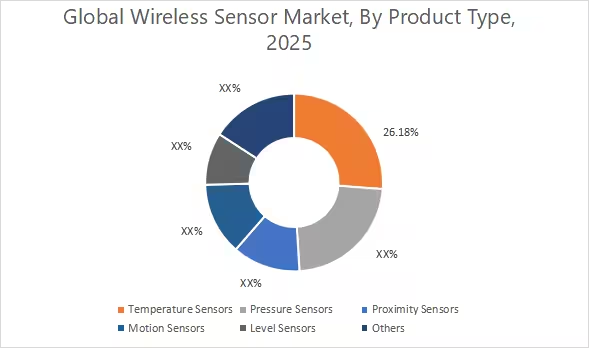
The temperature sensors segment accounted for the largest revenue share of 26.18% in the market in 2025.
- Temperature sensors are used for measuring the temperature of an object or environment. The integration of temperature sensors facilitates constant measurement of the temperature of equipment and materials used within industrial facilities to detect overheating and prevent failure.
- Moreover, temperature sensors also assist in ensuring optimum temperature in controlled industrial environments and enhance safety within industrial facilities.
- Additionally, the market is primarily driven by the acceleration of Industry 4.0 principles and industrial Internet of Things (IoT) platforms that demand continuous, remote asset health monitoring.
- According to the analysis, the above factors are further propelling the market growth.
The pressure sensors segment is anticipated to register a significant CAGR during the forecast period.
- The wireless pressure sensor segment includes transducers and transmitters that convert absolute, gauge, or differential pressure metrics into digital signals for remote broadcast.
- Wireless pressure sensors can operate autonomously in diverse environments, ranging from subterranean oil pipelines and industrial HVAC systems to automotive tire pressure monitoring configurations (TPMS) and portable medical devices.
- Moreover, the segment is driven by several factors, including the growing need for predictive maintenance, widespread adoption of micro-electro-mechanical systems (MEMS) technology, and the presence of stringent automotive safety mandates like tire pressure monitoring systems, among others.
- Hence, the above factors are expected to boost the market during the forecast period.
By Technology:
Based on technology, the market is segmented into Wi-Fi, Bluetooth/BLE, ZigBee, Zigbee/Z-Wave, near field communication (NFC), cellular, and others.
Trends in the technology:
- Rising adoption of IoT communication technologies to facilitate seamless data sharing and communication among several sensor nodes is driving the market.
- Rising trend in adoption of Wi-Fi technology, attributing to its several benefits including high data rates, flexible deployment, improved scalability, remote accessibility, and others.
Wi-Fi segment accounted for the largest revenue share in the market in 2025, and it is anticipated to register a substantial CAGR during the forecast period.
- Wi-Fi technology is commonly used in sensor networks for providing robust, flexible, and high-speed wireless connectivity.
- Moreover, Wi-Fi technology offers various benefits including high data rates, wide availability and standardization, flexible deployment, improved scalability, remote accessibility, and others, which are key prospects increasing its adoption in these sensors.
- Further, the market is driven by several factors such as the widespread integration of advanced Wi-Fi 6 and Wi-Fi 7 standards, rising need for high-throughput industrial automation and video-rich surveillance applications, and increasing adoption of device-free Wi-Fi sensing for smart building automation and occupancy tracking.
- According to the wireless sensor market analysis, the aforementioned factors are further driving the market.
By Sales Channel:
Based on sales channel, the market is segmented into direct sales and distributor sales.
Trends in the sales channel:
- Factors including the availability of excellent support and warranty, higher product quality, and reliable shipping and return policies are key trends driving the direct sales channel segment.
- Factors such as higher accessibility to a variety of products, higher flexibility, and expanded reach are primary aspects driving the distributor sales channel segment growth.
The direct sales channel segment accounted for significant revenue in the wireless sensor market share in 2025.
- In direct sales channel, sensors are sold directly to customers through numerous physical outlets, including company outlets, among others.
- Moreover, the direct sales channel also consists of an online mode, wherein the manufacturers sell sensors through its own company websites.
- Also, purchasing sensors from the direct sales channel offers several benefits, including higher product quality, higher return on investment, faster response time, competitive pricing, and others, which are key aspects for increasing the purchase of sensors from the direct sales channel.
- Therefore, the increasing availability of sensors in direct sales channels is driving the market.
The distributor sales segment is anticipated to register a substantial CAGR during the forecast period.
- The distributor sales channel involves an indirect distribution of sensors, wherein the sensor is purchased from several regional distributors operating in multiple regions worldwide.
- Moreover, distributor sales channels offer various benefits, including expanded market reach, lower capital expenditure, increased cost efficiency, and others. The above benefits of distributor sales channels are further increasing its utilization for sales of sensors.
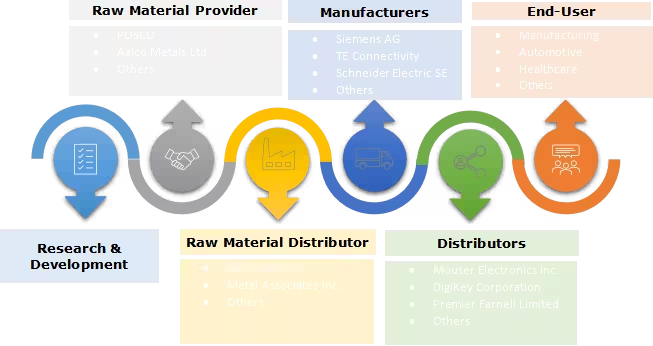
- For instance, Mouser Electronics Inc.,DigiKey Corporation, Premier Farnell Limited, and others are few of the distributors of sensors.
- Hence, the increasing availability of sensors in distributor sales channels is anticipated to boost the market during the forecast period.
By End User:
Based on end user, the market is segmented into manufacturing, automotive & transportation, consumer electronics, agriculture, mining, healthcare & life sciences, oil & gas, energy & utilities, building automation & smart homes, and others.
Trends in the end user:
- Rising trend in adoption of industrial automation in the manufacturing sector is driving the market growth.
- Growing integration of wireless sensors in oil & gas facilities to reduce equipment downtime, enhance productivity, and increase operational efficiency is boosting the market.
The manufacturing segment accounted for a significant revenue share in the market in 2025.
- Wireless sensing solutions are primarily integrated in manufacturing facilities for applications involving predictive maintenance of equipment, real-time monitoring of production lines, and seamless communication among different machines.
- Additionally, the increasing development of smart factories and technological advancements in manufacturing sector, such as industrial internet of things (IIoT), IoT analytics, artificial intelligence (AI), and others, are key factors driving the market.
- For instance, in December 2023, Mitsubishi Electric India introduced its new smart manufacturing facility for advanced factory automation systems in the state of Maharashtra, India. The new manufacturing facility is optimized to deliver products with the highest quality and reliability while strengthening its business in India and addressing the increasing need for advanced automation and smart manufacturing solutions.
- According to the analysis, the rising developments associated with smart factories and increasing adoption of automation in manufacturing facilities are driving the wireless sensor market trends.
The automotive & transportation segment is anticipated to register a substantial CAGR during the forecast period.
- In the automotive & transportation sector, these sensors are mainly used to monitor vehicular performance, passenger safety, tire pressure, powertrain efficiency, and fleet transit movement.
- The sensors eliminate bulky wiring harnesses inside vehicles and mostly rely on secure wireless communication protocols to relay telemetry to central electronic control units or cloud platforms.
- Also, the segment is driven by factors such as the rising consumer and regulatory demand for advanced driver assistance systems (ADAS), rapid transition toward electric and hybrid vehicle architectures, and rising advancements in connected vehicle telematics and autonomous mobility.
- According to the analysis, the above factors are expected to drive the wireless sensor market during the forecast period.
Regional Analysis:
The regions covered are North America, Europe, Asia Pacific, Middle East and Africa, and Latin America.
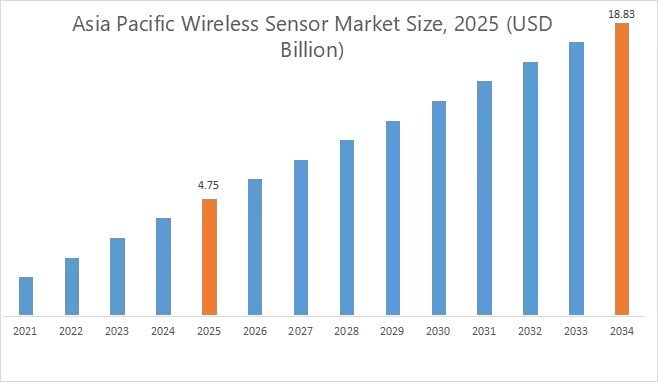
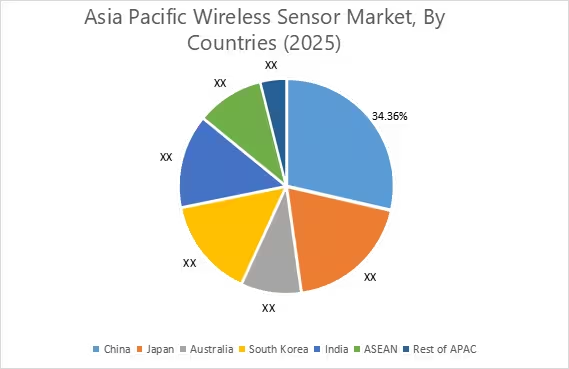
Asia Pacific region was valued at USD 4.75 Billion in 2025. Moreover, it is projected to grow by USD 5.45 Billion in 2026 and reach over USD 18.83 Billion by 2034. Out of this, China accounted for the maximum revenue share of 34.36%. As per the market analysis, the adoption of these sensors in the Asia-Pacific region is primarily driven by rising adoption of industrial automation, widespread adoption of the Industrial Internet of Things (IIoT), and extensive government-backed smart city initiatives in key economies such as China, Japan, India, and South Korea, among others. Moreover, government investments in industrial manufacturing, combined with growing oil & gas, agriculture, and other industrial sectors, are increasing the need for real-time asset visibility, predictive maintenance, and operational efficiency, which are further driving the market.
- For instance, according to the Indian Ministry of Petroleum & Natural Gas, there were approximately 283 hydrocarbon projects under implementation in the oil & gas sector in India as of October 2024.The above factors are further driving the market in the Asia-Pacific region.
North America is estimated to reach over USD 21.94 Billion by 2034 from a value of USD 5.77 Billion in 2025 and is projected to grow by USD 6.59 Billion in 2026. In North America, the market is mostly driven by expanding industrial automation, significant proliferation of robotics, and booming electric vehicle (EV) and mining sectors, among others. Moreover, rising adoption of Industry 4.0 models, rapid incorporation of smart factory solutions, and increasing advancements in automated industrial facilities are further contributing to the wireless sensor market demand.
- For instance, in September 2024, Epiroc launched its new its Surface Mining Automation Center (SMAC) in Utah, United States. The new facility aims to develop autonomous haulage solutions for the surface mining sector. The above factors are expected to drive the marketin North America during the forecast period.
Meanwhile, according to the regional analysis, factors including the prevalence of favorable government measures for facilitating industrial automation, increasing development of industrial facilities, combined with the rising adoption of automation solutions in key sectors such as automotive, healthcare, and others, are driving the market demand in Europe. Furthermore, according to the market analysis, the market in Latin America, Middle East, and African regions is expected to grow at a considerable rate due to factors such as increasing pace of industrialization, growing investments in development of oil & gas facilities, rising adoption of industrial automation solutions, and significant investments in the modernization of industrial manufacturing facilities, among others.
Top Key Players & Market Share Insights:
The global wireless sensor market is highly competitive with major players providing solutions to the national and international markets. Key players are adopting several strategies in research and development (R&D), product innovation, and end-user launches to hold a strong position in the wireless sensor industry. Key players in the market include-
- Siemens AG (Germany)
- TE Connectivity (Ireland)
- Schneider Electric SE (France)
- Honeywell International Inc. (United States)
- Emerson Electric Co. (United States)
- ABB (Switzerland)
- Rockwell Automation Inc. (United States)
- STMicroelectronics N.V. (Switzerland)
- Texas Instruments Incorporated (United States)
- NXP Semiconductors N.V. (Netherlands)
- Yokogawa Electric Corporation (Japan)
- Endress+Hauser Group Services AG (Switzerland)
Wireless Sensor Market Ecosystem:
Recent Industry Developments :
Product Launches:
- In October 2024, XY Sense launched a wireless, battery-powered presence sensor designed to track utilization in micro-offices and small, enclosed work areas. The device uses passive infrared (PIR) technology to achieve 99% accuracy while maintaining privacy compliance (GDPR/CCPA) through a 3-year battery-operated, no-camera design.
- In November 2023, Worldsensing introduced a rugged, LoRa-enabled wireless vibration sensor designed for long-term, autonomous structural monitoring in civil engineering, construction, and mining. The IP68-rated device features 3-axis MEMS technology for real-time data analysis and edge intelligence to immediately detect threshold violations.
Wireless Sensor Market Report Insights:
| Report Attributes | Report Details |
| Study Timeline | 2021-2034 |
| Market Size in 2034 | USD 176.75 Billion |
| CAGR (2026-2034) | 22.70% |
| Base Year | 2025 |
| By Product Type |
|
| By Technology |
|
| By Sales Channel |
|
| By End User |
|
| By Region |
|
| Key Players |
|
| North America | U.S. Canada Mexico |
| Europe | U.K. Germany France Spain Italy Russia Benelux Rest of Europe |
| APAC | China South Korea Japan India Australia ASEAN Rest of Asia-Pacific |
| Middle East and Africa | GCC Turkey South Africa Rest of MEA |
| LATAM | Brazil Argentina Chile Rest of LATAM |
| Report Coverage |
|
Key Questions Answered in the Report
How big is the wireless sensor market? −
The wireless sensor market was valued at USD 16.72 Billion in 2025 and is projected to grow to USD 63.85 Billion by 2034.
Which is the fastest-growing region in the market? +
Asia-Pacific is the region experiencing the most rapid growth in the market.
What specific segmentation details are covered in the wireless sensor report? +
The wireless sensor report includes specific segmentation details for product type, technology, sales channel, end user, and region.
Who are the major players in the market? +
The key participants in the market are Siemens AG (Germany), TE Connectivity (Ireland), Schneider Electric SE (France), Honeywell International Inc. (United States), Emerson Electric Co. (United States), ABB (Switzerland), Rockwell Automation Inc. (United States), STMicroelectronics N.V. (Switzerland), Texas Instruments Incorporated (United States), NXP Semiconductors N.V. (Netherlands), Yokogawa Electric Corporation (Japan), Endress+Hauser Group Services AG (Switzerland), and others.
Overview
Reputation & Certifications


Our Services
- Market Intelligence & Forecasting
- Custom Research Solutions
- Market Entry Strategy
- Competitive Intelligence
- Customer Insights
- Industry Innovation Analysis
- Investment Advisory