Jump to Content
3D Printing Materials Market - Size, Share, Industry Trends, and Forecasts (2025 - 2035)
3D Printing Materials Market 2025 - 2035:
- The Global 3D Printing Materials Market was valued at USD 4.35 billion in 2025.
- The market is projected to grow at a CAGR of 20.05% during 2025–2035.
- The market size is expected to reach USD 27.05 billion by 2035.
- Asia Pacific is projected to record the fastest growth during the 2025–2035 forecast period.
Market Scope & Overview:
3D printing materials, as the term suggests, cover the entire gamut of materials that can be utilized for 3D printing. Such materials include polymers, metals, ceramics, and composite materials, which can be utilized for various 3D printing techniques, including fused deposition modeling, stereolithography, selective laser sintering, and metal powder bed fusion. The industry covers material production, formulation, and supply for industrial and prototyping applications. Major end users include aerospace, automotive, healthcare, consumer goods, and industrial manufacturing companies.
The 3D printing materials market is witnessing growth due to the increasing demand for 3D printing technology in manufacturing and product development. The demand for lightweight materials and custom designs is increasing the consumption of 3D materials in the aerospace and healthcare industries. Improvements in high-performance materials, including polymers, have also led to the growth of the 3D materials market. Investment in localized manufacturing and rapid prototyping infrastructure is further strengthening market growth.
Market Size & Forecast
- 2024 Market Size : USD 3.62 Billion
- 2025 Market Size : USD 4.35 Billion
- 2035 Evaluate Market Size : USD 27.05 Billion
- CAGR (2025-2035) : 20.05%
- Largest Market in 2025: North America
How is the 3D Printing Materials Market Affected by AI?
Artificial intelligence technology is enhancing the development of materials and optimization of the 3D printing process in the 3D printing materials sector. This technology uses machine learning to analyze the parameters of the printing process and the materials involved in order to improve the quality of the prints and minimize the waste of the materials. This enhances the ability of the materials to perform better in the aerospace, medical, and industrial sectors.

Market Dynamics - (DRO):
Key Drivers:
Rising adoption of additive manufacturing across industrial production drives the market growth
Manufacturing companies are expanding the use of additive manufacturing in the production of prototypes and end-use parts. The aerospace, automotive, and medical industries are using 3D printing in the production of lightweight and complex parts. This has improved the use of specialized materials in the 3D printing sector. The material suppliers are expanding their product offerings to meet the needs of the 3D printing technology.
- For instance, in December 2025, SINTX Technologies entered into a supply agreement with Evonik to make SiN/PEEK compound, which is a silicon nitride-infused PEEK filament for the production of AI-designed 3D-printed patient-specific implants in trauma, spine, and oncology applications.
Therefore, the rising use of additive manufacturing in the manufacturing sector is boosting the demand for advanced 3D printing materials.
Key Restraints:
High cost of advanced metal powders and specialty polymers restrains the market growth
Specialized materials like high-performance metal powders and engineering-grade polymers require sophisticated processing and quality assurance. The production of such materials requires specialized equipment and stringent material standards. This increases the overall cost of the material and the operational cost for the company. Budget constraints are one of the issues for small and medium-scale enterprises in using advanced additive manufacturing materials.
Therefore, the cost of advanced metal powders and specialty polymers is one of the key factors hindering the use of the material in the industry.
Future Opportunities:
Development of bio-based and recyclable printing materials is opening new avenues in sustainable manufacturing creates growth avenues
Material developers are focusing on bio-based polymers and recyclable feedstocks for additive manufacturing. Environmental regulations and sustainability targets are encouraging industries to adopt eco-friendly production materials. Research centers and material suppliers are currently working on the development of biodegradable materials that are suitable for use in 3D printing. This is an encouraging aspect that supports the use of sustainable practices in the field of 3D printing while maintaining the quality of the printing process.
- For instance, in November 2025, Arkema announced the availability of sustainable 3D printing materials at the Formnext 2025 exhibition, including Orgasol PA12 powders for powder bed fusion with up to 50% recyclability, Rilsan Clear transparent bio-based polyamide pellets for extrusion, and N3xtDimension flame retardant UV curable resins for safer electronics and aerospace applications.
Hence, development of bio-based and recyclable printing materials is creating growth opportunities in the 3D printing materials industry.
Market Segmental Analysis:
By Type:
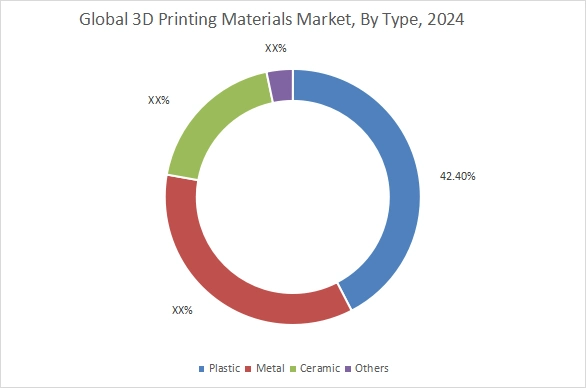
On the basis of type, the 3D printing materials market is segmented into plastic, metal, ceramic, and others.
Trends in the Type:
- Increasing industrial adoption of polymer-based printing materials is expanding the use of plastic materials.
- Rising demand for high-strength components is encouraging development of advanced metal powders.
The plastic 3D printing materials was responsible for the highest revenue share of 42.4% in 2024.
- Plastic materials are commonly used in prototyping and small-scale manufacturing processes.
- The ability of plastic materials to work with various printing techniques is also beneficial for their adoption.
- In addition, lower material cost improves accessibility across industrial and consumer applications.
- Further, availability of diverse polymer formulations strengthens product versatility.
- Therefore, broad application usage is supporting dominance of the plastic segment.
It is anticipated that the metal will exhibit the highest compound annual growth rate (CAGR) during the forecast period.
- Metal materials support production of durable and high-strength industrial components.
- Also, rising adoption of metal additive manufacturing in aerospace and automotive sectors is increasing demand.
- In addition, advancements in alloy powder development are expanding industrial applications.
- Also, growing use in customized medical implants is supporting adoption.
- Therefore, increasing industrial production use is driving growth of the metal segment.
By Form:
On the basis of Form, the 3D printing materials market is segmented into powder, filament, and liquid.
Trends in the Form:
- Expansion of powder-based additive manufacturing systems is increasing demand for metal and polymer powders.
- Rising use of desktop 3D printers is supporting growth of filament materials.
The filament was responsible for the highest revenue share in 2024.
- Filaments are widely used in fused deposition modelling systems across industrial and consumer environments.
- Moreover, easy handling and storage improve operational convenience.
- In addition, the availability of various thermoplastics helps meet the needs of product development.
- Further, the cost efficiency will also promote the adoption of the technology.
- Therefore, strong compatibility with widely used printers is supporting dominance of the filament segment.
It is anticipated that the powder will exhibit the highest compound annual growth rate (CAGR) during the forecast period.
- Powder materials support advanced printing technologies such as SLS and metal laser sintering.
- Also, industrial demand for high-performance parts is increasing usage of powder feedstock.
- In addition, improvements in powder metallurgy are enhancing material consistency.
- Moreover, adoption of metal additive manufacturing is expanding powder demand.
- Therefore, growing industrial applications are driving growth of the powder segment.
By Technology:
On the basis of technology, the 3D printing materials market is segmented into stereolithography, fused deposition modelling (FDM), selective laser sintering (SLS), direct metal laser sintering (DMLS), electron beam melting (EBM), multi jet fusion (MJF), and others.
Trends in the Technology:
- Continuous improvement in industrial additive manufacturing systems is expanding material compatibility.
- Increasing adoption of high-precision printing technologies is supporting specialized material development.
The fused deposition modelling (FDM) was responsible for the highest revenue share in 2024.
- FDM systems are commonly used for prototyping and small-scale manufacturing processes.
- Moreover, the ability to work with various thermoplastics will also make the system more user-friendly.
- In addition, lower equipment and operational cost supports broader adoption.
- Further, increasing deployment in educational and research environments strengthens demand.
- Therefore, widespread accessibility is supporting dominance of the FDM segment.
It is anticipated that the direct metal laser sintering (DMLS) will exhibit the highest compound annual growth rate (CAGR) during the forecast period.
- DMLS enables production of complex and durable metal components.
- Also, aerospace and medical industries are increasing adoption of metal additive manufacturing.
- In addition, improvements in the quality of metal powders will also support the system's efficiency.
- Moreover, growing use in customized implants and aerospace components is expanding applications.
- Therefore, increasing industrial demand for metal printing is driving growth of the DMLS segment.
By Application:
On the basis of application, the 3D printing materials market is segmented into spare parts, dental products, prosthetics, jewellery, glasses and eyewear, tooling, model making, functional prototypes, and others.
Trends in the Application:
- Increasing adoption of additive manufacturing for rapid prototyping is expanding material demand.
- Growing customization requirements across healthcare and consumer products are supporting new applications.
The functional prototypes were responsible for the highest revenue share in 2024.
- Companies are widely using 3D printing for product design validation and development.
- Moreover, faster prototyping reduces product development timelines.
- In addition, material flexibility supports testing of multiple product designs.
- Further, industries are integrating additive manufacturing into research and development workflows.
- Therefore, expanding product development activities are supporting dominance of the functional prototypes segment.
It is anticipated that the prosthetics will exhibit the highest compound annual growth rate (CAGR) during the forecast period.
- 3D printing enables production of customized prosthetic devices.
- Also, growing demand for patient-specific healthcare solutions is increasing adoption.
- In addition, healthcare institutions are integrating additive manufacturing into medical device production.
- Moreover, material advancements are improving strength and comfort of prosthetic products.
- Therefore, increasing healthcare applications are driving growth of the prosthetics segment.
By End User:
On the basis of end user, the 3D printing materials market is divided into automotive, aerospace & defence, medical and healthcare, consumer goods, building & construction, and others.
Trends in the End User:
- Industries are expanding the use of additive manufacturing for lightweight and customized component production.
- Increasing investment in advanced manufacturing technologies is supporting wider adoption.
Automotive accounted for the largest revenue share in the year 2024.
- Automotive manufacturers are using additive manufacturing for rapid prototyping and component production.
- Moreover, demand for lightweight components is increasing use of advanced printing materials.
- In addition, integration of digital manufacturing strategies is supporting additive manufacturing adoption.
- Further, automotive companies are expanding research in material optimization for vehicle components.
- Therefore, increasing production and prototyping applications are supporting dominance of the automotive segment.
Medical and healthcare is anticipated to register the fastest CAGR during the forecast period.
- Healthcare institutions are adopting 3D printing for customized implants and medical devices.
- Also, demand for patient-specific treatment solutions is increasing adoption of additive manufacturing.
- In addition, research in biocompatible materials is expanding medical applications.
- Moreover, hospitals and medical device manufacturers are integrating 3D printing into production processes.
- Therefore, growing healthcare applications are driving growth of the medical and healthcare segment.
Regional Analysis:
North America, Europe, Asia Pacific, the Middle East and Africa, and Latin America are the regions of coverage.
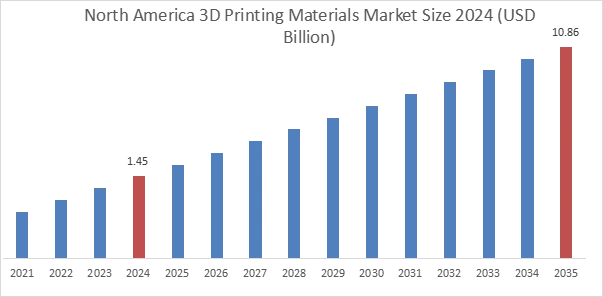
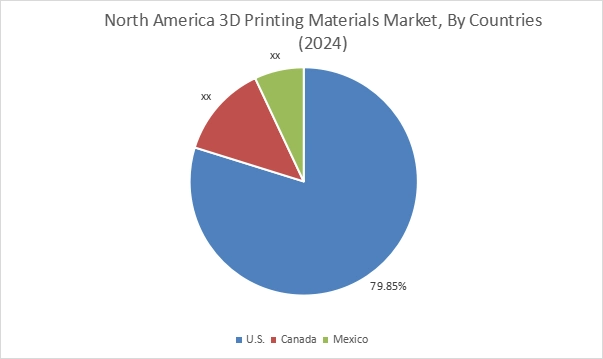
In 2024, North America accounted for the highest market share at 40.15% and was valued at USD 1.45 Billion, and is expected to reach USD 10.86 Billion by 2035. In North America, the U.S. accounted for the highest market share of 79.85% during the base year of 2024. Growth in the region is fueled by high adoption rates for additive manufacturing in the aerospace, automotive, and healthcare sectors. Availability of advanced manufacturing infrastructure, along with high investments in industrial 3D printing technology, is boosting demand for materials in the country.
- For example, in June 2025, Aerospace Industries Association announced that the US aerospace and defense industry generated USD 995 billion in business activity in 2024, including USD 556 billion in direct output and USD 439 billion in supply chain activities.
Asia Pacific is expected to grow at the fastest rate during this period. Countries, such as China is increasing additive manufacturing capacity in industrial production sectors and electronics manufacturing sectors. Japan is increasing the use of high-performance materials in precision manufacturing sectors. India is observing growth in prototyping and small-scale additive manufacturing in the automotive sector, consumer products, and others.
- For example, In December 2025, IBEF stated that industrial production in India has increased by 6.7% in November 2025, after two years of decline. Increasing industrial production in sectors such as the automotive, electrical, and textile industries is driving the use of additive manufacturing, including 3D printing, which requires printing materials.
Europe market for 3D printing materials is driven by the strong industrial manufacturing capabilities of countries such as Germany, France, and the UK. Automotive and aerospace manufacturers are increasingly adopting 3D printing technology in their product development processes. Research centers and industry leaders are stepping up their efforts to develop new materials.
The growth of the Latin America market is driven by the steady adoption of additive manufacturing technology in the automotive and industrial sectors in countries such as Brazil and Mexico. Increasing use of 3D printing for prototyping and tooling applications is supporting material demand.
The Middle East and Africa market is driven by increasing investment in advanced manufacturing technologies in the UAE and Saudi Arabia. Industrial diversification programs are encouraging adoption of additive manufacturing across production environments.
Top Key Players & Market Share Insights:
The market for 3D printing materials is moderately fragmented, with companies operating in the fields of polymers, metal powder, and specialty materials. Suppliers of materials are enhancing their portfolios to accommodate various additive manufacturing processes and industries. There is a rise in collaborations between printer makers and material producers, enhancing compatibility and material standards. There is a rise in competition, with industrial manufacturers and chemical companies investing in new materials for large-scale additive manufacturing. Key participants in the market for 3D printing materials include:
- Stratasys Ltd. – US
- 3D Systems Corporation – US
- Arkema S.A .– France
- Evonik Industries AG – Germany
- BASF SE – Germany
- Solvay S.A. – Belgium
- Höganäs AB – Sweden
- Sandvik Group – Sweden
- EOS GmbH – Germany
- Desktop Metal, Inc. – US
Recent Industry Developments:
- In February 2026, 3D Systems has announced the release of its latest multi-material dental 3D printing solutions, which include the NextDent Model 2B, NextDent Stone, and NextDent Surgical Guide resins, used in the creation of precise models, durable dental stones, and surgical guides, respectively.
- In November 2025, 3D Systems has announced the release of Accura SbF, an antimony-free resin used in the creation of stable QuickCast patterns with high modulus, low ash, and fast draining, used in casting high-performance metals like nickel superalloys and titanium, and Accura Xtreme Black, used in the creation of durable and low-shrinkage prototyping of functional parts like snap fits and enclosures.
3D Printing Materials Market Report Insights:
| Report Attributes | Report Details |
|---|---|
| Study Timeline | 2019-2035 |
| Market Size in 2035 (USD Billion) | USD 27.05 Billion |
| CAGR (2025-2035) | 20.05% |
| By Type |
|
| By Form |
|
| By Technology |
|
| By Application |
|
| By End User |
|
| By Region |
|
| Key Players |
|
| Report Coverage |
|
Key Questions Answered in the Report
How big is the 3D printing materials market? −
The 3D printing materials market size is estimated to reach over USD 27.05 Billion by 2035 from a value of USD 3.62 Billion in 2024 and is projected to grow by USD 4.35 Billion in 2025, growing at a CAGR of 20.05% from 2025 to 2035.
Which segmentation details are covered in the 3D printing materials report? +
The 3D printing materials report includes specific segmentation details for type, form, technology, application, end user, and regions.
Which is the fastest segment anticipated to impact the market growth? +
Metal materials are the fastest growing segment due to rising use of metal additive manufacturing in aerospace and healthcare.
Who are the major players in the 3D printing materials market? +
The key participants in the 3D printing materials marketare Stratasys Ltd. (US), 3D Systems Corporation (US), Arkema S.A. (France), Evonik Industries AG (Germany), BASF SE (Germany), Solvay S.A. (Belgium), Höganäs AB (Sweden), Sandvik Group (Sweden), EOS GmbH (Germany), Desktop Metal, Inc. (US), and others.
What are the key trends in the 3D printing materials market? +
Increasing industrial adoption of additive manufacturing and development of high-performance and recyclable printing materials are shaping the market.
Overview
Reputation & Certifications


Our Services
- Market Intelligence & Forecasting
- Custom Research Solutions
- Market Entry Strategy
- Competitive Intelligence
- Customer Insights
- Industry Innovation Analysis
- Investment Advisory