Jump to Content
Acephate Market - Size, Share, Industry Trends, and Forecasts (2025-2032)
Acephate Market Size:
Acephate Market size is estimated to reach over USD 1,903.86 Million by 2032 from a value of USD 1,380.55 Million in 2024 and is projected to grow by USD 1,412.55 Million in 2025, growing at a CAGR of 4.1% from 2025 to 2032.
Acephate Market Scope & Overview:
Acephate is an organophosphate insecticide widely used for controlling pests in agricultural and non-agricultural settings. It is valued for its effectiveness, systemic action, and broad-spectrum pest control.
Acephate is characterized by its solubility in water, low volatility, and long-lasting effects. It penetrates plant tissues and acts on pests through ingestion or contact, ensuring comprehensive protection. The compound targets various pests, including aphids, thrips, and caterpillars, making it an essential tool in integrated pest management.
The benefits include improved crop yields, enhanced quality of produce, and reduced pest resistance. Its systemic properties enable it to protect new growth, minimizing the need for frequent reapplications.
Applications of acephate are found in the cultivation of fruits, vegetables, cereals, and ornamental plants. It is also used in turf management and public health programs for pest control. End-use industries include agriculture, horticulture, and landscaping, where effective pest management is critical.
Acephate plays a pivotal role in ensuring food security and maintaining crop health. Its properties and versatility make it a preferred choice among farmers and pest control professionals, supporting sustainable agricultural practices and ecosystem balance.
How is AI Impacting the Acephate Market?
AI is impacting the acephate market by promoting precision agriculture and integrated pest management (IPM). AI-powered systems, leveraging drones, sensors, and machine learning, enable farmers to identify pest infestations earlier and apply acephate more precisely, reducing overall chemical usage and waste. This shift towards targeted application driven by AI analytics may lead to a more efficient but potentially smaller overall volume demand for acephate. Furthermore, AI is accelerating R&D for sustainable and eco-friendly alternatives, which could gradually shift market preference away from traditional chemical solutions like acephate due to increasing regulatory scrutiny and environmental concerns.

Acephate Market Dynamics - (DRO) :
Key Drivers:
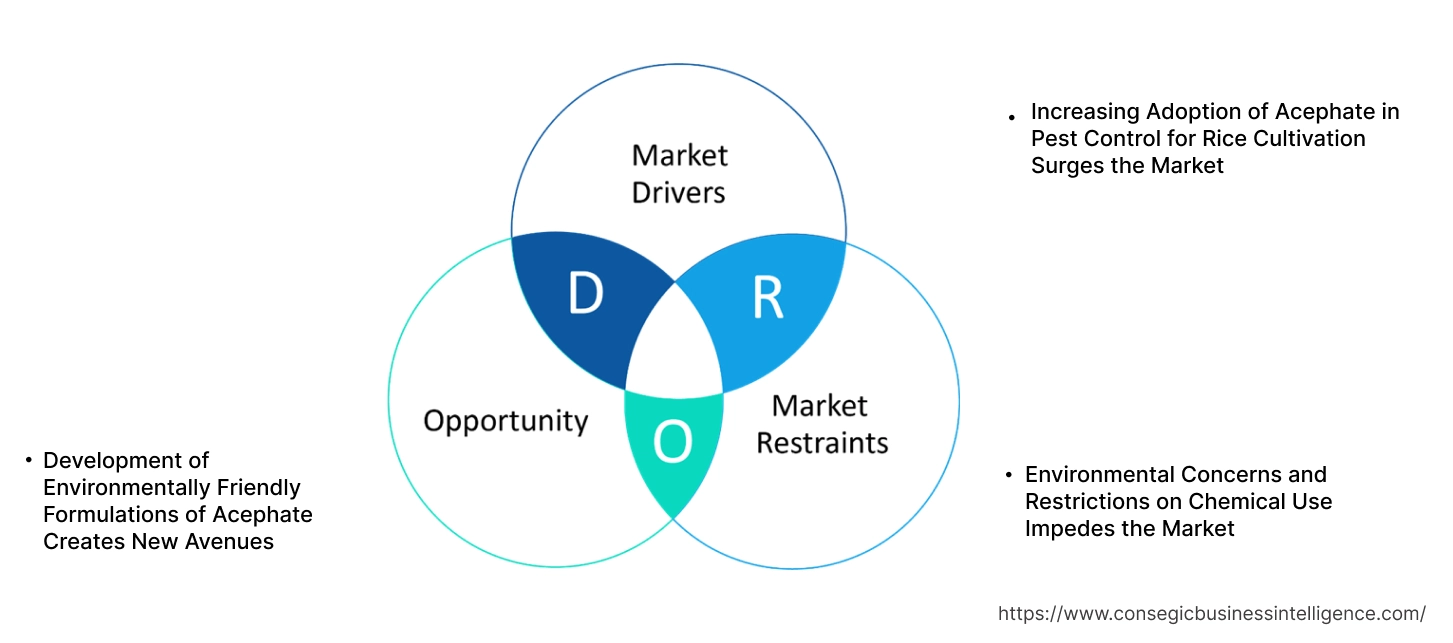
Increasing Adoption of Acephate in Pest Control for Rice Cultivation Surges the Market
Acephate, a widely used organophosphorus insecticide, is gaining traction in agricultural pest control, especially in rice cultivation. Rice is highly susceptible to pest infestations, particularly from rice stem borers and leafhoppers, which can lead to significant yield losses. It is highly effective in controlling these pests due to its systemic action, which allows it to move through the plant and provide long-lasting protection. This characteristic makes it ideal for rice farmers, who need reliable and efficient solutions to safeguard their crops during crucial growth stages.
For instance, in regions like Southeast Asia, where rice farming is a major agricultural activity, the adoption of acephate has helped farmers reduce crop losses caused by pest invasions. By effectively controlling pests that are resistant to other insecticides, acephate ensures the sustainability of rice production and enhances the efficiency of pest management systems.
Thus, the increasing application of acephate in rice cultivation drives the market for this insecticide, addressing the need for effective pest control in the agricultural sector.
Key Restraints:
Environmental Concerns and Restrictions on Chemical Use Impedes the Market
The use of acephate, like many chemical insecticides, is facing scrutiny due to concerns about its environmental impact and toxicity. While acephate is effective in controlling pests, it has been associated with harmful effects on non-target species, including beneficial insects like bees, and may also pose a risk to aquatic life. As awareness of these environmental risks increases, regulations on the use of acephate are becoming more stringent in several countries.
For example, the European Union has imposed restrictions on the use of certain organophosphates, including acephate, due to their potential to contaminate soil and water, as well as their long-term ecological effects. Additionally, rising consumer preference for organic and eco-friendly products has led to a shift away from synthetic chemical-based pest control solutions. This shift creates a barrier for acephate's market penetration, particularly in regions with strong environmental protection laws.
Therefore, increasing environmental concerns and regulatory restrictions on the use of acephate act as significant restraints to its widespread adoption in pest control.
Future Opportunities :
Development of Environmentally Friendly Formulations of Acephate Creates New Avenues
In response to growing environmental concerns, there is a significant opportunity for the development of environmentally friendly formulations of acephate. Research and development in the agricultural chemical industry are focused on creating safer, less toxic versions of traditional insecticides, including acephate, which can minimize ecological impact while maintaining effectiveness in pest control. Advances in encapsulation technologies, for example, could enable more targeted application of acephate, reducing its dispersion into the environment.
Moreover, biotechnological innovations are opening new avenues for creating hybrid formulations of acephate that combine its efficacy with reduced environmental toxicity. The development of these green formulations could appeal to eco-conscious farmers and align with stricter regulatory standards for chemical pesticides.
As these innovative, environmentally friendly formulations are introduced, they have the potential to meet the increasing Acephate Market expansion towards sustainable farming practices. This shift presents a significant Acephate Market opportunity to expand while aligning with global trends towards sustainable agriculture.
Acephate Market Segmental Analysis :
By Type:
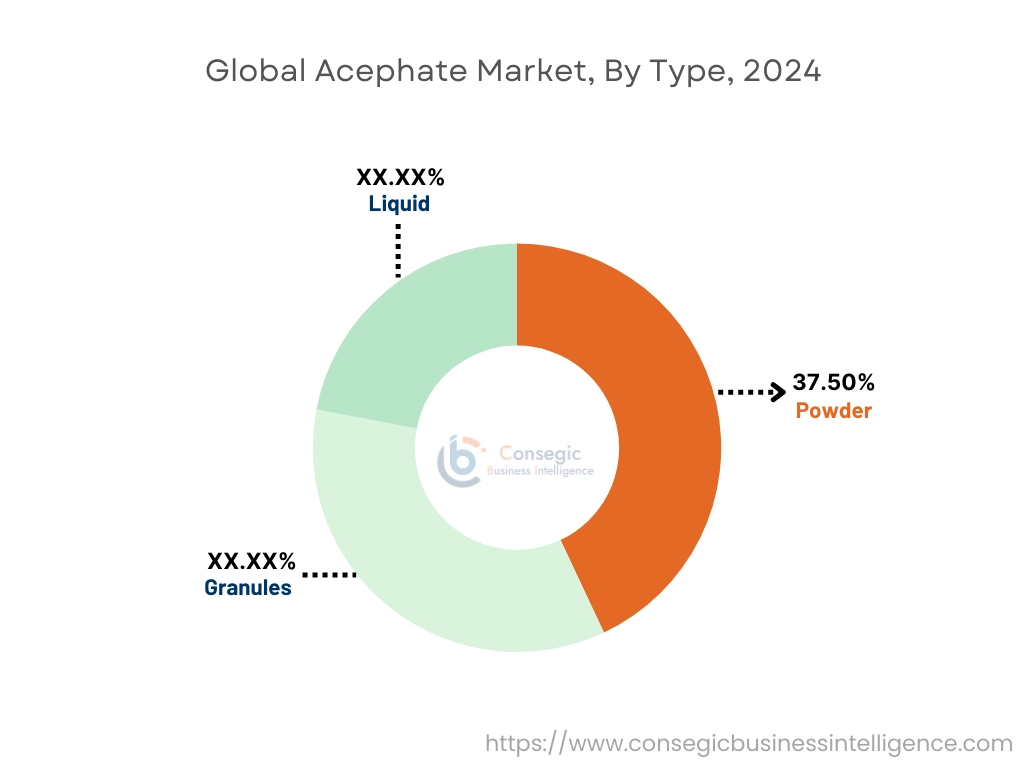
Based on type, the acephate market is segmented into powder, granules, and liquid forms.
The powder segment accounted for the largest revenue share by 37.50% in 2024 and is anticipated to register the fastest CAGR during the forecast period.
- Acephate powder is widely used for its efficiency in pest control and its ability to be easily applied to crops and plants.
- It is commonly mixed with water to create sprays for agricultural applications, targeting pests like aphids, whiteflies, and termites.
- The powder form is favored for its ease of storage and transportation, and its long shelf life.
- With its effective performance in controlling pests across different types of crops, it has seen widespread use in agriculture, horticulture, and turf management.
- As the need for easy-to-apply solutions in pest control rises, the powder form of acephate continues to see strong trend.
- Therefore, according to Acephate Market analysis, the powder segment continues to dominate the market due to its versatility, convenience, and effectiveness in a wide range of applications, driving both current Acephate Market share and future growth potential.
By Application:
Based on application, the acephate market is segmented into agriculture, horticulture, forestry, and turf and ornamentals.
The agriculture segment accounted for the largest revenue share in 2024 and is expected to register the fastest CAGR during the forecast period.
- Acephate plays a crucial role in controlling a wide range of pests that threaten crop yields, from insects like aphids to termites and caterpillars.
- Its systemic action means it is absorbed by the plants and provides longer-lasting protection compared to other pesticides, making it highly effective for large-scale agriculture.
- Acephate is especially beneficial in high-value crops like cotton, vegetables, and fruits, where crop protection is crucial for maintaining quality and yield.
- The increasing trend for sustainable and efficient pest control methods in agricultural settings will drive the Acephate Market growth.
- Additionally, rising global expansion towards food production and more stringent pest control measures will further contribute to the widespread use of acephate in agriculture.
- Thus, according to Acephate Market analysis, the agriculture segment continues to hold the largest share in the acephate market due to its critical role in protecting crops from various pests and contributing to higher yields, owing to a future Acephate Market trend.
By Formulation:
Based on formulation, the market is segmented into wettable powder (WP), soluble powder (SP), and emulsifiable concentrate (EC).
The wettable powder (WP) formulation accounted for the largest revenue share in 2024 and is anticipated to register the fastest CAGR during the forecast period.
- Wettable powders of acephate are highly effective when mixed with water and applied to crops.
- This formulation allows for easy distribution and faster absorption by the plants, providing effective pest control with minimal environmental impact.
- WP formulations are commonly used in both large-scale commercial farming and residential gardening for pest management.
- The increased preference for eco-friendly, water-soluble formulations that offer minimal residue on crops boosts the growth of the WP segment.
- Wettable powders also have the advantage of being highly customizable, allowing farmers and pest control providers to adjust concentrations based on specific needs and conditions.
- Therefore, according to market analysis, the wettable powder (WP) formulation remains the most popular due to its ease of use and environmental benefits, while also continuing to see the fastest growth as farmers increasingly seek efficient pest control solutions.
By Sales Channel:
Based on sales channel, the acephate market is segmented into direct sales, agrochemical retail stores, and online platforms.
The direct sales segment accounted for the largest revenue share in 2024 and is anticipated to register the fastest CAGR during the forecast period.
- Direct sales are the preferred method for large-scale agricultural buyers, such as farms, cooperatives, and pest control service providers, due to the need for bulk purchases and customized solutions.
- This channel allows manufacturers to develop close relationships with customers, providing tailored support and ensuring timely delivery of products.
- Additionally, direct sales offer more control over product distribution and pricing, which is essential for establishing long-term business relationships in the agricultural industry.
- The trend toward direct-to-consumer models, particularly in agricultural markets, further strengthens the direct sales segment.
- Manufacturers and distributors are also increasingly leveraging technology to facilitate smoother transactions and support for large-scale buyers.
- Thus, according to market analysis, the direct sales segment remains the largest and fastest-growing due to the trend for bulk transactions and personalized service, with agricultural buyers relying on direct relationships for consistent supply and support.
By End-Use:
Based on end-use, the acephate market is segmented into crop protection, pest control services, and home and garden.
The crop protection segment accounted for the largest revenue share in 2024 and is expected to register the fastest CAGR during the forecast period.
- Acephate is widely used in crop protection due to its ability to control a broad spectrum of pests, contributing to improved crop yields and quality.
- It is commonly applied in the protection of food crops from harmful insect infestations, reducing the need for more toxic pesticides.
- The growing expansion to organic and sustainable farming practices, combined with acephate's relatively low toxicity to humans and animals, drives its adoption in crop protection.
- Increased awareness of integrated pest management (IPM) solutions is also driving the use of acephate as a key element in sustainable farming practices.
- Additionally, regulatory pressure to reduce the use of more toxic chemical pesticides further supports the growth of the crop protection segment.
- Therefore, according to market analysis, the crop protection segment will continue to lead in revenue generation, as the increasing focus on sustainable agriculture and pest management fuels the demand for acephate as an efficient and environmentally friendly pest control solution.
Regional Analysis:
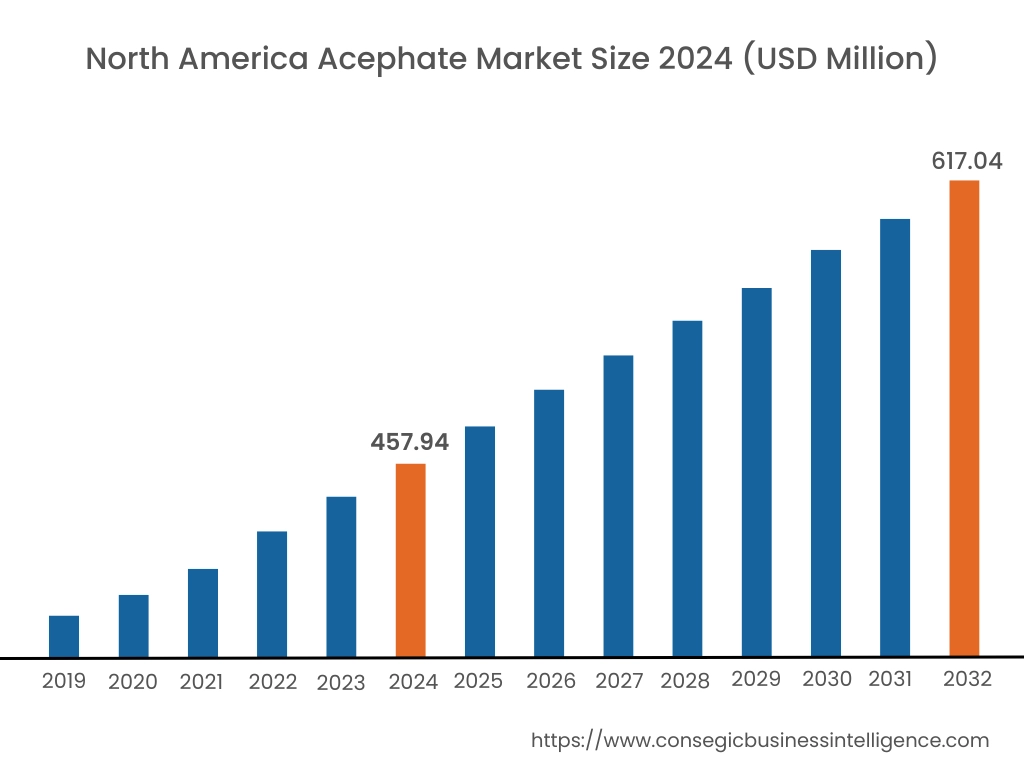
In 2024, North America was valued at USD 457.94 Million and is expected to reach USD 617.04 Million in 2032. In North America, the U.S. accounted for the highest share of 73.10% during the base year of 2024.
North America holds a substantial share in the acephate market, driven by its well-established agricultural industry. The U.S. and Canada are key markets, with high demand for acephate in pest control applications. Strict regulatory standards ensure that only approved products are used, influencing market dynamics. The growing focus on sustainable agriculture also impacts the usage trends of acephate-based solutions in the region.

In Asia Pacific, the market is experiencing the fastest growth with a CAGR of 4.5% over the forecast period. Asia-Pacific represents the largest market for acephate due to the region’s vast agricultural landscape, particularly in China and India. The increasing use of chemical pesticides in crop protection to combat pest infestations is a significant factor. However, concerns about environmental impact and the push for organic farming may affect future market performance. Despite this, the region remains a major consumer of acephate for rice, cotton, and other crops.
In Europe, the acephate market faces stringent regulatory scrutiny. The European Union’s focus on reducing pesticide use and promoting environmentally friendly farming practices affects Acephate Market demand. However, some countries, particularly in Southern Europe, still use acephate for controlling pests in crops such as fruits and vegetables. The market’s growth is constrained by these regulatory hurdles, along with the growing adoption of integrated pest management (IPM) strategies.
The Middle East and Africa region shows moderate demand for acephate, with agricultural practices in countries like Egypt and South Africa relying on pest control solutions. The market is influenced by the need to protect crops in arid conditions and the rising demand for higher agricultural yields. Limited access to advanced pest control technologies, along with regulatory variations across countries, affects market stability.
Latin America sees steady demand for acephate, particularly in Brazil and Argentina, which have significant agricultural sectors. The region relies on chemical pesticides to maintain crop productivity, especially in the production of soybeans, corn, and coffee. However, increasing concerns over pesticide residues and the shift toward more sustainable agricultural practices may influence future market trends.
Top Key Players & Market Share Insights:
The Global Acephate Market is highly competitive with major players providing products and services to the national and international markets. Key players are adopting several strategies in research and development (R&D), product innovation, and end-user launches to hold a strong position in the Global Acephate Market. Key players in the Acephate industry include-
- BASF SE (Germany)
- Syngenta AG (Switzerland)
- Sumitomo Chemical Co., Ltd. (Japan)
- Mitsui Chemicals Agro, Inc. (Japan)
- Bayer AG (Germany)
- Dow Chemical Company (United States)
- Adama Agricultural Solutions Ltd. (Israel)
- UPL Limited (India)
- Nufarm Limited (Australia)
- FMC Corporation (United States)
Acephate Market Report Insights:
| Report Attributes | Report Details |
| Study Timeline | 2019-2032 |
| Market Size in 2032 | USD 1,903.86 Million |
| CAGR (2025-2032) | 4.1% |
| By Type |
|
| By Application |
|
| By Formulation |
|
| By Sales Channel |
|
| By End-Use |
|
| By Region |
|
| Key Players |
|
| North America | U.S. Canada Mexico |
| Europe | U.K. Germany France Spain Italy Russia Benelux Rest of Europe |
| APAC | China South Korea Japan India Australia ASEAN Rest of Asia-Pacific |
| Middle East and Africa | GCC Turkey South Africa Rest of MEA |
| LATAM | Brazil Argentina Chile Rest of LATAM |
| Report Coverage |
|
Key Questions Answered in the Report
How big is the Acephate Market? −
In 2024, the Acephate Market was USD 1,380.55 million.
What will be the potential market valuation for the Acephate Market by 2032? +
In 2032, the market size of Acephate Market is expected to reach USD 1,903.86 million.
What are the segments covered in the Acephate Market report? +
The type, application, formulation, sales channel, and end-use are the segments covered in this report.
Who are the major players in the Acephate Market? +
BASF SE (Germany), Syngenta AG (Switzerland), Dow Chemical Company (United States), Adama Agricultural Solutions Ltd. (Israel), UPL Limited (India), Nufarm Limited (Australia), FMC Corporation (United States), Sumitomo Chemical Co., Ltd. (Japan), Mitsui Chemicals Agro, Inc. (Japan), Bayer AG (Germany) are the major players in the Acephate market.
Overview
Reputation & Certifications


Our Services
- Market Intelligence & Forecasting
- Custom Research Solutions
- Market Entry Strategy
- Competitive Intelligence
- Customer Insights
- Industry Innovation Analysis
- Investment Advisory