Jump to Content
Acrylates Copolymer Market Size & Industry Share - Growth Trends & Forecasts (2026 - 2034)
Acrylates Copolymer Market Size:
The Acrylates Copolymer Market is expected to expand from 8,409.21 (US$M) in 2025 to 9,293.85 (US$M) in 2026, and is forecast to surpass 20,688.21 (US$M) by 2034, growing at a CAGR of 10.5% between 2026 and 2034, according to a recent report from Consegic Business Intelligence.
Acrylates Copolymer Market Scope & Overview:
Acrylates copolymer represents a synthetic polymer derived from acrylate monomers. This product features strong adhesion, water resistance, ultraviolet resistance, flexibility, and dimensional stability under diverse environmental conditions. It provides improved durability, extended product lifespan, and enhanced surface protection when applied to substrates. In addition, it exhibits excellent compatibility with pigments and additives, enabling stable dispersion and uniform film formation. This versatility contributes to high-performance coatings, adhesives, sealants, and personal care formulations. Moreover, the product supports simplified processing and reliable end-use performance through efficient application methods. Widely adopted in automotive, construction, cosmetics, and packaging industries, it assists manufacturers in achieving product differentiation, consistent quality, and compliance with stringent performance standards. Focus on sustainability drives ongoing research into lower emissions, improved biodegradability, and renewable raw materials. The market benefits from growing demand for advanced materials designed to address evolving application requirements.
How is AI Impacting the Acrylates Copolymer Market?
AI is impacting the Acrylates Copolymer market by enhancing efficiency and driving innovation across its lifecycle. AI-powered systems are optimizing the manufacturing process, from raw material selection to polymerization, leading to improved yields, reduced waste, and better quality control. Through advanced analytics, AI can predict the performance of new formulations, accelerating research and development of tailored acrylates for specific applications like coatings, adhesives, and personal care products. Furthermore, AI-driven market intelligence enables more accurate demand forecasting and supply chain management, ensuring manufacturers can respond swiftly to evolving consumer preferences and industry trends, particularly towards sustainable and eco-friendly solutions.

Acrylates Copolymer Market Dynamics - (DRO) :
Key Drivers:
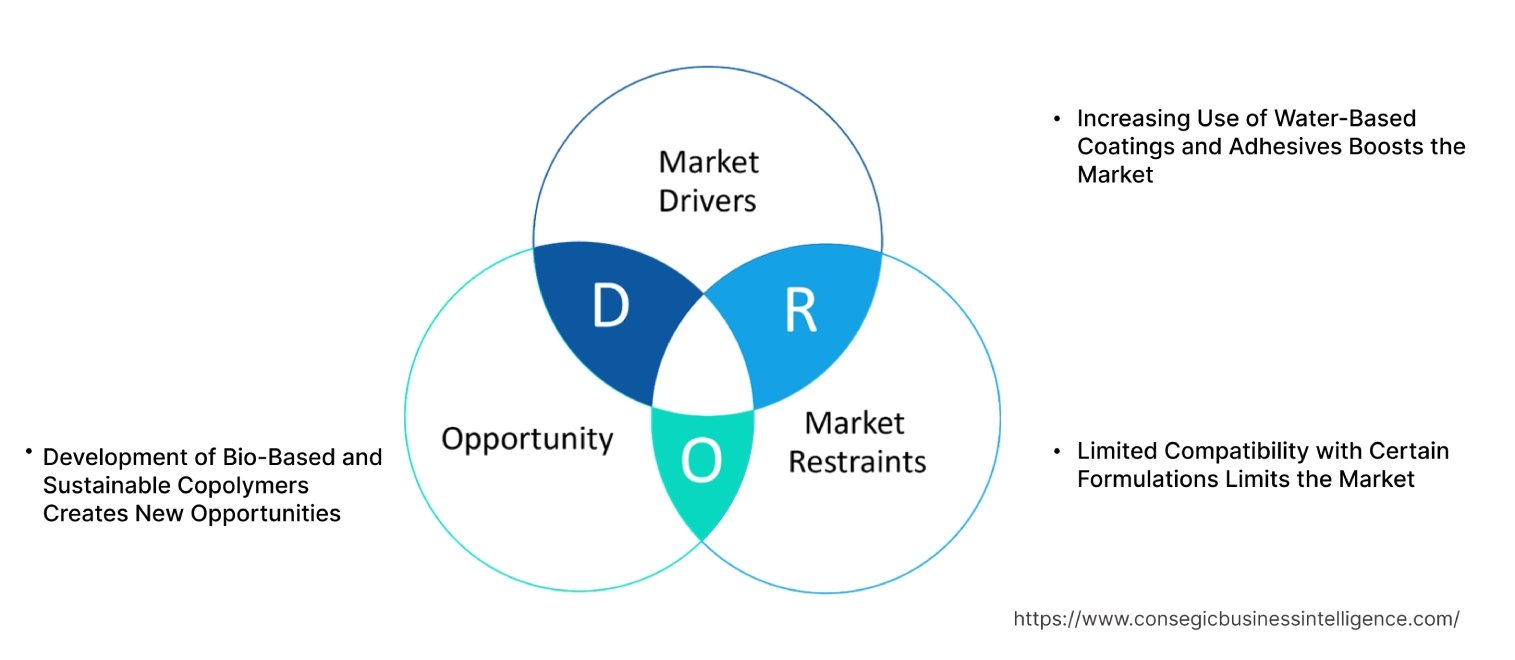
Increasing Use of Water-Based Coatings and Adhesives Boosts the Market
The shift toward environmentally friendly products has significantly boosted the adoption of acrylates copolymer in water-based coatings and adhesives. These formulations are increasingly favored due to their low volatile organic compound (VOC) content, aligning with global trends in sustainability and stricter environmental regulations. Acrylates copolymer provides excellent adhesion, durability, and resistance to water, making it a critical component in high-performance coatings for the automotive, construction, and packaging industries.
In water-based adhesives, the copolymer ensures strong bonding capabilities and flexibility, which are essential for a wide range of applications, including laminates, labels, and wood products. Trends in industrial innovation highlight the growing preference for safer and sustainable adhesives and coatings, positioning acrylates copolymer as a versatile and reliable material in eco-friendly formulations.
Key Restraints :
Limited Compatibility with Certain Formulations Limits the Market
Despite its versatility, acrylates copolymer faces challenges in compatibility with specific formulations. In environments requiring extreme pH conditions, such as highly acidic or alkaline systems, the performance of the copolymer can be suboptimal. This limitation restricts its use in certain specialized applications, where alternative polymers or additives may offer better stability and functionality.
Additionally, when combined with specific solvents or active ingredients, acrylates copolymer may exhibit reduced effectiveness, necessitating adjustments to formulations. These challenges force manufacturers to invest in research to enhance the copolymer's compatibility across a broader range of applications. Addressing these limitations is crucial to expanding its role in advanced and niche industrial uses.
Future Opportunities :
Development of Bio-Based and Sustainable Copolymers Creates New Opportunities
The increasing emphasis on sustainability has opened new avenues for the development of bio-based and eco-friendly acrylates copolymers. Innovative trends in renewable feedstocks, such as plant-derived monomers and biopolymers, are enabling the creation of sustainable alternatives without compromising performance. These bio-based copolymers reduce reliance on fossil fuel-derived raw materials and align with global trends toward green chemistry and reduced carbon footprints.
Additionally, bio-based acrylates copolymers are gaining traction in industries where environmental responsibility is a priority, such as packaging, personal care, and construction. Manufacturers are also exploring new processing techniques that lower energy consumption and minimize waste, further enhancing the sustainability of these materials. Analysis suggests that as regulatory and consumer focus on sustainability intensifies, the adoption of bio-based copolymers will become a defining trend in the market.
Acrylates Copolymer Market Segmental Analysis :
By Chemical:
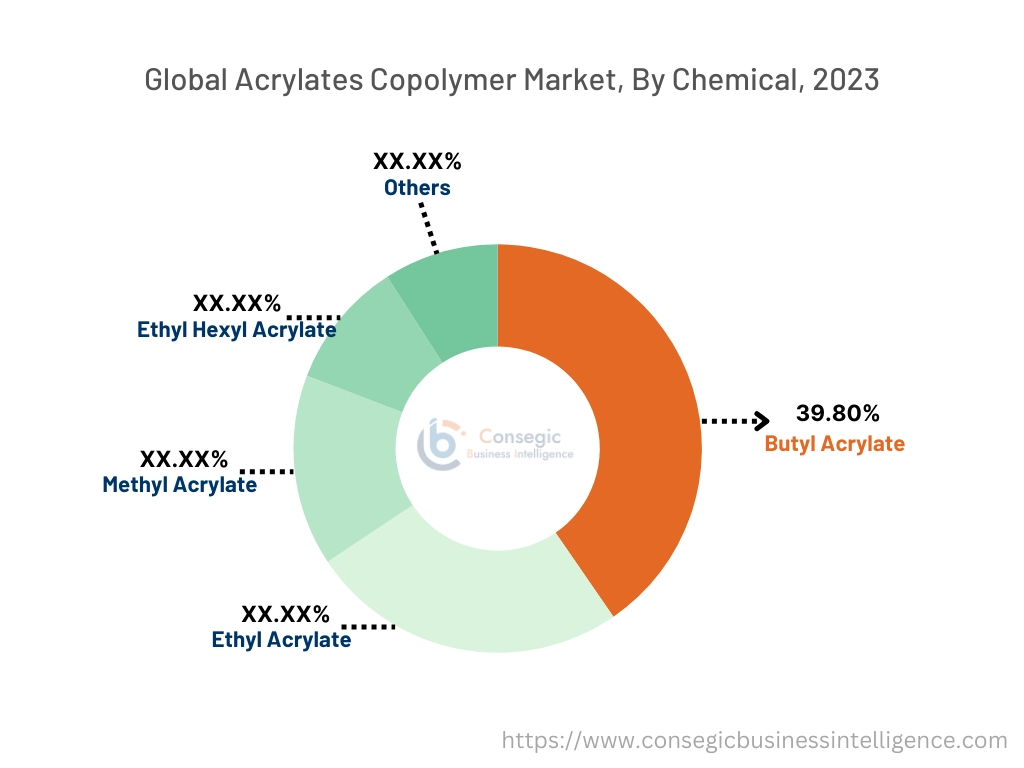
Based on chemicals, the market is segmented into butyl acrylate, ethyl acrylate, methyl acrylate, ethyl hexyl acrylate, and others.
The butyl acrylate segment accounted for the largest revenue of 39.80% share in 2023.
- Butyl acrylate is widely used in paints and coatings, adhesives, and textiles due to its excellent adhesion, flexibility, and water resistance properties.
- Its dominance is driven by the surge for high-performance materials in the construction and automotive industries.
- Additionally, butyl acrylate’s low volatility and ability to enhance the durability of coatings make it a preferred choice for outdoor applications.
- The increasing focus on eco-friendly and water-based formulations further supports the market development of this segment.
- Butyl acrylate analysis leads the acrylates copolymer market trends due to its versatility and extensive application in paints, coatings, and adhesives across construction and automotive industries.
The ethyl hexyl acrylate segment is anticipated to register the fastest CAGR during the forecast period.
- Ethyl hexyl acrylate is gaining popularity for its superior flexibility and impact resistance, making it ideal for high-performance coatings and adhesives.
- The growing adoption of advanced adhesives in the automotive and packaging sectors, along with the shift towards lightweight and durable materials, is driving growth in this segment.
- Additionally, innovations in low-VOC formulations using ethyl hexyl acrylate are further propelling its demand.
- Ethyl hexyl acrylate is expected to grow rapidly, driven by its superior properties and increasing use in high-performance adhesives and coatings.
By Product Type:
Based on product type, the market is segmented into water-based and solvent-based acrylates copolymers.
The water-based segment accounted for the largest revenue in acrylates copolymer market share in 2023.
- Water-based acrylates copolymers are favored due to their low VOC emissions, compliance with environmental regulations, and suitability for eco-friendly formulations.
- These copolymers are extensively used in paints, coatings, and adhesives, providing excellent durability and adhesion.
- The demand for water-based products is further fueled by the growing consumer preference for sustainable and non-toxic materials, particularly in personal care and packaging applications.
- Water-based acrylates copolymers dominate the market, driven by their environmental benefits, regulatory compliance, and growing adoption of sustainable formulations.
The solvent-based segment is anticipated to register steady growth during the forecast period.
- Solvent-based acrylates copolymers are known for their superior durability and resistance to harsh environmental conditions, making them ideal for industrial applications.
- These products are particularly used in automotive coatings and heavy-duty adhesives where high performance is critical.
- Despite environmental concerns, advancements in low-VOC solvent-based formulations are sustaining acrylates copolymer market demand in industrial sectors.
- Solvent-based acrylates copolymers analysis portrays it continues to grow steadily due to their high performance and advancements in environmentally friendly formulations.
By End-Use Industry:
Based on end-use, the market is segmented into construction, automotive, personal care & cosmetics, packaging, textiles, and others.
The construction segment accounted for the largest revenue in acrylates copolymer market share in 2023.
- The construction sector is the largest consumer of acrylates copolymers, particularly in paints, coatings, and sealants.
- These materials provide superior adhesion, durability, and weather resistance, making them ideal for building and infrastructure projects.
- The rising advancement for sustainable and energy-efficient construction materials further supports the adoption of acrylates copolymers.
- Additionally, the rapid urbanization and infrastructure development in emerging economies are driving development in this segment.
- Construction analysis leads the acrylates copolymer market demand due to its extensive use of acrylates copolymers in paints, coatings, and sealants, supported by urbanization and sustainable building practices.
The personal care & cosmetics segment is anticipated to register the fastest CAGR during the forecast period.
- Acrylates copolymers are widely used in personal care products, including hair gels, sunscreens, and moisturizers, for their film-forming, thickening, and water-resistant properties.
- The growing demand for premium personal care products, driven by rising consumer awareness of skincare and haircare, is fueling acrylates copolymer market growth in this segment.
- The trend toward natural and sustainable formulations is further driving the adoption of acrylates copolymers in cosmetics.
- Personal care & cosmetics are expected to grow rapidly, driven by rising consumer rise for high-performance, sustainable formulations in skincare and haircare products.
Regional Analysis:
The regions covered are North America, Europe, Asia Pacific, the Middle East and Africa, and Latin America.
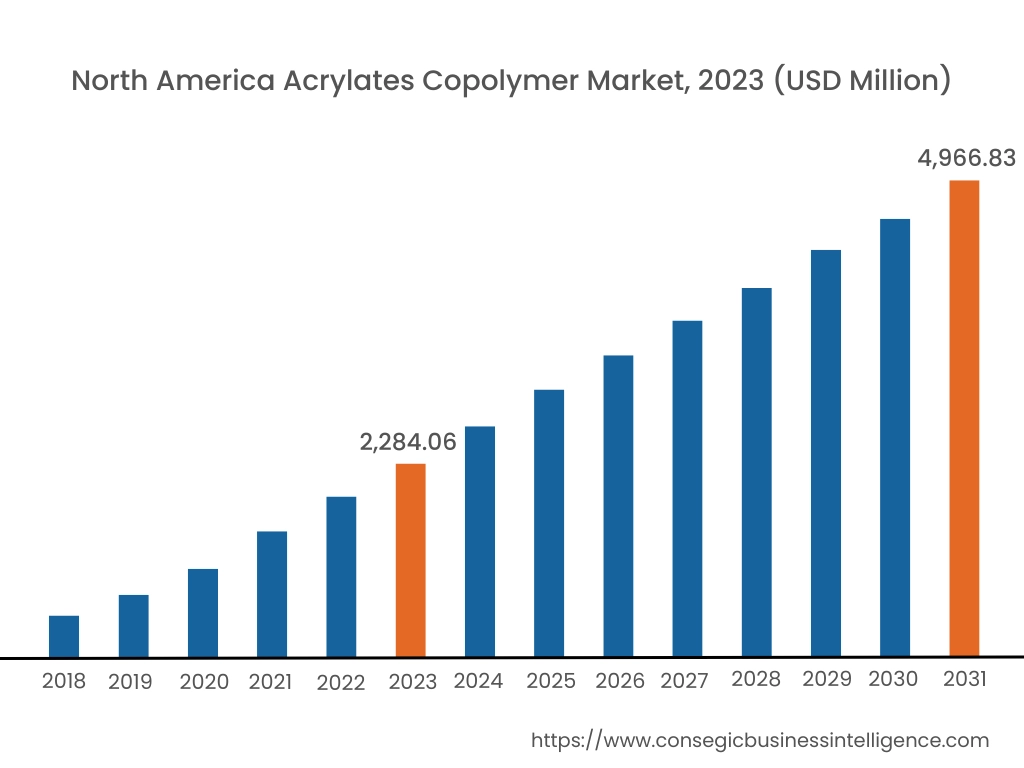
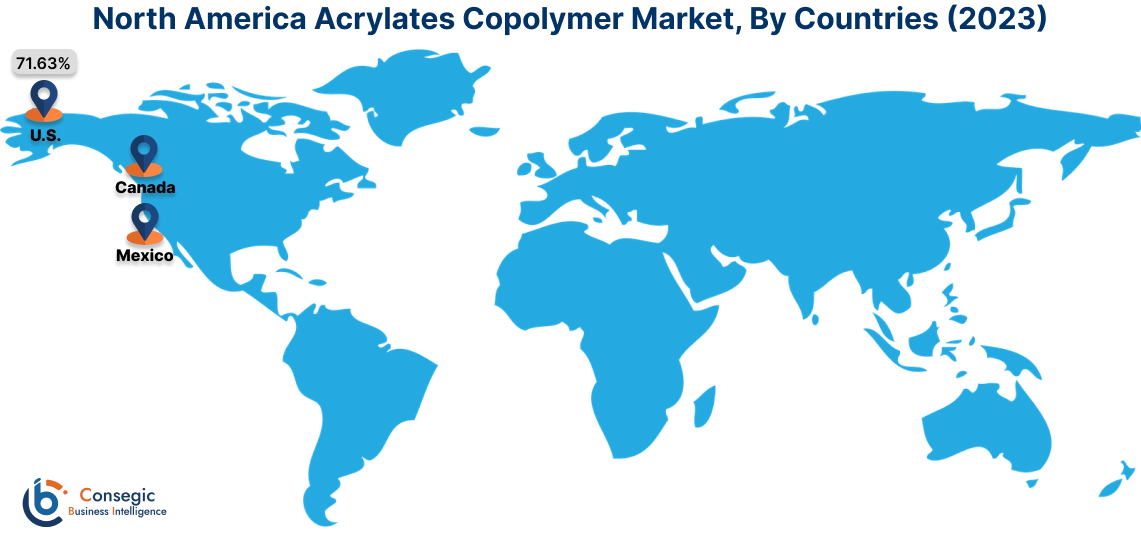
In 2023, North America was valued at USD 2,284.06 Million and is expected to reach USD 4,966.83 Million in 2031. In North America, the U.S. accounted for the highest share of 71.63% during the base year of 2023. North America holds a significant share in the acrylates copolymer market analysis, driven by its extensive use in personal care, adhesives, and coatings industries. The U.S. leads the region with a strong demand for acrylates copolymers in skincare and haircare products, as these polymers improve texture, stability, and water resistance. The growing construction and automotive sectors also support the use of acrylates copolymers in paints, sealants, and adhesives. Canada contributes through its rising adoption of eco-friendly formulations in personal care and industrial applications. However, stringent regulatory standards on chemical usage and environmental sustainability can challenge acrylates copolymer market expansion in the region.
In Asia Pacific, the market is experiencing the fastest growth with a CAGR of 11.0% over the forecast period. Asia-Pacific is the largest and fastest-growing region in the acrylates copolymer market analysis, fueled by rapid industrialization, urbanization, and increasing consumption of personal care and construction products in China, India, and Japan. China dominates the market with extensive use in adhesives, coatings, and personal care formulations, driven by its large manufacturing base. India’s expanding construction and cosmetics industries further boost growth for acrylates copolymers in sealants, paints, and skincare products. Japan leverages high-quality acrylates copolymers in advanced formulations for electronics, automotive coatings, and personal care. However, challenges such as fluctuating raw material prices and environmental concerns may impact market dynamics in the region.
Europe is a prominent market for acrylates copolymers, supported by its advanced personal care and construction industries. Countries like Germany, France, and the UK are key contributors. Germany’s robust automotive and construction sectors drive the adoption of acrylates copolymers in coatings, adhesives, and sealants. France emphasizes their use of premium skincare and cosmetics, aligning with consumer demand for high-performance and eco-friendly products. The UK sees rising adoption of water-based coatings and adhesives to comply with stringent EU regulations on volatile organic compounds (VOCs). However, regulatory complexities and high production costs may pose challenges for manufacturers in the region.
The Middle East & Africa region is witnessing steady growth in the acrylates copolymer market, driven by increasing acrylates copolymer market opportunities investments in construction and rising growth for personal care products. Countries like Saudi Arabia and the UAE are adopting acrylates copolymers in coatings and adhesives to support large-scale infrastructure projects and industrial applications. In Africa, South Africa is an emerging market, with growing use in personal care products and water-based coatings. However, limited local manufacturing capabilities and reliance on imports for raw materials may constrain market development in certain areas.
Latin America is emerging for acrylates copolymers market growth, with Brazil and Mexico leading the region. Brazil’s growing construction and cosmetics industries utilize acrylates copolymers in waterproof coatings, sealants, and skincare products. Mexico’s expanding automotive and industrial sectors also adopt these copolymers in coatings and adhesives. The region’s interest in eco-friendly and water-based formulations aligns with global sustainability acrylates copolymer market trends. However, economic instability and inconsistent regulatory frameworks may limit broader market expansion across the region.
Top Key Players and Market Share Insights:
The acrylates copolymer market is highly competitive with major players providing products and services to the national and international markets. Key players are adopting several strategies in research and development (R&D), product innovation, and end-user launches to hold a strong position in the global acrylates copolymer market. Key players in the acrylates copolymer industry include -
Recent Industry Developments :
Product Launches:
- In April 2024, Archroma introduced APPRETAN® FFX1540 liq, an innovative formaldehyde- and PFAS-free acrylic copolymer enhancing fabric durability and environmental responsibility. Designed for technical fabrics and nonwovens, it offers superior hydrophobicity, low water absorption, and exceptional water tightness in both static and dynamic conditions. Its unique low-cure profile reduces the carbon footprint while ensuring high performance, particularly in glass fiber finishing.
- In November 2023, SKFP introduced LOTRYL® 40MA05T, an ethylene-acrylate copolymer with 40% methyl acrylate, designed for high flexibility and compatibility with polar resins. It targets markets like flexible cables (UV- and temperature-resistant), impact modification, and engineering plastics flexibilization.
Acrylates Copolymer Market Report Insights :
| Report Attributes | Report Details |
| Study Timeline | 2021-2034 |
| Market Size in 2034 | USD 20,688.21 Million |
| CAGR (2026-2034) | 10.52% |
| Base Year | 2025 |
| By Chemical |
|
| By Product Type |
|
| By End-Use Industry |
|
| By Region |
|
| Key Players |
|
| North America | U.S. Canada Mexico |
| Europe | U.K. Germany France Spain Italy Russia Benelux Rest of Europe |
| APAC | China South Korea Japan India Australia ASEAN Rest of Asia-Pacific |
| Middle East and Africa | GCC Turkey South Africa Rest of MEA |
| LATAM | Brazil Argentina Chile Rest of LATAM |
| Report Coverage |
|
Key Questions Answered in the Report
What is the projected market size of the Acrylates Copolymer Market by 2031? −
Acrylates Copolymer Market size is estimated to reach over USD 15,324.99 Million by 2031 from a value of USD 6,885.75 Million in 2023 and is projected to grow by USD 7,487.29 Million in 2024, growing at a CAGR of 10.52% from 2024 to 2031.
What drives the demand for acrylates copolymers in water-based formulations? +
The increasing focus on environmentally friendly products has boosted the adoption of water-based acrylates copolymers due to their low volatile organic compound (VOC) emissions, excellent adhesion, and durability.
Which chemical segment dominates the market? +
The butyl acrylate segment holds the largest revenue share, driven by its extensive use in paints, coatings, and adhesives, particularly in the construction and automotive industries.
What are the major challenges faced by the Acrylates Copolymer Market? +
The primary challenges include limited compatibility with extreme pH conditions or specific formulations and the high production costs associated with advanced grades.
Overview
Reputation & Certifications


Our Services
- Market Intelligence & Forecasting
- Custom Research Solutions
- Market Entry Strategy
- Competitive Intelligence
- Customer Insights
- Industry Innovation Analysis
- Investment Advisory