Jump to Content
Alternative Finance Market Size & Industry Share - Growth Trends & Forecasts (2026 - 2034)
Alternative Finance Market Size:
Alternative Finance Market size is estimated to reach over 74.31 (US$B) by 2034 from a value of 18.54 (US$B) in 2025 and is projected to grow by 21.63 (US$B) in 2026, growing at a CAGR of 16.7% from 2026 to 2034, according to a recent report from Consegic Business Intelligence.
Alternative Finance Market Scope & Overview:
Alternative finance refers to financial services and funding options that operate outside traditional banking systems. This market includes a variety of platforms and instruments such as crowdfunding, peer-to-peer (P2P) lending, invoice trading, and private equity. These innovative financial mechanisms are designed to provide businesses and individuals with flexible access to capital, bypassing the conventional requirements of banks and other traditional financial institutions.
This market supports a diverse range of funding demands, including small business loans, real estate investments, and personal financing. Alternative finance platforms leverage digital technology to streamline processes, connect borrowers directly with lenders or investors, and enhance transparency. These platforms are equipped with advanced tools for risk assessment, payment processing, and investor management, ensuring efficient operations.
End-users of these services include startups, small and medium-sized enterprises (SMEs), individual borrowers, and institutional investors seeking opportunities beyond conventional financial systems. The alternative finance market plays a crucial role in bridging funding gaps and fostering financial inclusion across various sectors.
How is AI Impacting the Alternative Finance Market?
Artificial Intelligence (AI) is significantly impacting the alternative finance market by enhancing data analysis, improving risk management, and offering personalized investment strategies. AI algorithms analyze real-time transaction patterns to identify anomalies and flag suspicious activities indicative of fraud, significantly strengthening security measures. Also, AI automates routine tasks such as data entry, document verification, and loan application processing, reducing manual effort and accelerating loan origination. This leads to cost reductions and frees up human resources to focus on more strategic activities.

Alternative Finance Market Dynamics - (DRO) :
Key Drivers:
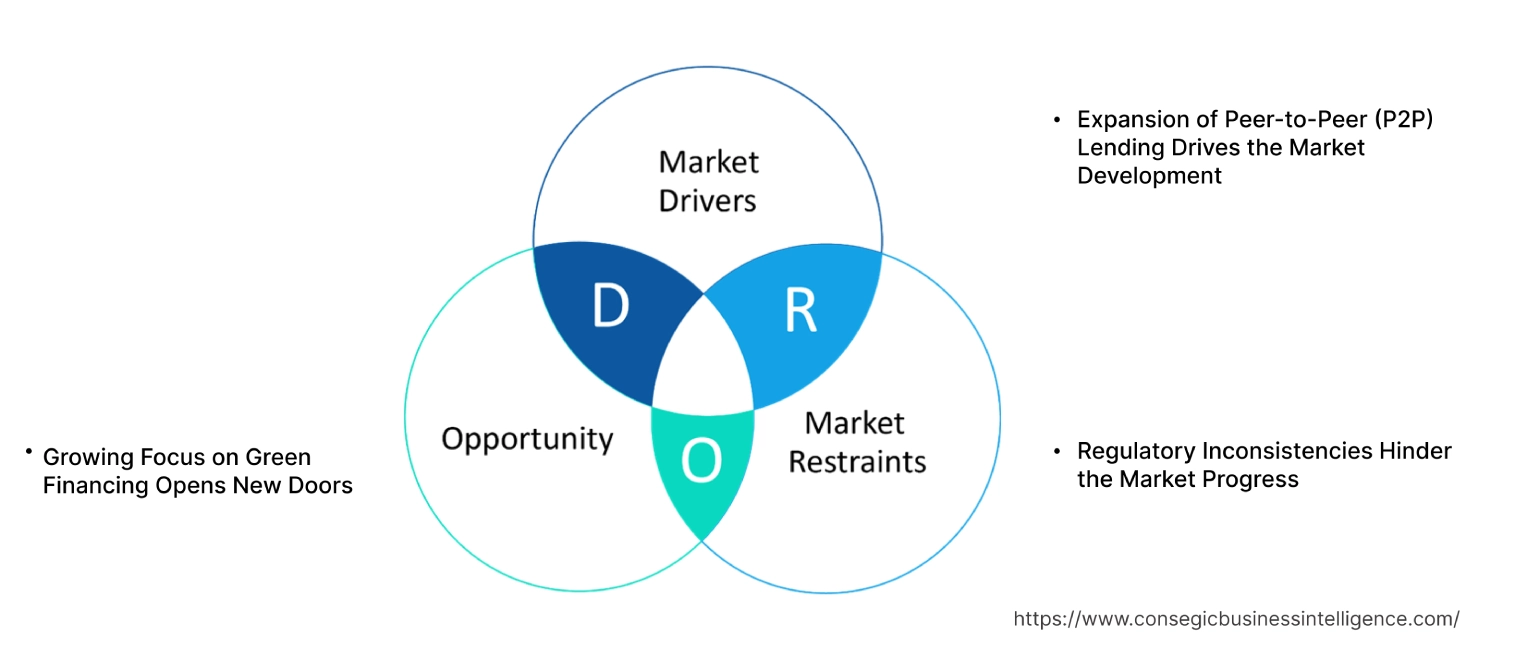
Expansion of Peer-to-Peer (P2P) Lending Drives the Market Development
Peer-to-peer (P2P) lending platforms are revolutionizing the financial ecosystem by connecting borrowers directly with individual or institutional lenders, eliminating the need for traditional financial intermediaries. This model has proven particularly advantageous for small businesses and individuals who face challenges accessing conventional credit due to stringent eligibility criteria. By employing advanced technologies, such as AI-driven credit scoring and blockchain-based transaction security, P2P platforms streamline the lending process, reducing approval times and operational costs.
Borrowers benefit from competitive interest rates and greater flexibility, while lenders gain access to diverse investment possibilities with the potential for higher returns. The scalability of P2P platforms, coupled with their ability to adapt to local regulatory environments, is driving their global adoption. This trend is further fueled by increasing financial inclusion initiatives, as P2P lending bridges gaps in underserved markets, offering a modern and efficient alternative to traditional banking systems, which further drives the alternative finance market growth.
Key Restraints :
Regulatory Inconsistencies Hinder the Market Progress
The absence of well-defined and consistent regulatory frameworks in emerging markets presents a significant constraint to the growth of alternative finance models. Variability in compliance requirements, taxation policies, and operational guidelines creates complexities for platform operators attempting to establish a foothold in these regions. Such regulatory ambiguities often lead to operational delays, higher legal costs, and increased risks, discouraging both investors and borrowers from engaging with these platforms.
Moreover, the lack of harmonized international standards exacerbates restraints for cross-border operations, as platforms must navigate disparate rules in each jurisdiction. This uncertainty hinders innovation and scalability, particularly in markets with significant potential for financial inclusion. While some emerging economies are beginning to establish clearer frameworks to attract alternative finance investments, the pace of regulatory adaptation remains slow, creating a cautious environment for stakeholders seeking to capitalize on these opportunities, and limiting the alternative finance market demand.
Future Opportunities :
Growing Focus on Green Financing Opens New Doors
The increasing emphasis on sustainability and environmental responsibility is driving the demand for eco-focused financing solutions. Green financing models, such as green bonds, renewable energy crowdfunding, and sustainability-linked loans, are gaining popularity among businesses and investors aiming to support environmentally friendly projects. These models provide funding for initiatives like renewable energy installations, energy-efficient infrastructure, and sustainable agriculture, aligning with global efforts to combat climate change.
Investors are increasingly prioritizing Environmental, Social, and Governance (ESG) criteria, creating a fertile ground for green financing platforms to thrive. Additionally, government incentives and regulatory support for sustainable projects further encourage adoption. Platforms leveraging digital technologies to connect eco-conscious investors with impactful projects are well-positioned to capitalize on this trend. As businesses seek innovative ways to meet their sustainability goals, green financing is becoming a critical component of the financial ecosystem, driving alternative finance market opportunities.
Alternative Finance Market Segmental Analysis :
By Type:
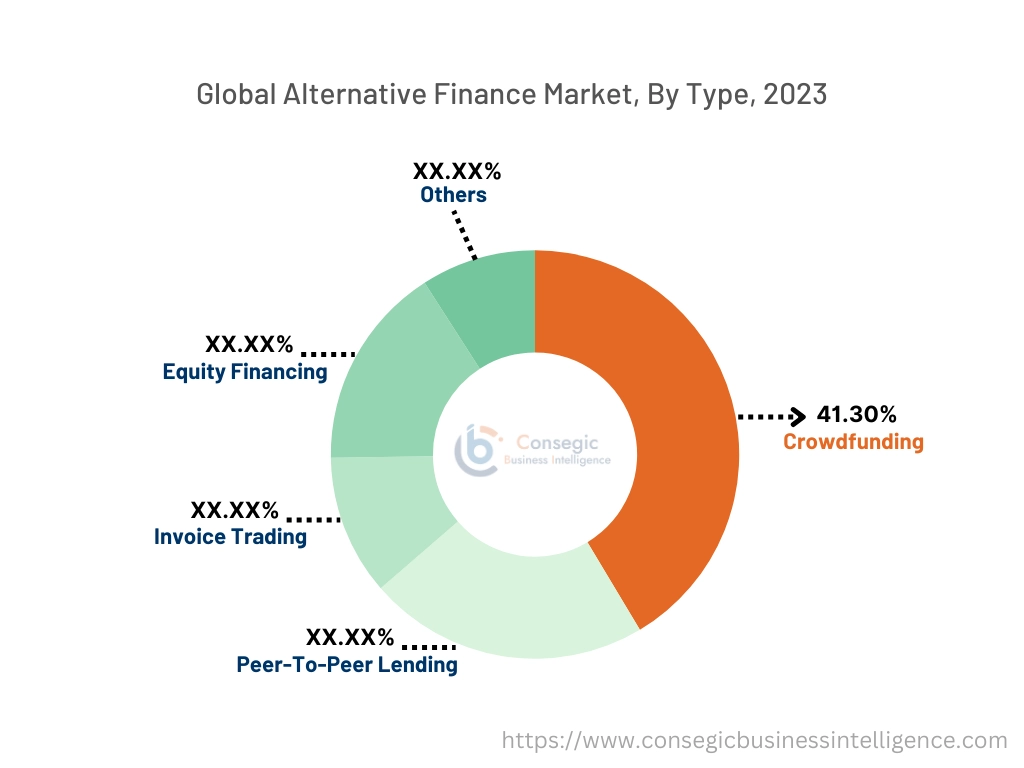
Based on type, the market is segmented into crowdfunding, peer-to-peer lending, invoice trading, equity financing, and others.
The Crowdfunding segment held the largest revenue of 41.30% of the total alternative finance market share in 2023.
- Crowdfunding platforms are widely adopted for raising small amounts of capital from a large pool of contributors, particularly for startups and creative projects.
- This type is highly favored due to its ability to connect fundraisers directly with potential investors or supporters through digital platforms.
- Reward-based crowdfunding, where contributors receive non-monetary rewards, has gained significant traction in industries like media, technology, and consumer goods.
- As per segmental trends analysis, the dominance of crowdfunding is driven by its versatility and accessibility for fundraisers, especially in sectors with limited access to traditional financing options, driving the alternative finance market expansion.
The Peer-to-peer lending segment is expected to grow at the fastest CAGR during the forecast period.
- Peer-to-peer lending enables borrowers to obtain loans directly from individual lenders without the involvement of traditional financial institutions.
- This type is popular among individuals and SMEs seeking quick and cost-effective alternatives to conventional bank loans.
- Platforms offering risk assessment tools and advanced algorithms ensure secure and efficient matchmaking between lenders and borrowers.
- As per the alternative finance market analysis, the rapid growth of this segment reflects its ability to cater to underserved markets and provide competitive interest rates compared to traditional banking systems.
By Asset Class:
Based on asset class, the market is segmented into equity, debt, real estate, commodities, and others.
The Debt segment accounted for the largest revenue of the total alternative finance market share in 2023.
- Debt-based alternative financing models, such as peer-to-peer lending and invoice trading, are widely used for short-term funding demand and working capital management.
- SMEs often rely on debt financing to overcome cash flow challenges and sustain operations during periods of financial instability.
- The dominance of this segment is supported by the increasing adoption of digital platforms for managing debt-based transactions and ensuring transparency.
- As per the market analysis, debt financing offers predictable returns for investors, making it a preferred choice among institutional and retail investors alike, which encourages alternative finance market growth.
The Real estate segment is expected to grow at the fastest CAGR during the forecast period.
- Real estate crowdfunding platforms allow investors to pool funds for property development or acquisition, democratizing access to high-value real estate investments.
- This segment benefits from the rising interest in fractional ownership models, enabling smaller investors to participate in lucrative real estate opportunities.
- Advanced analytics tools on digital platforms provide detailed insights into property valuations and expected returns, enhancing investor confidence.
- As per alternative finance market trends, the fast-track growth of real estate financing reflects its appeal as a relatively stable asset class with the potential for long-term returns.
By End-User:
Based on end-users, the market is segmented into small and medium enterprises (SMEs), individuals, and large enterprises.
The Small and medium enterprises (SMEs) segment accounted for the largest revenue share in 2023.
- SMEs heavily rely on alternative financing models, such as peer-to-peer lending and invoice trading, to address liquidity challenges and fund expansion projects.
- Alternative finance platforms provide SMEs with quicker access to capital compared to traditional banking systems, reducing the time and complexity of securing loans.
- The increasing adoption of digital platforms by SMEs to connect with potential investors and lenders is driving this segment's prominence.
- Thus, the market analysis depicts that the dominance of SMEs reflects their critical role in the global economy and the ongoing efforts to bridge financing gaps in this industry, which fuels the alternative finance market demand.
The individual segment is expected to grow at the fastest CAGR during the forecast period.
- Individuals leverage crowdfunding and peer-to-peer lending platforms for personal projects, debt consolidation, or educational financing.
- Rising awareness of digital platforms and the ease of accessing funds without stringent credit requirements are attracting individual users to this market.
- The growing interest in social impact crowdfunding, where individuals support causes aligned with their values, is further driving this segment.
- As per alternative finance market trends, the rapid growth of the individual segment is underpinned by the increasing use of alternative finance as a tool for achieving financial goals.
Regional Analysis:
The regions covered are North America, Europe, Asia Pacific, the Middle East and Africa, and Latin America.
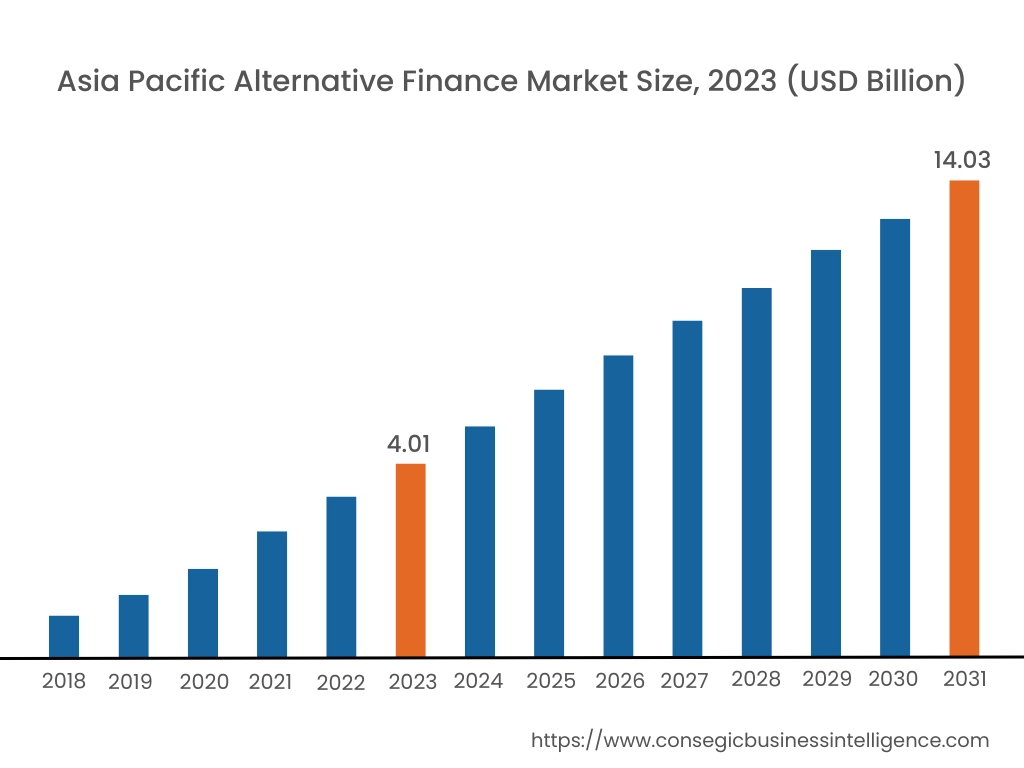
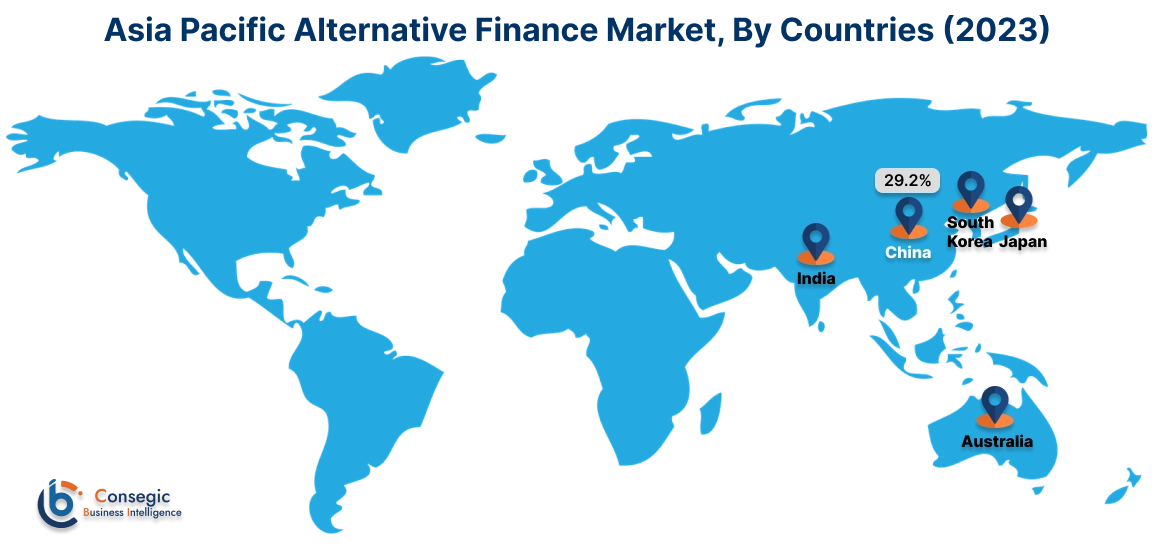
Asia Pacific region was valued at USD 4.01 Billion in 2023. Moreover, it is projected to grow by USD 4.61 Billion in 2024 and reach over USD 14.03 Billion by 2031. Out of these, China accounted for the largest share of 29.2% in 2023. Asia-Pacific is emerging as a key player in the alternative finance industry, driven by advancements in digital payment systems and the proliferation of fintech platforms. Countries like China, India, and Southeast Asian nations are leveraging technology to address gaps in traditional financial systems. The alternative finance market analysis of the region shows a growing focus on microfinance and SME funding through online platforms.
North America is estimated to reach over USD 15.39 Billion by 2031 from a value of USD 4.53 Billion in 2023 and is projected to grow by USD 5.20 Billion in 2024. North America plays a pivotal role in the alternative finance market, driven by the widespread adoption of peer-to-peer lending platforms and equity-based crowdfunding solutions. The United States leads in embracing these models, supported by robust technological advancements and a favorable entrepreneurial ecosystem driving significant alternative finance market opportunities. Key trends include a focus on digital lending and the integration of blockchain technology to enhance transparency and efficiency.
Europe holds a prominent position in the alternative finance market, with its growth anchored by innovation in fintech and crowdfunding platforms. The United Kingdom stands out as a leader, owing to supportive regulatory frameworks and an active investor base. Trends such as the use of alternative finance for renewable energy projects and real estate funding are prominent in this region, contributing to the alternative finance market expansion.
The Middle East & Africa region is witnessing the gradual adoption of alternative finance models, particularly in markets with strong entrepreneurial ecosystems like the UAE and South Africa. As per the market analysis, the region's push for digital transformation and financial inclusion has created possibilities for alternative finance platforms, especially in the form of micro-lending and Islamic finance models.
Latin America is an emerging market for alternative finance, with countries such as Brazil and Mexico showing increasing adoption of crowdfunding and peer-to-peer lending. The region’s growing startup ecosystem and rising internet penetration support the adoption of innovative financial models. Analysis indicates a trend toward leveraging alternative finance to support small businesses and expanding access to credit.
Top Key Players & Market Share Insights:
The alternative finance market is highly competitive with major players providing products and services to the national and international markets. Key players are adopting several strategies in research and development (R&D), product innovation, and end-user launches to hold a strong position in the global alternative finance market. Key players in the alternative finance industry include -
- LendingClub (USA)
- Funding Circle (UK)
- Square Capital (USA)
- Zopa (UK)
- OakNorth Bank (UK)
- SoFi (USA)
- OnDeck (USA)
- BlueVine (USA)
- Prosper (USA)
- Avant (USA)
Recent Industry Developments :
Partnerships and Collaborations:
- In November 2023, Funding Circle and Atom Bank announced a new partnership to provide up to £150 Billion in funding to UK small businesses through the Government-backed Recovery Loan Scheme. This marks their third collaboration, bringing Atom Bank's total lending with Funding Circle to approximately £800 Billion. The partnership aims to enhance access to finance for SMEs, leveraging Funding Circle's technology and distribution platform.
- In February 2024, Funding Circle partnered with Barclays Bank and TPG Angelo Gordon to provide £300 Billion in funding to UK small businesses. This collaboration leverages Funding Circle's technology-driven platform to efficiently deploy capital, aiming to support business growth and job creation.
- In October 2024, Zopa Bank partnered with John Lewis Money to offer personal loans ranging from £1,000 to £35,000 to John Lewis's 23 Billion customers. Customers can receive personalized loan quotes in three minutes without affecting their credit scores, with approved funds typically available within two hours. This collaboration aims to provide simple, transparent, and valuable financial options to consumers.
- In December 2024, SoFi partnered with Templum to offer accredited investors access to three private market funds: the Cosmos Fund (solely focused on SpaceX), Pomona Investment Fund, and StepStone Private Markets Fund. This initiative responds to growing retail investor interest in private companies, aiming to democratize access to alternative assets.
Alternative Finance Market Report Insights :
| Report Attributes | Report Details |
| Study Timeline | 2021-2034 |
| Market Size in 2034 | USD 74.31 Billion |
| CAGR (2026-2034) | 16.68% |
| Base Year | 2025 |
| By Type |
|
| By Asset Class |
|
| By End-User |
|
| By Region |
|
| Key Players |
|
| North America | U.S. Canada Mexico |
| Europe | U.K. Germany France Spain Italy Russia Benelux Rest of Europe |
| APAC | China South Korea Japan India Australia ASEAN Rest of Asia-Pacific |
| Middle East and Africa | GCC Turkey South Africa Rest of MEA |
| LATAM | Brazil Argentina Chile Rest of LATAM |
| Report Coverage |
|
Key Questions Answered in the Report
What is the size of the Alternative Finance Market? −
Alternative Finance Market size is estimated to reach over USD 46.78 Billion by 2031 from a value of USD 13.62 Billion in 2023 and is projected to grow by USD 15.65 Billion in 2024, growing at a CAGR of 16.68% from 2024 to 2031.
What are the key segments in the Alternative Finance Market report? +
The Alternative Finance Market is segmented by type (Crowdfunding, Peer-to-Peer Lending, Invoice Trading, Equity Financing, Others), asset class (Debt, Equity, Real Estate, Commodities, Others), end-user (Small & Medium Enterprises (SMEs), Individuals, Large Enterprises), and region (Asia-Pacific, Europe, North America, Latin America, Middle East & Africa).
Which segment is expected to grow the fastest in the Alternative Finance Market? +
The Peer-to-Peer (P2P) Lending segment is expected to grow at the fastest CAGR during the forecast period, driven by its ability to connect borrowers directly with lenders, offering competitive interest rates and flexibility, especially in underserved markets.
Who are the major players in the Alternative Finance Market? +
Key players in the Alternative Finance Market include LendingClub (USA), Funding Circle (UK), SoFi (USA), OnDeck (USA), BlueVine (USA), Prosper (USA), Avant (USA), Square Capital (USA), Zopa (UK), and OakNorth Bank (UK).
Overview
Reputation & Certifications


Our Services
- Market Intelligence & Forecasting
- Custom Research Solutions
- Market Entry Strategy
- Competitive Intelligence
- Customer Insights
- Industry Innovation Analysis
- Investment Advisory