Jump to Content
Alternative Lending Market Size & Industry Share - Growth Trends & Forecasts (2026 - 2034)
Alternative Lending Market Size:
The Alternative Lending Market is expected to expand from 347.78 (US$B) in 2025 to 393.69 (US$B) in 2026, and is forecast to surpass 1,061.51 (US$B) by 2034, growing at a CAGR of 13.2% between 2026 and 2034, according to a recent report from Consegic Business Intelligence.
Alternative Lending Market Scope & Overview:
Alternative lending encompasses non-traditional financing methods that provide individuals and businesses with access to credit outside conventional banking systems. This market includes peer-to-peer (P2P) lending, crowdfunding platforms, invoice financing, and other digital lending solutions designed to offer flexible and accessible funding options. These platforms leverage innovative technologies to connect borrowers directly with investors, streamlining the borrowing process and reducing reliance on traditional financial intermediaries.
Alternative lending solutions cater to a variety of financing needs, such as personal loans, small business funding, real estate investments, and short-term capital requirements. These platforms often incorporate advanced tools for credit assessment, automated risk analysis, and digital payment processing, ensuring efficiency and transparency in lending operations.
End-users of these services include small and medium-sized enterprises (SMEs), individual borrowers, and startups seeking quick and flexible funding alternatives to support their financial objectives. The alternative lending market plays a vital role in bridging funding gaps and offering innovative solutions tailored to diverse borrower needs.

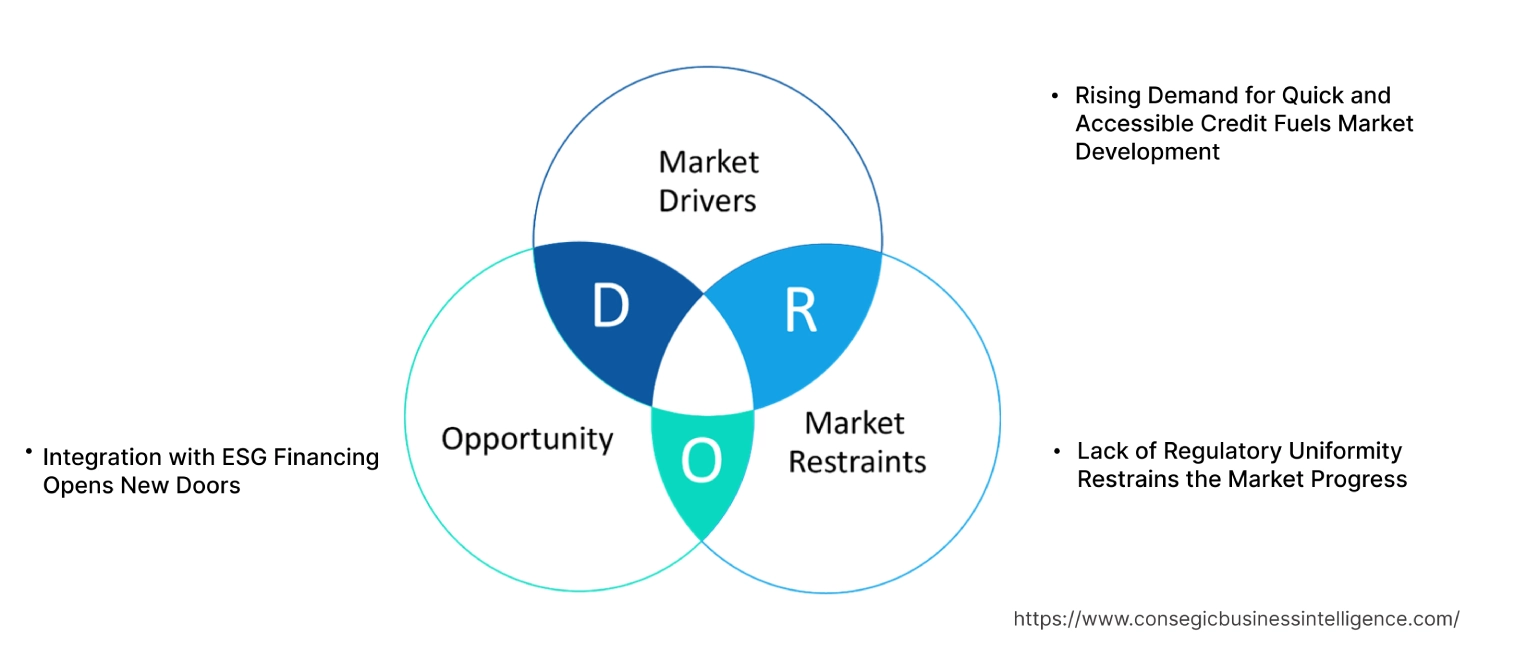
Alternative Lending Market Dynamics - (DRO) :
Key Drivers:
Rising Demand for Quick and Accessible Credit Fuels Market Development
The rising demand for quick and accessible credit is a significant driver in the alternative lending market, particularly among small and medium enterprises (SMEs) and individual borrowers. Traditional financial institutions often involve lengthy approval processes and stringent requirements, which is challenging for borrowers with limited credit history. Alternative lending platforms address this gap by leveraging advanced technology-driven credit assessment tools, enabling faster loan approvals and disbursements.
These platforms utilize machine learning algorithms and big data analytics to evaluate creditworthiness more efficiently, ensuring accessibility to a wider demographic. This approach is particularly beneficial for SMEs seeking immediate funding to manage cash flow, expand operations, or invest in growth opportunities. The ability to provide rapid and flexible financing options has positioned alternative lending as an attractive solution in today’s fast-paced financial ecosystem, aligning with the growing demand for convenience and speed in borrowing processes, and contributing to the alternative lending market growth.
Key Restraints :
Lack of Regulatory Uniformity Restrains the Market Progress
Inconsistent frameworks often result in uncertainty for platform operators, making it difficult to navigate compliance requirements. This variability impacts key aspects such as interest rate caps, borrower protections, and operational guidelines, leading to complexities in cross-border operations. For new entrants, unclear regulatory landscapes act as a deterrent, increasing the risks associated with market entry.
Established players also face obstacles in scaling their services internationally due to the need for localized adjustments and adherence to varying legal structures. Additionally, the absence of standardized rules creates an uneven playing field, allowing some platforms to operate without adequate oversight, which undermines market credibility. These regulatory inconsistencies not only hinder alternative lending market expansion but also limit the market’s potential to establish a cohesive and transparent ecosystem across regions.
Future Opportunities :
Integration with ESG Financing Opens New Doors
The integration of Environmental, Social, and Governance (ESG) principles into alternative lending models is creating significant opportunities for market growth. ESG-focused financing platforms cater to the increasing demand from socially conscious investors seeking to fund sustainable and ethical projects. By supporting green initiatives, renewable energy developments, and socially impactful ventures, these platforms align with global sustainability goals, such as reducing carbon emissions and promoting social equity. This approach not only enhances their appeal to investors but also builds credibility among borrowers prioritizing sustainability.
Furthermore, as ESG compliance becomes a key consideration for businesses and governments, platforms incorporating these criteria will be able to access new market segments and secure long-term partnerships. The growing emphasis on ESG integration is shaping the future of lending by encouraging responsible investment practices while opening avenues for innovative, sustainability-driven financial solutions thus creating alternative lending market opportunities.
Alternative Lending Market Segmental Analysis :
By Type:
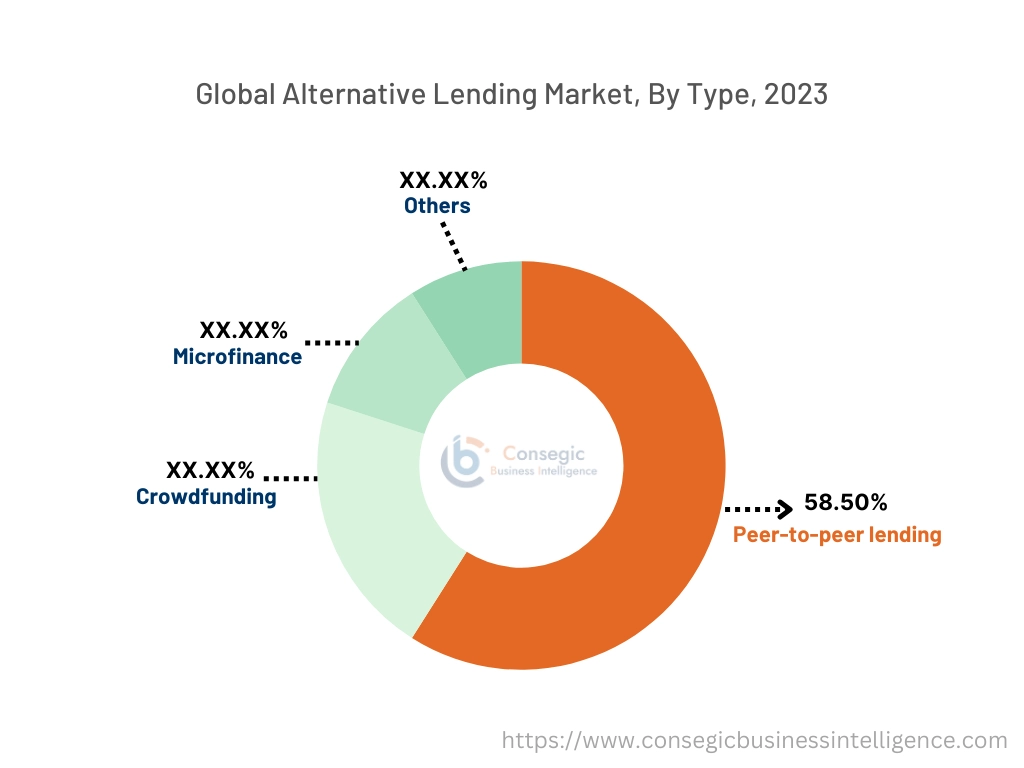
Based on type, the market is segmented into peer-to-peer lending, crowdfunding, microfinance, and others.
The Peer-to-Peer Lending segment held the largest revenue of 58.50% of the total alternative lending market share in 2023.
- Peer-to-peer lending platforms provide direct connections between borrowers and individual investors, reducing intermediaries and offering competitive interest rates.
- The flexibility in loan amounts and repayment terms attracts a diverse borrower base, including individuals and small businesses.
- Advanced digital platforms supporting peer-to-peer lending enhance transparency, ease of access, and faster loan processing, making it a popular choice.
- As per market trends, the segment's dominance is driven by its role in providing an alternative financing option, particularly for borrowers underserved by traditional banking systems, which further boosts the alternative lending market demand.
The Crowdfunding segment is expected to grow at the fastest CAGR during the forecast period.
- Crowdfunding allows businesses, particularly startups, to secure funding from a broad base of small investors, often in exchange for rewards or equity.
- Digital platforms are expanding crowdfunding's reach, enabling global access and enhancing investor participation.
- Creative industries and small-scale entrepreneurs are increasingly leveraging crowdfunding for project funding and business extension.
- As per alternative lending market analysis, the segment’s rapid growth is supported by evolving regulations and the rising popularity of decentralized finance models.
By Loan Type:
Based on loan type, the market is segmented into personal loans, business loans, debt consolidation loans, real estate loans, and others.
The Business Loans segment accounted for the largest revenue of the alternative lending market share in 2023.
- Business loans are essential for funding working capital, expansion, and operational costs, especially for small and medium-sized enterprises.
- Alternative lenders provide faster approvals, customized loan products, and relaxed eligibility criteria compared to traditional financial institutions.
- Online lending platforms streamline loan applications, enabling businesses to access funding efficiently.
- As per alternative lending market trends, the segment's dominance reflects the growing reliance of SMEs on alternative lending solutions to meet their financial requirements.
The Real Estate Loans segment is expected to grow at the fastest CAGR during the forecast period.
- Real estate loans provided through alternative channels cater to property developers and individual buyers seeking flexible financing options.
- Crowdfunding platforms and peer-to-peer lending models are gaining traction in funding real estate projects.
- The demand for alternative real estate loans is driven by stricter regulations and higher thresholds imposed by traditional banking systems.
- The segment's proliferation is supported by technological advancements that facilitate seamless transactions and ensure transparency in real estate financing, driving alternative lending market growth.
By End User:
Based on end-users, the market is segmented into individuals, small & medium enterprises (SMEs), and large enterprises.
The Small & Medium Enterprises (SMEs) segment held the largest revenue share in 2023.
- SMEs face challenges in accessing traditional loans due to stringent credit requirements, leading to increased reliance on alternative lending.
- Platforms offering customized financial products address the unique funding needs of SMEs, including working capital and inventory financing.
- Government initiatives promoting SME financing through alternative channels further strengthen this segment.
- As per the market trends, the dominance of this segment is attributed to the pivotal role of SMEs in driving economic activities and the tailored solutions offered by alternative lenders, contributing to the alternative lending market expansion.
The Individuals segment is expected to grow at the fastest CAGR during the forecast period.
- Individuals utilize alternative lending for personal financing, including education, medical expenses, and debt consolidation.
- Digital platforms simplify the borrowing process for individuals, offering quick approvals and competitive interest rates.
- The segment's rapid progress is supported by the rising awareness of alternative financing options among consumers.
- As per alternative lending market analysis, increasing digital literacy and the proliferation of online lending platforms contribute to the segment's sustained enlargement.
Regional Analysis:
The regions covered are North America, Europe, Asia Pacific, the Middle East and Africa, and Latin America.
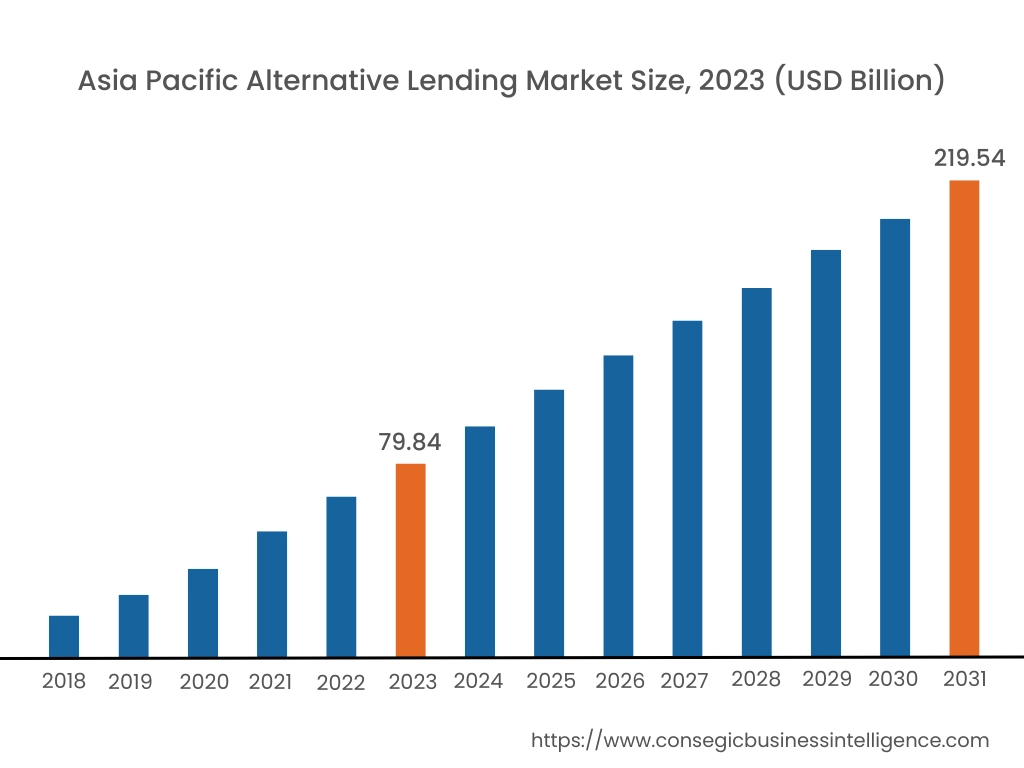
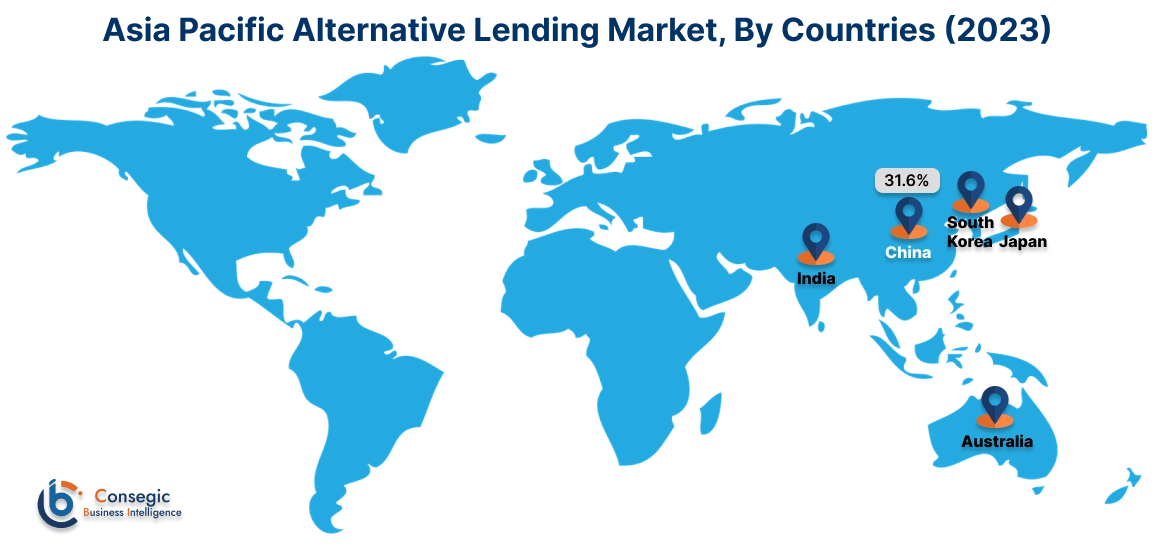
Asia Pacific region was valued at USD 79.84 Billion in 2023. Moreover, it is projected to grow by USD 89.11 Billion in 2024 and reach over USD 219.54 Billion by 2031. Out of these, China accounted for the largest share of 31.6% in 2023. The Asia-Pacific region is witnessing rapid growth in alternative lending, propelled by technological advancements and a large unbanked population. China and India are leading this surge, with numerous fintech startups offering innovative lending solutions. The analysis reveals a trend of regulatory bodies implementing frameworks to oversee the burgeoning sector, aiming to mitigate risks associated with non-traditional lending, fueling the alternative lending market demand.
North America is estimated to reach over USD 240.76 Billion by 2031 from a value of USD 90.23 Billion in 2023 and is projected to grow by USD 100.44 Billion in 2024. The alternative lending industry in North America, particularly in the United States, has experienced significant progress, driven by the increasing adoption of digital platforms that leverage artificial intelligence and big data to offer personalized financial solutions. As per alternative lending market trends, the shift is attributed to a growing demand for flexible lending options beyond traditional banking models.
In Europe, the market is characterized by a robust regulatory framework aimed at ensuring transparency and consumer protection. Countries like the United Kingdom and Germany have seen a rise in peer-to-peer lending platforms, catering to both individual and small business borrowers. The analysis indicates a trend towards increased collaboration between traditional financial institutions and alternative lenders to enhance service offerings, creating significant alternative lending market opportunities.
Alternative lending in the Middle East & Africa is in the nascent stages but shows promising potential, especially in countries like the United Arab Emirates and South Africa. The market is gradually embracing fintech solutions to address the credit gap faced by small and medium-sized enterprises. Trends indicate a growing interest in crowdfunding and peer-to-peer lending models.
Latin America's alternative lending market is emerging, with Brazil and Mexico at the forefront. The region is leveraging alternative financing to boost financial inclusion and support entrepreneurial ventures. The analysis highlights a trend of increasing mobile penetration facilitating access to digital lending platforms.
Top Key Players & Market Share Insights:
The Alternative Lending market is highly competitive with major players providing products and services to the national and international markets. Key players are adopting several strategies in research and development (R&D), product innovation, and end-user launches to hold a strong position in the global Alternative Lending market. Key players in the Alternative Lending industry include –
Recent Industry Developments:
Product Launches:
- In November 2024, Paychex introduced Paychex Funding Solutions, offering small and mid-sized businesses quick access to capital through invoice factoring. This service provides upfront funds based on a company's assets, facilitating payroll, vendor payments, and growth reinvestment. Unlike traditional bank loans, Paychex Funding Solutions offers a streamlined approval process, with decisions partly based on the creditworthiness of a business's customers, allowing organizations that might not qualify for traditional loans to benefit.
Partnerships & Collaborations:
- In February 2024, Funding Circle, the UK's leading SME lending platform, announced a new partnership with Barclays Bank and TPG Angelo Gordon to provide £300 Billion in funding to UK small businesses. This collaboration leverages Funding Circle's data-driven platform to efficiently deploy capital, supporting small business growth and job creation in the UK economy.
- In November 2023, Funding Circle and Atom Bank announced a new lending partnership to provide up to £150 Billion in funding to UK small businesses. This collaboration leverages Funding Circle's technology and distribution platform to support approximately 4,000 SMEs, bringing Atom Bank's total lending with Funding Circle to around £800 Billion. The partnership aims to enhance access to finance for small businesses, particularly through the Government-backed Recovery Loan Scheme.
Alternative Lending Market Report Insights :
| Report Attributes | Report Details |
| Study Timeline | 2021-2034 |
| Market Size in 2034 | USD 1,061.51 Billion |
| CAGR (2026-2034) | 13.20% |
| Base Year | 2025 |
| By Type |
|
| By Loan Type |
|
| By End User |
|
| By Region |
|
| Key Players |
|
| North America | U.S. Canada Mexico |
| Europe | U.K. Germany France Spain Italy Russia Benelux Rest of Europe |
| APAC | China South Korea Japan India Australia ASEAN Rest of Asia-Pacific |
| Middle East and Africa | GCC Turkey South Africa Rest of MEA |
| LATAM | Brazil Argentina Chile Rest of LATAM |
| Report Coverage |
|
Key Questions Answered in the Report
What is the size of the Alternative Lending Market? −
Alternative Lending Market size is estimated to reach over USD 731.79 Billion by 2031 from a value of USD 271.45 Billion in 2023 and is projected to grow by USD 302.44 Billion in 2024, growing at a CAGR of 13.2% from 2024 to 2031.
What are the key segments in the Alternative Lending Market? +
The Alternative Lending Market is segmented by type (Peer-to-Peer Lending, Crowdfunding, Microfinance, Others), loan type (Personal Loans, Business Loans, Debt Consolidation Loans, Real Estate Loans, Others), end-user (Individuals, Small & Medium Enterprises (SMEs), Large Enterprises), and region (Asia-Pacific, Europe, North America, Latin America, Middle East & Africa).
Which segment is expected to grow the fastest in the Alternative Lending Market? +
The Crowdfunding segment is expected to register the fastest CAGR during the forecast period. This growth is driven by increasing participation from investors and businesses, as well as expanding digital platforms that provide global access and enhance investor engagement.
Who are the major players in the Alternative Lending Market? +
Key players in the Alternative Lending Market include OnDeck (USA), BlueVine (USA), Fundbox (USA), LendingClub (USA), Prosper (USA), Upstart (USA), Funding Circle (UK), SoLo Funds (USA), and Zopa (UK).
Overview
Reputation & Certifications


Our Services
- Market Intelligence & Forecasting
- Custom Research Solutions
- Market Entry Strategy
- Competitive Intelligence
- Customer Insights
- Industry Innovation Analysis
- Investment Advisory