Jump to Content
Aluminum Cans Recycling Market - Size, Share, Industry Trends, and Forecasts (2024 - 2031)
Aluminum Cans Recycling Market Size:
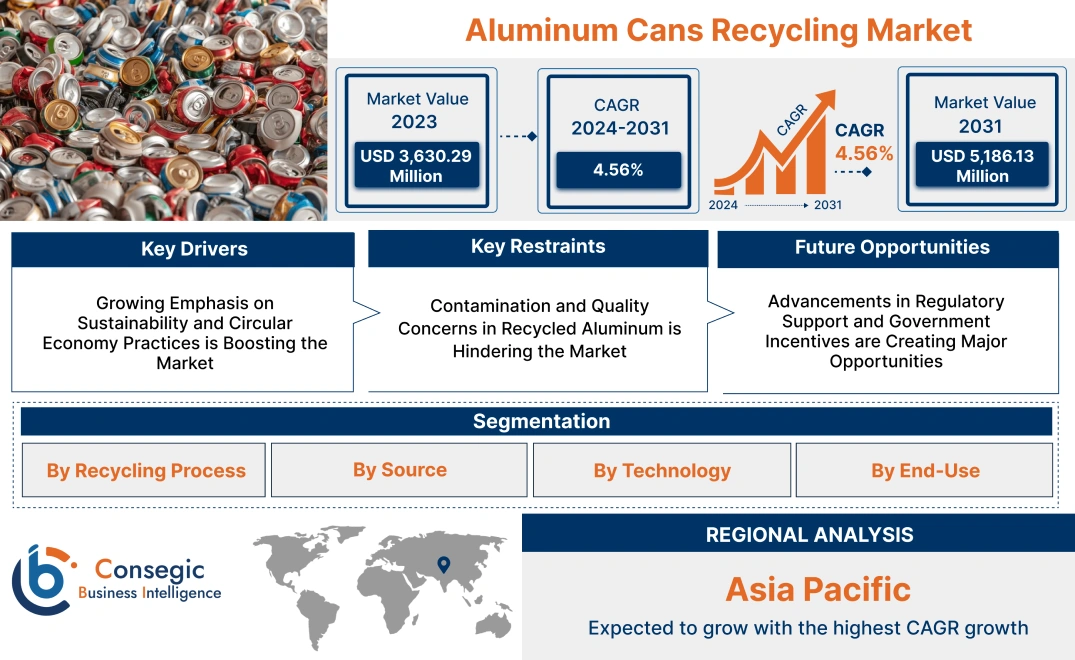
Aluminum Cans Recycling Market size is estimated to reach over USD 5,186.13 Million by 2031 from a value of USD 3,630.29 Million in 2023 and is projected to grow by USD 3,731.15 Million in 2024, growing at a CAGR of 4.56% from 2024 to 2031.
Aluminum Cans Recycling Market Scope & Overview:
The aluminum cans recycling is used in the execution of recovery and reprocessing of used aluminum cans into raw materials for new products. Aluminum recycling is a highly efficient process that preserves material quality while significantly reducing energy consumption and environmental impact compared to primary aluminum production. Key characteristics of aluminum can recycling include closed-loop recyclability, high scrap value, and energy efficiency, making it a cornerstone of sustainable packaging. The benefits include reduced greenhouse gas emissions, conservation of natural resources, and cost savings for manufacturers. Applications span the production of new beverage cans, automotive components, and construction materials. End-users include recycling facilities, beverage manufacturers, and industrial product developers, driven by increasing environmental awareness, stringent regulations promoting recycling, and growing consumer demand for eco-friendly packaging solutions.
Aluminum Cans Recycling Market Dynamics - (DRO) :
Key Drivers:
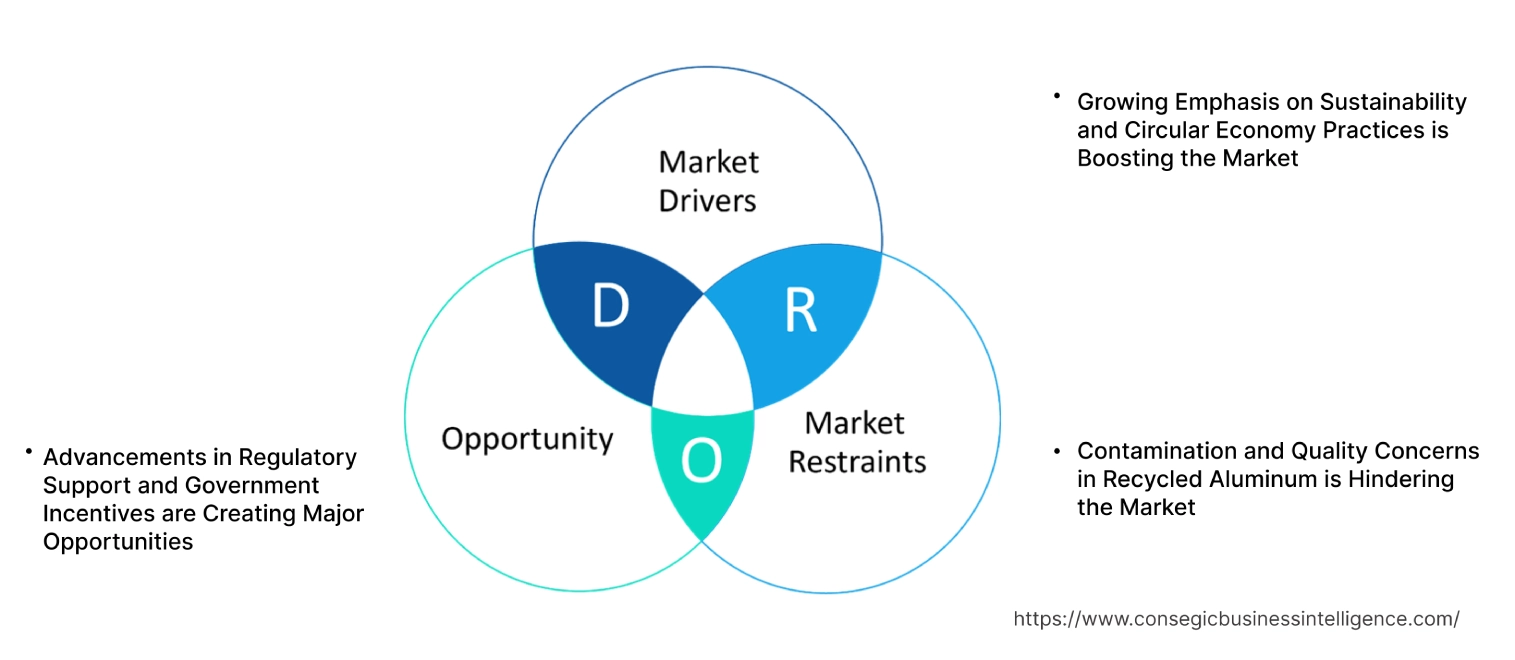
Growing Emphasis on Sustainability and Circular Economy Practices is Boosting the Market
The recycling of aluminum cans has become a cornerstone of sustainability efforts worldwide, driven by the material's infinite recyclability and significant energy-saving potential compared to primary aluminum production. Recycling aluminum cans reduces greenhouse gas emissions, conserves natural resources, and aligns with the principles of the circular economy. These practices support environmental conservation while addressing global waste management challenges.
Trends in corporate sustainability initiatives and eco-conscious consumer behavior are further reinforcing the importance of aluminum recycling. Companies are increasingly incorporating recycled aluminum into their products to meet sustainability goals and enhance their brand image. Analysis indicates that as stakeholders across the value chain embrace circular economy principles, the aluminum cans recycling market expansion will continue to play a vital role in fostering sustainable development.
Key Restraints:
Contamination and Quality Concerns in Recycled Aluminum is Hindering the Market
One of the key challenges in aluminum cans recycling is contamination within the waste stream, which can adversely affect the quality of recycled aluminum. Residual food waste, mixed materials, and improper sorting processes introduce impurities that complicate recycling operations and increase costs. Contaminated materials often require additional cleaning and refining, reducing the overall efficiency of recycling systems.
These quality concerns limit the usability of recycled aluminum in high-performance applications, such as packaging for food and beverages or components for the automotive sector. Addressing these issues requires advancements in waste segregation technologies, public education on proper disposal practices, and investments in more sophisticated processing methods. Improved quality control measures can enhance the marketability and reliability of recycled aluminum.
Future Opportunities :
Advancements in Regulatory Support and Government Incentives are Creating Major Opportunities
Regulatory frameworks and government incentives are key enablers for the market, encouraging industry stakeholders to adopt sustainable practices. Policies mandating extended producer responsibility (EPR) and setting targets for recycled content in packaging are driving the integration of recycled aluminum into products. These measures not only reduce environmental impact but also support compliance with national and international sustainability goals.
Subsidies and grants for the development of recycling infrastructure are also fostering innovation and capacity expansion within the sector. The analysis highlights that regulatory support is particularly impactful in regions with emerging recycling systems, where financial incentives can accelerate the establishment of organized recycling networks. As governments continue to prioritize resource efficiency, these initiatives will play a crucial role in advancing the aluminum cans recycling market opportunities.
Aluminum Cans Recycling Market Segmental Analysis :
By Recycling Process:
Based on the recycling process, the market is segmented into melting, remelting, and others.
The melting process segment accounted for the largest revenue in aluminum cans recycling market share in 2023.
- The melting process is a widely utilized method in aluminum recycling due to its efficiency in converting aluminum scrap into molten aluminum, which can then be repurposed for various applications.
- This process is highly cost-effective and energy-efficient compared to primary aluminum production.
- Melting is extensively used in the production of aluminum sheets, extrusions, and castings, which are essential in industries such as automotive, construction, and packaging.
- Additionally, the ability to handle a wide variety of scrap materials, including beverage cans, industrial waste, and consumer goods, has made melting the preferred recycling process.
- The growing demand for recycled aluminum, driven by sustainability goals and cost advantages, has reinforced the dominance of the melting process in the market.
The remelting process segment is anticipated to register the fastest CAGR during the forecast period.
- Remelting involves the reprocessing of pre-sorted aluminum scrap to produce high-quality aluminum suitable for demanding applications, such as aerospace and automotive components.
- This process ensures material purity and retains the structural integrity of recycled aluminum, making it ideal for critical applications.
- With industries increasingly emphasizing high-quality recycled materials and circular economy initiatives, remelting is gaining traction as a sustainable and efficient recycling method.
- Additionally, advancements in remelting technologies, such as automated sorting systems and energy-efficient furnaces, are expected to further drive the adoption of this process.
- The growing focus on achieving high-performance standards in end-use applications is a key factor contributing to the rapid growth of the remelting segment.
By Source:
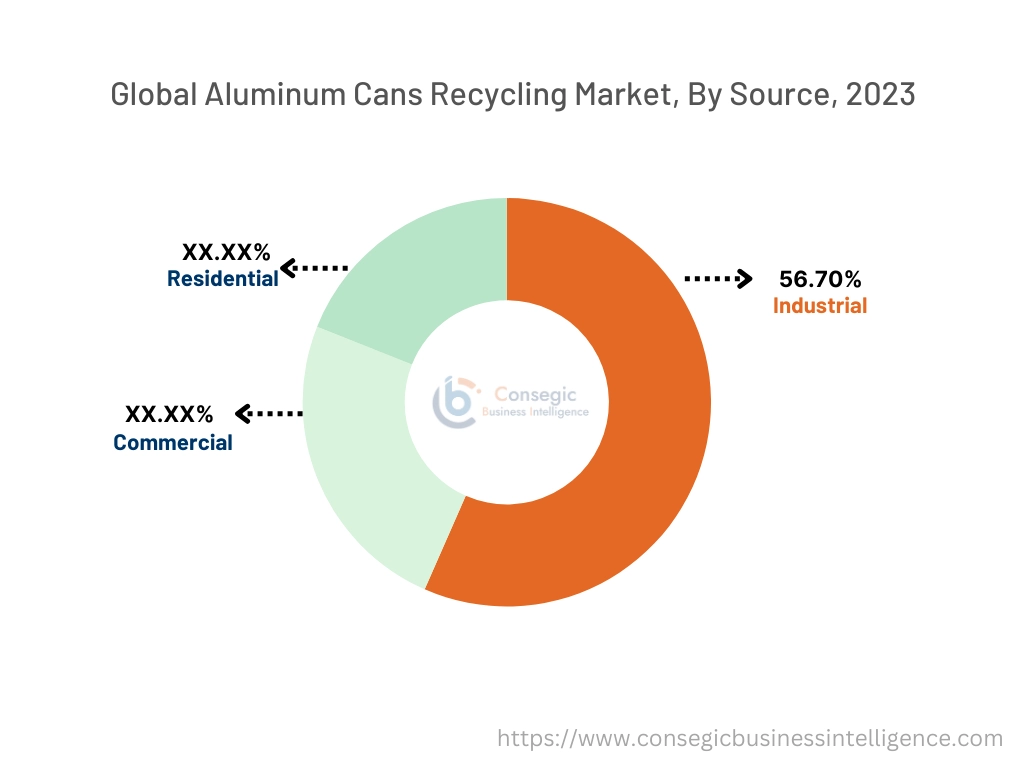
Based on the source, the aluminum scrap recycling market is segmented into residential, commercial, and industrial.
The industrial segment accounted for the largest revenue share of 56.70% in aluminum cans recycling market share in 2023.
- The industrial sector is the leading source of aluminum scrap, generating significant quantities of production waste, off-cuts, and by-products from manufacturing processes.
- Industries such as automotive, construction, and aerospace contribute heavily to the recycled aluminum supply chain.
- These industries rely on aluminum for its lightweight, durable, and corrosion-resistant properties, and the scrap generated is easily recyclable, providing a consistent supply for recycling facilities.
- The increasing opportunities for the adoption of recycling practices in industrial operations to reduce raw material costs and improve environmental sustainability have further solidified the dominance of the industrial segment.
- Moreover, regulatory mandates encouraging waste reduction and recycling in industrial sectors have amplified the segment’s significance in the market.
The residential segment is anticipated to register the fastest CAGR during the forecast period.
- The residential sector is becoming an increasingly important source of aluminum scrap, driven by rising awareness of recycling practices among consumers.
- Aluminum waste from packaging materials, such as beverage cans, foils, and food containers, constitutes a significant portion of residential scrap.
- Government initiatives promoting waste segregation at the household level, coupled with expanding curbside recycling programs, have enhanced the collection and recycling of aluminum from residential sources.
- Additionally, the growing trends of consumer awareness about sustainability and the benefits of recycling have spurred participation in residential recycling programs.
- As these efforts continue to expand globally, the residential segment is expected to witness significant growth.
By Technology:
Based on technology, the market is segmented into closed-loop recycling and open-loop recycling.
The closed-loop recycling segment accounted for the largest revenue share in 2023.
- Closed-loop recycling involves reprocessing aluminum scrap into products of the same or similar quality without significant material degradation.
- This method is widely used in industries like packaging and automotive, where high-quality recycled aluminum is required.
- Closed-loop recycling minimizes waste and reduces the environmental footprint by continuously reusing materials within the same production cycle.
- For instance, beverage cans made from aluminum can be recycled indefinitely through closed-loop systems.
- The increasing adoption trends of circular economy practices, where industries strive to achieve sustainability by reducing raw material consumption and promoting recycling, has driven the dominance of closed-loop recycling in the aluminum scrap recycling market.
The open-loop recycling segment is anticipated to register the fastest CAGR during the forecast period.
- Open-loop recycling involves converting aluminum scrap into products with different characteristics or applications, such as using recycled aluminum from beverage cans to produce construction materials or automotive components.
- This technology is vital for diversifying the applications of recycled aluminum and meeting the growing aluminum cans recycling market demand for eco-friendly materials in various industries.
- The adoption of advanced sorting and processing technologies has improved the efficiency of open-loop recycling, enabling greater recovery and utilization of aluminum scrap.
- As industries like construction and consumer goods increasingly incorporate recycled materials into their production processes, the open-loop recycling segment is expected to experience rapid aluminum cans recycling aluminum cans recycling market growth.
By End-Use:
Based on end-use, the market is segmented into food & beverage, automotive, construction, consumer goods, and others.
The food & beverage segment accounted for the largest revenue share in 2023.
- The food and beverage sectors heavily rely on recycled aluminum for packaging solutions, including beverage cans, food trays, and foils.
- Aluminum's lightweight, non-toxic, and corrosion-resistant properties make it an ideal material for sustainable and durable packaging.
- The increasing focus on sustainability, coupled with stringent regulations promoting the use of recycled materials in packaging, has driven the adoption of aluminum scrap recycling in this segment.
- Beverage cans, in particular, represent a significant portion of recycled aluminum, as they can be recycled indefinitely without losing their properties.
- The growing demand for eco-friendly and recyclable packaging options has solidified the dominance of the food and beverage segmental trends in the market.
The automotive segment is anticipated to register the fastest CAGR during the forecast period.
- The automotive sector is witnessing a surge in demand for recycled aluminum, driven by the need for lightweight materials to improve fuel efficiency and reduce carbon emissions.
- Recycled aluminum is extensively used in manufacturing vehicle components such as engine blocks, body panels, and wheels.
- The shift toward electric vehicles (EVs), which require lightweight materials to enhance battery performance and driving range, has further boosted the adoption of recycled aluminum in the automotive sector.
- Additionally, the increasing emphasis on sustainability and energy efficiency in automotive manufacturing is expected to drive rapid growth in this segment during the forecast period.
Regional Analysis:
The regions covered are North America, Europe, Asia Pacific, the Middle East and Africa, and Latin America.
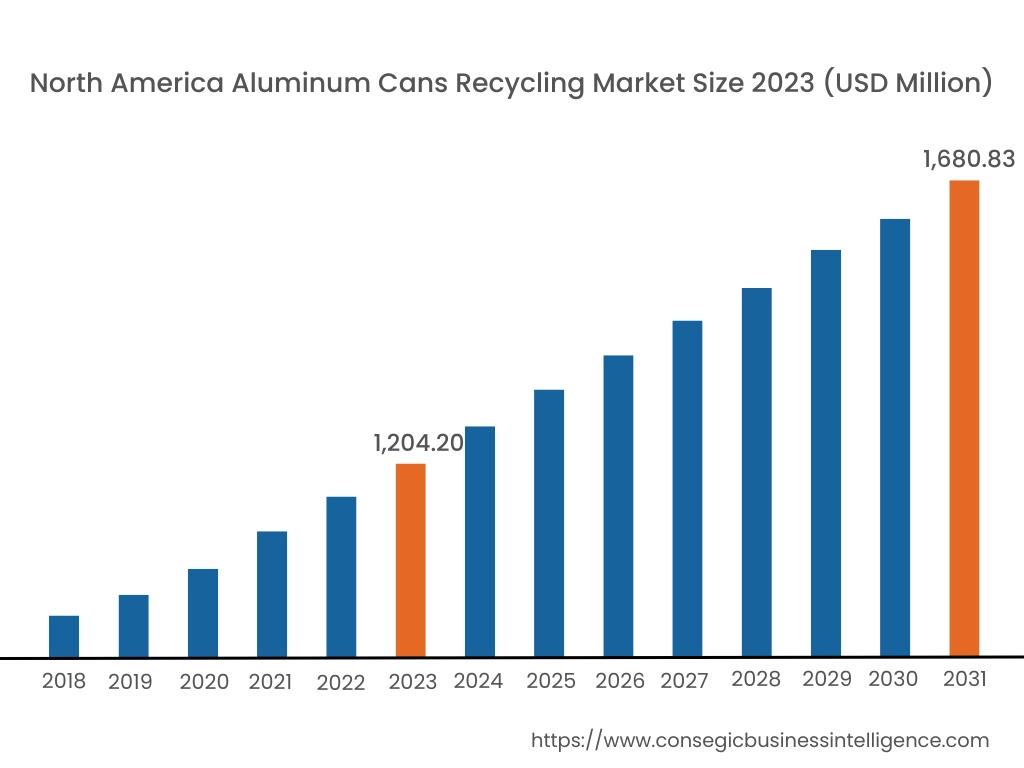
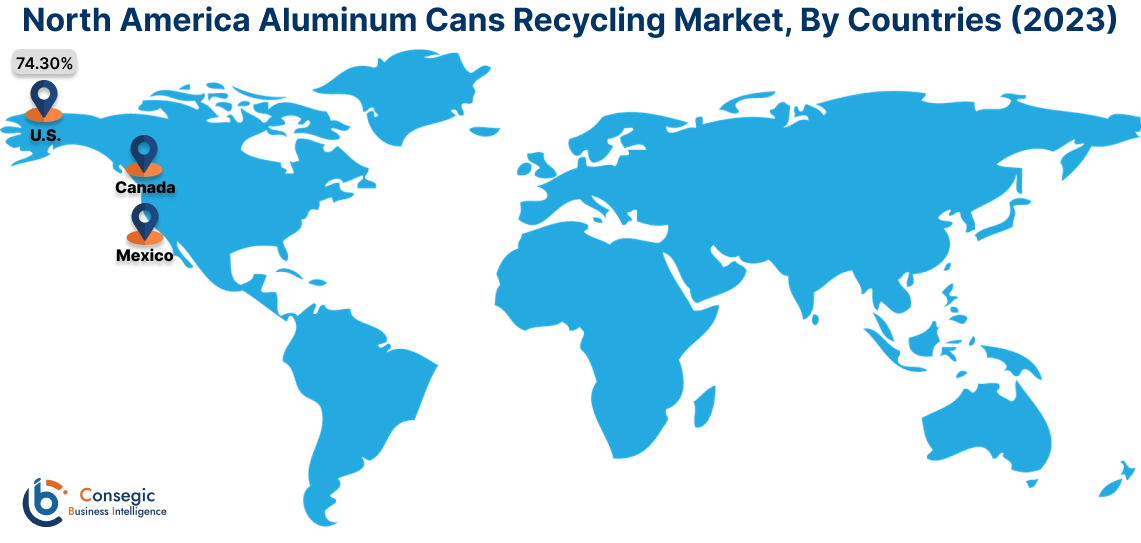
In 2023, North America was valued at USD 1,204.20 Million and is expected to reach USD 1,680.83 Million in 2031. In North America, the U.S. accounted for the highest share of 74.30% during the base year of 2023. North America holds a significant share in the aluminum cans recycling market analysis, driven by strong recycling infrastructure and high awareness of sustainability. The U.S. leads the region with large-scale recycling programs supported by governmental initiatives and private sector efforts to promote a circular economy. Aluminum cans are a key focus due to their high recyclability and economic value. Canada also contributes through the increasing adoption of extended producer responsibility (EPR) programs, which encourage manufacturers to prioritize recyclable materials. However, fluctuations in raw material prices and operational challenges in recycling facilities may impact the aluminum cans recycling market trends.
In Asia Pacific, the market is experiencing the fastest growth with a CAGR of 5.0% over the forecast period. Asia-Pacific is the fastest-growing region in the aluminum cans recycling market analysis, fueled by rapid urbanization, increasing consumption of beverages in cans, and growing sustainability awareness in China, India, and Japan. China leads the market trends with large-scale recycling initiatives supported by government policies to reduce environmental pollution and promote resource efficiency. India’s informal recycling sector is gradually transitioning to organized systems, driving the recovery of aluminum cans. Japan’s advanced waste management infrastructure ensures high recycling rates, emphasizing the use of aluminum in sustainable packaging. However, challenges such as inadequate infrastructure in emerging markets and fluctuating scrap prices may limit growth in certain areas.
Europe is prominent for aluminum cans recycling market trends, supported by stringent environmental regulations and high recycling rates across the region. Countries like Germany, the UK, and France are key contributors. Germany’s well-established recycling system and emphasis on deposit-return schemes drive high aluminum can recovery rates. The UK analysis focuses on promoting closed-loop recycling systems, while France emphasizes reducing landfill waste through comprehensive waste management policies. However, rising energy costs associated with aluminum processing and challenges in managing cross-border recycling operations may affect market growth.
The Middle East & Africa region is witnessing steady growth in the aluminum cans recycling market, driven by increasing investments in recycling infrastructure and rising awareness of sustainability. In the Middle East analysis, countries like Saudi Arabia and the UAE are implementing initiatives to promote recycling as part of their broader sustainability goals. In Africa, South Africa leads the market with organized aluminum can collection and recycling programs, often driven by community initiatives and public-private partnerships. However, limited local processing capabilities and dependency on exports for recycling materials may constrain market development in the region.
Latin America is an emerging market for aluminum cans recycling, with Brazil and Mexico leading the region’s trends. Brazil has one of the highest recycling rates for aluminum cans globally, supported by a robust informal recycling sector and government incentives for sustainable practices. Mexico’s growing beverage sectors and increasing awareness of recycling benefits drive the recovery and reuse of aluminum cans. The region is also exploring innovative recycling technologies to improve efficiency. However, economic instability and lack of standardization in recycling policies across countries may pose challenges.
Top Key Players and Market Share Insights:
The Aluminum Cans Recycling market is highly competitive with major players providing products and services to the national and international markets. Key players are adopting several strategies in research and development (R&D), product innovation, and end-user launches to hold a strong position in the global Aluminum Cans Recycling market. Key players in the Aluminum Cans Recycling industry include -
- Novelis Inc. (U.S.)
- Ball Corporation (U.S.)
- Bottleman Recycling Services (U.S.)
- Tal Metal Inc. (Canada)
- Sims Metal Management (U.S.)
- United Scrap Metal (U.S.)
- Brand & Howes Environmental (U.S.)
- Steinert GmbH (Germany)
- Eldan Recycling A/S (Denmark)
- Reliance Scrap Metal (U.S.)
Recent Industry Developments :
Product Launch:
- In September 2022, Novelis developed black-laminated aluminum can end material, enhancing the visual appeal and reducing the carbon footprint by approximately 33% compared to traditional liquid coating processes.
Aluminum Cans Recycling Market Report Insights :
| Report Attributes | Report Details |
| Study Timeline | 2018-2031 |
| Market Size in 2031 | USD 5,186.13 Million |
| CAGR (2024-2031) | 4.56% |
| By Recycling Process |
|
| By Source |
|
| By Technology |
|
| By End-Use |
|
| By Region |
|
| Key Players |
|
| North America | U.S. Canada Mexico |
| Europe | U.K. Germany France Spain Italy Russia Benelux Rest of Europe |
| APAC | China South Korea Japan India Australia ASEAN Rest of Asia-Pacific |
| Middle East and Africa | GCC Turkey South Africa Rest of MEA |
| LATAM | Brazil Argentina Chile Rest of LATAM |
| Report Coverage |
|
Key Questions Answered in the Report
What is the projected market size of the Aluminum Cans Recycling Market by 2031? −
Aluminum Cans Recycling Market size is estimated to reach over USD 5,186.13 Million by 2031 from a value of USD 3,630.29 Million in 2023 and is projected to grow by USD 3,731.15 Million in 2024, growing at a CAGR of 4.56% from 2024 to 2031.
What are the key drivers for the Aluminum Cans Recycling Market growth? +
Key drivers include the growing emphasis on sustainability and circular economy practices, increasing environmental awareness, and stringent regulations promoting recycling. The high recyclability and energy efficiency of aluminum also contribute significantly to market growth.
What are the major challenges in aluminum cans recycling? +
Contamination and quality concerns in recycled aluminum, such as impurities from mixed materials and improper sorting, pose challenges. These issues impact the usability of recycled aluminum in high-performance applications, requiring advancements in waste segregation and processing technologies.
What future opportunities exist in this market? +
Advancements in regulatory support, government incentives, and innovations in recycling infrastructure offer significant opportunities. Technologies that improve efficiency and quality in recycling processes are also expected to play a crucial role.
Overview
Reputation & Certifications


Our Services
- Market Intelligence & Forecasting
- Custom Research Solutions
- Market Entry Strategy
- Competitive Intelligence
- Customer Insights
- Industry Innovation Analysis
- Investment Advisory