Jump to Content
Automotive Chassis Market - Size, Share, Industry Trends, and Forecasts (2025-2032)
Automotive Chassis Market Size:
Automotive Chassis Market Size is estimated to reach over USD 152.77 Billion by 2032 from a value of USD 91.03 Billion in 2024 and is projected to grow by USD 95.53 Billion in 2025, growing at a CAGR of 7.3% from 2025 to 2032.
Automotive Chassis Market Scope & Overview:
An automotive chassis is the foundational framework of a vehicle that supports all other components in the vehicle. The system provides structural integrity by bearing the weight of the engine, transmission, suspension, and body. Further, increasing adoption of lightweight materials is driving the market growth of chassis system. The lightweight materials, such as aluminum and composites are increasingly used to improve fuel efficiency and reduce emissions. Additionally, the integration of advanced technologies like electric vehicle platforms and autonomous driving systems is reshaping chassis design in turn requiring greater flexibility and modularity in chassis design.
How is AI Impacting the Automotive Chassis Market?
AI is significantly impacting the automotive chassis market through advancements in design, manufacturing, and functionality. AI-powered tools are enabling the creation of stronger, lighter, and more efficient chassis components using generative design and smart factories. AI is transforming automotive manufacturers by improving precision and reducing errors through computer vision, digital twins, and deep learning. Furthermore, AI is enhancing chassis functionality with features like predictive maintenance, personalized driving experiences, and advanced driver-assistance systems (ADAS). Additionally, AI analyzes sensor data to anticipate potential issues with chassis components, enabling proactive maintenance and reducing the risk of unexpected failures.

Automotive Chassis Market Dynamics - (DRO) :
Key Drivers:
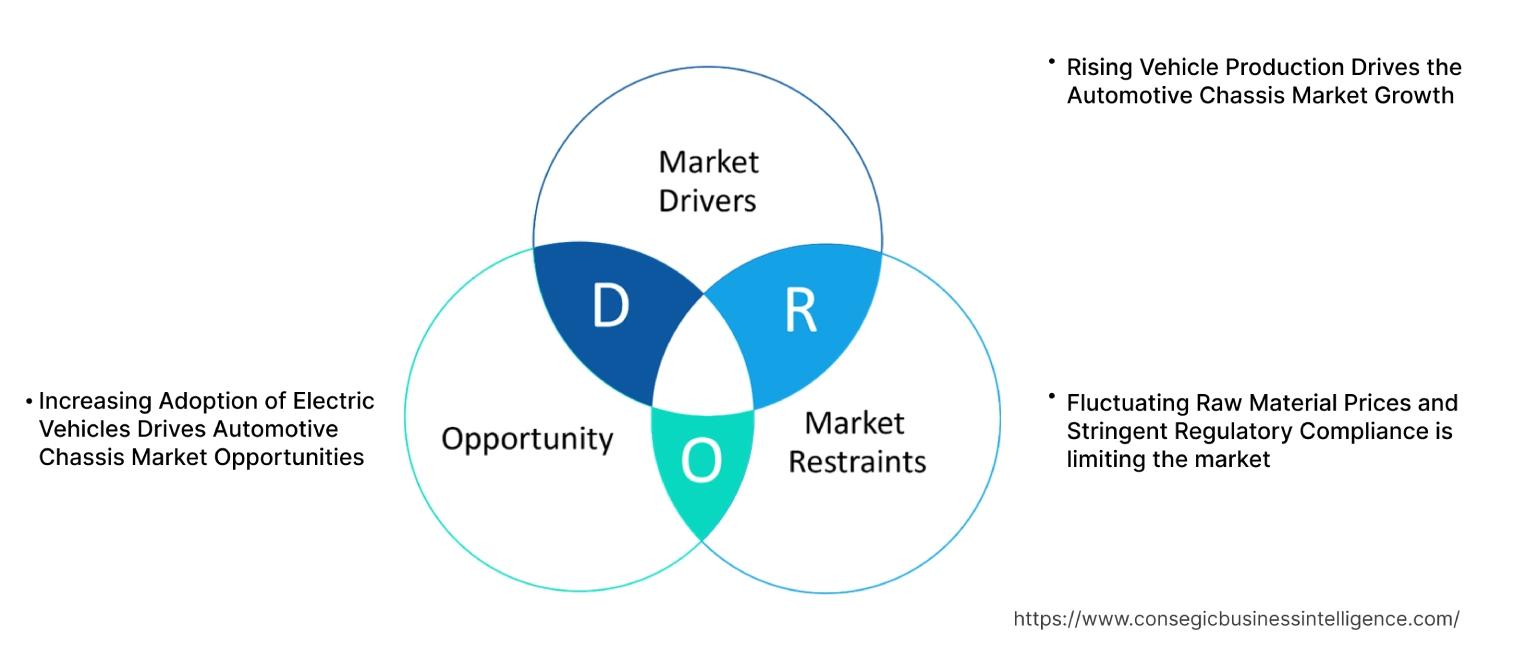
Rising Vehicle Production Drives the Automotive Chassis Market Growth
The automotive chassis market is experiencing significant growth primarily fueled by the consistent rise in global vehicle production. The rising disposable income and technological advancement is driving the sales which in tun drives the need for chassis components, including control arms, suspension systems, and axles. Further, surge in production is further amplified by the evolving automotive landscape, which includes the growing popularity of electric vehicles (EVs). Additionally, stringent safety regulations and the integration of advanced driver-assistance systems (ADAS) are pushing manufacturers to innovate and enhance chassis performance.
- For instance, as per the European Automobile Manufacturers' Association (ACEA), vehicle production worldwide reached 85.4 million units in 2022, observing a 5.7% rise from 2021.
Thus, increasing vehicle ownership driven by technological advancement, sustainability concerns, rising disposable incomes and urbanization contributes significantly to the automotive chassis market size.
Key Restraints:
Fluctuating Raw Material Prices and Stringent Regulatory Compliance is limiting the market
Fluctuating raw material prices pose a significant challenge to the automotive chassis market as steel and aluminum which are vital for production of chassis components, experience considerable price volatility. The unpredictability in prices disrupts the manufacturing cost projections and can squeeze profit margins. Moreover, stringent regulatory compliance, particularly concerning safety and emissions, necessitates substantial investments in research and development. Further, the automakers are required to adapt for changes in chassis designs to meet evolving standards which in turns increases production complexities and expenses.Thus, fluctuating material costs and stringent regulations collectively hinder the market growth by creating an environment of financial uncertainty and escalating production expenditures.
Future Opportunities :
Increasing Adoption of Electric Vehicles Drives Automotive Chassis Market Opportunities
The growing adoption of electric vehicles (EVs) is significantly driving the substantial opportunities in chassis requirements. EVs have a distinct architecture and heavier battery packs which require specialized chassis systems. Further, the surge in EV production necessitates the need for robust chassis design which is capable of handling increased weight and delivering enhanced stability. Furthermore, manufacturers are actively developing lightweight and strong chassis materials using advanced aluminum alloys and composites to optimize EV performance and efficiency. Additionally, the integration of advanced technologies like regenerative braking and sophisticated suspension systems is driving innovation in chassis design.
- For instance, according to IEA electric car sales in Europe rose from 2.7 million units in 2022 to 2 million units in 2023. The increased sales are driving the demand for chassis components.
Thus, growing need for electric vehicles and advancement in chassis design drives the automotive chassis market opportunities
Automotive Chassis Market Segmental Analysis :
By Component:
By Component:
Based on the component, the market is segmented into control arms, cross-axis joints, knuckles & hubs, stabilizer links, suspension ball joints, and tie-rods
Trends in the Component:
- Increasing focus on use of lighter materials to improves fuel efficiency is driving the automotive chassis market trends.
- Increasing development of electrically assisted tie-rods for advanced steering systems is expected to drive automotive chassis market size.
Control arms accounted for the largest revenue share in the year 2024.
- Increasing development of adjustable control arms for adaptive suspension systems is driving the automotive chassis market share.
- Further, there is an increasing trend in the adoption of materials such as aluminum and composite materials for weight reduction.
- Furthermore, growing requirement for ADAS requires precise and reliable chassis which in turn drives the automotive chassis market trends.
- For instance, Hirschvogel Group manufactures various control arms for front and rear axles, utilizing aluminum 6000 series. The production process includes aluminum hot forging, milling, and assembly, resulting in products with lightweight design, high strength, and ductility,
- Thus, as per automotive chassis market analysis, material advancement, growing adoption of ADAS, and development of adjustable control arms are driving the market.
Suspension ball joints is anticipated to register the fastest CAGR during the forecast period.
- Growing development of low friction ball joints for smoother suspension action drives the automotive chassis market share.
- Further, growing use of higher-grade materials for increased strength in turn drives the automotive chassis market demand.
- For instance, ZF Friedrichshafen AG offers suspension ball joints that ensure accurate wheel movement by maintaining tight kinematic tolerances, resulting in responsive steering and maneuverability.
- Therefore, based on analysis, low friction ball joints and use of higher-grade materials are anticipated to boost the market during the forecast period.
By Chassis Type:
Based on the chassis type, the market is segmented into monocoque chassis, backbone chassis, ladder chassis, and modular chassis.
Trends in the Chassis Type:
- Backbone chassis is designed to maximize torsional stiffness, improving handling and stability which in turn drives the automotive chassis market demand.
- In ladder chassis there is an increasing trend in the adoption of coatings and materials that are anti corrosive which protect against rust and corrosion in turn extending the lifespan of chassis.
Monocoque chassis accounted for the largest revenue share of 40.96% in the year 2024.
- Growing adoption of monocoque chassis in sports cars and supercars due to lightweight and high strength properties.
- Further, advantages including enhanced safety, fuel efficiency, improved handling, and weight reduction are driving the automotive chassis industry.
- Furthermore, technological advancements in welding, bonding, and forming processes are leading to more precise and efficient monocoque development.
- Thus, as per automotive chassis market analysis, adoption in sports cars, a wide range of advantages, and technological advancements are driving the market.
Modular chassis is anticipated to register the fastest CAGR during the forecast period.
- Modular chassis platforms offer automobile manufacturers a cost-effective solution to produce multiple vehicle variants from a standardized chassis design.
- Further, modular chassis is ideal for electric vehicles, allowing easy integration of different battery sizes and powertrain configurations which subsequently propels the automotive chassis market expansion.
- Therefore, based on analysis, adoption in electric vehicles and a cost-effective solution to produce multiple vehicle variants is anticipated to boost the growth of the market during the forecast period.

By Vehicle Type:
Based on the vehicle type, the market is segmented into passenger cars, light commercial vehicles, and heavy commercial vehicles.
Trends in the Vehicle Type:
- Stringent emissions regulations are driving the development of fuel-efficient chassis which in turn drives the automotive chassis market expansion.
- Growing e-commerce and last mile delivery service market fuels the need for light commercial vehicles which subsequently propels the automotive chassis market.
Passenger cars accounted for the largest revenue share in the year 2024 and is anticipated to register the fastest CAGR during the forecast period.
- The growing need for autonomous vehicles is driving the demand for technologically advanced chassis system.
- Further, increasing consumer requirement for refined driving experiences is resulting in the development of chassis that improves ride comfort, handling, and stability.
- Furthermore, growing demand for electric and hybrid vehicles is driving the automobile industry, which in turn drives automotive chassis market growth.
- For instance, as per International Organization of Motor Vehicle Manufacturers there has been a significant rise in global passenger car sales, rising from 58.64 million units in 2022 to 65.27 million units in 2023, which in turn drives the demand for automotive chassis.
- Thus, based on analysis, autonomous vehicles, adoption of electric and hybrid vehicles, and need for enhanced driving experience is driving the market.
Regional Analysis:
The regions covered are North America, Europe, Asia Pacific, the Middle East and Africa, and Latin America.
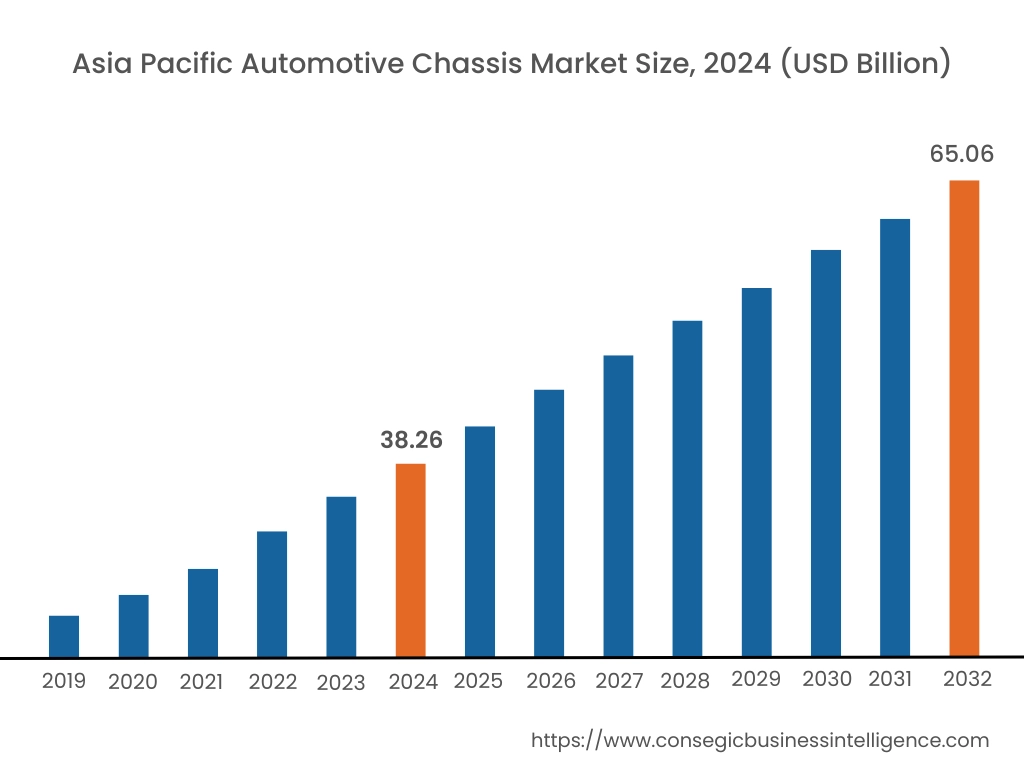
Asia Pacific region was valued at USD 38.26 Billion in 2024. Moreover, it is projected to grow by USD 40.20 Billion in 2025 and reach over USD 65.06 Billion by 2032. Out of this, China accounted for the maximum revenue share of 38.63%. The market growth for automotive chassis is mainly driven by robust automotive production which is stimulated by rapid urbanization and a growing middle class. Additionally, the rising adoption of electric vehicles particularly in China, necessitates the need for advanced chassis designs.
- For instance, according to Global EV Outlook 2024 by IEA, the sale of electric cars in China grew to 8.2 million units in 2023 from 5.9 million units in 2022. The increased sales of electric vehicles are resulting in the growing need for chassis system.

North America is estimated to reach over USD 36.66 Billion by 2032 from a value of USD 21.93 Billion in 2024 and is projected to grow by USD 23.01 Billion in 2025. The North American market is primarily driven by increasing need for high-performance vehicles, including SUVs and trucks, which require advanced and robust chassis systems. Additionally, focus on electric and autonomous vehicles is driving the development of specialized chassis systems.
- In February 2025, ZF Aftermarket expanded TRW Chassis Line by introducing over 130 new parts. The expansion increases their chassis coverage by approximately 29 million vehicles in operation across the U.S. and Canada.
The regional trends analysis depicts that stringent environmental regulations, development of lighter and efficient chassis system, and focus on advanced safety standards in Europe is driving the market. Additionally, the factors driving the market in the Middle East and African region are increasing infrastructure development and rising disposable incomes that boost the requirement for both passenger and commercial vehicles. Further, expanding automotive production and increasing need for affordable vehicles is paving the way for the progress of market trends in Latin America region.
Top Key Players and Market Share Insights:
The global automotive chassis market is highly competitive with major players providing solutions to the national and international markets. Key players are adopting several strategies in research and development (R&D), product innovation, and end-user launches to hold a strong position in the automotive chassis industry. Key players in the global automotive chassis market include-
- Aisin Seiki Co., Ltd. (Japan)
- ZF Friedrichshafen AG (Germany)
- Delphi Technologies (UK)
- Schaeffler AG (Germany)
- ROBERT BOSCH GMBH (Germany)
- American Axle & Manufacturing Inc (US)
- HYUNDAI MOBIS CO. LTD. (South Korea)
- Continental AG (Germany)
- Magna International Inc (Canada)
- Gestamp Automocin S.A. (Spain)
Recent Industry Developments :
Merger and Acquisition :
- In May 2024, ZF and Foxconn finalized their joint venture, ZF Foxconn Chassis Modules, with Foxconn acquiring a 50% stake in ZF Chassis Modules GmbH. The partnership aims to drive innovation and growth in passenger car chassis systems. Further, by combining their expertise, the venture is expected to serve existing and new customers with innovative technologies and strengthen their positions in growing markets.
Business Expansion:
- In September 2024, Continental AG expanded its aftermarket product range to meet the growing technical demands of modern vehicles. This expansion includes new product groups like sensors for driver assistance systems, chassis and steering components, and high-pressure fuel pumps.
Automotive Chassis Market Report Insights :
| Report Attributes | Report Details |
| Study Timeline | 2019-2032 |
| Market Size in 2032 | USD 152.77 Billion |
| CAGR (2025-2032) | 7.3% |
| By Component |
|
| By Chassis Type |
|
| By Vehicle Type |
|
| By Region |
|
| Key Players |
|
| North America | U.S. Canada Mexico |
| Europe | U.K. Germany France Spain Italy Russia Benelux Rest of Europe |
| APAC | China South Korea Japan India Australia ASEAN Rest of Asia-Pacific |
| Middle East and Africa | GCC Turkey South Africa Rest of MEA |
| LATAM | Brazil Argentina Chile Rest of LATAM |
| Report Coverage |
|
Key Questions Answered in the Report
How big is the Automotive Chassis market? −
The Automotive Chassis market is estimated to reach over USD 152.77 Billion by 2032 from a value of USD 91.03 Billion in 2024 and is projected to grow by USD 95.53 Billion in 2025, growing at a CAGR of 7.3% from 2025 to 2032.
What specific segmentation details are covered in the Automotive Chassis report? +
The Automotive Chassis report includes specific segmentation details for component, chassis type, vehicle type, and regions.
Which is the fastest segment anticipated to impact the market growth? +
In the Automotive Chassis market, passenger cars is the fastest-growing segment during the forecast period.
Who are the major players in the Automotive Chassis market? +
The key participants in the Automotive Chassis market are Aisin Seiki Co., Ltd. (Japan), ZF Friedrichshafen AG (Germany), Delphi Technologies (UK), Schaeffler AG (Germany), ROBERT BOSCH GMBH (Germany), American Axle & Manufacturing Inc (US), HYUNDAI MOBIS CO. LTD. (South Korea), Continental AG (Germany), Magna International Inc (Canada), Gestamp Automocin S.A. (Spain), and others.
What are the key trends in the automotive chassis market? +
The automotive chassis market is being shaped by several key trends including technological advancements in chassis design, growing electric vehicle market, and adoption of autonomous vehicles.
Overview
Reputation & Certifications


Our Services
- Market Intelligence & Forecasting
- Custom Research Solutions
- Market Entry Strategy
- Competitive Intelligence
- Customer Insights
- Industry Innovation Analysis
- Investment Advisory