Jump to Content
Ball Valves Market Size & Industry Share - Growth Trends & Forecasts (2026 - 2034)
Ball Valves Market Size:
Ball Valves Market size is estimated to reach over 20,572.68 (US$M) by 2034 from a value of 14,579.78 (US$M) in 2025 and is projected to grow by 15,148.39 (US$M) in 2026, growing at a CAGR of 3.9% from 2026 to 2034, according to a recent report from Consegic Business Intelligence.
Ball Valves Market Scope & Overview:
A ball valve (BV) is a quarter-turn shut-off valve that is used for isolation and controlling the flow of gas or liquid. Ball valve is used with minimal energy consumption to provide smooth and accurate flow control to the essential fluid systems. Additionally, they feature small dimensions, are lightweight, and do not exist in the gate or globe valve, thereby, reducing the amount of valves required. Further, the operational and maintenance costs are low, and the valves ensure smooth performance by effectively controlling the airflow to provide leakproof service. In oil and gas production facilities, the ball valve is implemented offshore and onshore as fluid shutoff valves.
How is AI Transforming the Ball Valves Market?
AI is increasingly being used in the ball valves market, particularly to enhance various aspects of its design, manufacturing, and operation. AI integration into valve systems can help in improving performance, efficiency, and reliability, primarily in industries such as oil and gas, chemical processing, and power generation, among others. Moreover, AI-powered automation can streamline the production process, reduce human error, and improve the overall quality and consistency of ball valves.
Further, AI-powered smart valves can provide real-time data on valve performance, which enables operators to monitor and optimize flow control systems. Therefore, the aforementioned factors are expected to positively impact the market growth in upcoming years.

Ball Valves MarketDynamics - (DRO) :
Key Drivers:
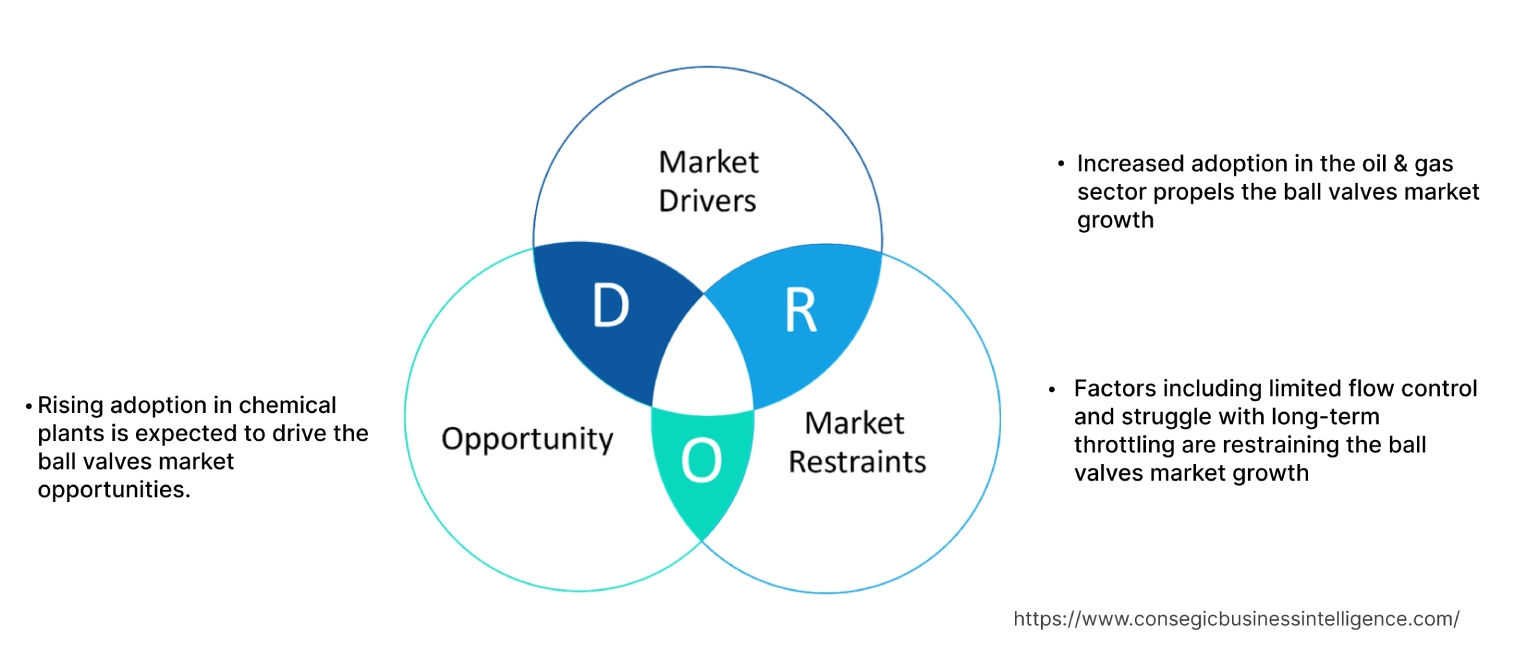
Increased adoption in the oil & gas sector propels the ball valves market growth
In the oil & gas sector, a wide range of industrial valves are used for efficient and safe transmission of hydrocarbon resources from one point to another. Ball valves are ideal for the oil and gas sector spectrum because of reliable leak protection, fast closing, and opening, and it also exhibits low-pressure drop. Additionally, fast shut-offs are provided to the pipelines with tight sealing. Further, trunnion valves are used in high-pressure conditions, and floating valves are used in low to medium-pressure pipelines.
- For instance, in February 2024, Valmet launched the Neles XH ball valve in the X-series ball valve family. The ball valve is designed for application in several industries including oil and gas refining.
Thus, the rising adoption of ball valves in the oil & gas sector is driving the ball valves market size.
Key Restraints :
Factors including limited flow control and struggle with long-term throttling are restraining the ball valves market growth.
Ball valves have limited capability of controlling flow, particularly in larger sizes where the design of the full bore ball leads to a high-pressure drop in fluids, thereby reducing the efficiency in a fluid where precision control is required. Additionally, long-term throttling is not suitable in either fully closed or fully open positions for long durations of time. Further, operating in partially open positions leads to inaccuracy in controlling the flow rate.
Hence, the prevalence of certain limitations including limited flow control and struggle with long-term throttling is hindering the ball valves market expansion.
Future Opportunities :
Rising adoption in chemical plants is expected to drive the ball valves market opportunities.
The rising adoption of ball valves is growing for regulating the flow of chemicals from pipelines to vessels. Further, shut-off capabilities and crucial control for gases and liquids are provided at different temperatures and high pressures to manage corrosive liquids, fluids, and slurries. Additionally, they deliver air-tight seals in the closed position, which is ideal in the chemical industry to maintain, operate, and offer low flow resistance.
- For instance, in May 2024, Shin-Etsu Chemical built a chemical plant for silicon products in China to expand its silicone businesses.
According to the analysis, the rising investments in chemical plants are increasing the adoption of valves, in turn driving the ball valves market opportunities.
Ball Valves Market Segmental Analysis :
By Material:
Based on the material, the market is segmented into steel, iron, alloy, plastic, and others.
Trends in the Material:
- There is an increasing trend toward the adoption of steel ball valves to control fluid flow.
- Rising trend towards the utilization of plastic valves because it is less prone to damage compared to other kinds of valves.
The steel segment accounted for the largest revenue in the overall ball valves market share in 2023, and it is anticipated to register a significant CAGR during the forecast period.
- Steel ball valve is a connector used in pipes that can withstand corrosive environments and corrosive fluids.
- Stainless steel valves help to control the flow of the corrosive fluids without having to reassemble or disassemble the pipes.
- Steel ball valve is used in various industrial applications, water wells, plumbing applications, and others.
- For instance, NDL offers steel BVs in its product offerings. The steel ball valve offers several features such as large diameters for commercial transcritical and industrial CO2 systems.
- Therefore, the rising developments associated with steel ball valves are driving the ball valves market size.
By Type:
Based on the type, the market is segmented into floating, trunnion-mounted, flanged, stem, and others.
Trends in the type:
- There is an increasing trend towards the adoption of floating ball valves because of superior bi-directional sealing that maintains tight shut-off.
- Rising utilization of flanged ball valves due to low fluid resistance, lightweight, and small dimensions.
The trunnion-mounted segment accounted for the largest revenue share of the total ball valves market share in 2023.
- Trunnion-mounted valves are quarter-turn valves, wherein the shaft called trunnion is connected to one side and the ball is connected to the other side for flow control of fluids in a pipeline.
- Trunnion-mounted valve is suitable for high-pressure and high-temperature applications such as pipelines transporting natural gas, crude oil, and other fluids.
- Trunnion-mounted valve costs are significantly lower as compared to other free-floating valves and are used for low as well as high-pressure applications.
- For instance, in May 2021, Vexve launched a trunnion mounted ball valve product series for distinct energy requirements.
- According to the analysis, the rising developments and advancements in trunnion-mounted valves are driving the ball valves market trends.
Floating segment is anticipated to register the fastest CAGR during the forecast period.
- Floating ball valve is a quarter-turn valve that is suitable for industrial applications where leaks are the primary concern.
- Floating valves provide superior bi-directional sealing that maintains tight shut-off for maintaining the performance of various industrial processes at different temperatures.
- Floating valves are used in various industrial applications including gas, oil, steam, petrochemicals, and water.
- For instance, Flowserve offers floating ball valves in its product offerings. The floating ball valve offers benefits such as improved sealing and superior leakage performance.
- According to the analysis, the rising advancements in floating ball valves for leakage applications are driving the ball valves industry.
By End-Use:
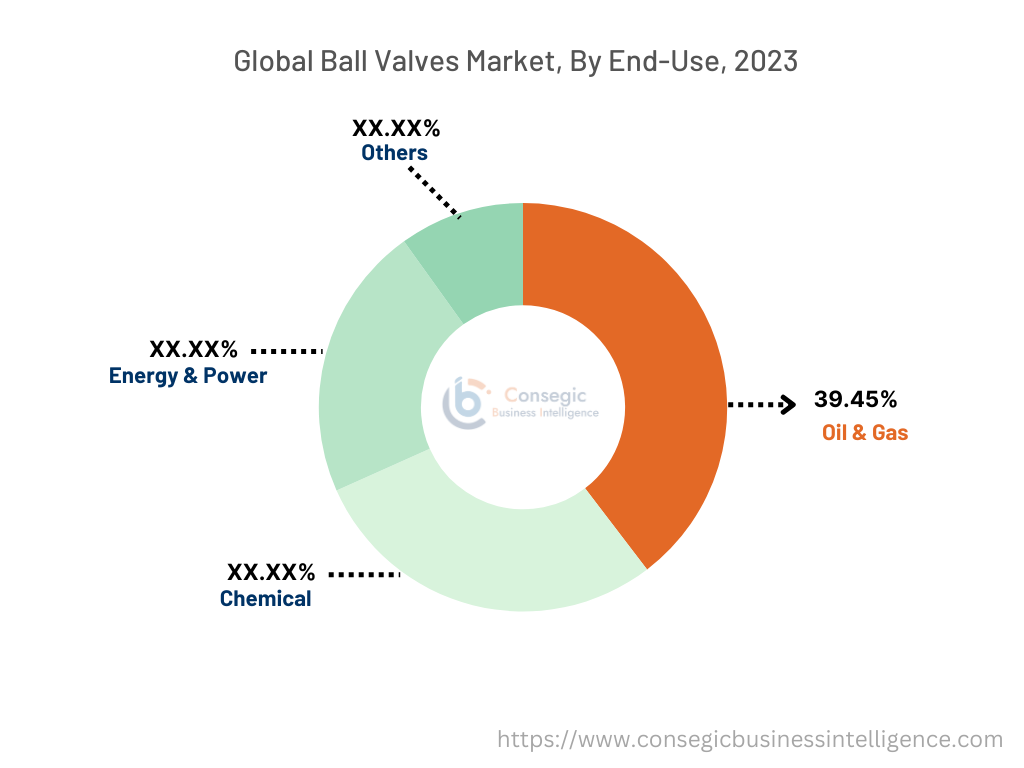
Based on the end-use, the market is segmented into oil & gas, chemical, energy & power, and others.
Trends in the end use:
- There is an increasing trend towards the adoption of valves in chemical plants for regulating chemical flow.
- Rising utilization of valves in the energy & power sector for reducing operational costs and increasing energy savings.
Oil & gas accounted for the largest revenue at 39.45% f the overall market share in 2023, and it is anticipated to register the fastest CAGR during the forecast period.
- In the oil and gas industry, ball valves are used for leak protection and accurate flow control of oil and gases in pipelines.
- BVs are used in manifolds, wellheads in upstream operations, and pipelines to control the flow of natural gas and crude oil.
- Ball valve is suitable for various oil and gas applications, such as high-temperature, corrosive conditions, and high-pressure.
- For instance, in June 2023, FITOK launched FITOK BHP series 3-piece high-purity ball valves, which are designed for application in bulk gas distribution lines.
- Therefore, the rising adoption of ball valves in the oil & gas sector is driving the ball valves market trends.
Regional Analysis:
The regions covered are North America, Europe, Asia Pacific, the Middle East and Africa, and Latin America.
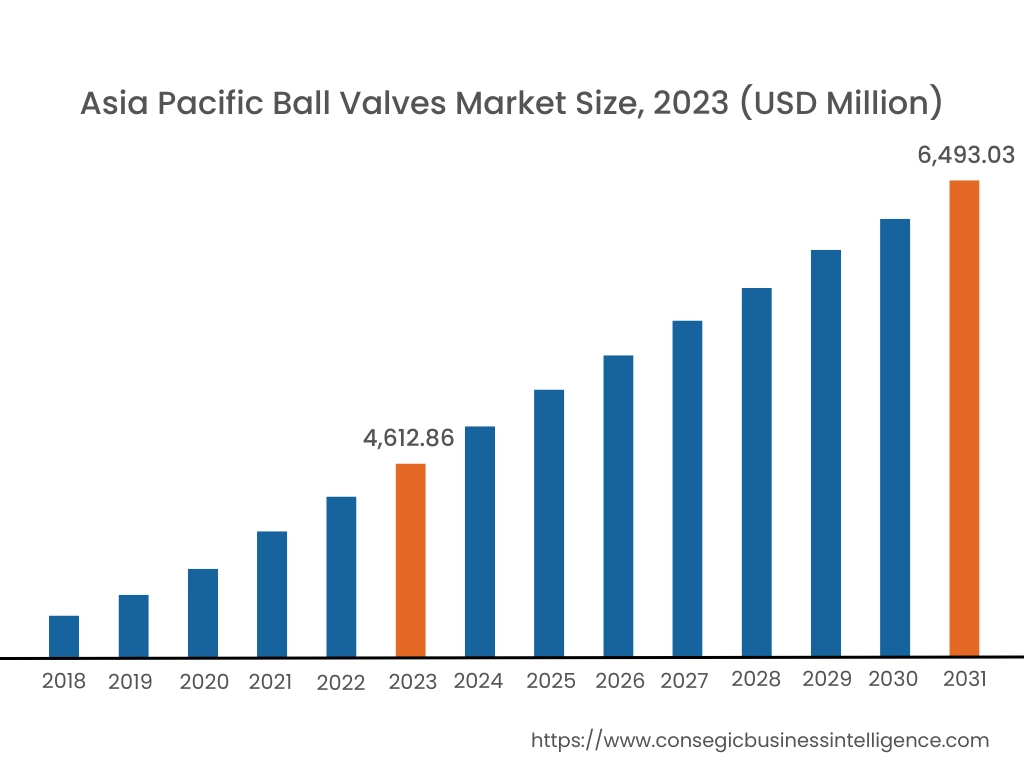
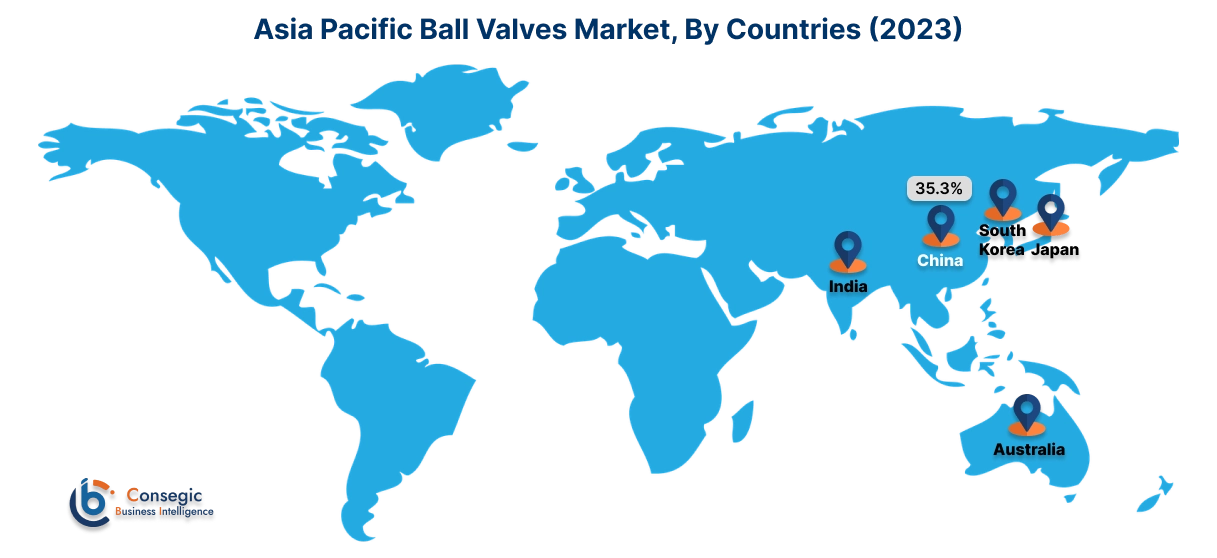
Asia Pacific region was valued at USD 4,612.86 Million in 2023. Moreover, it is projected to grow by USD 4,795.35 Million in 2024 and reach over USD 6,493.03 Million by 2031. Out of this, China accounted for the maximum revenue share of 35.3%. As per the ball valves market analysis, the adoption of valves, particularly in countries such as China, India, and Japan is growing due to the growth of chemicals, pharmaceuticals, energy & power, and other industries. The rapid development and growing investments in the energy and power sector are accelerating the ball valves market expansion.
- For instance, in March 2024, Asahi Kasei unveiled a hydrogen plant in Kawasaki, Japan to accelerate its hydrogen business activities. This further increases the market demand for ball valves for application in hydrogen plants.
North America is estimated to reach over USD 5,157.74 million by 2031 from a value of USD 3,779.96 Million in 2023 and is projected to grow by USD 3,919.16 Million in 2024. As per the market analysis in North America, the growth is driven by the rising demand for leak control and constant control in flow for low-pressure applications in various industries such as petrochemicals, residential houses, energy, and others to increase efficiency. Rising trends for quick cycle times, extended service lives, and long-lasting applications are driving the market growth. In addition, increasing investment in the energy sector is massively contributing to the ball valves market demand.
- For instance, according to the International Energy Agency (IEA), the Bipartisan Infrastructure Investment and Jobs Act of 2021 allocated USD 550 billion for clean energy and infrastructure, thereby increasing the market demand for valve application in energy plants.
The regional analysis depicts that the rising growth in energy projects is increasing the demand for valves in distribution systems and power generation, in turn driving the ball valves market demand in Europe. Further, as per the ball valves market analysis, the primary factors driving the market in the Middle East and African region include increasing investment in the oil & gas sector for improving connectivity and development of oil refinery projects. In addition, the rising investments in the petrochemical sector are accelerating the demand for valves, in turn driving the market growth in the Latin America region.
Top Key Players & Market Share Insights:
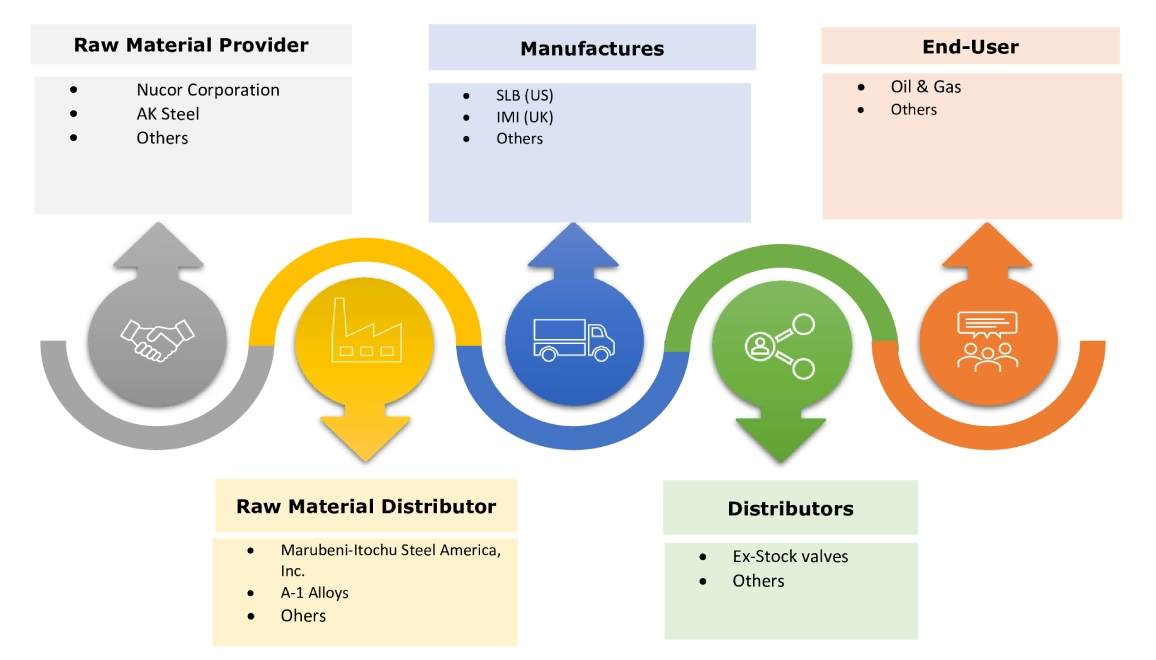
The ball valves market is highly competitive with major players providing services to the national and international markets. Key players are adopting several strategies in research and development (R&D), product innovation, and end-user launches to hold a strong position in the global ball valves market. Key players in the ball valves industry include -
- Emerson Electric Co. (US)
- Flowserve Corporation (US)
- Kirloskar Ltd (India)
- L&T valves (India)
- Maverick Valves (Netherlands)
- SLB (US)
- IMI (UK)
- Valmet (Finland)
- Crane Company (US)
- KITZ Corporation (Japan)
Recent Industry Developments :
Product Launches:
- In November 2024, KI launched a tank bottom ball valve, which is used for general-purpose vessels or tanks. It includes features such as anti-static design and fire resistance.
- In November 2022, KLINGER collaborated with Monoball KHO and launched a ball valve for district heating pipes to handle temperature fluctuations.
Ball Valves Market Report Insights :
| Report Attributes | Report Details |
| Study Timeline | 2021-2034 |
| Market Size in 2034 | USD 20,572.68 Million |
| CAGR (2026-2034) | 3.90% |
| Base Year | 2025 |
| By Material |
|
| By Sensor Type |
|
| By End-Use |
|
| By Region |
|
| Key Players |
|
| North America | U.S. Canada Mexico |
| Europe | U.K. Germany France Spain Italy Russia Benelux Rest of Europe |
| APAC | China South Korea Japan India Australia ASEAN Rest of Asia-Pacific |
| Middle East and Africa | GCC Turkey South Africa Rest of MEA |
| LATAM | Brazil Argentina Chile Rest of LATAM |
| Report Coverage |
|
Key Questions Answered in the Report
How big is the ball valves market? −
The ball valves market was valued at USD 13,477.39 Million in 2023 and is projected to grow to USD 18,341.90 Million by 2031.
Which is the fastest-growing region in the ball valves market? +
Asia-Pacific is the region experiencing the most rapid growth in the ball valves market.
What specific segmentation details are covered in the ball valves report? +
The ball valves report includes specific segmentation details for material, type, end-user, and region.
Who are the major players in the ball valves market? +
The key participants in the ball valves market are Emerson Electric Co. (US), Flowserve Corporation (US), SLB (US), IMI (UK), Valmet (Finland), Crane Company (US), KITZ Corporation (Japan), Kirloskar Ltd (India), L&T valves (India), and Maverick Valves (Netherlands).
Overview
Reputation & Certifications


Our Services
- Market Intelligence & Forecasting
- Custom Research Solutions
- Market Entry Strategy
- Competitive Intelligence
- Customer Insights
- Industry Innovation Analysis
- Investment Advisory