The auto repair industry has never been more complex or more exciting. Modern vehicles are rolling computers, packed with hundreds of sensors, software-controlled systems and networked components that would have seemed like science fiction just two decades ago. Keeping these machines running demands a new kind of expertise and that expertise increasingly belongs to artificial intelligence. From smarter diagnostics to predictive maintenance, AI is quietly revolutionizing what happens inside the repair bay.
The Old Way Can't Keep Up
For most of automotive history, a skilled mechanic could diagnose a problem by listening to an engine, feeling vibrations through the steering wheel or reading a simple OBD-II fault code. Those instincts still matter- but they're no longer enough on their own.
A single modern vehicle can contain over 100 electronic control units (ECUs) communicating across multiple data networks. A fault in one system can cascade into seemingly unrelated symptoms in another. Traditional diagnostic tools present mechanics with thousands of possible codes and freeze-frame data, but leave the interpretation largely to human judgment. That creates bottlenecks, misdiagnoses and unnecessary parts replacements- costing both shop owners and customers time and money.
Smarter Diagnostics, Fewer Guesses
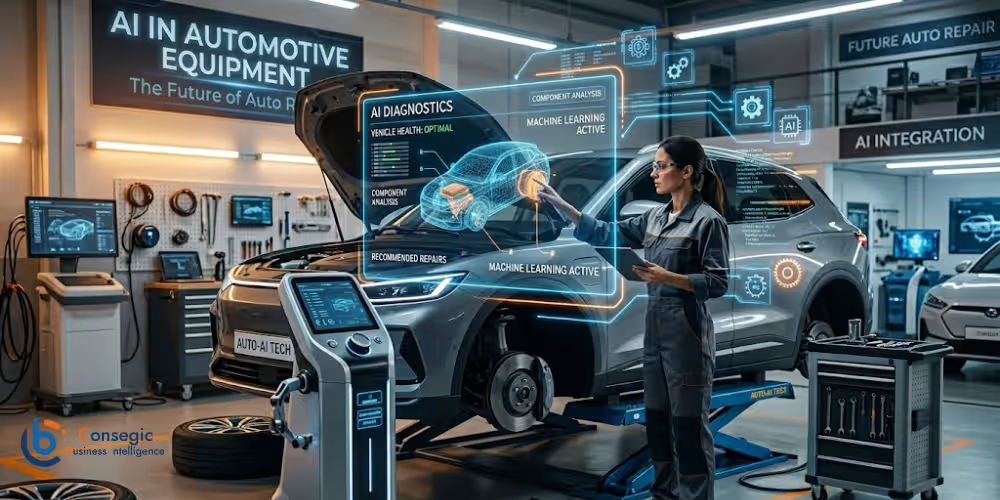
The shift from guessing what's wrong with a vehicle to knowing with certainty based on data comes via AI diagnostics. These systems tap into the car's information network and compare what sensors tell them at that exact moment against databases containing millions of examples of how millions of vehicles like the one in your bay have failed before and the factory technical service bulletins, or TSB's, which provide known solutions.
Instead of a mechanic staring at a list of 47 fault codes and deciding where to start, an AI system can cross-reference those codes with the vehicle's live data, mileage, geographic location and even local weather conditions to rank likely root causes in order of probability.
Companies like Bosch, Snap-on and Mitchell 1 are already embedding machine learning into their flagship diagnostic tools, and the results are striking. Shops using AI-assisted diagnostics report significant reductions in diagnostic time and measurable improvements in first-time fix rates.
Predictive Maintenance: Fixing Problems Before They Happen
Maybe the most revolutionary use of AI in the auto maintenance sector is not the fixing of failures, but rather their prevention.
The AI-powered predictive maintenance systems constantly monitor a vehicle's condition, detecting failing parts by identifying subtle changes in vehicle performance data. An AI model trained on engine vibration data, for example, can detect the early signatures of a bearing beginning to wear- weeks before it becomes a problem the driver would notice.
For fleet operators managing hundreds of trucks, vans or delivery vehicles, this is enormously valuable. Unplanned breakdowns are expensive. A single commercial vehicle out of service can cost thousands of dollars per day in lost productivity. By integrating AI-telematics systems into fleet operations, managers can arrange for maintenance to be scheduled around operational requirements rather than during a crisis.
The same technology is being introduced into consumer vehicles; many car companies are offering connected services that allow vehicles to "phone home" so that when their internal computers notice wear trends that indicate that service will be needed soon, they inform the owner as well as nearby dealerships.
AI-Powered Repair Assistance for Technicians
Diagnostics and maintenance prediction are just the beginning. AI is also becoming a hands-on assistant inside the repair bay itself.
Augmented reality systems paired with AI can overlay step-by-step repair guidance directly onto a mechanic's field of view through smart glasses or a tablet camera. These tools recognize the specific vehicle and component being worked on and surface the correct procedure, torque specifications, wiring diagrams and even video walkthroughs- all without the technician leaving the work area to search a service manual.
AI chatbots trained on technical documentation are available around the clock to help technicians work through complex repairs. Unlike a static service manual, these systems understand context. A technician can describe a symptom in plain language and receive targeted guidance drawn from OEM documentation, known issues and community repair knowledge.
This matters especially for independent shops, which often face the challenge of servicing an enormous variety of makes and models without the specialized training franchised dealerships receive. AI levels the playing field, putting expert-level knowledge within reach of every technician.
The Road Ahead: Autonomous Repair?
Long term, AI is starting to get involved in robotics in ways that will be used for repetitive repairs. We can already see systems that carry out precise wheel alignments and tire changes. Several research centers are looking at AI vision systems controlling robotic arms to undertake tasks such as fluid top ups and filter changes.
Full autonomous repair for the majority of repairs will be some way off, with real world damage varying and physical jobs on some systems being far too complex for hands to be replaced. However, the repetitive jobs will gradually be undertaken by AI automation.
Challenges and Considerations
The rise of AI in auto repair isn't without friction. Data privacy is a genuine concern as connected diagnostic systems gather enormous amounts of information about driving behaviour and vehicle health. Questions about who owns that data and how it can be used, are still being worked out through regulation and industry standards.
There's also the skills gap question. AI tools are only as effective as the people using them. Shops that invest in training their technicians to interpret and act on AI-generated insights will pull ahead; those that don't may find the technology more confusing than helpful. The industry will need to adapt its training pipelines to produce a new generation of technicians who are as comfortable with software and data as they are with wrenches.
A Repair Revolution Already Underway
This future of auto repair isn’t still years away; it’s arriving now, one software update, one AI-powered diagnostic report, one predictive warning at a time. The shop floor of the future is likely to resemble less a greasy, manual labour shop and more a data-driven, highly advanced diagnostic center, with human and AI working in tandem.
Shop owners need to be willing to adapt- it's already becoming a prerequisite for success. Car owners can look forward to fewer breakdowns and greater vehicle longevity. And for the industry as a whole, AI is an inspiring concept; one that points toward a safer, more efficient and dependable journey into the future.