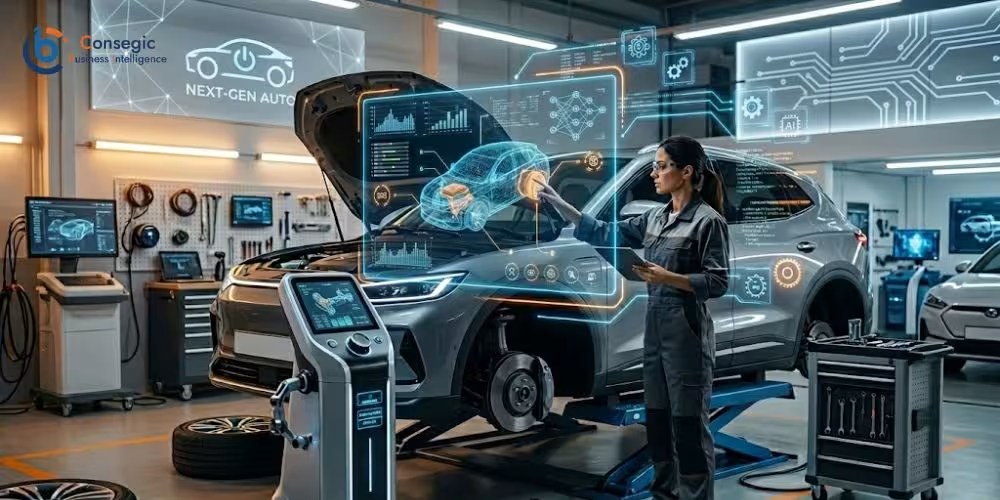
Walk into a cutting-edge auto repair shop today and you might not immediately recognize it. Gone are the days when a workshop was defined by a hydraulic lift, a toolbox on wheels and a mechanic armed with little more than experience and instinct. Today's best-equipped workshops look more like technology hubs and the equipment driving that transformation is rewriting the rules of what's possible in auto repair.
Next-generation automotive workshop equipment isn't just making repairs faster. It's making them smarter, safer and more precise than anything the industry has seen before. Here's a look at the technologies reshaping the workshop floor and why they matter for every stakeholder in the automotive ecosystem.
Advanced Vehicle Lifts: Beyond the Basic Hoist
The hydraulic lift has been a workshop staple for decades, but the latest generation is a far cry from its ancestors. Modern column lifts and scissor lifts now come integrated with load-sensing technology that automatically adjusts lifting pressure based on vehicle weight distribution which is critical for the growing range of heavy electric vehicles arriving on the market.
Wireless, app-controlled lift systems allow technicians to raise, lower and lock platforms from anywhere in the bay, eliminating trips back to the control column during inspections. Some advanced platforms incorporate built-in scales and alignment sensors, meaning a vehicle can be weighed and pre-checked for suspension geometry issues the moment it's lifted- before a single tool is picked up.
Safety has advanced in lockstep with functionality. Automatic safety lock engagement, overload detection and anti-drop systems are now standard on premium lifts, dramatically reducing the risk of workplace accidents.
Wheel Alignment Systems: Millimeter Perfect Precision
Of all workshop tools, none has progressed as significantly as the wheel alignment system. Once, each sensor had to be individually installed on the wheel and would take the mechanic time before providing one measurement reading. Modern 3D imaging wheel alignment systems scan all four wheels in seconds using high-resolution cameras and structured light, mapping all four wheels in seconds and reporting the results in increments of hundredths of a millimeter.
The latest high-end systems link the physical hardware to intelligent software. This AI-driven software cross-references with the factory specs of thousands of different vehicles, alerts to any readings out-of-spec automatically and generates a consumer-friendly report complete with before and after pictures. Some alignment platforms even tie into vehicle history databases in order to flag a vehicle that has come in with repeat alignment problems; in reality this can indicate worn suspension parts that an alignment won't correct on its own.
Because the wheel alignment on an electric vehicle is more important now than it ever has been. An electric vehicle misalignment does more than just cause premature tire wear- it creates rolling resistance which translates directly to a reduction in range and quality alignment equipment is an essential addition to any workshop looking to provide EV services.
Tire Changing and Balancing: Speed Meets Sophistication
Tire changers and wheel balancers have undergone a quiet revolution. Touchless tire changers, which remove and mount tires without metal contact with the wheel rim, are now the standard for any shop handling premium alloy or low-profile performance tires. These machines use roller and press systems guided by programmable force control, adapting to each tire and wheel combination to eliminate the scratching and bending that plagued older equipment.
Modern balancers go well beyond spin-balance. Road force balancing machines simulate the pressure of a vehicle's weight on the tire as it rolls, identifying stiffness variations in the tire itself- issues invisible to conventional balancers- that cause vibration at highway speeds. High-end systems also flag wheel runout and hub problems that would otherwise send a technician chasing a phantom vibration issue for hours.
Automated tire mounting robots are beginning to appear in high-volume shops, capable of mounting and balancing a tire in under two minutes with no manual handling, reducing both labour cost and the risk of technician injury from repetitive strain.
ADAS Calibration Equipment: The New Essential
Advanced Driver Assistance Systems- the cameras, radar modules, ultrasonic sensors and LiDAR units that power lane-keeping, automatic emergency braking, adaptive cruise control and parking assistance- have made one category of workshop equipment non-negotiable: ADAS calibration tools.
Any time a vehicle fitted with ADAS undergoes a windshield replacement, a front-end collision repair, a suspension adjustment, or even a wheel alignment, those sensors must be recalibrated to manufacturer specifications. Get it wrong, and the safety systems the driver relies on become unreliable or dangerous.
ADAS calibration rigs use precisely positioned target boards, radar reflectors and camera alignment jigs set up in a carefully controlled environment to walk technicians through the calibration process for specific vehicle makes and models. The newest systems are connected and cloud-updated, pulling in the latest OEM calibration procedures as manufacturers release them- ensuring shops are always working to the correct standard even as vehicle technology continues to evolve rapidly.
For workshops, ADAS calibration is also a significant revenue opportunity. As ADAS-equipped vehicles make up an ever-larger share of the vehicle parc, demand for calibration services is growing faster than the supply of shops equipped to perform them.
Battery and EV Service Equipment: The Workshop of Tomorrow and Today
Electric vehicles have introduced an entirely new category of workshop equipment. High-voltage battery diagnostic tools, insulated toolsets rated for EV work and dedicated battery pack service stations are becoming essential as EV penetration accelerates globally.
EV battery testers can assess individual cell health, state of charge, state of health and thermal performance- giving technicians and customers a clear picture of battery condition and remaining service life. DC fast-charging test equipment allows workshops to verify charging system performance and diagnose faults in onboard chargers and charging port assemblies.
Thermal imaging cameras are now a standard part of the EV technician's arsenal, used to identify hot spots in battery packs, power electronics and high-voltage wiring that can indicate developing faults before they become failures.
Safety infrastructure has had to evolve as well. EV-capable workshops invest in thermal runaway containment systems, high-voltage personal protective equipment stations and emergency battery isolation procedures- requirements that simply didn't exist a decade ago.
Connected Workshop Management: The Digital Backbone
Tying all of this equipment together is a new generation of workshop management software that connects diagnostic tools, lifts, alignment systems and service history into a single digital workflow. When a vehicle arrives, its VIN populates a repair order that links directly to live diagnostic data, open recalls and the service history of that specific vehicle.
Technician tablets display job instructions and equipment readings in real time. Service advisors see job progress on a live floor view. Customers receive transparent, photo-and-video-supported digital vehicle health reports on their phones before any work is approved.
This connected ecosystem doesn't just improve customer communication — it reduces the administrative burden on technicians, minimizes errors, and creates a data trail that helps shops continuously improve the quality of their work.
Investing in the Future
Building out a next-generation workshop requires investment, but the competitive equation is undeniable. Shops with high-tech alignment, ADAS calibration, EV service and connected diagnostics capability are going to win work that shops that lack these capabilities simply cannot execute.
And as cars become more complicated and customer expectations for transparency and quick turnaround grow higher, the disparity between the two will widen further still.
The workshop of tomorrow is here; it's just being built one piece of next-generation equipment at a time. For owners willing to put capital down, there's massive potential; for owners that hesitate, time is running out quickly.