Why Aero-Engine Materials Must Go Beyond Titanium
Modern aero-engines face extreme conditions of heat, pressure, vibration, corrosion, and mechanical strain. The use of titanium alloys is very typical for the aerospace industry because of the high cost-effectiveness that results from the combination of low density, sufficient strength, and corrosion resistance of titanium. Unfortunately, the capabilities of titanium alloys become increasingly insufficient with increasing temperatures in engines. Components that should withstand the effect of the hottest parts of the engines require materials that can withstand these extreme conditions.
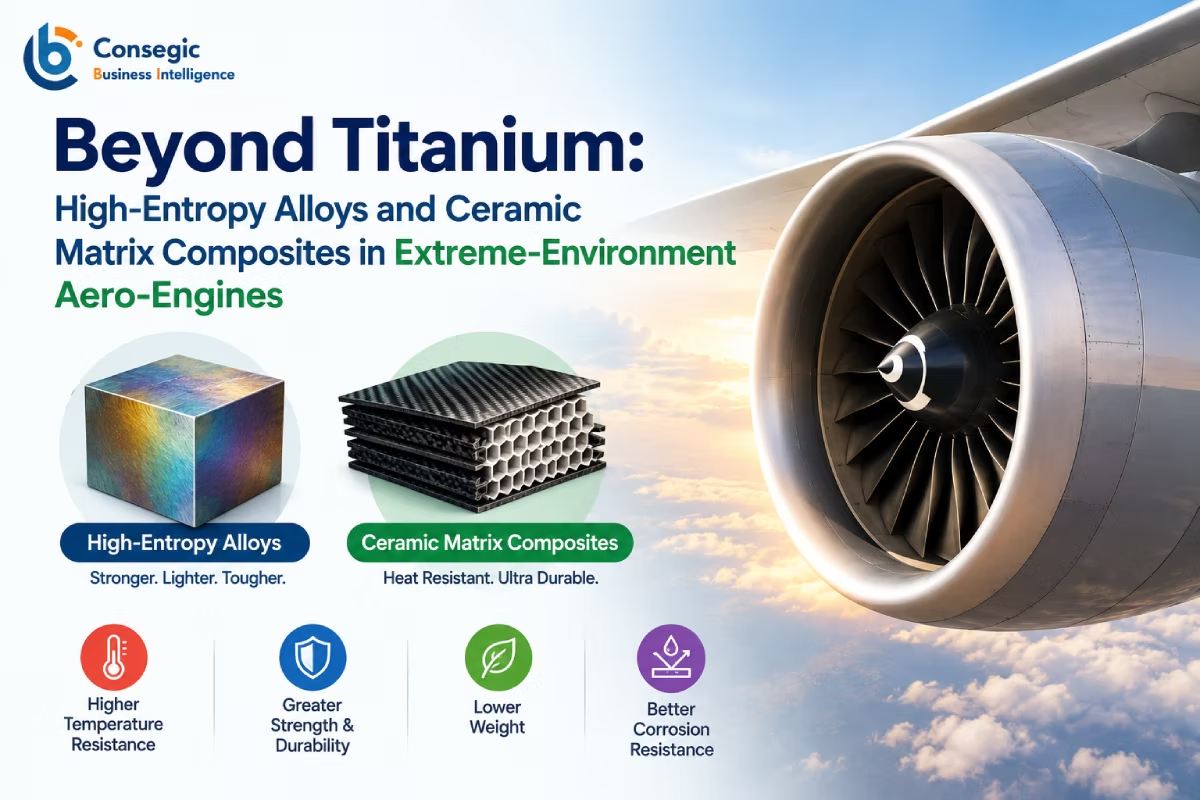
These conditions force engineers to develop new materials that will be able to provide high-temperature properties. One such type of material is high-entropy alloys (HEA), another one – ceramic matrix composites (CMC). Unlike the usual improvement of alloys' capabilities, this approach introduces completely different ways of solving the problem of creating materials with high-temperature properties. HEAs consist of several principal elements and have complex structures that provide high strength, wear resistance, and thermal stability. Ceramic matrix composites are the combination of ceramic fibers and matrices that provide temperature resistance along with low weight.
Thus, together these two types of materials can be used in the future to design aero-engines that can withstand higher temperatures and pressures.
High-Entropy Alloys: Engineering Strength for Extreme Temperatures
Currently, HEAs represent an exciting development path for aerospace engineering materials which have problems meeting the severe requirements in the field. While classical alloys are made from one major element, HEAs consist of many major elements in comparable amounts. This composition allows to obtain unique microstructure, as well as high strength, hardness, corrosion and heat resistance.
In particular, the mentioned features are important in creating the elements of the aero-engine which will be subjected to high levels of load both thermal and mechanical. The specific composition of the alloy will enable researchers to create certain combination of strength, oxidation resistance and creep performance for high temperature environments, especially those related to turbines.
Still, there are some problems which HEAs face. They cannot be considered a replacement of classic materials since their long-term properties, cost, oxidation resistance, welding properties and compatibility with current production technologies still need to be studied. Moreover, consistent material quality is very important since the products in aerospace engineering should be highly reliable. Future studies in this direction may reveal in which areas HEAs are more beneficial for the construction of the aero-engine.
Ceramic Matrix Composites: Lightweight Materials for Hotter Engines
Ceramic Matrix Composites have been receiving much attention since they are capable of withstanding high temperatures which surpass those of many metallic materials. Moreover, there is a considerable weight saving in using CMCs. CMCs consist of ceramic fibers and a ceramic matrix, forming a material that has high-temperature capability and lightweight properties. This makes them particularly important for the design of new aero-engines.
In the case of turbines, reduction in the amount of cooling can be just as important as high temperature capability. Metallic materials need substantial amounts of cooling air to prevent overheating, while CMCs can perform with lower cooling requirements. This means that there will be a chance to increase the efficiency of the engine by letting more air flow into the combustion chamber than for the cooling of its components.
CMCs pose several challenges in their production. Forming complicated shapes, surface protection against oxidation, joining and quality control all of this is difficult and expensive to implement. Besides, impact and thermal cycling capabilities must be thoroughly evaluated.
HEAs vs. CMCs: Comparing Performance in Extreme Environments
HEAs and CMCs represent different solutions to problems in extreme environment aerospace. The former are metals, which gives them a number of material properties advantages, including toughening, ductility, and manufacturing capacity, that ceramics lack. Moreover, HEAs' compositions can be designed to ensure high strength and thermal stability necessary for extreme environments of high mechanical loading and temperature.
By contrast, CMCs are best for situations when weight minimization and extremely high temperatures are top priorities. In particular, CMCs' light weight is one more factor in engine weight minimization, and thermal properties can provide an incentive for redesigning of cooling approaches. But, in general, ceramics require special attention to fracture toughness, bonding issues, impact resistance, and environmental effects.
In conclusion, the selection of appropriate material for a certain engine element is very dependent on its location and conditions of operation. While HEAs can be useful where toughness and metallic processing are important criteria, CMCs may give additional benefits in extremely hot engine parts. Instead of regarding HEAs and CMCs as rivals, it is possible to combine them in new engine designs together with superalloys, coatings, and other advanced materials.
The Future of Aero-Engine Materials: From Advanced Alloys to Hybrid Systems
The materials of tomorrow's engines won't be based on one supermaterial that would take the place of all the conventional materials currently being used. The next generation of engines is likely to feature various advanced materials depending on the thermal, mechanical and environmental conditions in which the respective parts operate. HEAs would bring additional strength and heat resistance for certain metallic parts of the engine, while CMCs would be able to facilitate light-weight structures in the hottest areas.
This multi-material solution may also involve advanced coatings, environmental barrier coating, thermal protection systems and advanced manufacturing techniques. Additive manufacturing may make a further contribution to design freedom through enabling complex geometries and material structures hard to fabricate using traditional production techniques. However, lifecycle costs, inspection needs, reparability and certification must be considered prior to implementation of these innovations.
A need to make aircraft engines work at higher temperatures is crucial in terms of increasing their efficiency and decreasing emissions. HEAs and CMCs present two different ways to solve this problem. The development of these materials can lead to the creation of propulsion systems that are going to be lighter, more thermally efficient and stronger than current titanium-based solutions.
Conclusion
The development of materials for aero engines becomes vital in order to achieve high operational temperatures, high efficiency and low weights. Although titanium is highly useful in the aerospace industry, the development of high-entropy alloys and ceramic matrix composites presents unique capabilities that may become crucial when the use of traditional materials faces significant challenges. High-entropy alloys can contribute with strength, toughness and high stability at temperature. On the other hand, ceramic matrix composites can demonstrate outstanding resistance to temperature and lightweight characteristics. It should be noted that these technologies are not aimed at the replacement of superalloys, coatings and other advanced materials, but rather can supplement them.