Introduction: The Rise of AI-Powered Consumer Understanding
Customer discovery, evaluation, and purchase process is becoming much faster thanks to the tremendous amount of behavioral data generated by digital platforms. Every action, from searching to buying something, leaving a product review, and interacting with the content can provide businesses with insights about customer preferences that change. However, traditional business analytics usually works with the actions performed by customers and not their potential needs and desires. Thanks to generative AI, companies can now interpret complicated patterns of customer behavior and make predictions based on them.
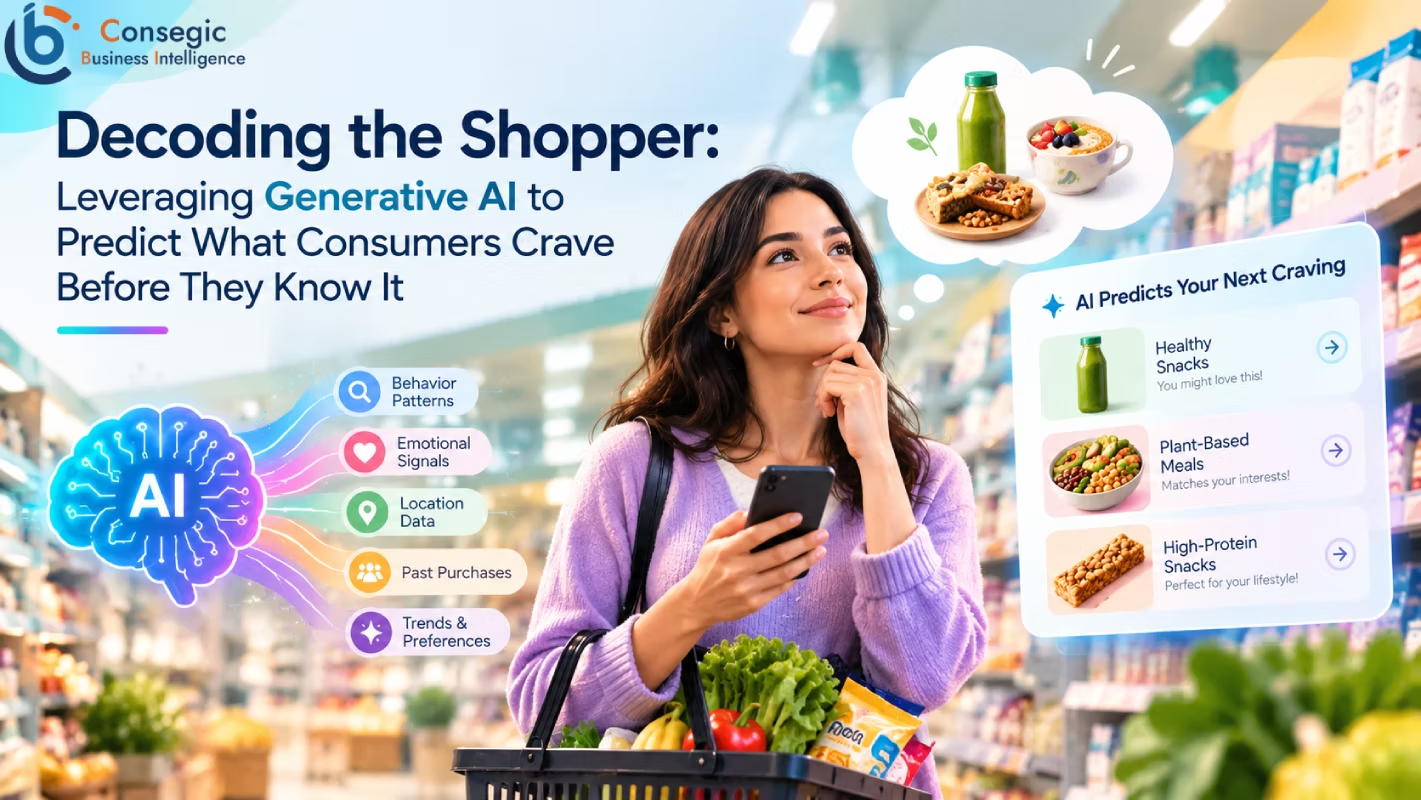
AI can be used to analyze various types of data, such as browsing activity, transaction history, social media engagement, customer reviews, and market trends. This will give businesses a chance to get a better understanding of the individual customer and his or her segment. Thus, businesses can abandon the practice of demographic targeting and switch to a more advanced type of marketing and sales.
The idea to predict customer desires even before they started searching for them is an excellent opportunity for modern business. Instead of reacting to demands, businesses can predict preferences and create relevant recommendation systems, campaigns, and experiences.
How Generative AI Decodes Shopper Behaviour and Preferences
Knowing the consumers goes beyond defining their past purchases. External factors that are always changing such as emotions, trends, budget, seasonal changes or personal preference could influence the buying decisions of people. Generative AI technology has the ability to analyze huge amounts of structured and unstructured data to discover interconnections that might be hard to spot through traditional analytics.
By applying generative AI, retailers will be able to create detailed behavioral profiles without the need to define prearranged customer segments. For instance, generative AI can take into account past purchases of the consumer, his search queries, reviews, website activity, reactions to promotional materials, and other elements. Thus, the retailer may find out that the customer who buys fitness clothes more frequently is looking for accessories for running. Accordingly, the company will be able to offer him some recommendations concerning running shoes, water products, and fitness equipment.
In addition, the generative AI system may comprehend natural-language comments of the customer. Reviews, chats, survey results, and other texts can show particular preferences and needs of the customer.
Thus, it will allow businesses to learn not just the products purchased by consumers, but the reasons for their purchases.
Predicting Consumer Needs Before They Become Visible
One of the critical uses of generative AI in the retail industry is the possibility of predicting customer demands before they are even realized by the consumers themselves. Instead of reacting to consumers who have been browsing for a certain product, the retailers can be analyzing the signals and trends to predict what might draw the interest of consumers in the coming period.
For example, an online retailer may see increasing searches related to travel destinations, luggage and outdoors wear among certain group of consumers. The generative AI can combine these signals and find out that there is an emerging demand from these consumers. Retailers can offer some suggestions and useful information to these consumers before they start browsing for the products.
Another way through which AI can find out about the emerging consumer behaviors is by analyzing social conversations, product reviews, search trends and buying behavior.
But prediction is not always a certainty. Consumers might act unpredictably based on the state of the economy, culture, their own situation, or some new product. This means that predictions made by AI systems should be considered as guides for decisions.
Personalized Shopping Experiences Through Generative AI
The role of personalization in digital commerce has become significant; however, it is not limited to product recommendations. Instead of displaying the same messages and list of items, the retailer will use the technology to personalize the experience taking into account the consumer's interest, history, preference, and even real-time interaction.
For instance, a fashion retailer could suggest different items according to the consumer's preference, previous purchases, season, and browsing history. With the help of the technology, businesses could even personalize the description of the item, its promotion, shopping guide, or even virtual assistance depending on the needs of particular customers.
Consumers would get a chance to make product discovery easier with the help of natural language in interaction with the shopping assistants. The customer might tell the system about the event, budget, style, or requirement, and it would give the corresponding suggestion without having the consumer browse through a vast number of products.
However, it is essential to pay special attention to how the process is implemented to make sure the consumers are comfortable. In other words, there should be proper transparency about the collection and use of the data, appropriate privacy safeguarding measures, and avoidance of intrusive experiences.
The Future of Predictive Retail: Opportunities, Challenges, and Ethics
The future of retail may rely more and more on the capability to interpret consumer intent before it manifests itself in the form of purchase decisions. The potential of generative AI allows for companies to assess complicated behavioral patterns, to discern trends of emerging preferences, and offer customized solutions. In such a way, this technology might be useful to retailers in making better inventory planning, developing more effective marketing strategies and products, enhancing customer service, etc.
At the same time, there are several challenges in connection with the introduction of predictive retail. First of all, the accuracy of prediction relies largely on the quality of the data being used in AI. If the data are inaccurate or biased in any way, the result of the prediction may also be wrong or even discriminatory.
The issue of privacy is another problem that has to be considered because of the analysis of detailed behavioral patterns by the business.
Conclusion
Generative AI is changing the retail industry by allowing companies to learn about consumer behavior, their upcoming requirements and offering better personalized retailing experience. By studying consumer patterns, searches, feedback, and other signs of behavior, AI allows making valuable conclusions about how to make better recommendations, marketing campaigns and engage customers. At the same time, predictive retail is associated with such problems as quality of data, concerns about privacy and possible biases. Therefore, it is essential for businesses to use generative AI responsibly and ensure that they keep consumers' trust and allow people to have control over their personal data.