Introduction
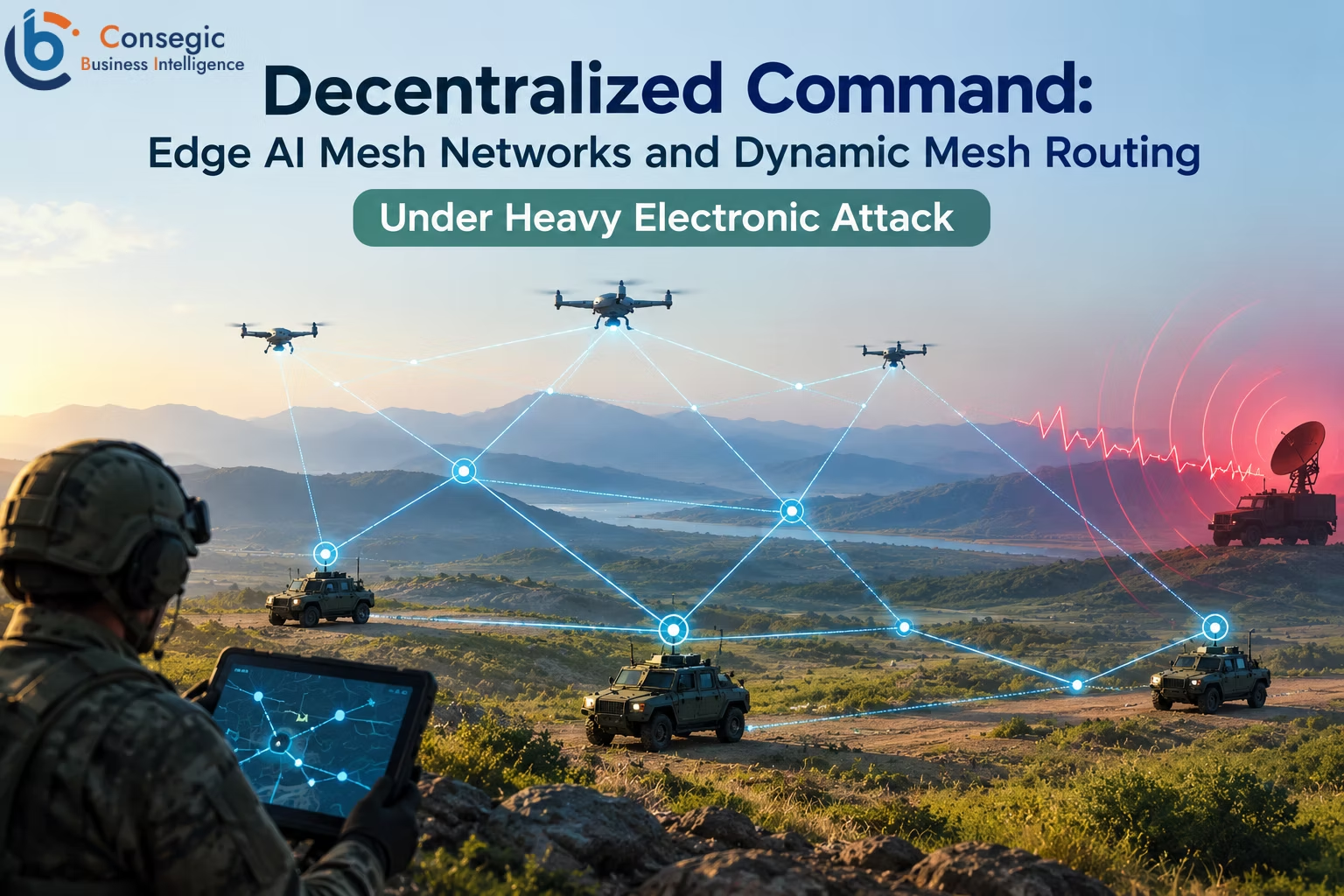
Modern military command has long depended on a tidy assumption: information flows up to a headquarters, decisions flow down, and the radio links in between are reliable enough to carry both. Contested electromagnetic environments break that assumption. Recent conflicts, especially in Ukraine, have shown that jamming, spoofing, and signal geolocation can turn a unit’s most important link into its most dangerous liability. A transmitter that can be heard can be found, and a link that can be jammed will be. The response taking shape across defense research is a shift from centralized command toward decentralized command. In this model, intelligence is pushed to the edge, and communications are carried by self-organizing mesh networks that route around damage rather than depend on any single node or path.
From Hierarchy to Mesh
A traditional tactical network resembles a tree. Units connect to a relay, relays connect to a command post, and the command post connects to the wider force. The design is efficient, but it has chokepoints. Destroy or jam the relay and everything beneath it goes silent.
A mesh network has no privileged center. Each node, whether a soldier’s radio, a ground vehicle, a drone, or a sensor, can send, receive, and forward traffic for its neighbors. If one link fails, packets find another path. Redundancy is built into the topology, so there is no single point of failure to attack. This also matches the military doctrine of “mission command,” in which subordinates are given intent rather than detailed orders, so they can act when communications are degraded.
Why Edge AI Matters
A mesh solves the transport problem, but it cannot fix the bandwidth problem. Under heavy electronic attack, usable throughput may drop from megabits to kilobits, or to nothing for stretches of time. Streaming raw video or sensor data back to a central processing site becomes unrealistic.
Edge AI addresses this by moving computation to where the data is generated. Small, efficient models running on low-power hardware can do the following locally:
- Perception: detecting and classifying objects in imagery or radio-frequency signatures on the device, so only a compact result (“vehicle, type X, grid Y”) needs to be transmitted instead of the raw feed.
- Compression and prioritization: deciding which information is worth the scarce bandwidth, so that a threat report goes out ahead of routine telemetry.
- Autonomy during silence: allowing a platform to continue a mission, hold formation, or return to a rally point when contact with operators is lost.
- Local fusion: letting neighboring nodes share compact summaries and build a common picture without a central server.
The result is a network that degrades gracefully. Instead of a binary state of connected or blind, each node keeps functioning at a level proportional to the information it has.
Dynamic Mesh Routing in a Hostile Spectrum
The harder problem is routing. Classic protocols were designed for friendly networks where links fail by accident. In a contested environment, an adversary is deliberately degrading links, and the topology changes continuously as units move.
Several ideas define the current approach to dynamic routing:
Link-quality awareness. Instead of treating a link as simply up or down, nodes continuously measure signal quality, packet loss, latency, and interference, and weight their routing choices accordingly. A link under partial jamming can be avoided before it fails completely.
Multipath and diversity. Sending traffic over several paths, across several frequencies or media, reduces the chance that a single jammer defeats a transmission. Frequency hopping, spread spectrum, directional antennas, and even optical or acoustic links can all serve as alternate channels.
Delay-tolerant networking. When no end-to-end path exists, nodes can store messages and forward them opportunistically as links reappear, a “store, carry, and forward” approach. Communication becomes slower but does not stop.
Emission control. In a network where being heard means being targeted, routing also has to consider signature management. Algorithms can favor low-power, short-hop, or directional transmissions and minimize how often any node emits, trading speed for survivability.
Learned routing policies. Reinforcement learning and related techniques are being explored to let nodes adapt routing behavior to jamming patterns they have not seen before, rather than relying only on fixed rules. The attraction is adaptation at machine speed, faster than a human operator could retune a network. The limitation is that learned policies must be small enough to run at the edge and robust enough not to fail unpredictably.
Risks and Limits
Decentralization is not a free improvement, and several challenges remain.
Security of the mesh itself. Every node is a potential entry point. A captured or compromised device can inject false routing information, attempt to attract traffic, or leak the network’s structure. Strong authentication, rapid revocation of lost devices, and routing protocols resistant to manipulation are essential.
AI under adversarial pressure. Edge models can be fooled by deceptive inputs, camouflage, decoys, or poisoned data. A model that performs well in testing may behave poorly against an adversary who studies it. Operators need ways to understand and verify what the system is doing.
Coordination without a center. Decentralized units can drift into inconsistent pictures of the situation, duplicate effort, or work at cross purposes. Maintaining shared understanding with intermittent links is an unsolved design tension, not a solved one.
Resource constraints. Edge devices are limited in power, processing, and heat, and a mesh adds overhead because every node spends energy forwarding traffic for others.
Accountability and control. Giving systems more autonomy when communications are cut raises legal and ethical questions. Meaningful human control, and clear rules about what a node may do alone, must be designed in from the start rather than added afterward.
Conclusion
The central lesson of electronic warfare is that connectivity cannot be assumed. Forces that depend on a continuous link to a distant command center are fragile in exactly the conditions where they most need to function. Edge AI mesh networks offer a different philosophy: distribute intelligence so that each node can act sensibly on its own, and distribute communications so that no single failure silences the whole. Dynamic routing is what makes that mesh adaptive, steering information around jamming and keeping emissions low in a spectrum where every signal is a potential target.