The Future of Electric Vehicles: Trends, Challenges & Opportunities
The internal combustion engine dominated the 20th century so completely that most people never imagined anything could replace it. A century of roads, fuel stations, regulations, habits and entire economies were built around the sound of a petrol engine turning over. And yet, here we are- at the inflection point of perhaps the most significant shift in personal transportation since Henry Ford put the Model T on the assembly line. Electric vehicles (EVs) are no longer a curiosity for early adopters or a symbol of environmental virtue. They are becoming the mainstream.
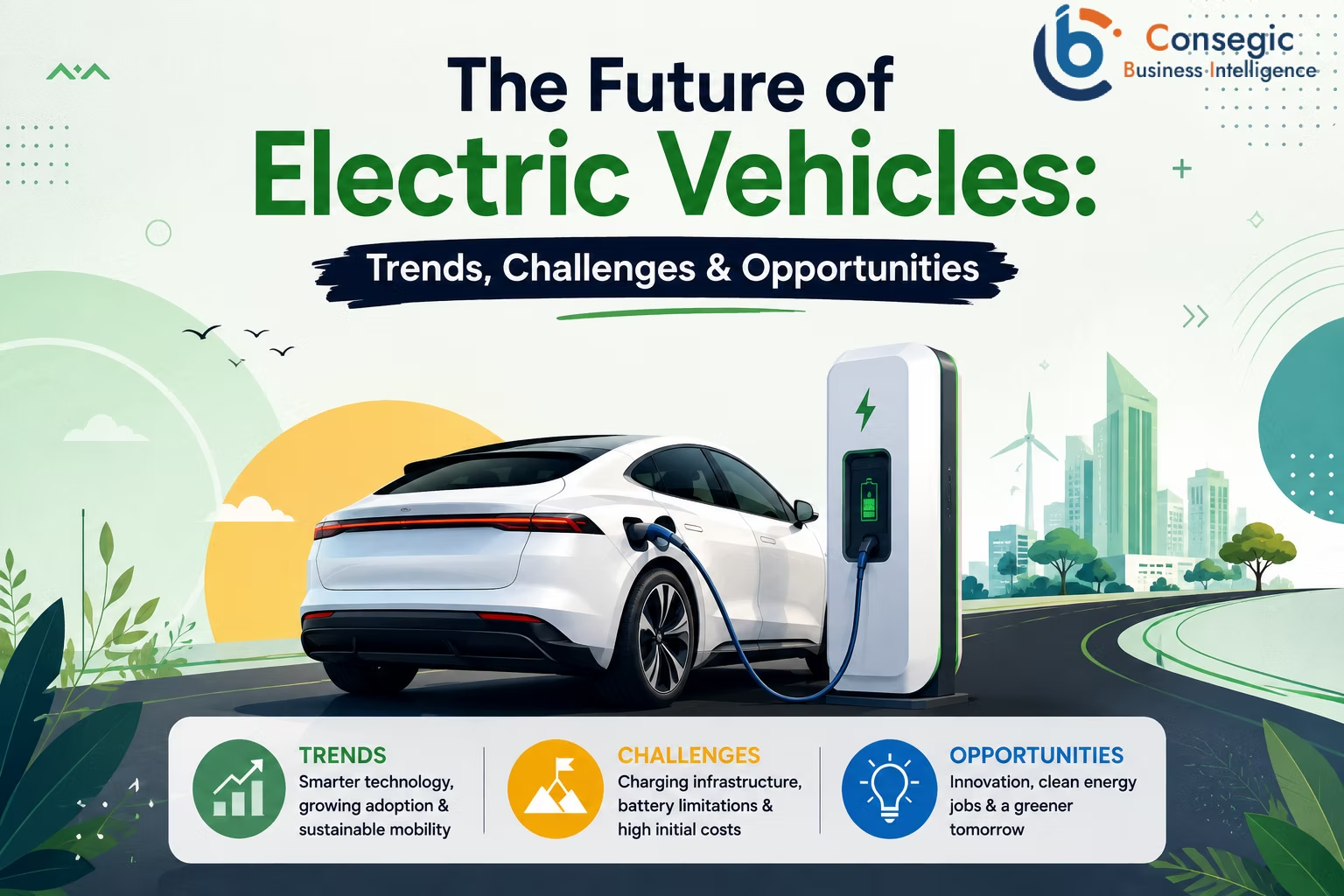
But the road ahead is not without its bumps. But underneath the idea of a clean-emissions commute and the quiet burst from the throttle is a tangled web of technological roadblocks, lack of infrastructure, global politics and the market which will decide which countries, corporations and ultimately consumers get rewarded in this new revolution. Here is a clear-eyed look at where electric vehicles are headed- and what stands between today's moment and tomorrow's reality.
The Trends Reshaping the Industry:
Battery Technology Is Advancing Faster Than Expected
The battery is the heart of an EV and its performance- energy density, charge speed, lifespan and cost- dictates almost everything else. For years, lithium-ion chemistry dominated, but the next generation of batteries is already arriving.
With liquid electrolyte replaced by a solid component, solid-state batteries offer a huge jump in energy density, charging speed and safety. The race to scale them up to commercial production level is between Toyota, Samsung SDI and QuantumScape with several manufacturers targeting the production car market by late 2020s.
Simultaneously, the cheapest, longest and cobalt-free Li-ion phosphate batteries-often dubbed LFP-have seen tremendous sales growth mainly due to their widespread adoption in the mass market. China based manufacturers like BYD and CATL, leading this LFP push, now dominate its supply chain and deliver these cells to the whole automotive industry.
Charging Infrastructure Is Finally Catching Up
Range anxiety- the fear of running out of charge before reaching a station- has been the most persistent psychological barrier to EV adoption. That narrative is beginning to change. Fast-charging networks are expanding rapidly across Europe, North America and parts of Asia. Tesla's Supercharger network, long the gold standard, has opened to non-Tesla vehicles, adding millions of potential users overnight. In India, the government's push under the FAME scheme and the emergence of operators like Tata Power and Ather Grid are steadily dotting the national highway network with charging points.
Ultra-fast chargers capable of adding 200 kilometers of range in under 15 minutes are becoming commercially viable. Vehicle-to-grid (V2G) technology- which allows EVs to feed stored energy back into the electricity grid during peak demand- is transitioning from pilot projects to real-world deployment in countries like the UK and Japan.
Software Is the New Engine
Today, most EVs are simply software platforms on wheels. The beauty is that we can improve the range, add features and fix performance glitches through Over-the-Air (OTA) updates that don't even require a visit to the workshop. Manufacturers that grasp this concept are developing recurring revenue models based on software subscriptions, charging users for access to "better autopilot", heated seat options, or performance upgrades.
This "software" mentality is now facilitating deeper integration with homes, smart energy networks and urban environments. Your car will soon be intelligent enough to understand when electricity is the cheapest, only then recharge itself and even supply your home during a power outage.
The Challenges That Cannot Be Ignored:
The Raw Material Problem
EVs require significant quantities of lithium, cobalt, nickel and manganese. The global supply of these materials is concentrated in a handful of countries- lithium in the "Lithium Triangle" of South America, cobalt largely in the Democratic Republic of Congo and rare earth elements heavily in China. This consolidation creates both supply chain vulnerabilities, issues of ethical sourcing and geopolitical power that governments and auto makers are only just beginning to seriously address.
The urgency of battery recycling and second-life applications for batteries is on the rise, as even a degraded battery is still useful enough to continue for energy storage until it is finally recycled. Building robust closed-loop battery economies will be essential to the long-term sustainability of the EV transition.
The Grid Must Keep Pace
An EV revolution that simply shifts emissions from tailpipes to coal-fired power plants is not a clean revolution. The promise of electric mobility depends entirely on the cleanliness of the electricity that powers it. In countries where the grid still runs heavily on fossil fuels, the carbon calculus for EVs is complicated. Massive investment in renewable energy generation, grid modernization and storage capacity must parallel- not trail- the growth of the EV fleet.
Affordability Remains a Barrier
Despite falling battery costs, EVs remain more expensive upfront than comparable petrol vehicles in most markets. In price-sensitive markets like India, Southeast Asia and sub-Saharan Africa, this gap is a real obstacle. Two- and three-wheelers, not passenger cars, account for the majority of vehicles on the road in these regions and the electrification of that segment, while accelerating, faces its own challenges around charging infrastructure, battery swapping logistics and financing access.
Government subsidies and purchase incentives have been critical in driving adoption, but these policies are inconsistent across markets and politically vulnerable to budget pressures and changing administrations.
The Opportunities on the Horizon:
Emerging Markets as the Next Frontier
Where in the West they are still debating charging standards at the micro-level, huge opportunities are arising in the developing countries. India's EV market is increasing at a CAGR of over 40%, which is mainly driven by the two wheelers and commercial vehicles. Electric buses are transforming urban public transit in cities from Shenzhen to Bengaluru. For nations that import petroleum, the economic case for domestic electricity-powered transport is compelling beyond the environmental argument.
Local manufacturers in these markets- Ola Electric, Ather Energy, Tata Motors in India; Ampere, Hero Electric and others- are not simply copying Western models. They are designing for local conditions: rough roads, high heat, mixed charging environments and cost ceilings that premium Western brands cannot meet.
New Business Models Are Emerging
The shift to EVs is not just a product change- it is a business model transformation. There is also significant movement in battery-as-a-service where customers buy the vehicle but lease the battery and pay for usage based on mileage. Fleet electrification has picked up speed in delivery, ride hailing and logistics because of low total cost of ownership over the lifespan of the vehicles. Changing network operators, energy aggregators and software platform providers are all building new revenue streams that did not exist five years ago.
The Autonomy Convergence
Electric powertrains and autonomous driving technology are natural partners. The same software architecture, sensor fusion and connectivity that makes an EV intelligent also underpins self-driving capability. As autonomy matures- particularly in geofenced urban environments and highway-assist modes- EVs will be the primary platform on which it is deployed. This convergence opens the door to robotaxis, shared autonomous fleet, and fundamentally different models of urban mobility.
The Road Ahead
The question is no longer whether the future is electric. That debate has been settled- by falling costs, by government mandates, by consumer preference and by the simple physics of an electric motor being vastly more efficient than a combustion engine. The questions that remain are how fast, for whom and on whose terms.
The nations and companies that build the batteries, own the software platforms, control the charging networks and secure the critical minerals will define the geopolitics of 21st-century transportation. The transition will not be neat or uniform- it will be messy, contested and full of false starts alongside genuine breakthroughs.
But the direction is clear. The age of the electric vehicle is not coming. It is already here- accelerating quietly, mile by mile, charge by charge, toward a future that the petrol engine simply cannot follow.