How Technology is Revolutionizing Car Maintenance
There was a time when taking your car to a mechanic felt like stepping into the unknown. You'd hand over your keys; wait for a diagnosis you barely understood and hope the bill wouldn't leave you breathless. That era is rapidly fading.
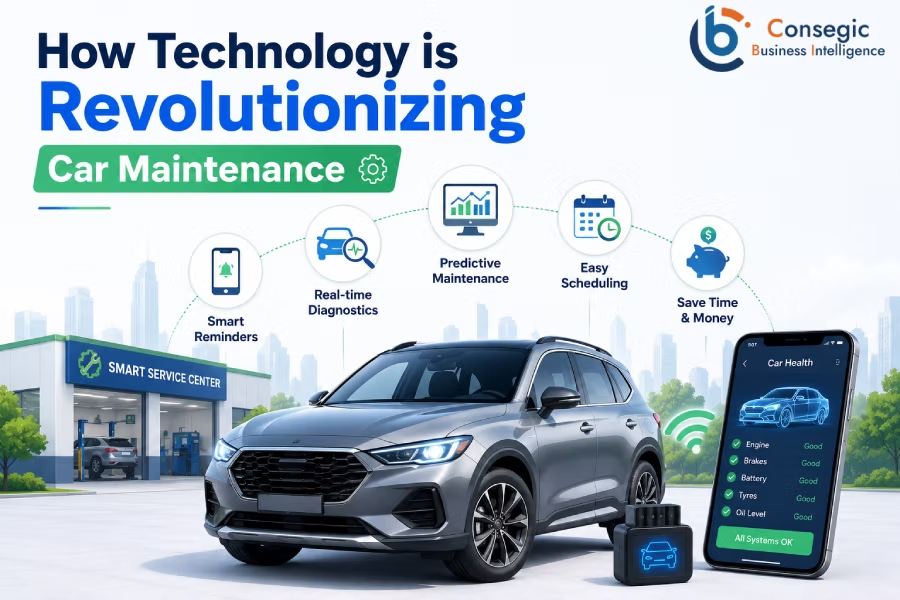
Today there is a synergy of the technologies, including AI and Internet of Things and AR, predictive analytics, that are all reshaping the way our vehicles are maintained, diagnosed and repaired. Car maintenance is no longer reactive. It's becoming intelligent, proactive and, for the first time in history, something the average driver can genuinely understand.
The OBD-II Revolution: Your Car Learns to Talk
It started quietly in the 1990s when regulators mandated that every car sold in the United States include an On-Board Diagnostics (OBD-II) port. This small socket, typically tucked beneath the dashboard, became the foundation for everything that followed. Plug in a scanner and your car will tell you exactly what's wrong- no guesswork, no mystery.
Today, compact Bluetooth dongles costing as little as ₹1,500 can plug into that port and stream real-time data directly to your smartphone. Apps like Torque Pro or Car Scanner decode fault codes, monitor engine temperature, track fuel efficiency and even flag issues before the check engine light blinks on. What once required a dealership visit and a diagnostic fee can now be done from your own driveway in under two minutes.
Predictive Maintenance: Fixing Problems Before They Exist
Perhaps the most transformative shift in modern car care is the move from scheduled maintenance to predictive maintenance. Traditional service intervals- change the oil every 5,000 kilometres, replace the filter every year- are blunt instruments. They don't account for how a car is actually being driven.
Modern vehicles equipped with telematics systems continuously monitor hundreds of data points: engine load, brake pad thickness, battery health, transmission temperature and more. Machine learning algorithms analyze this data in real time and generate highly accurate predictions about when a component is likely to fail. Tesla, for instance, has been doing this for years- notifying owners of battery anomalies or suspension wear before the driver has even noticed a change in ride quality.
Fleet operators have embraced this technology enthusiastically. Companies offering predictive maintenance for their logistics customers claim to have reduced unscheduled breakdowns by as much as 30%, lowering down time and repair expenses. Now, as this technology decreases in price, the same ability becomes available to owners of individual vehicles through networked car systems and manufacturer apps.
AI-Powered Diagnostics: The Mechanic in Your Pocket
Artificial intelligence is now embedded in diagnostic tools used both by professional technicians and curious car owners. Modern AI diagnostic platforms don't just read error codes- they interpret them in context. They cross-reference a fault code with the car's mileage, driving history, climate conditions and known issues for that make and model, then suggest the most probable root cause and the most cost-effective repair path.
For mechanics, AI tools like those offered by Bosch or Snap-on have dramatically reduced diagnostic time. A job that once took an experienced technician 90 minutes of careful inspection can now be flagged and narrowed down in minutes, freeing up workshop time and reducing labour costs passed on to the customer.
For drivers, AI-powered chatbots and apps can walk a non-technical person through basic troubleshooting- interpreting a rattling sound, explaining what a dashboard warning light actually means, or advising whether it's safe to continue driving or time to pull over immediately.
Augmented Reality in the Workshop
Augmented reality (AR) is beginning to make its mark on the repair bay. Technicians at some forward-thinking workshops now wear AR headsets that overlay digital instructions directly onto the physical engine they're working on. Rather than flipping through a paper manual or pausing to consult a laptop, a mechanic can see step-by-step guidance projected in real time over the actual component in front of them.
Car manufacturers are exploring AR for customer self-service as well. Imagine pointing your phone at your engine bay and seeing animated labels appear over each component, with tap-to-expand information about maintenance intervals and current health status. Several concept applications from BMW and Hyundai have already demonstrated this capability and commercial rollout is closer than most people realize.
Electric Vehicles and the New Maintenance Landscape
Electric vehicles (EVs) are also reshaping what car maintenance even means. EVs have dramatically fewer moving parts than combustion engines- no oil changes, no timing belts, no exhaust systems, no spark plugs. The maintenance agenda shrinks considerably. What remains- battery management, software updates, brake fluid and tyre wear- is increasingly handled over-the-air or monitored automatically.
Software updates delivered wirelessly can fix bugs, improve performance and even unlock new features while the car sits in your garage overnight. Tesla, Rivian and newer models from traditional manufacturers all support OTA updates, effectively turning the car into a device that gets smarter and better maintained over time without a single workshop visit.
The Connected Ecosystem: Everyone Benefits
The implications of this technological leap spread far beyond just the owner of the vehicle. Insurance companies are coming up with usage-based insurance policies which provide the owners of the well maintained, accident free cars with affordable rates. Resale Web sites are factoring in Vehicle health data in to their prices to instill buyers with greater confidence and sellers with increased transparency. Road-side assistance has gotten intelligent too; connected cars notify rescue operators or tow trucks when a crucial defect is found, often before the driver is aware of anything amiss.
Looking Ahead
We are still in the early chapters of this transformation. As 5G connectivity expands, as sensors become cheaper and more capable and as AI models grow more sophisticated, the car maintenance experience will continue to evolve. It envisions a future, "within reach" of "zero unplanned breakdowns," where your vehicle is proactive in its health management, makes its own service appointments and is the transparent, trustworthy source of information you rely on.
The garage isn't disappearing. But the uncertainty, the anxiety and the information gap that once defined it? Those are already becoming problems of the past.