The Growing Need for Precision in Pharmaceutical Dosing
In pharmaceutics, precise dosing is highly required since slight changes in the volume of active ingredients may significantly affect the efficiency of treatment. There is a possibility that traditional packaging, such as multidose bottles and large packaging units, will create issues for patients and professionals that will need to measure specific amounts of a drug. Micro packaging technology could serve as a solution by creating smaller packages in order to match one dose
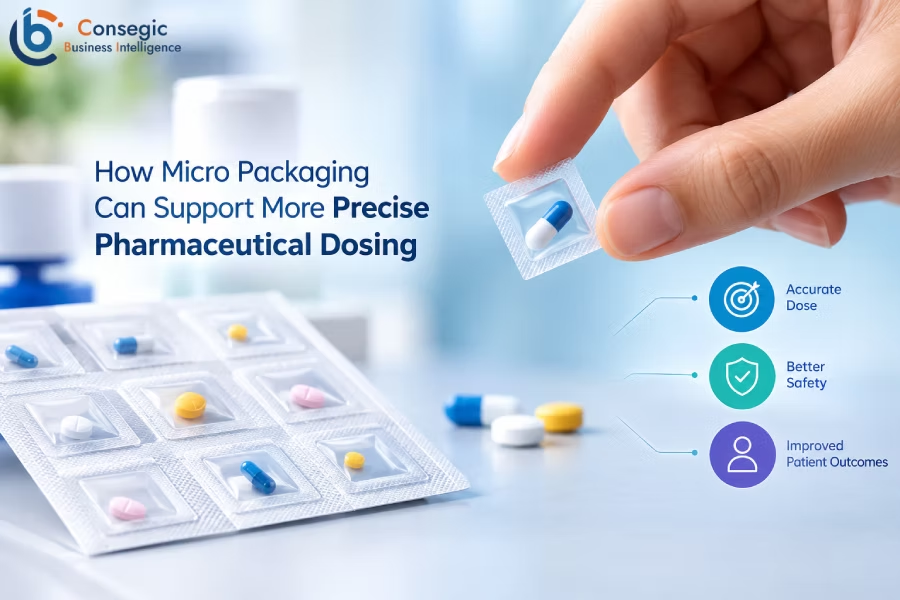
Micro packaging is defined as small-sized packaging technologies that allow for the protection of pharmaceutical products from moisture, air, light, contamination, and physical impacts. Based on the type of the formula, unit-dose pouches, sachets, cavities of blisters, ampoules, and other packages may be used.
This technique may prove to be useful for the medications that require dosing according to strict schedule or have a narrow range of efficiency. By providing the predetermined volume of medicine in one package, it becomes easier to avoid measuring. With the advancement of pharmaceuticals and increasing specialization of their therapies, packaging evolves from just a container to dosing support.
How Micro Packaging Enables Accurate and Controlled Drug Delivery
Another major strength of micro packaging is that it allows the distribution of pharmaceuticals in predetermined amounts. This method eliminates the need to manually calculate the correct dose by means of spoons, cups, droppers, or other tools; every package can be made in such a way that contains the required amount of formulation for one use.
During pharmaceutical manufacturing, automated technologies of filling and sealing of the packages can help regulate the quantity of formulations enclosed in every package. Highly accurate mechanisms will measure formulations following certain standards, and quality control will identify possible flaws and differences. Such methods can help provide uniformity within large batches of pharmaceutical products.
The physical and chemical characteristics of a drug can be taken into account during the process of designing micro packaging. Sometimes a certain drug requires packaging materials with specific barrier properties that protect it from moisture, oxidation, and other unfavorable factors. Stabilization of the product can indirectly contribute to precise dosing since it prevents the degradation of the drug and loss of its potency.
All in all, micro packaging can become a great tool in the context of pharmaceutical dosing in healthcare settings thanks to its labeling and packaging options.
Reducing Medication Errors Through Single-Dose and Unit-Dose Packaging
Medication errors may take place at various stages, namely, prescription, distribution, preparation, and administration of drugs. Even though packaging does not prevent all errors, unit-dose or single-dose forms can contribute to the prevention of mistakes related to the measurement or identification of medications. Micro packaging allows for reducing the number of manual calculations due to predetermined quantity of the medication.
Unit-dose packaging can be useful for the organization of the medication process in hospitals, pharmacies, and other long-term care settings as it makes possible to separate medications based on patients, schedules, and required amounts. The information on each pack will consist of the name of medicine, its dosage, batch number, expiration date, etc.
Furthermore, micro packaging can be useful in terms of medicines that are distributed in small amounts or designed specifically for certain age groups. Accurate portioning of drugs may facilitate administration in cases when there is little medication required.
Still, proper packaging is important. The labels must be legible and clear and the design of the package and the opening mechanism must not allow any confusion. Micro packaging can be an extra tool in the prevention of mistakes if it is dispensed and verified properly.
The Role of Smart Micro Packaging in Improving Dose Tracking and Compliance
Apart from physical portioning, there can be digital technologies implemented in micro packaging helping patients and healthcare professionals to control medication intake. In such smart packaging, there may be technologies such as QR-codes, NFC-tags, sensors, or connected labels providing information on the product and administration schedule.
Patients with complicated therapy plans will find it simpler to recognize if one dose was already taken thanks to individually packed doses. There are possible opportunities for digital technologies to integrate packaging with mobile apps or medication management software making possible reminders and record of medication adherence.
Healthcare professionals may have a better insight on medication use especially if this treatment requires frequent monitoring. Serialized and digitized packages can help pharmacies manage inventory and trace products more efficiently.
The combination of micro packaging and technology solutions may prove useful for treatment plans involving several types of medication, changing schedules, or special dosage demands. Yet, these systems must be built upon such principles as usability, data security, reliability, and cost-efficiency.
In connection with development of the concept of connected healthcare, intelligent micro packaging may thus become a tool facilitating dose recognition, adherence, traceability, and communication between patients and healthcare system.
Balancing Protection, Stability, and Precision in Pharmaceutical Micro Packaging
Dosage accuracy not only involves the amount initially filled in the package, but also ensuring the quality of the medicine up to its administration time. There are pharmaceutical goods that can have a certain sensitivity to moisture, oxygen, light, heat or contamination. As such, micro packaging requires both protection and maintenance of the dose during its entire shelf life.
A barrier material would be helpful when trying to protect the drug from being exposed to its environment. Depending on what medicine is contained inside, there will be certain materials used in order to limit the transfer of moisture, oxygen, or light into the package. The importance of the sealing aspect should not be overlooked either since any damaged package may cause instability in the product.
There should also be taken into account the compatibility between the drug formulation and the packaging material. Any chemical reaction or material migration may negatively impact the product quality. Similarly, any improper packaging dimensions will be unhelpful as well.
While all of the mentioned aspects need to be considered during the development of micro packaging, ease of use, handling, identification, and disposal of the package should not be overlooked either.
The Future of Micro Packaging in Personalized and Precision Medicine
There is a potential future opportunity that the increased attention to personalized medicine can provide to the field of micro packaging. Contemporary treatments become more and more personalized with the requirement of individualized medicine intake based on the individual patient’s characteristics, medical condition, and response. Thereby, the necessity arises for packaging that allows delivering the proper dose.
This type of packaging will enable the customization of the dosage because the medicine will be available in small or specialized doses. It may also become possible to manufacture or assemble the packaging according to the schedule of individual treatment as technological advancement in digital manufacturing and automated packaging is taking place.
The combination of the micro packaging with smart identification, connection and automation will allow receiving the right dose and medicine and giving more information to both the patient and health care providers.
At the same time, there is an issue of sustainability that remains relevant. With smaller packages, the amount of packaging materials increases per dose, so manufacturers should try to find recyclable and lighter packaging.
Conclusion
Micro packaging is becoming an increasingly useful strategy in increasing accuracy, safety, and efficacy in the pharmaceutical dose process. This is achieved by offering precise measurements that can aid in decreasing medication errors due to inaccurate dosage. The use of sophisticated barrier material can also help to prevent medicines from being affected by moisture, oxygen, light, and other contaminants, thus ensuring quality until the expiration date. Moreover, smart packaging solutions can also improve dose monitoring, adherence, traceability, and consumer engagement. With the advancement in personalized medicine, micro packaging is likely to offer a promising solution for customized dose needs. Nevertheless, it is important to balance precision with usability, cost-efficiency, environmental friendliness, and protection of pharmaceuticals.