How is Technology Reshaping the World in 2026?
In the year 2026, humans will see the emergence of a full-scale tech revolution. With artificial intelligence, quantum-ready computing capabilities and smart technologies having moved past experimental stages into becoming the core of the way people live, work and communicate, technological advancements have taken a central place in all aspects of life.
In addition to personal assistants powered by artificial intelligence and other advanced software, such innovations as intelligent systems capable of designing products and optimizing energy networks, diagnosing diseases and finding their solutions become a regular part of the human existence.
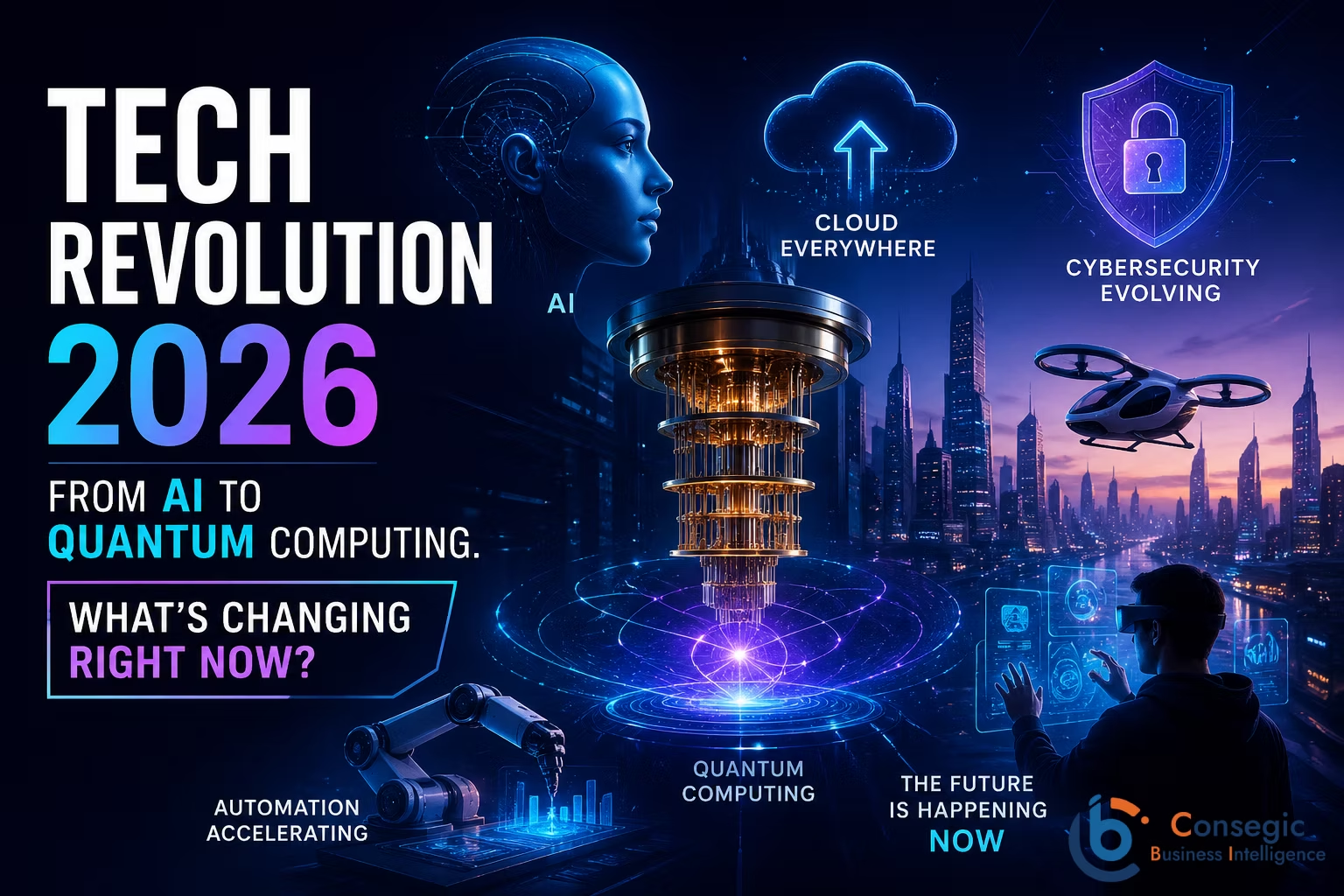
As for autonomous cars, smart cities and robots, they transform the manufacturing industry, logistics, healthcare and education in many ways. Tech revolution 2026 is the era when digital transformation turns from being an option to a necessity, forcing countries, companies and citizens to reconsider their approaches to employment, skill sets, privacy and security.
Agentic and Autonomous AI
Autonomous and agentic artificial intelligence refers to the new generation of AI models which changes conventional interactions with users by giving responses based on user queries. The autonomy and agency in AI models make them take actions independently and without having to receive any specific instructions from users.
A key characteristic of agentic AI models is their ability to reason in a step-by-step, process-oriented manner. When assigned a particular task, they can divide it into smaller, manageable steps. These steps may involve gathering and analysing information, generating written material, interacting with various software tools and coordinating multiple actions to complete the overall objective.
The working of autonomous AI agents has become increasingly sophisticated in 2026. The main advantage of these agents is the fact that they are capable of carrying out multi-step reasoning. In this context, this implies that they can perform complex processes with layers involved in a step-by-step manner. Such processes may involve anything from developing a marketing strategy to improving supply chain logistics.
Agentic and autonomous AI has been a huge leap forward in terms of the application of artificial intelligence. These technologies have made artificial intelligence more proactive in the workflow rather than just serving as an instrument. But as the technology advances further and develops new applications, it would be essential to strike a balance between innovation and accountability.
Next Gen AI Chips and Data Center Infrastructure
The next generation AI chips and infrastructures for the data center form the core of the technology revolution in 2026. The current technology is not based on traditional server racks but on the new kind of servers, which include AI-specialized chips, dense racks and more advanced infrastructure to manage high computing needs for AI applications.
The new AI chips have specific features. Apart from general-purpose GPUs used by most companies, many are now using customized chips or AI accelerators. Alongside, smaller and denser semiconductor nodes and high bandwidth memory enable better processing of AI data.
AI data centers look different from regular ones. These data centers are fitted with very dense racks, high-powered computing, efficient networking and cooling such as liquid cooling because AI processes involve high heat dissipation.
This transition is important since it increases efficiency, reduces cost, and helps to speed up the process of developing AI. It is also driving fast growth in the technology sector, making AI infrastructure one of the largest and fastest growing industries in 2026.
Quantum‑Classical Hybrid Systems
The integration of quantum processing units (QPUs) with classical computer systems remains one of the most promising directions of application of quantum computing in 2026.
In such systems, quantum and classical computer units collaborate, whereby classical computers process input data and execute tasks related to data analysis and system management, while quantum processing units conduct complicated calculations and computations. In essence, quantum and classical computer units operate separately and classic computers change the input data based on the results received after the quantum calculations.
Hybrid quantum-classical computing systems are now integrated with the infrastructure of large-scale supercomputers, which is usually done via cloud platforms. Such systems provide smooth interaction between quantum and classical computer systems and AI is now used to optimize the performance of QPUs.
Currently, hybrid quantum-classical computing systems are applied in industries including pharmaceuticals, finance, and logistics.
Sodium‑Ion Batteries and Advanced Energy Storage
The other technology set to play a significant role in the 2026 transition to green technology will be that of sodium-ion batteries and advanced energy storage. Sodium-ion batteries represent an economical, safe and more accessible substitute for batteries that are currently based on lithium.
Just like lithium-ion batteries, sodium-ion batteries store electrical energy through ions moving between electrodes. However, they replace lithium with sodium, making them much more sustainable. In addition, modern versions offer good energy density and may be used both in urban electric vehicles as well as commercially.
The main advantage of these batteries lies in cost efficiency. The abundance of sodium makes these batteries significantly cheaper to produce. Moreover, they tend to be much safer as they have no risks of catching fire. Besides, they can be effectively used at extreme temperatures.
The reason why this is important in 2026 is that it will allow us to have more sustainable use of energy, especially when we are using high-energy-consuming technologies such as AI data centers. In addition, it will make electric cars and renewable energy options cheaper and more available in developing countries.
Autonomous Mobility and Robotics
The concepts of autonomous mobility and robotics in 2026 imply vehicles and machines that are capable of moving, sensing things around themselves and making decisions without human intervention due to AI and edge computing.
The attention is shifting from electric vehicles to those equipped with autonomous driving technology that implies the combination of cameras, radar and LiDAR. The application of autonomous technology to buses, trucks and industrial machinery contributes to increased safety and reduction of human labour in heavy-duty activities.
Moreover, robotics is becoming more autonomous since autonomous mobile robots are actively used in warehouses, hospitals and manufacturing facilities, where they move independently and perform tasks, such as carrying loads or monitoring the facility's condition.
This development can be considered significant since it will increase operational efficiencies in the transport and logistics sectors, improve safety in hazardous environments and even result in the creation of new employment opportunities through AI operators and robot servicing.
The Impact of 2026 Tech Revolution
The technological revolution of 2026 leaves no doubt about the nature of innovations that they have become an inseparable part of an ecosystem, which includes agentic artificial intelligence, advanced computer system, quantum-classical computer, energy storage system and autonomous machines.
However, it is important to understand that with the development of innovative processes there arises a number of challenges, such as issues of responsible implementation, ethical problems and skill development.
To summarize, the technology revolution of 2026 brings about significant changes and serves as evidence of the necessity for digital transformation, which can be both a challenge and an opportunity in the future.