Introduction: The Role of Temporary Labor in Managing Demand Uncertainty
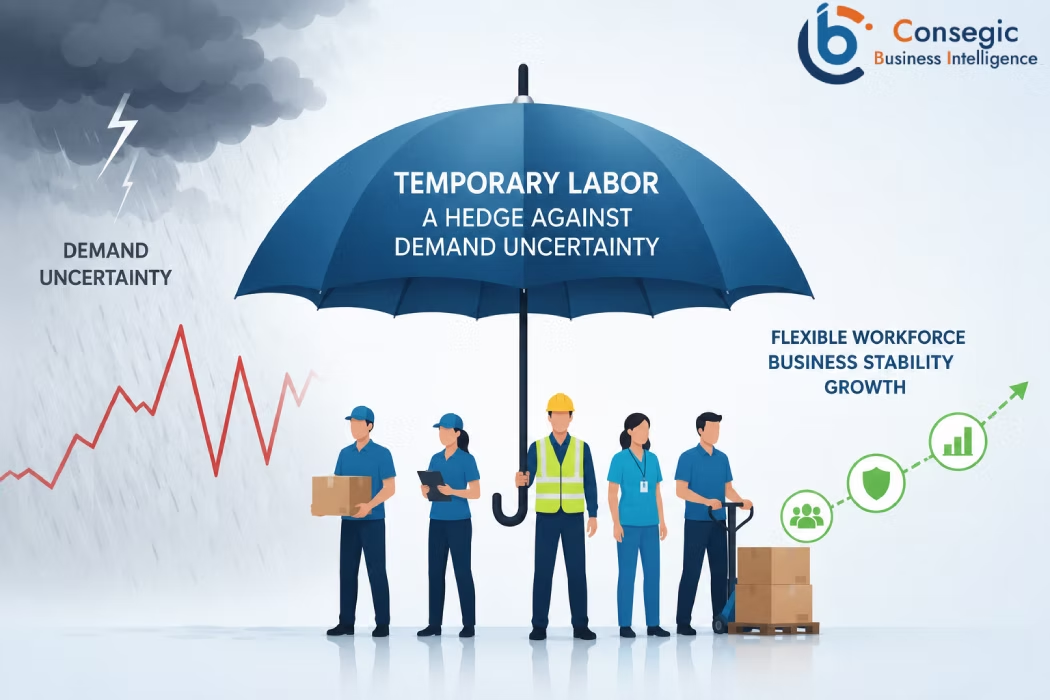
Demand fluctuation for various firms due to seasonality, economic environment, changes in customer tastes, marketing programs, and other market events is common across different sectors. Maintaining permanent staff that would be able to cope with the highest levels of demand would lead to higher expenses of operations when there is lower demand. Temporary labor is a useful instrument that allows firms to vary the number of their employees depending on the current situation. Firms can employ temporary, contract or seasonal workers when they need more staff and decrease the dependence on those employees when there is no demand. This approach enables companies to sustain productivity while not being committed to a bigger permanent workforce. In industries such as retail, logistics, manufacturing, hospitality, health care, and e-commerce, where the size of the workforce must be flexible enough to meet the changing nature of demand, temporary labor is especially important. This is due to the fact that these sectors require a labor force that is able to adapt to various levels of demand.
How Temporary Labor Provides Workforce Flexibility
Using temporary labor provides organizations with an opportunity to adjust workforce capacity in case it is required without making any permanent hiring decision. In case there is an increase in customer order or demand in production, the organization has an opportunity to get extra labor force to meet the organizational demands. On the other hand, organizations can reduce temporary labor in case there is less work to be done. Therefore, the organizations will not have excess labor capacity. This option is especially applicable for organizations that are working in markets where demand cannot be predicted with certainty. For instance, organizations like retailers may have increased labor capacity in holidays, while logistics firms will need more labor force during shopping seasons. Additionally, manufacturing organizations have the option of hiring temporary labor in case there are large and unexpected orders from the clients. Apart from helping organizations meet their increasing demand in a short period of time, temporary labor can assist firms to cope with employee absences, project-based requirements, and entry into a new market. This is due to the availability of staffing agencies and workforce platforms where the organization can easily get skilled labor.
Reducing Labor Costs During Demand Fluctuations
One of the main strengths of the use of temporary labor in business includes the ability of the companies to manage the labor costs more effectively. The presence of a considerable number of permanent workers at times of low demands may lead to increased payroll expenses, inefficiency of employees, and decreased productivity levels. Temporary labor will allow companies to increase the number of employees only for a certain period of time in case the increase in labor force is necessary but without increasing the labor costs permanently. Therefore, companies will be able to connect their expenditures to the productive activities. The use of temporary labour may also allow organizations to decrease some of the costs related to the employment of the workers. However, in order to calculate the actual advantage of the temporary labour, organizations should consider the wage levels, agency fees, and costs related to the training. In addition, the effective management of the workforce is an important element in determining whether the temporary labour will bring benefits to the organization or not.
Scaling Operations Quickly During Peak Demand
The use of temporary labor enables companies to quickly scale up their operational capacity when unexpected demand spikes or during regular peak times occur. The process of hiring permanent employees takes several weeks or even months, thus making it inappropriate for meeting the needs of a quick rise in the company’s load. Temporary employment relations may offer the company a chance to hire more staff in a much faster way. It is especially relevant for industries that experience a fast growth in demand at certain periods of time, for example, e-commerce, retail, logistics, warehousing, food industry, and manufacturing. During festivals, marketing campaigns, holiday seasons, or new product launches, temporary labour may be involved in activities like order processing, packaging, inventory, customer support, and manufacturing. After the peak period is over, the company will have an opportunity to decrease the number of temporary staff without involving complicated and lengthy processes of workforce restructuring. In addition to that, the opportunity to increase the number of employees quickly helps to avoid any bottlenecks and ensure high-performance rates while maintaining the high level of service.
Temporary Labor as a Strategy for Managing Business Risk
Uncertainty regarding demand leads to various risks for companies, such as over-staffing, under-staffing, increase in operational expenses, delay in production, and decrease in the level of customer satisfaction. The use of temporary workers will enable the organization to lower such risks due to the increased flexibility that will be possible through workforce planning. Rather than having a specified number of permanent employees that would be hired in anticipation of uncertain demand in the future, the firm will hire a certain number of permanent employees and then hire the temporary ones if the need arises. This will be applicable especially in instances where there is economic volatility, disruptions in the supply chain, and expansion of the business. The temporary workers can also help firms in cases where their permanent employees are not available because of vacation, staff turnover, among other operational reasons. However, the organizations must have effective workforce planning techniques that can help them determine the number of temporary workers needed and when they are to be hired. Over-reliance on temporary workers will pose challenges in areas like employee retention, training, company culture, and consistency.
The Future of Flexible Workforce Models in Uncertain Markets
As the world market becomes more complex, the number of flexible workforce models should grow. Technological advancements in staffing, workforce management systems, artificial intelligence and big data make it easier to predict the need for staff and contact temporary workers. In addition, companies are able to use business data in real time to monitor changes in demand and adjust staffing accordingly. It might become possible to have a flexible workforce model that will include permanent employees, temporary employees, freelancers, contractors and even special talents as needed by operations. Flexibility will help businesses better respond to seasonal demands, uncertainties, changes in technology and new market opportunities. However, organizations will still have to find ways to overcome problems with worker protection, compensation, training, compliance and motivation of temporary labour force. Meanwhile, governments and businesses will pay increasing attention to sustainability of flexible employment policies. In general, temporary work will continue to play an important role in the flexible workforce models of future. The ability of companies to balance flexibility of their workforces and employee stability will give them the advantage in managing demand uncertainties.
Conclusion
The use of temporary labour has become one of the most viable approaches for companies to cope with demand volatility while remaining efficient. Using the capacity to alter the number of employees according to fluctuating needs, temporary labour can contribute to cost efficiency, scalability, and business continuity. The possible worth of this approach lies most clearly in those industries that suffer from seasonality and uncertainty in their demand. However, the worth that organizations may derive from hiring temporary workers should be balanced with the problems of training, retention, organizational culture, compliance, and worker safety. Proper planning of the labour force and use of technologies can provide organizations better ways of using temporary labour.