The Growing Demand for Sugar Substitutes in Food and Beverages
The food and beverage industry is beginning to search for alternatives to traditional sugar as people grow more aware about the caloric content of their diet as well as their metabolism and nutritional needs. As a result, new opportunities arise for producers to search for sweetening agents that allow reducing the sugar content in the products they produce. Nevertheless, not every promising sweetening agent found through scientific experimentation proves to be commercially viable.
It is important for manufacturers to find substitutes that would be suitable from the point of view of taste, consistency of the effect, regulations, and cost-effectiveness. Commercial viability is based on the effectiveness with which a substitute could be introduced into a product line without increasing the expenses for manufacturing. Food and beverage companies have to think of other things like ingredient availability, manufacturing process, shelf life, consumers' demands, and labeling issues as well.
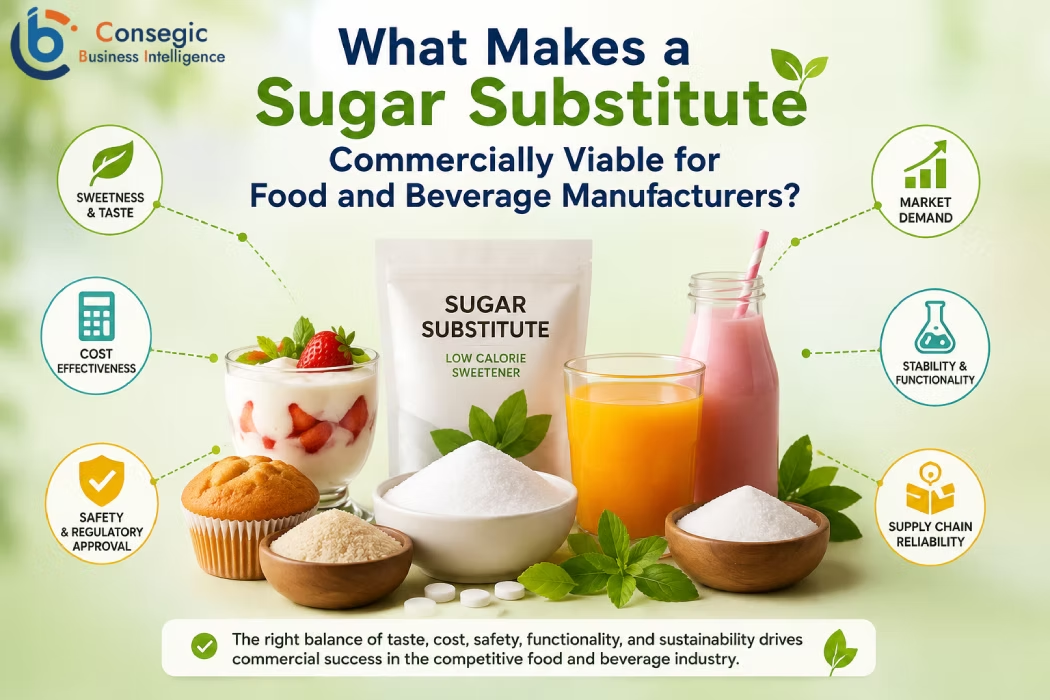
With the growing demand for reduced-sugar beverages, bakery products, dairy products, confectionery, and functional foods, there arises a requirement to introduce commercially viable substitutes of sugar.
Cost, Supply and Scalability: The Foundation of Commercial Viability
Cost is one of the main elements that affect the adoption of a sugar substitute. Food and beverage manufacturers operate in a competitive environment and have to consider the cost of their ingredients while developing their products. A substitute needs to deliver its intended functions without causing a significant rise in the overall cost of the finished product. The manufacturers analyze not only the cost per kilogram but also the sweetness level, dosage, transportation cost, processing costs, and storage cost.
Scalability is yet another key factor to take into account. Even an excellent sweetener can fail in terms of adoption in case the supply of the raw material proves unreliable or the volume of its production varies significantly. Reliable suppliers are necessary to ensure that the manufacturer receives products of stable quality in large quantities.
An ideal sugar substitute needs to enable efficient high-volume manufacturing without demanding the purchase of costly special equipment. Those substitutes that can be efficiently produced, delivered to the manufacturer at competitive costs, and integrated into the current purchasing infrastructure have more chances for commercialization.
Taste, Texture and Consumer Acceptance: Meeting Product Expectations
The taste continues to be one of the most difficult factors that sugar substitutes face. Consumers tend to expect a similar sensory experience from their sugar substitutes as they get from regular sugar. Certain substitutes can exhibit certain undesirable traits like being bitter or metallic in taste, having excessive cooling effect, or creating an aftertaste. Such disadvantages may lead to poor consumer loyalty even if the product has been designed successfully from a nutritional perspective. Thus, manufacturers carefully evaluate the sensory experience and sweetness profile of the substitute in question.
Just like taste, texture and mouthfeel can be critical in the development process since sugar does not provide only sweetness to food products but also helps with the creation of structure through moisture control, structure, viscosity, browning, and other factors. Thus, replacement of sugar might require the inclusion of certain additives into the formula.
Consumers' opinions of the ingredient might also influence the choice of sugar substitute. Some customers might prefer natural or known ingredients whereas others might have a preference for lower calorie content.
Thus, the good substitute is expected to provide a combination of both sensory qualities and structural benefits to help create the product.
Regulatory Approval, Safety and Clean-Label Considerations
Regulatory compliance is critical to the successful use of a substitute in commercial food and beverages. Manufacturers should ensure that an ingredient has been assessed and authorized for its intended applications in the particular market environment. Regulatory requirements could vary from one country to another and include safety evaluation, permissible intake levels, permitted categories of products, labeling, and restrictions on use.
Safety is especially crucial since food companies should prove that the ingredients used in their products meet certain standards. In case of regulatory uncertainty, it could increase the time and cost of development, which makes ingredients with established safety records preferable. Companies require scientific and technical information about ingredients provided by suppliers.
On the other hand, there is the trend of clean-label when consumers become increasingly interested in ingredient lists and ingredients themselves and prefer natural ingredients. However, expectations of clean labels vary across different markets and among different consumer groups. The ingredient that is accepted in one place may be considered suspicious in another one.
From the perspective of the manufacturer, thus, commercial viability is a matter of finding balance between regulatory acceptability, safety, functionality, and user-friendly labeling. The ingredients that can be made to comply with regulations effectively while also meeting the changing consumer standards will be accepted in the marketplace.
Processing Performance, Market Potential and Long-Term Profitability
The substitute sweetener should also be stable throughout the entire process of manufacture for commercial viability. Food and beverages companies consider the way the ingredient responds to factors such as heating, cooling, fermentation, freezing, mixing, and storage. The stability factor becomes critical since the substitute should be able to sustain its sweetness and functionality over the period of use. If the substitute does not perform well during the process, it will lead to quality problems, formulation expenses, and difficulties in the production process.
Another crucial factor to consider during the analysis of market substitutes includes the versatility of the substitute. Manufacturers would prefer ingredients that have wide uses in beverages, bakery, candies, dairy products, sauces, and functional foods among other applications. Versatility makes the company able to use the ingredient platform for various products.
Profitability in the long run will depend on the total value proposition. In the assessment of substitutes, food companies consider the cost of the ingredient, dose needed, stability during processing, acceptability, legality, supply, and potential demand in the market. Even though a substitute sweetener might appear cheaper, it may require costly formulation changes.
The most economically promising sweeteners thus are those which exhibit all five criteria above – good sensory properties, processability, availability, regulatory approval, and economic viability. These attributes may enable a reduction of sugar while preserving product quality and profitability.
Conclusion
The commercial feasibility of a sugar substitute is not based merely on the capacity of the sweetener to deliver sweetness. Manufacturers of food and beverages are looking for raw materials which will not only be cost-effective and have ready availability, but are also scalable and will exhibit excellent sensory and functional properties, including compatibility with manufacturing processes. Approvals from regulatory agencies and safety aspects will also hold the same importance, especially when consumers are now showing more preference towards clean-label ingredients and health-oriented products. It should also be noted that a good sugar substitute will ensure consistency in taste, texture, stability, and overall product quality at all stages of processing and distribution. In short, manufacturers will prefer sugar substitutes which have an impressive combination of functionality and consumer acceptance along with commercial viability.