All of the inventions within the aviation industry- from the Wright brothers' initial flight to the invention of the jet engine- have transformed the way people fly. Today another transformation is beginning to take place- one that could make flying cleaner, quieter and more sustainable for the future.
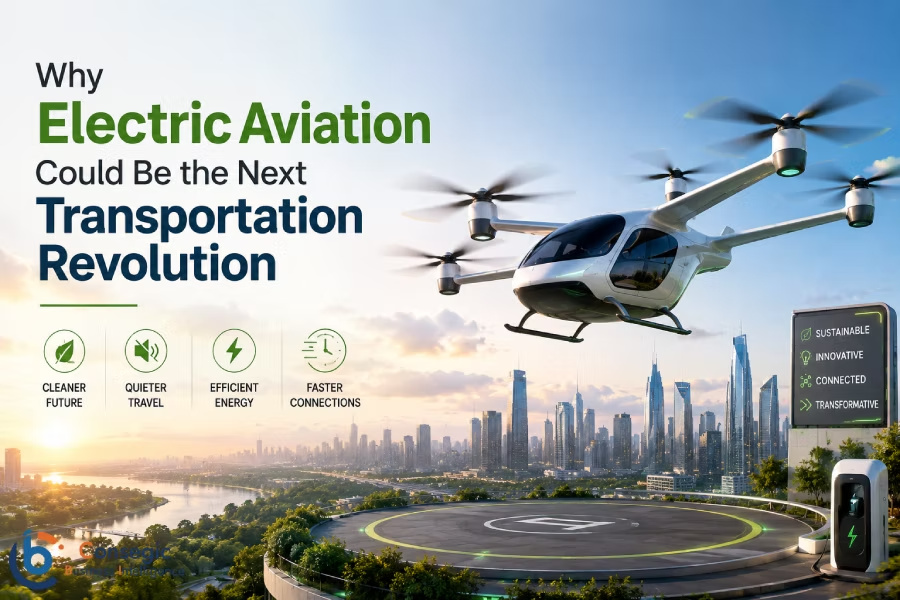
Electric Aviation in Numbers
- 5% of global CO2 emissions come from fuel-based aeroplanes.
- 800+ electric aircraft projects are currently under development worldwide.
- $30 billion projected market value by 2030.
For decades, aviation remained one of the most difficult sectors to decarbonize. While electric vehicles expand across roads and rail systems become more energy efficient, airplanes continued to rely heavily on jet fuel. This situation is now starting to change.
Advances in battery technology, improved aircraft design and growing investments are putting aircraft aviation from experimental concept into real world applications. What once seemed futuristic is quickly becoming a developing industry with working aircraft, commercial passengers and evolving regulations supporting it around the world.
Electric aviation is no longer a distant dream. For short distance travel, it has already become a reality.
Why Aviation Needs Electrification
Aviation’s environmental impact is greater than many people realise. Commercial flights contribute around 2.5% of global CO2 emissions, but the total climate impact becomes much larger when effects such as contrails and nitrogen oxide emissions are included. With billions of passengers flying every year, reducing emissions from aviation has become increasingly important.
Electric propulsion offers a promising solution. The energy efficiency of electric motors is much greater than that of jet engines, producing no direct emissions during operation and has fewer moving parts. This could lead to decreased maintenance costs, as well as increased readability. Another key aspect is the decreased levels of noise produced, which could lead to a more sustainable option of air travel for urban cities.
Electric motors can achieve an efficiency approaching 95% whereas modern turbofan engines are efficient around 35-40%, this could make an immense saving in terms of both fuel cost and emissions in large fleets.
The Current State of Electric Aviation
By 2026, electric aviation has progressed into several categories based on aircraft range and purpose. Smaller electric training aircraft produced by companies such as Pipistrel and Bye Aerospace are already being used by flight schools. At the same time, Urban Air Mobility (UAM) vehicles which are often described as flying taxis are undergoing certification trials with authorities such as the FAA and EASA.
Companies including Joby Aviation, Archer and Lilium have successfully flown full scale prototypes that demonstrate quieter operations and promising performance capabilities. These aircrafts are designed mainly for short urban routes and regional transportation.
Important Milestones
2015
Solar Impulse 2 completed their first solar powered flight around the world, proving that long duration electric flight was technically possible.
2019
Harbour Air and MagniX carried out first fully electric commercial floatplane flight in Canada, an important milestone for regional aviation.
2022
Heart Aerospace’s ES-30 regional electric aircraft secured large orders from airlines including United Airlines and Air Canada, showing increasing industry confidence.
2024-2025
Several eVTOL passengers services officially began in selected cities, while battery energy density crossed 400 Wh/kg- a key benchmark for practical short range electric flights.
The Biggest Challenges Ahead
Although electric aviation has several potential, the industry still faces major technical and financial challenges. The most significant problem is battery energy density. Aircraft require huge amount of energy while remaining as lightweight as possible and today’s lithium-ion batteries still store far less energy by weight than jet fuel. This limits fully electric aircraft mainly to shorter flights.
Another major issue is airport infrastructure, as large-scale electric aviation will require expensive upgrade to airport electrical grid, charging systems and ground support equipment. Certification is also very slow and complex process as the aviation authorities have very high safety standards and a new aircraft design could take a number of years to receive clearance for passenger flights.
Hybrid and hydrogen electric systems are being tested by many firms to provide a bridging solution between current combustion engines and battery electric systems due to battery technology limitations.
Both Airbus and Boeing are carrying out hybrid electric research, whereas new start-ups like Zero Avia are testing hydrogen fuel cell systems on small commuter aircraft which could significantly reduce emission while battery technology develops.
Why This Time Feels Different
Electric aviation has attracted excitement before, but several factors make the current moment more realistic than the earlier attempts. Battery energy density has steadily improved over the past decade and solid-state battery technology currently being developed could dramatically increase performance in the coming years.
At the same time, the falling costs of batteries and electric components mirrors the same trend that helped electric cars and solar energy become commercially successful. Governments and investors are now treating electric aviation as a serious long-term industry rather than a niche experiment.
Short haul travel is especially suitable for electrification. Flights between 100 and 500 miles produce a large share of aviation emissions while remaining inefficient for traditional aircraft since take off and climb consume large amounts of fuels. The technology is currently best suited for these shorter flight paths and operating costs are predicted to drop, making domestic flights cheaper and potentially more widespread.
Government policies are aiding development of the sector. The FAA has put out the MOSAIC guidelines, which ease the certification process of smaller electric aircraft and EASA have also developed rules for the certification of eVTOL aircrafts. In addition, governments like Norway's have begun outlining plans to electrify their national flights over the next few decades.
The Broader Impact of Electric Aviation
Every major transportation revolution in history followed a similar pattern. New technologies initially appeared unrealistic, but once economics and engineering improved, they rapidly transformed society. Cars changed city design, commercial aviation reshaped global travel and container shipping revolutionised trades.
Electric aviation could follow a similar path. The transition is likely to take time, starting with city air taxis and commuter regional aircraft and developing to larger hybrid and fully electric passenger planes. Each stage will help develop public trust, improve infrastructure and encourage further investment.
The complete transition may take decade, possibly expanding through 2050. However, the direction is becoming increasingly clear. Airlines, manufactures, investors and Governments are all making huge investments because they see the future of this technology.
The airline of tomorrow will never be completely electric, but the technology has to be one of the biggest breakthroughs in transport since it was first invented. If technology carries on improving, the future air travel will be considerably greener and quieter, but also very sustainable.