The smartest advisor no longer charges $500 an hour but rather it now runs on your phone.
For decades, getting financial advice only meant one thing- paying huge fees, trusting someone else with your money and hoping that the advice received is truly in your favour. In reality, many advisors were limited by the products their firms sold, pressured by sales target and affected by the same emotional biases that affect every investor.
That system is now changing and is changing fast. Artificial intelligence is transforming the world of finance, and for once, the biggest winner will not be the ultra-rich. They could be ordinary people who previously could not afford high quality financial guidance at all.
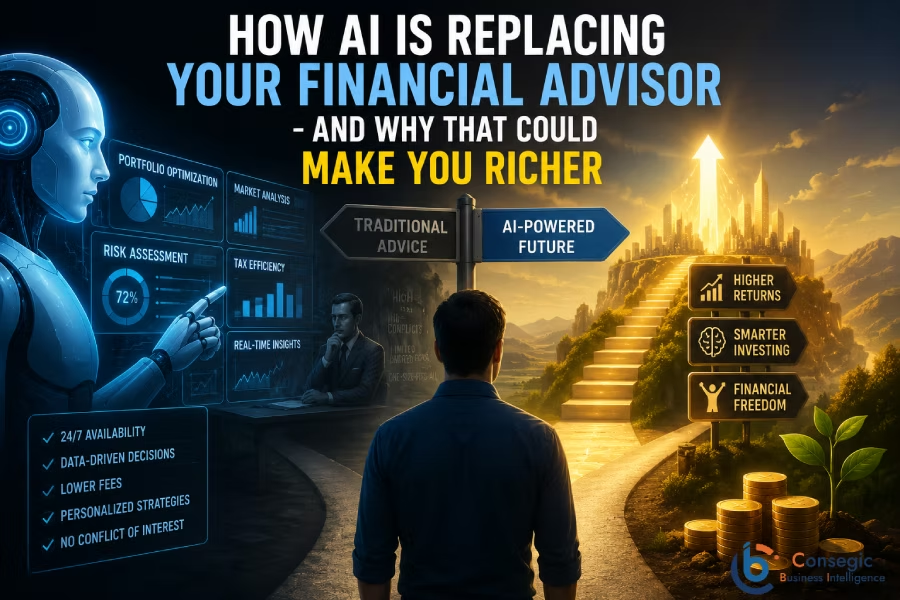
The Old System Favoured the Wealthy
Traditional financial advisors operated under a business model that structurally used to reward complexity and scale. The more money invested, the more attention and expertise received. Someone with millions in asset would receive tailored advice whereas someone with moderate investments often received generic advice or was ignored altogether.
For most working people the choices were limited- pay a fee-only planner for occasional consultations you could barely afford, trust commission-driven brokers with a clear incentive to sell you expensive products or navigate your financial future largely alone. None of these options were good.
The AI wave is, for the first time, offering a fourth path. Affordable, data driven financial management that was once reserved for the elite class is now becoming accessible to all because of the involvement of artificial intelligence. As many experts now argue, sophisticated financial planning is no longer exclusive to the wealthy. AI is making it accessible to everyone.
Where Is AI Doing Better?
Human advisors still offer value, specially in emotionally complex situations. Surely a human advisor brings something irreplaceable, but when it comes to the core mechanisms of investing, AI has several structural advantages that are difficult to ignore.
Traditional advisors are limited by time and capacity and most of them can only work during the specified hours and often manage hundreds of clients at once, making it difficult to give every portfolio constant attention. Their decisions can also be affected by emotions, personal biases or products that their firm wants to promote. On top of that, many advisors charge 1-1.5% of asset they manage as fees.
AI powered advisors work very differently. They are available around the clock, can serve millions of users equally and can make decision entirely based on data and predefined strategies rather than emotions. Instead of being restricted to a firm’s investment products, AI systems can analyse a much broader range of investment opportunities. They also cost significantly less, with many platforms charging only 0.25% annually.
Over time, these small adjustments can make a surprisingly large difference. Small advantages in tax efficiency and portfolio investments can accumulate to make large differences over decades and provides access for everyday investors to strategies previously accessible only to the very rich.
The Fee Gap Is More Dramatic Than It Looks
At first, a 1% or 1.5% management fee may not seem like a major expense. Most investor barely notice it because it is gradually deducted over time. But in the long-term investing, even small percentages can have a massive impact on how much wealth you actually build.
For instance, assume you've invested $200,000 at an average annual return of 7% over 30 years. By working with a human advisor, who may charge 1.2% per year, your investment would amount to approximately $1.03 million at the end of this term. If that investment were managed using an AI adviser, charging 0.25% per year, your investment could be about $1.47 million. That is a difference of almost $440,000- lost purely to management fees.
The most important thing to understand that these fees do not just reduce your money once. They continuously reduce the amount available to compound and grow every single year. Over decades, they create a huge gap between two investors earning the exact same market returns.
In many ways, this represents a major shift in personal finance. Instead of large portions of investment growth going towards advisor fees, most of that money stays invested and continues working for the investor. The people who benefit the most from lower fees are often smaller investors, because high fees consume a much larger share of modest portfolios.
Emotions are Often the Biggest Investing Problem
Behavioural finance research has shown repeatedly that investors struggle with emotional decision making. People panic during market crashes, chase trends during booms and make instant decisions based on headlines or fears. Even experienced professionals are not immune to this. AI, however, does not panic.
When market became volatile in 2020, many AI advisors simply continued executing their programmed strategies while countless individual investors sold their shares even at losses out of fears.
That emotional detachment may sound cold, but over long periods, disciplined consistency tends to outperform emotional reactions. AI does not stay awake at midnight doom scrolling financial news and suddenly decide to move everything into cash. In investing, this quality is extremely valuable.
Personalization Is Becoming Far More Advanced
The first generation of robo-advisors was relatively simple. Most platforms asked users a few basic questions about their age, income and risk tolerance before placing them in a standard portfolio of index funds. While this was still far more efficient and convenient than traditional investing for many people, it still lacked personalisation.
Modern AI powered financial tools are becoming far more sophisticated. Instead of relying on a short questionnaire, these systems can analyse a person’s complete financial picture. This includes spending habits, income, debt obligations, tax situation, insurance coverage, saving goals and even long-term plans.
What makes AI more powerful is its ability to adapt continuously. This level of personalised financial planning was once available to only the wealthy individuals who could afford private wealth managers and financial consultants. AI is now making similar strategic insights accessible at a much lower cost.
Human Advisors Are Not Disappearing Completely
Though AI is fundamentally altering the landscape of personal finance, humans will not be replaced in this domain. This is largely down to the unique way human advisors can manage highly sensitive and emotive life events such as estate planning, divorce settlements, inheritance or business decisions. In such circumstances it is extremely difficult for technology to mimic empathy and human intuition.
In future the answer is likely to be a combination between the two technologies. AI will handle many of the administrative tasks such as portfolio re-balancing, optimization and tax efficiency planning. Humans will likely be used to advise on larger life decisions and a personal approach.
The question for the consumer will eventually be how far human advisors can justify the fee they charge. As AI based investing tools continue to become both more affordable and more powerful, it's likely that many people will conclude that low-fee, technology driven tools are a far more intelligent and cost-effective route to growing their long-term wealth.