Banking in 2026 is much smarter, data-intensive, and surveillant than at any point in history. Every digital transaction, withdrawal from an ATM, transfer between accounts, card transaction, or login to mobile banking produces behavioural data which is analysed instantly through AI. As digital banking becomes more pervasive, payments become instantaneous, mobile banking becomes increasingly popular, and cross-border transactions increase exponentially, the likelihood of financial crime grows. This has prompted financial institutions to deploy smart algorithms designed specifically for monitoring purposes. Modern-day banks no longer rely entirely on automated fraud warnings based on logical rules. They make use of artificial intelligence algorithms which learn about the user’s behaviour, expenditure habits, device usage, and time of access.
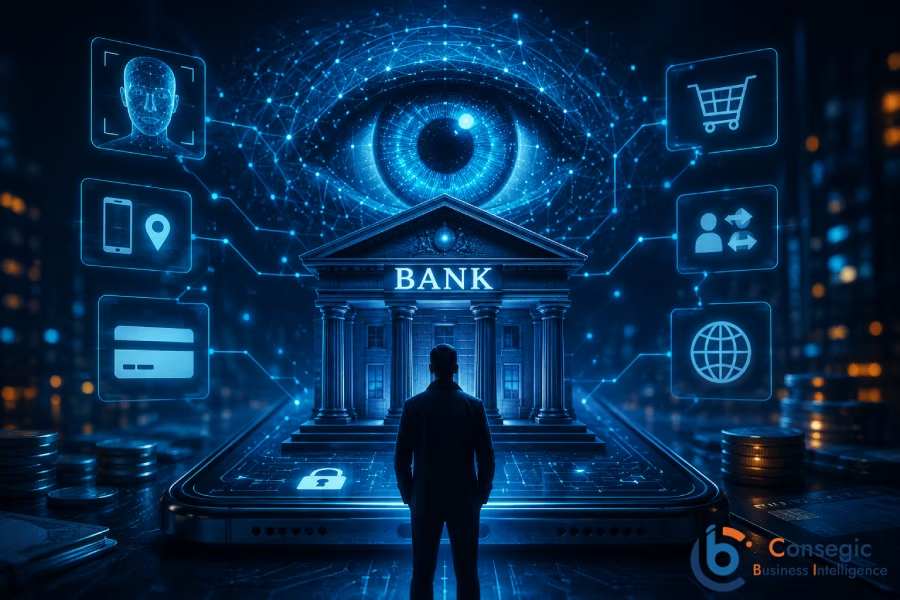
The development of generative AI technology has served to drive this transition even faster. Criminals are now able to produce deepfake audio tracks, fake identities, and automated schemes of scams with the help of artificial intelligence phishing emails. This way, cybercrime becomes ever more advanced and challenging to prevent. That is why banks have started to change their attitude toward preventing fraud and have been developing a new approach that seeks to anticipate any fraudulent actions to prevent them in advance. To avoid suffering huge losses, banks all over the world have been spending billions on establishing advanced artificial intelligence-based safety infrastructures.
How Do Banks Use AI to Detect Fraud Before You Even Notice It?
Modern-day banks now deploy complex AI systems that analyse millions of transactions on the fly to detect any instances of fraud even before the victim is aware of them. Unlike older techniques of detecting frauds, which relied on pre-defined rules, current approaches employ machine learning systems which have the capability to learn from user behaviour. Some factors that are considered include transaction size, location, device identity, login patterns, typing pace, purchasing rate, and spending history in order to determine whether the transactions are legitimate or not.
Another area where banks employ advanced technologies to protect themselves and their users is behavioural biometrics, facial recognition, voice authentication, and device fingerprinting. Moreover, the AI-based risk engines score every transaction and determine the likelihood of the transaction being fraudulent within a matter of milliseconds. In case the transaction seems suspicious, the system will either deny processing the transaction or ask for additional verification steps or notify the customer about the potential threat. All-green fraud detection is especially critical because cybercriminals usually employ stolen yet legitimate identities infrastructures.
In addition, banks have integrated AI into their AML (anti-money laundering) systems and KYC (Know Your Customer) checks to help identify identity theft, suspicious transactions, and criminal financial networks. AI also helps eliminate false positives because it understands customer behaviour better than older, rule-based systems do.
The New Age of Financial Fraud: Deepfakes, Synthetic Identities, and AI-Generated Scams
AI is not only being used by banks to protect themselves from fraudsters but is also helping criminals in developing more advanced methods of financial fraud than ever before. In 2026, the most prominent method of fraud is one that involves automation, scale, and sophistication in its techniques to trick the victims. The most prevalent type of fraud in 2026 is deepfake fraud, which allows the criminals to use AI to generate a video or audio that is capable of impersonating a bank executive, a customer service officer, or even a person's close relative.
Moreover, the second prominent method used by cybercriminals to commit crimes is known as synthetic identity fraud because it uses both fake and authentic identity credentials in order to create a whole new identity. Other methods include the use of AI in creating fake documents, fake selfies, and other media in order to fool people who try to check people through digital onboarding and KYC systems.
Financial crime is now functioning as an organized international industry through the utilization of fraud-as-a-service models which sell scamming products utilizing artificial intelligence technology to cyber criminals around the world. APP (Authorized Push Payment) scams have increased dramatically in recent years through psychological tactics which encourage people to transfer money freely to scammers. As more advancements are made in artificial intelligence technology, there is increasing pressure on banking institutions to upgrade their identity verification processes and deepfake detection methods.
What AI Fraud Detection Means for Customers: Security, Privacy, and False Transaction Flags
Fraud detection mechanisms based on artificial intelligence have been changing the way people engage in their banking processes, improving the safety of financial operations and allowing customers to have a fast and secure experience when performing transactions. Current systems can detect potentially fraudulent activity, stop any suspicious actions, and send notifications in case of any problem, thus preventing any financial losses. Moreover, with enhanced security measures, fraud resolution is significantly improved, as well as the process of verifying identity, and people can be assured that they will not become victims of cybercrime.
However, the use of AI surveillance for detecting fraud in banks is raising a number of issues related to privacy, customer freedom, and transparency. Today, banks use AI to monitor many different factors when calculating their customers' risk of being defrauded, including transaction history, spending behaviors, device usage, logins, physical location when purchasing goods and services, IP address, and others. Many customers are concerned about the amount of information about their finance’s banks store using these technologies.
Another issue is the rise of false flags on transactions made due to automated fraud detection systems. Valid transactions might also be flagged as fraudulent by the artificial intelligence. The result would be temporary blocks, declined payments, and further verification of accounts while the banks conduct investigations on any abnormal transaction. Moreover, there are also fears that artificial intelligence can be biased in its interpretation of the customers' actions. In light of regulations requiring financial institutions to be transparent in their operations, banks have to balance between protecting themselves from cyber threats and providing excellent customer service.
How to Protect Yourself in the Era of AI Banking Surveillance and Smart Fraud Detection
With the increased sophistication of AI-based fraudsters, clients will need to be more vigilant in safeguarding their finances and online identities. For instance, multi-factor authentication needs to be activated for all banking accounts as it will add another layer of authentication on top of passwords. Other recommendations include ensuring that there are unique passwords and passkeys, implementing biometric authentication, and keeping banking software and devices updated to lower cybersecurity threats.
Moreover, it is advisable for consumers to know how to spot an AI-generated scam. Fake voices, phone scams from pretend customer support, cloning of banks’ web pages, and very tailored phishing emails are some common types of financial scams. Consumers must not respond to any urgent demand for money without proper confirmation and must never share banking details via call, messages, or fake links.
The next key step is minimizing digital exposure. The more private data a person shares via social networks, the more likely they will be targeted by cybercriminals who may employ an AI-based scamming tactic to steal their identity. Finally, customers are advised not to perform any banking operations on public Wi-Fi, which is crucial to minimize potential risks.
While AI has been proving itself a potent ally for banks, it should be noted that cybersecurity specialists agree on equal importance of the human factor. In the age of digitalization, the financial safety of clients will rely equally on sophisticated AI security systems and clients' knowledge about various fraud techniques.
Conclusion
The development of artificial intelligence has already brought a drastic change to the banking sector as it has revolutionized the fraud prevention process, which has become more efficient and even more predictive. Although the implementation of monitoring software based on artificial intelligence makes it possible to protect banks from financial crime and their clients from highly sophisticated fraudulent activities, there is no denying that such solutions pose certain risks associated with the potential violation of individuals' privacy, surveillance, and erroneous identification of legitimate transactions. However, the ongoing application of generative AI by cybercriminals forces both banks and their clients to adjust to the new realities of cyberspace.