What Is Social Engineering and Why It Works So Well?
A form of cyber-attacks that involves the use of psychological manipulation of humans instead of attacking computer systems is called social engineering. In contrast to the other forms of attacks that involve hacking, in social engineering hackers use various tactics to persuade victims to provide them with sensitive information, transfer money or grant them access to certain resources.
Social engineering can be described as one of the most effective means of compromising people and computers since firewalls and antivirus programs cannot recognize when there is an attack. The key factor behind the efficiency of social engineering is that it takes advantage of the victim’s inherent traits including trust, fear, urgency, and obedience.
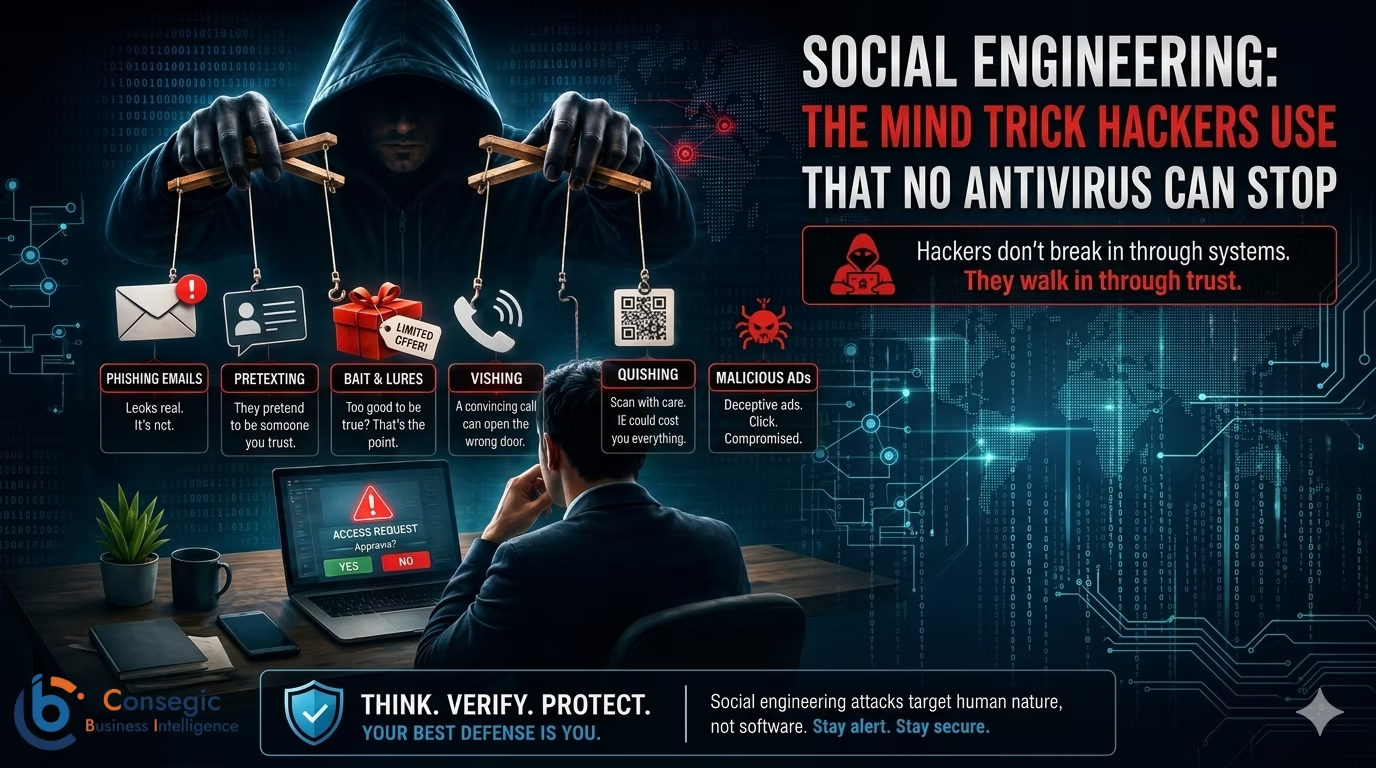
The most recent statistics paint a clearer picture of the problem’s magnitude. Social engineering attacks are among the most common methods used by hackers to compromise organizations IT systems; many of them account for the majority of security breaches worldwide. The most prevalent technique of social engineering, phishing, involves sending billions of emails each day.
The emergence of new technologies such as artificial intelligence only exacerbates the problem. Hackers can use AI algorithms to design highly convincing communications that do not contain any telltale signs that were once indicative of a scam, such as poor grammar. Because of its sophistication and advanced nature, social engineering represents an extremely complex challenge in terms of preventing cyber-attacks using modern technological solutions.
Common Social Engineering Tactics Hackers Use Today
Social engineering tactics have grown in complexity and diversity over the years to be more than the traditional phishing attacks carried out through email. Although phishing remains the most common type of social engineering attack, the process has since become much more advanced. For instance, over millions of phishing attacks took place around the world during the year 2025.
Another recent advance in social engineering is the use of artificial intelligence in phishing attacks. Research reveals that more than 80% of phishing emails use AI to craft convincing emails which can be almost impossible to differentiate from legitimate emails.
The quishing attack, also known as QR code phishing attack, is yet another type of phishing that has seen a rise in its usage over the past year. These attacks rose in the first few months of 2026 due to the utilization of mobile technology and the incapability of the current security system to identify the QR codes used. The business email compromise (BEC) attacks occur after masquerading as vendors or executives; they have led to great financial damage due to payment manipulation.
Moreover, cybercriminals are resorting to multi-channel techniques that employ a combination of emails, instant messaging, and phone calls to establish their legitimacy. This technique enables cyber criminals to enhance their credibility at multiple fronts simultaneously, making it harder to identify them.
The Psychology Behind Manipulation and Trust Exploitation
The success of social engineering depends heavily on psychological manipulation of people. Cybercriminals make use of certain principles, such as authority, scarcity, or urgency, to influence people and induce their actions without considering the possible outcomes. The authority principle can be one of the most effective tactics since people tend to believe those who hold high positions, such as executives and even politicians.
Additionally, urgency is another tactic that can be effective in influencing people since there is no time left for verifying information. According to the studies conducted by psychologists, people are more vulnerable to making mistakes when they have little time to analyse information.
In addition to this, personalization has made these tactics even more effective. Using the wealth of personal information gathered through social media and data breaches, the attackers can formulate personalized messages for particular people.
Additionally, recent research has found that users generally have a hard time differentiating between actual and artificially generated messages, posing a new problem for cyber security training programs. Trained experts, too, have been shown to fall victim due to constant development in these attacks that exploit human tendencies.
Ultimately, social engineering works not because of technical brilliance but because of exploiting basic human nature.
Real-World Examples of Social Engineering Attacks
Several cases in the real world show the growing sophistication of social engineering attacks. An emerging technique involves artificial intelligence–based impersonations, where the perpetrators use deepfakes to replicate audio and video of an executive or a trustworthy person. In some situations, the victim may even be coerced to send money and perform malicious actions during the seemingly legal virtual meeting.
A phishing attack continues to be the most common entry point used by attackers before launching a larger cyberattack. Reports from industry suggest that a significant number of cyber-attacks begin with a phishing attack, showing how effective it still is at getting the job done.
Additionally, financial fraud has also witnessed unprecedented proportions in 2025. For instance, cryptocurrency scams using a combination of social engineering and artificial intelligence techniques caused billions of dollars’ worth of losses, as impersonations were one of the most used tools in such scams. The majority of cryptocurrency scams included either fake investment schemes, impersonation of a government official, or false customer service calls.
Furthermore, multi-channel approaches are becoming increasingly prevalent in cybercrime operations. Hackers can reach potential victims using e-mail, use instant messengers for following up, and confirm their identities using a call. All these cases show that social engineering does not remain an issue for individual schemes but becomes a key element of cybercrimes on a large scale.
How to Protect Yourself from Attacks No Software Can Detect
A response to social engineering should take a more holistic perspective, focusing on the people involved rather than just technology-based controls. Because social engineering exploits human behaviors rather than flaws within technology, a purely technological solution to the issue will not solve the problem completely.
One of the best ways to protect oneself from attacks is by having a “zero trust” mentality where anything could be considered to be malicious until proven otherwise. It involves verifying any sensitive actions being done, particularly those that include financial dealings or credential exchanges. Multi-factor authentication (MFA) can also provide further security but does have weaknesses when it comes to more sophisticated phishing attacks. Moreover, it is also imperative to decrease the exposure of personal information when trying to prevent cyber-attacks since cybercriminals use information available online to conduct their malicious activities.
Technology assistance for combating social engineering attacks should be concentrated in behavioural analysis and real-time attack identification instead of signature detection only. With increased numbers of AI-driven attacks, protection against such threats should include advanced detection approaches as well.
Conclusion
Social engineering is considered to be one of the most dangerous threats to cybersecurity because such attacks do not aim at any software or hardware but rather target the decision-making abilities of people. The emergence of personalized marketing and artificial intelligence makes such attacks more plausible and harder to spot. Current protective measures were shown to be ineffective in defending against social engineering attacks. In today’s world, building resilience requires not just raising awareness but also applying critical thinking and verification processes that help defend oneself from such attacks.