The Shift from Smart Cities to Cognitive Cities with 6G
The urban infrastructure is witnessing a paradigm shift from smart cities powered by data to cognitive cities powered by artificial intelligence. Although smart cities utilized IoT and 5G to collect and analyze data, 6G will be a game-changer that will revolutionize the city’s network into a cognitive and intelligent network system, which can sense, learn, and self-optimize urban systems.
Different from the previous technologies, 6G is being developed as an AI-native network, machine learning algorithms are integrated into the network architecture. In other words, this network will allow infrastructure not only to transport data but also to understand it. As a result, researchers refer to 6G as a "digital mirror" of the physical world.
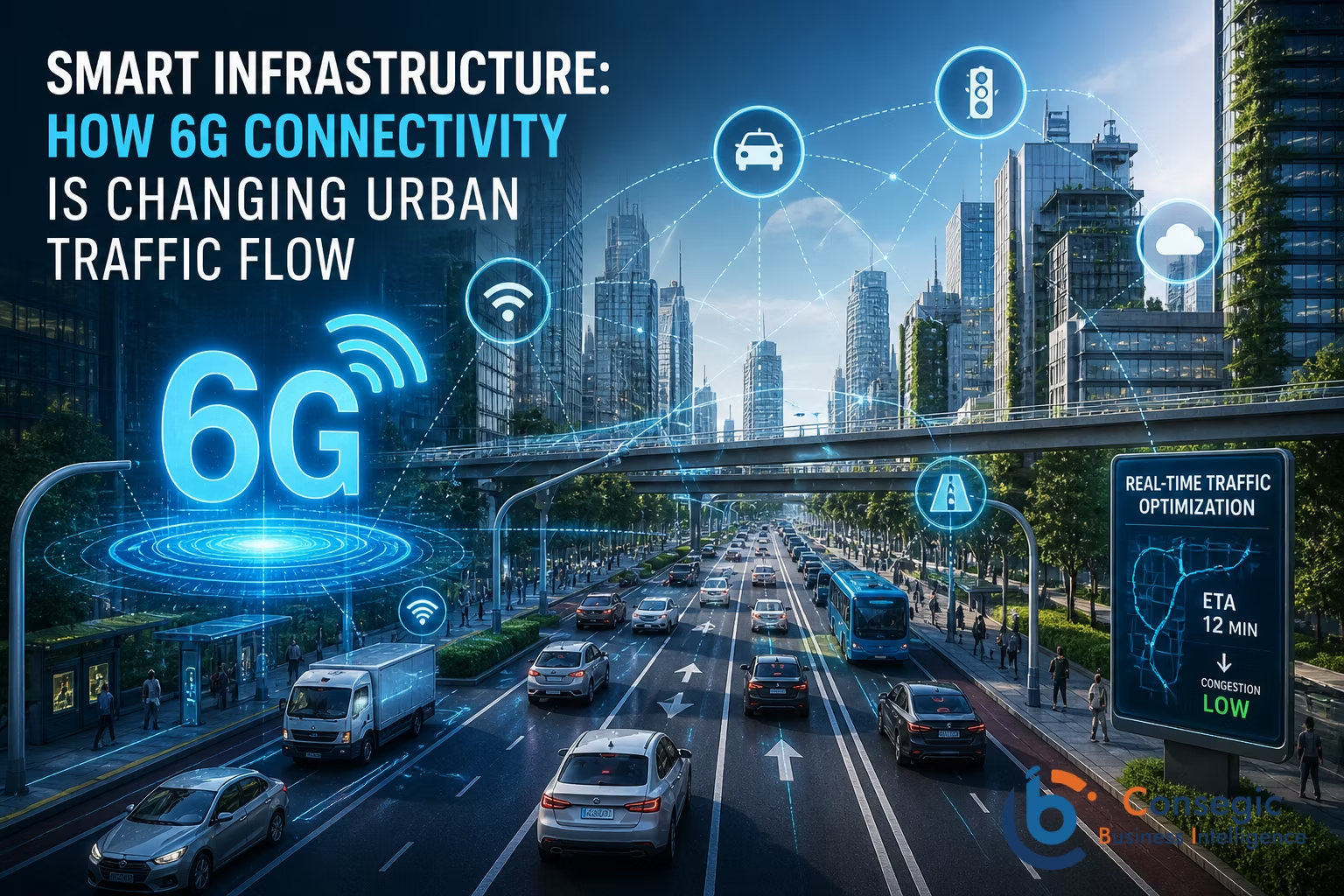
The improvements in performance only strengthen this development even more. 6G promises sub-millisecond latency and super-reliability, facilitating instant coordination between potentially millions of connected devices. With such an enormous number of devices operating simultaneously, it becomes possible for the system to coordinate vehicle and sensor movement at the level of entire cities.
In cognitive cities, traffic control systems cease to be rule-driven. They transform into self-managing networks able to detect congestion points and make adjustments accordingly to achieve the optimal results. Such an approach demonstrates a new level of urban evolution from controlling traffic transitions to orchestrating it.
Ultra-Low Latency and Real-Time Traffic Intelligence
Among the revolutionary impacts that will be brought about by 6G technology is its ability to provide ultra-low latency services. Although 5G technology managed to lower latency to less than 1 millisecond, 6G technology will manage to bring latency to a level of 0.1 millisecond.
The lowering of delay will play a crucial role in ensuring real-time traffic intelligence. In areas of dense traffic where cars move at high speed, the difference between one second and another may be the difference between life and death. Through the use of 6G technology, information can be transmitted from a vehicle to other vehicles or infrastructures along the road network within fractions of seconds. Additionally, edge computing will enable real-time traffic intelligence through the incorporation of mobile edge computing in the 6G network.
Moreover, 6G offers the ISAC function, allowing for real-time detection and tracking of objects like vehicles and people. Such an advanced system will provide continuous situational awareness regarding traffic even when there is no line-of-sight for any sensor. This leads to the emergence of real-time intelligent traffic systems that can adjust traffic signals, reroute traffic instantly, and take proactive measures to handle any incidents. The implementation of such technology will improve traffic and also enhance the safety of roads.
AI-Powered Traffic Prediction and Digital Twin Ecosystems
One of the most important components of 6G-enabled traffic control systems is artificial intelligence. A key example of how AI can be used in such systems is digital twin technology. It creates real-time simulation of urban infrastructures through data collected by means of sensors, vehicles, and network devices.
Within the context of 6G, digital twins become live decision-makers as they get the ability to operate through continuous synchronization based on ultra-low latencies and high-speed data transfer. In other words, in the framework of 6G, AI models make decisions in real time about different aspects of operation of urban infrastructure.
Moreover, AI models include various kinds of machine learning algorithms, like deep learning and reinforcement learning, which analyze large datasets to make predictions about traffic congestion and routing. This way, cities can move away from reactive traffic control towards optimizing its performance. The one rising idea is that of network digital twins that will combine mobility and communications information. It will allow optimizing the flow of cars and traffic networks at once, guaranteeing reliable traffic despite high loads.
Also, there is a possibility to test scenarios and shape traffic as authorities will be able to experiment with various infrastructural changes, accidents, environmental influences, and other elements before implementing them in reality. Finally, artificial intelligence-based ecosystems make traffic management systems learn continuously and improve themselves.
Connected Mobility: Autonomous Vehicles and V2X Communication
Connected mobility plays an important role in the development of urban infrastructure using 6G. It is facilitated by the evolution of V2X communications that allow cars to communicate with one another and with pedestrians and infrastructure in the environment.
The main benefits offered by 6G in terms of V2X include ultra-high reliability, very low latency, and high capacity of communications, which is crucial for autonomous driving. In particular, the aforementioned qualities enable efficient data exchanges in terms of quantity and speed that cannot be achieved by 5G in congested urban areas.
The most revolutionary feature of 6G technology is the use of cooperative perception, where the cars can exchange information through sensors about their environment. Moreover, cooperative manoeuvring makes it possible for cars to perform tasks like lane change and intersection crossings together in real time.
Another aspect that makes 6G unique is the centimetre-level precision in terms of vehicle positioning and network-level sensing technologies, which provide the needed precision for navigation and traffic management. These technologies are critical in reaching levels 4 and 5 of autonomous driving.
In addition, cars become mobile computing devices within the 6G environment. They thus become part of a decentralized intelligence system where decisions are made collectively by both vehicles and the supporting infrastructure.
Challenges, Scalability, and the Future of 6G Traffic Systems
While the revolutionary effects brought about by the use of 6G in traffic systems cannot be ignored, there are many challenges that emerge with regards to scaling, infrastructure, and management. One of the main technological obstacles associated with the widespread implementation of 6G networks is the capability to connect millions of vehicles with ultra-reliable low-latency communications.
Moreover, the usage of terahertz frequencies ensures higher transmission rates, yet it results in reduced reach and increased sensitivity to interferences. Consequently, a large-scale infrastructure should be put in place to address such issues. Another important factor is scalability, which poses challenges regarding integration with different technologies, such as edge computing, artificial intelligence, satellite communication, and other existing solutions.
Additionally, both security and privacy issues are of equal importance. Due to the constant data transfer among cars, the infrastructure, and the network, there is likelihood of cyber-attacks, and the privacy of the user may be compromised. Moreover, AI-based decisions are bound to give rise to several issues such as those related to accountability and transparency.
Economic considerations have great influence on the matter as well. The expensive process of deploying the infrastructure, along with the need for standardization, could postpone the adoption of the technology till the latter half of the decade.
However, the future of 6G traffic systems will involve the development of fully autonomous urban mobility ecosystems that employ AI and digital twins for an intelligent, adaptive, and resilient city environment.
Conclusion
6G technology is expected to revolutionize urban mobility by creating traffic networks that are not only smart and adaptive but also capable of optimizing themselves. With the advancement of ultra-low latency, artificial intelligence analytics, digital twins, and enhanced V2X communication capabilities, future cities are likely to benefit from highly optimized traffic networks which are also safe and predictive. Although there are certain obstacles that stand in the way of implementing such solutions, existing progress and advancements show that a future based on 6G technology will become reality in the near future.