Why Sleep Optimization Is the Biggest Health Trend in 2026
In 2026, sleep is not treated as a passive rest but rather has been elevated to become the most actively optimized pillar of good health. Something that was long neglected has taken its place as the focal point of the global wellness revolution as researchers and other experts acknowledge that sleep is one of the primary factors behind living a long healthy life, clear-mindedness, and the absence of disease. According to studies and data from the market, the importance of sleep in modern society is more than just a passive process but rather an active one.
The reasons behind such a transformation are numerous. As fitness watches and other devices to track and analyse sleep patterns have become available, the perspective on sleep tracking has changed dramatically from just a few years ago. In 2026, more than half of all adults are using device to monitor their sleep patterns.
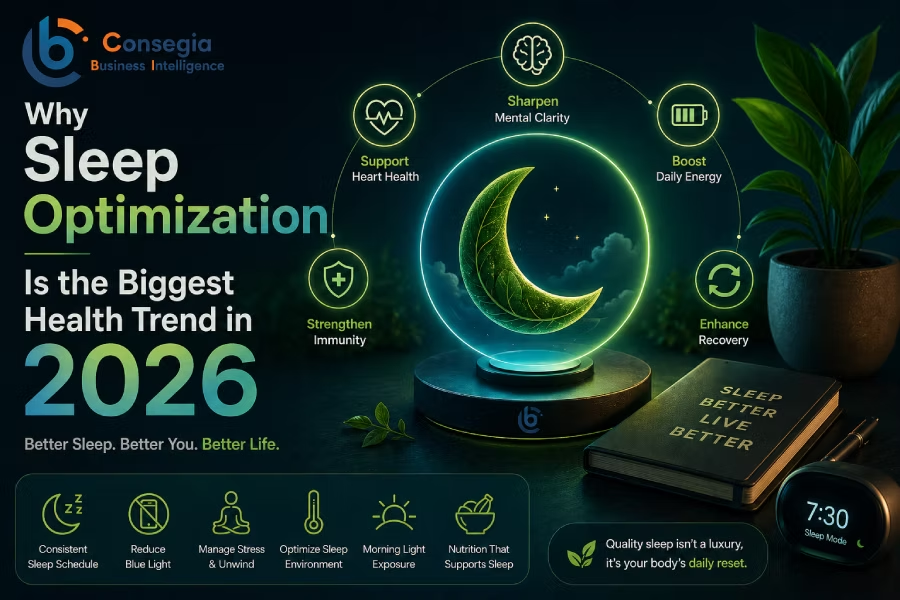
Simultaneously, the approach has been shifting from “sleep tracking” to “sleep optimization,” where people are changing their surroundings, their schedules, and even their lifestyles to ensure that they can achieve better quality sleep. Sleep optimization is the key health trend of 2026 because as it lies in the middle of technology, lifestyle, and preventive medicine.
In today’s world, which revolves around exhaustion and information overload, sleep optimization is not something that one should consider doing; rather, it is something that must be done.
How Rest Directly Shapes Emotional and Cognitive Health?
As per the 2025 neuroscience reports, sleep is no longer considered simply a relaxing process but a dynamic process for maintaining the brain’s health. This helps regulate people’s emotions and improve their cognitive functions. The process of sleeping implies a highly coordinated processes that help the brain restore balance by integrating learning and organizing memories, specifically through reorganizing neural activity in the prefrontal cortex, which controls logical thought, and the limbic system, regulating emotions and reaction to danger.
An important role in maintaining good psychological balance belongs to sleep cycle-specific activities. Where REM-sleep (Rapid Eye Movement) helps to restore the ability to properly regulate emotions by enabling the brain to "soften" them so that they do not react too strongly to everyday situations, while deep sleep (slow-wave sleep) is necessary for solidifying learning and memory. Without it, emotions may become uncontrollable.
Moreover, Insufficient sleep has direct negative impacts on the brain's regulation of activity, which occurs through the prefrontal cortex controlling the reactivity of the amygdala. The lack of sleep results in a weakened regulation, hence causing individuals to become impulsive, easily irritated, and highly emotional towards even slight provocations.
Additionally, Cognitive functioning is adversely affected by insufficient sleep. Some of the changes include slowing down of decision making, limited attention span, decreased ability to encode memories, lower creativity and problem-solving skills. All these effects take place very quickly, even after just one night of bad sleep. The most significant breakthrough in sleep research in 2025 relates to the identification of the glymphatic system of the brain, which acts as a waste clearance mechanism in the brain. The system activates when one is asleep, and it cleanses the brain of metabolic wastes that cause neurodegenerative diseases.
The Collapse of Burnout Culture in a Post-Pandemic World
The post-pandemic period brought a shift in the way that working, productivity, and well-being have been considered, causing the decline of the old-fashioned burnout culture. The coronavirus pandemic was the reset of the world on a global level, pushing people to rethink their goals from productivity to a holistic perspective. Hence, people began appreciating their mental health and boundaries at work, rather than being available all the time.
It has become clear that burnout is more of a physiological response caused by chronic stress than just a feeling. Chronic psychological stress, accompanied by sleep deprivation, increases cortisol levels and causes problems with circadian rhythms and restful sleep. Such an effect makes a vicious circle where bad sleep triggers the body’s response to stress.
One cultural transformation is the shift away from the work culture characterized by an “always-on” mentality to an “always-recover” culture where both companies and employees accept that consistent performance depends on recovery rather than continuous energy exertion. In addition, while it was believed that sleep debt could be managed in a few days of relaxation during the weekends, it is now acknowledged that sleep deprivation entails neurophysiological effects that can hardly be undone in the short term.
Moreover, workplace design experienced change in the period between 2024 and 2026 in order to adapt to this cultural transformation. Flexible schedules, productivity software and devices that support efficient sleeping, as well as practices discouraging overwork culture, are currently being adopted, signalling more systemic changes.
Culturally, success stories will also become different as sleep loss ceases to represent a measure of dedication and success and starts being regarded as detrimental to health and performance in the long run, representing a significant step away from the identity model that involves burnout.
Why Sleep Deprivation Fuels Anxiety, Depression, and Chronic Stress?
One of the biggest factors contributing to deterioration in one's psychological well-being is lack of proper sleep since it affects those areas of our brain which help us manage our emotions and handle stress. Recent studies have shown that there is a reciprocal relation between sleep and psychological disorders. Poor quality sleep contributes to mental problems, while psychological illnesses make it harder to sleep.
The lack of adequate sleep is highly related to anxiety and depression because it increases emotional sensitivity, thus reinforcing negative thoughts. Lack of sleep, even for short periods, may increase stress sensitivity.
From a physiological perspective, sleep deprivation is associated with increased sensitivity to emotional stimulation and a diminished capacity for cognitive control. This means that the brain becomes oversensitive to adverse stimuli at the same time as it loses the capability to reinterpret emotions. This process extends stress responses and makes it difficult for people to recover after an emotionally charged event. One such important biological process includes the Cortisol Stress Loop. The process of stress causes bad sleep patterns, and bad sleep patterns cause the production of more cortisol, thus ensuring that the body is trapped in a state of stress.
Recent discoveries for 2025 point out the link between insufficient sleep and reduced neuroplasticity, leading to less efficient emotional processing and a greater chance of having mental disorder.
The Shift from Hustle to Recovery: Sleep as a Performance Strategy
The shift from hustle culture to recovery performance has brought a revolution in terms of the understanding of productivity. High performers now use sleep quality, sleep reliability, and recovery scores as key performance indicators, which can be quantified using sophisticated biometric equipment and wearables.
According to studies, sleeping help individuals react quicker and make decisions better while being less stressed compared to additional working hours. It has been seen that sleep has more benefits than work in relation to maintaining good mental health and high performance when dealing with demanding cognitive tasks.
Moreover, the market for sleep optimization technology has seen rapid growth in recent times due to technological advances like AI-based sleep training, sleep monitoring using wearables, and optimization of the body’s natural circadian rhythm. Between 2025 and 2026, the main principal shift is: instead of time, which is viewed as an important indicator of efficiency and productivity, the concept of brain quality and efficient recovery has emerged.
Building a Rest-First Culture: Redefining Productivity and Success
Establishing a rest-first culture refers to a paradigm shift in terms of changing from a time-based productivity system to an energy-based productivity system, in which success is determined based on the results rather than the time one spent working.
The importance of sleep is now acknowledged and recognized as being equal to the significance of nutrition and physical activities, thus becoming a central element of the wellbeing system, affecting one’s ability to remain emotionally resilient and focused. Another shift is seen in what defines success. Hours spent at work, as well as other conventional definitions of success, have been substituted by measures such as cognitive efficiency and resilience.
Work culture is currently undergoing a change that can be observed in the form of enforcing healthy practices such as refraining from communicating outside office hours and allocating more time to recovery and rest. The alignment of work with one’s biological clock is also gaining momentum. Moreover, the perception of rest has changed drastically. Today, people perceive sleeping as strategic and purposeful actions that increase one’s productivity.
Conclusion
By 2026, sleep has become more than just an absolute necessity; it’s one of the key pillars of health, productivity, and wellness. Scientific discoveries regarding the importance of sleep in emotional and cognitive health, along with the ability of sleep deprivation to affect overall wellbeing, have become better known. While the burnout paradigm begins to dissipate, the idea of focusing on recovery rather than being always on top is adopted by people as the key to sustainable work productivity. Moreover, it has been proven that the lack of sleep can cause a wide range of health problems.