In April 2026, the electric vehicle (EVs) transition continues to move forward worldwide, achieving 24.7% market share even as subsidiaries decline, while hydrogen engines are emerging as a better solution for trucks and heavy-duty solutions where battery struggles.
The global transportation industry is standing at critical crossroads. For over a decade now, electric vehicles have been seen as a solution helpful in reducing carbon footprints and transforming mobility.
Driven by climate goals, government incentives and rapid advancements in battery technology, companies like Tesla have transformed the automotive landscape while traditional automakers such as Volkswagen and Toyota have shifted their transition towards electrification.
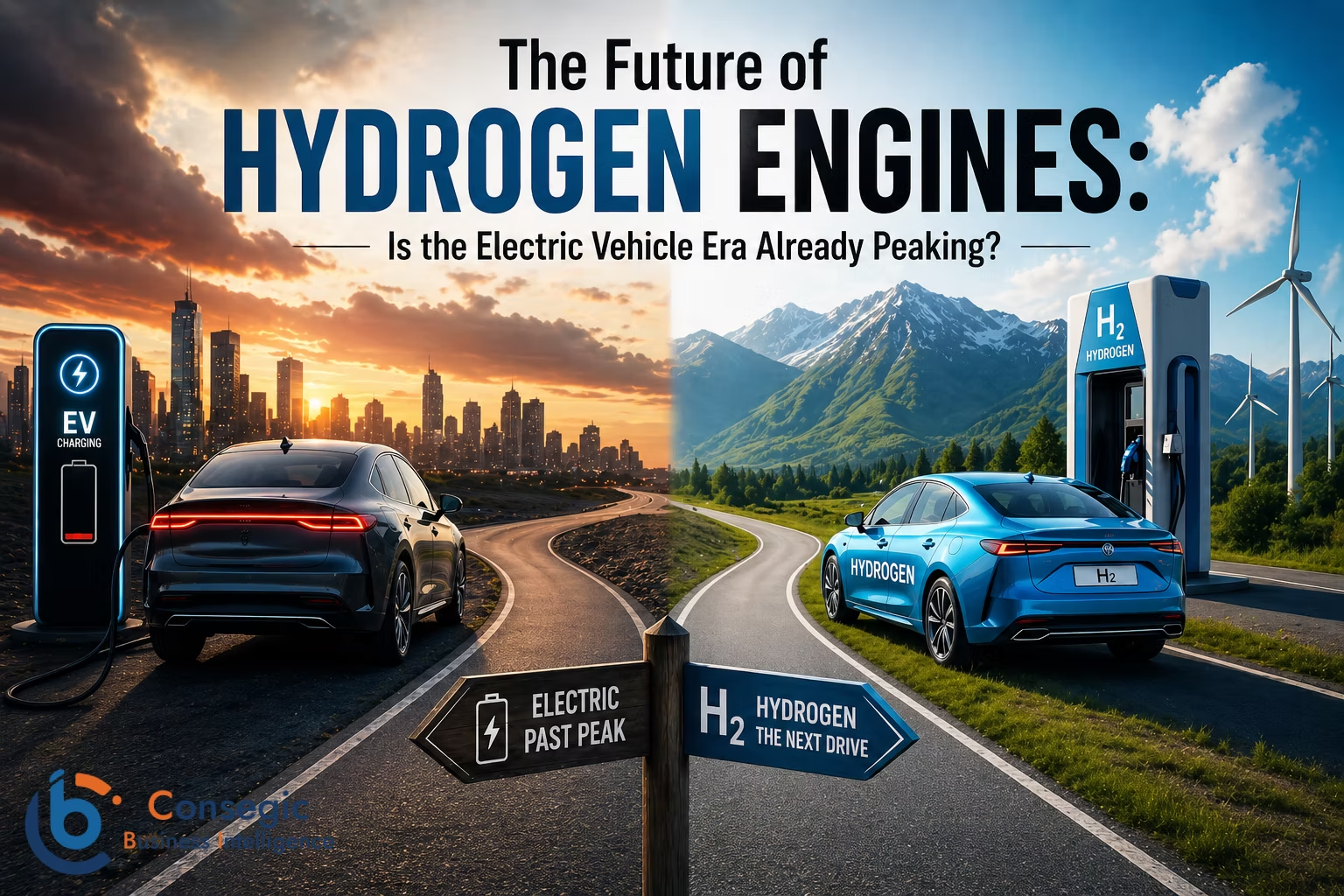
However, as the EV adoption is growing, so are the challenges related to it such as limited charging infrastructure, long charging times, high initial costs and concerns regarding battery production. These issues have encouraged the search of alternative methods.
On the other hand, hydrogen vehicles have become a topic of interest as an alternative option. Toyota and Hyundai are among the companies that are developing hydrogen automobiles that can be recharged faster, offer longer distances and are appropriate for carrying bigger cars than electric cars. But, on the other hand, some of the weaknesses associated with the use of hydrogen are its high cost, lower efficiency and poor infrastructure.
Hence, it is essential to question whether the period of electric cars has already peaked, or will there comes a time where different forms of transportation will emerge.
How Do Hydrogen Engines Work and What Role Will They Play in the Future of Transportation?
The hydrogen engine works on hydrogen gas rather than conventional fossil fuels for producing energy and thus reduces the carbon dioxide emissions by 90%.
The hydrogen engine can generally be classified into two categories- one is the H2-ICE (hydrogen internal combustion engine), where hydrogen is burned in a way that is similar to diesel or petrol. The other type is the FCEV (fuel cell electric vehicle), where energy is produced through chemical reaction for powering the electric motor. This form of technology is currently gaining popularity as a means of powering trucks and other heavy-duty vehicles.
Hydrogen technology is gaining importance in sectors such as heavy-duty trucking, construction, shipping and industrial power generation. Companies such as Cummins, Volvo Group and Toyota are actively testing hydrogen powered trucks and vehicles with longer driving ranges compared to many electric vehicles.
However, there are a number of obstacles that have yet to be overcome in relation to hydrogen engine technology. There is very little refuelling infrastructure in place at the moment and hydrogen fuel is quite expensive compared to other forms of energy. It is also necessary to solve problems such as NOx emissions when hydrogen is used in combustion engines, among others.
Why Are Hydrogen Engines Gaining Attention in Heavy Transport?
Hydrogen-powered engines have started attracting considerable interest in heavy transportation due to their capability to overcome some major shortcomings associated with battery-operated electric cars in this particular industry sector. Heavy-duty vehicles such as trucks, buses and construction machinery need a lot of energy input, a good driving range and a large cargo capacity. Batteries while effective, are bulky and heavy.
Hydrogen, with its much higher energy density, allows vehicle to travel longer distances without adding excessive weight, making it more practical solution for long haul solutions. Moreover, hydrogen powered vehicles can be refuelled in a matter of minutes while electric vehicles require long charging duration that can disrupt logistics and supply chain solutions.
In addition to all this, government and major automotive companies are increasingly investing in hydrogen technology to decarbonize sectors that are difficult to electrify. Companies like Volvo Group and Cummins are already testing hydrogen powered trucks, while the logistics sector is viewing hydrogen as a better alternative to diesel.
Can Hydrogen Solve the Limitations of Electric Vehicles?
Hydrogen has the potential to address several of the limitation in electric vehicles, but it is not a complete solution.
One of the biggest challenges in electric vehicles is its long charging time, while hydrogen powered vehicles can be refuelled in a matter of minutes, saving time and making it a practical option in long distance and commercial travel. Along with this, hydrogen offers much more density than batteries, meaning vehicles can achieve longer range without any carrying any added weight that reduces its efficiency.
Another potential use of hydrogen lies in the field of heavy duty and high demand applications. In scenarios such as long-distance trucking, marine transport and the construction sector, electric vehicles suffer from limitations posed by their batteries and the ability to perform well while operating at constant loads. It therefore makes hydrogen-powered fuel cells a better solution in such circumstances.
However, hydrogen comes with its own set of challenges. The lack of widespread refuelling stations, high production costs and lower overall energy efficiency as compared to electric vehicles, limit its scalability. Moreover, hydrogen today is not produced using clean methods, which makes it harmful to the environment.
Therefore, while hydrogen can address few limitations of electric vehicles, it has its own set of challenges that makes it unfit to replace EVs as a whole.
Is the Electric Vehicle Era Peaking?
The idea that electric vehicle era is “peaking” can be majorly misleading. Rather than declining, the electric vehicle market is transitioning from a phase of rapid growth to a more stable and complex stage of growth.
While EVs have dominated the market for a significant amount of time, recent trends show a shift in momentum rather than complete decline. In the near future, there are clear signs of a slowdown as EV demand has reduced in certain regions and hence, automakers are shifting their strategies.
Additionally, consumer concerns such as high upfront costs, limited charging infrastructure and unstable high range performance are rapidly influencing buying decisions, making the adoption curve steeper than usual.
The broader global picture, however shows a different trend. It signifies EV growth with many regions having a significant share of electric vehicles in new vehicle sales. Strong policy support, advancement in battery technology and increasing fuel costs are still driving the purchase of electric vehicles in many arts of the world.
Electric Vehicles: Peak Hype or Real Progress?
The EV industry is shifting from a hype driven growth to a more realistic and practical expansion. Growth now varies across regions and customer demand and preference are evolving. Automakers are increasingly changing their approach by adopting a multi technology approach by combining electric, hybrid and hydrogen solutions to meet demand.
In conclusion, the EV era is far from over. It is not reaching its peak, rather, it is growing more mature as the industry responds to the reality of life. The future of mobility will probably have more varieties of solutions, where the EVs will be one of the many choices, along with hydrogen.