Quick Summary: The EdTech Revolution
- The Shift: Traditional 4-year degrees are losing their monopoly as the "gold standard" due to high costs, long time commitments, and curricula that often become outdated before graduation.
- The Rise of Micro-Credentials: These short, skill-specific programs (like digital badges) offer a faster, more affordable, and flexible way to gain job-ready expertise. Over 320 million digital badges were issued globally by 2025.
- The Future is Hybrid: Degrees aren't becoming obsolete; they remain vital for foundational theory in fields like medicine and law. The 2026 workforce favors a hybrid model-combining the academic prestige of a degree with the agile, practical skills of micro-credentials.
From Traditional Degrees to Skill-Based Learning: The Rise of EdTech and Micro-Credentials
For decades, a traditional college degree was the gold standard in the field of education and a structured pathway which provided credibility, promised knowledge and led to a stable career. Students followed a predictable routine- finish school, enrol in a university, spend 3-4 years studying for a degree and enter the job market with job opportunities prevailing with the earned degree. This system worked well in a time when industries used to evolve slowly and university education held the same importance for years to come.
However, in the recent years, the educational industry is going through a massive transformation with the emergence of digital learning platforms that provides a new and interesting way to earn degrees. Educational technology or EdTech has played a crucial role in this shift by making leaning accessible anytime, anywhere and often at a fraction of cost spend on traditional education.
At the heart of this revolution lies micro credentials. These are short, online programs, lasting for weeks or months rather than years, that target specific skills and are issued as digital badges specially for jobs in fields like cybersecurity and project management. They support lifelong learning and micro credentials stacking can be used in place of a full degree, saving individual from long term commitment.
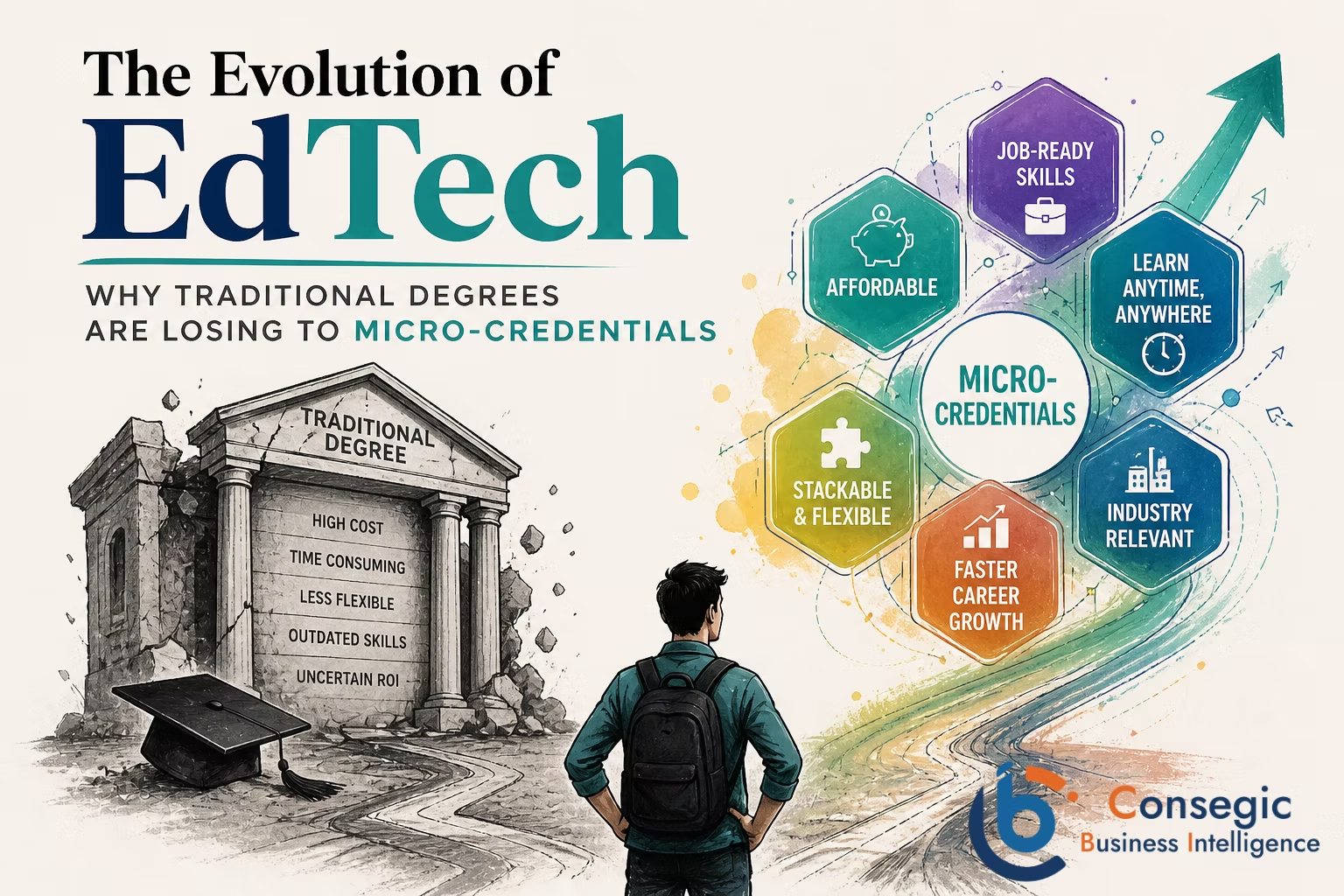
In this fast-changing competitive landscape, employers and companies prefer those candidates who can contribute from day one, making practical knowledge more valuable than simple theory. As a result, it is not about what degree you hold but rather about what you can do.
Keeping this change in mind, traditional degrees are not disappearing but are simply no longer the only and most efficient route to success. Instead, they are being challenged by a more dynamic and skill-based approach to education.
The Rise of Micro-Credentials in the EdTech Era
Micro credentials have quickly become a key feature of modern education driven by the growth of the EdTech era. These are short, skill-based courses that allows the individual to gain practical knowledge on recent trends and topics without committing to long term degrees. The number of digital badges globally has tripled since 2022, with over 320 million issued by 2025.
One of the biggest advantages provided by these micro credentials is the flexibility. Unlike traditional degrees which are offline and slow paced, these courses are majorly online or hybrid and are self-paced.
Learners can acquire job ready skills in weeks or months and apply them immediately through internships, freelancing or full-time roles. Also, the concept of stackable learning allows individuals to build multiple skills over time that act as a full degree together.
Why Are Traditional Degrees Losing Their Edge?
Traditional degrees are losing their dominance, mainly due to the time they require to complete. Most degrees require 3-4 years to finish, while the industries are evolving in a much faster rate. By the time students graduate, their knowledge becomes outdated.
Degrees often require high financial investments which makes them unaffordable and hence inaccessible to everyone and often does not guarantee strong job opportunities. In comparison, micro credentials are much affordable and allow students to start working and earning faster.
The gap between theoretical and practical learning is also growing. Education in its traditional form pays more attention to theory, but modern organizations give preference to those who can use their theoretical knowledge in real life practice, thus minimizing the time and effort needed to train new workers.
Are Degrees Becoming Obsolete?
Despite the rise of EdTech and micro-credentials, traditional degrees are definitely not becoming outdated or obsolete. Their value is simply changed. They are still as important as before in fields like medicine, law and engineering where academic background is very significant.
Also, they form solid foundations for critical thinking, theory and academics, which short courses significantly lack in. Thus, traditional degrees are necessary for creating a strong foundation for a stable career and good leadership qualities.
It should also be noted that now employers demand both theoretical degree and practical experience in their job. On one hand, a degree gives formal and academic value to candidates, while, on the other hand, micro-credentials offer valuable practical skills and knowledge. That’s why the future belongs to a mixture of degrees and micro-credentials.
The Future: Hybrid Education Models
The future of education is increasingly moving towards a hybrid model where traditional degrees and micro credentials exist side by side rather than competing with each other. Instead of relying on one specific degree for a long period of time, people are increasingly opting for a combination of educational qualifications and skill-oriented certificates.
In this model, conventional degrees offer structure to education, theoretical knowledge and credibility especially for fields where having an in-depth understanding of the basics is critical. Meanwhile, micro-credentials enhance flexibility and applicability, allowing one to learn and develop rapidly changing technology-related skills.
Continuous learning is another element of the above-mentioned hybrid approach. In this context, education does not end with the acquisition of a degree but continues all throughout one's career. In other words, the individual must continuously update his skill set by taking short courses, certification programs and engaging in online education.
Overall, the hybrid education model represents a shift from ‘one time education’ to lifelong and flexible learning, where degrees and micro credentials work together to prepare individuals for a dynamic and unpredictable future job market.
Conclusion
The evolution of EdTech has clearly reshaped the way education is perceived and delivered. While traditional degrees stood as the only pathway to a successful career, the rise of micro credentials has introduced a more flexible, skill developing and industry relevant approach to learning.
In todays fast paced world, where jobs and technologies are continuously changing, it is not wise to depend only on long term academic qualifications for career growth and success. However, it is important to know that traditional degrees have not lost their relevance but their roles are simply evolving.
In conclusion, the future of education does not completely depend on degree or micro-credentials but rather on an approach where both systems work hand in hand. By doing so, learners will be smart academically as well as professionally ready to embrace continuous learning amid ever-changing economic conditions globally.