The Rise of AI in Modern Healthcare
In 2026, AI has emerged as a crucial foundation for modern healthcare systems rather than an additional technology. Owing to the ever-increasing amounts of healthcare data, from EHRs to genomic sequences, and real-time wearable data, healthcare professionals find AI indispensable for increasing accuracy and effectiveness of their diagnoses. In comparison with standard procedures based on time-consuming and potentially error-prone human analysis of medical images, AI can examine large amounts of information in seconds.
New scientific publications point out that AI is making more than a procedural change. The development of new machine learning and deep learning algorithms has made it possible to make diagnoses at the level of human experts in cases of cancer, cardiovascular diseases, and even neurodegenerative diseases.
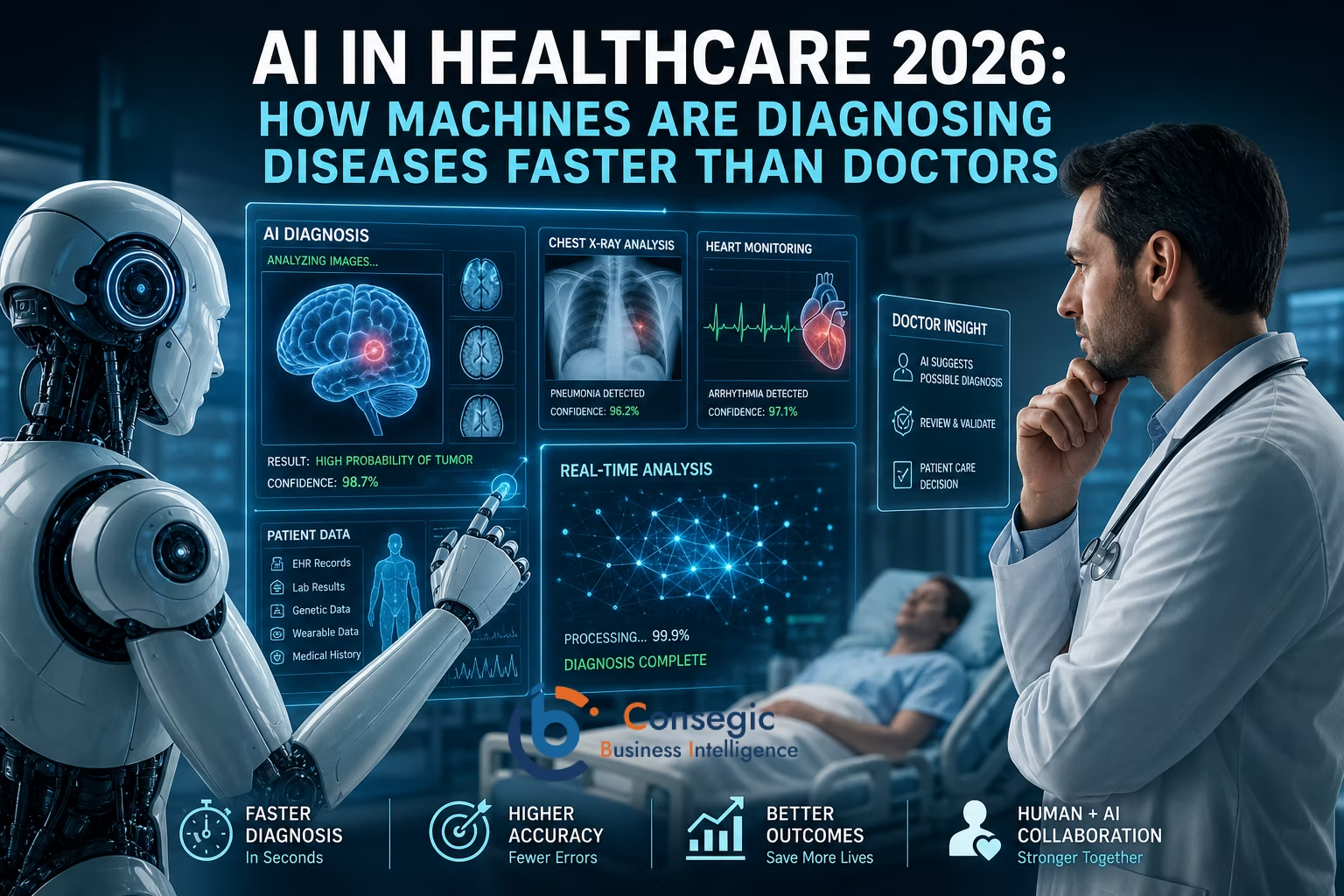
Moreover, the need for AI implementation is driven by the global problems in the field of healthcare, such as the shortage of physicians and higher workloads of patients. AI provides innovative solutions capable of addressing the problem of access to efficient treatment in regions where medical services remain underdeveloped. Furthermore, the industry is experiencing a transition towards the paradigm of data-driven healthcare management.
AI in healthcare stands for a paradigm shift in disease diagnosis and treatment from reactive medicine to preventive treatment options. The implementation of innovations is still in progress but the process is extremely significant.
How AI Diagnoses Diseases Faster Than Doctors
The primary reason behind AI surpassing doctors in diagnosing diseases is its capacity to handle large volumes of information at once. As opposed to human doctors, who have to analyze a case step-by-step, an AI system can analyze multiple cases all at once, making it much quicker and more efficient. Such an approach relies on the use of deep learning frameworks, such as CNNs in case of image analysis or transformers when working with medical text.
Contemporary AI is capable of handling millions of cases, which enables the AI algorithm to find patterns that escape the eye of even the most experienced doctor. A good example would be ECG diagnosis, where human doctors fail to diagnose many cases, while an AI performs much better.
Further examples of advancements help explain how fast an AI is compared to other techniques. More sophisticated diagnostic techniques help make complex diagnoses at a much faster rate with greater precision. It was proven in several experiments where AI provided better rates of diagnostics than physicians, taking significantly less time.
Moreover, generative models of artificial intelligence incorporate multimodal data such as images, lab reports, and patient stories to provide complete diagnostic output. The use of a multimodal system allows clinicians to reach conclusions at a faster pace.
Real-World Applications: Where AI Is Already Saving Lives
The implementation of AI technology is not limited to lab experiments anymore but rather is rapidly changing many aspects of medical practice. Among the most promising uses is the analysis of X-ray, CT scans, and MRI for finding such symptoms as tumors, fractures, and internal bleeding with the help of AI. This software helps radiologists prioritize the patients' treatment and diagnose their condition.
In cardiology, AI algorithms are used for the analysis of heart activity. According to recent research, there is a significant reduction of missed diagnoses when using AI technologies on ECG data.
Moreover, emergency care saw major developments with the help of artificial intelligence. According to recent research, AI technologies were able to make a diagnosis more accurately than doctors in emergency care triage scenarios.
Another revolutionary field is stroke detection, in which artificial intelligence can perform brain scan analysis faster than human doctors, in some cases even within an hour, which results in much better recovery outcomes due to prompt measures taken.
Not limited to hospitals, artificial intelligence is implemented in wearables as well as virtual medical assistance, facilitating constant patient monitoring and the early diagnosis of diseases. Moreover, virtual assistants and artificial intelligence-driven chatbots help patients get preliminary diagnoses and direct them to further treatment.
Can AI Truly Replace Doctors?
There are multiple advantages of AI applications in the healthcare industry. The main ones include improved diagnostic abilities, minimized human errors, increased efficiency, and lower costs. With the help of the technology, healthcare workers will be able to spend more time helping patients. Many studies have demonstrated that AI is just as effective as doctors at carrying out diagnostic tasks, especially where large amounts of data are required, for example, imaging and pattern recognition.
At the same time, there are some serious drawbacks associated with using AI in the healthcare sector which make it impossible for it to replace doctors completely. Firstly, AI models rely on the quality of the data they were trained with, and thus, if the data used was biased, so will be the model's predictions. Secondly, AI cannot possess the humane qualities which are important in providing treatment.
The other aspect of recent discoveries relates to the potential threat of overdependence on artificial intelligence. Patients and even doctors themselves might put too much faith into the advice offered by artificial intelligence technologies, which can result in misdiagnosis and even wrong treatment.
What is more, the legal, ethical, and regulatory issues have not been sorted out yet, hindering further development of the AI approach in medicine. In this context, it should be noted that AI can complement but cannot replace doctors. The optimal healthcare system will combine computer analysis and human intuition and compassion.
The Future of AI in Healthcare: What Lies Ahead Beyond 2026
The future of Artificial Intelligence in healthcare looks set to go beyond diagnostics and bring about an age of completely integrated intelligent health care. One of the major innovations is that of personalized medicine, wherein AI processes a wide variety of genetic, environmental, and lifestyle information for developing personalized treatments.
There are some very exciting applications of artificial intelligence that promise to speed up the process of developing new drugs and minimize costs. Robotics, on the other hand, has already started improving surgical procedures through the use of autonomous robots that can help minimize risks and complications.
Recent studies indicate that intelligent multi-agent AI systems – modelled after teams of doctors working together – have the capacity to perform as well as or better than human practitioners when it comes to diagnosing and treating patients.
Conclusion
The role of AI technology in the healthcare industry in 2026 entails the adoption of a system that is fast, accurate, and data-driven diagnosis. Sophisticated technologies allow the processing of enormous amounts of information within seconds, surpassing humans in the analysis of medical data. Nonetheless, the role of AI in the process should be limited only to providing assistance in diagnosing diseases. There is no replacement for human empathy and moral considerations which doctors have. Thus, the development of AI should be oriented towards cooperation with human doctors.