Jump to Content
Boom Trucks Market - Size, Share, Industry Trends, and Forecasts (2025-2032)
Boom Trucks Market Size:
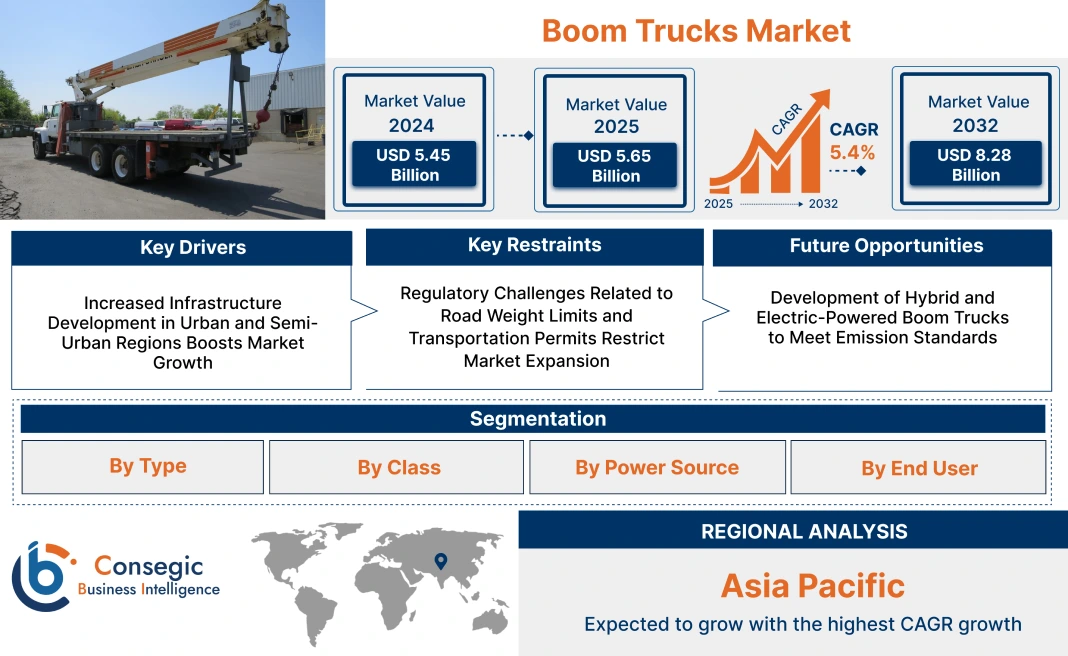
Boom Trucks Market size is estimated to reach over USD 8.28 Billion by 2032 from a value of USD 5.45 Billion in 2024 and is projected to grow by USD 5.65 Billion in 2025, growing at a CAGR of 5.4% from 2025 to 2032.
Boom Trucks Market Scope & Overview:
Boom trucks are mobile lifting vehicles equipped with a hydraulic crane mounted on a commercial truck chassis, designed for material handling and aerial lifting tasks. Commonly used in construction, utilities, telecommunications, and maintenance operations, they combine transportation and lifting capabilities in a single unit.
These machines feature extendable booms, rotating turrets, stabilizing outriggers, and operator cabins or remote controls for precision handling. Configurations vary by load capacity, reach height, and mounting style, allowing customization for specific jobsite requirements.
Key benefits include enhanced maneuverability, quick setup, and reduced equipment transport needs. Boom trucks improve jobsite efficiency by enabling lifting and hauling without the need for separate cranes or trailers. Their versatility in accessing elevated work areas and lifting heavy loads makes them a reliable solution for dynamic operational environments where space, time, and mobility are critical.
Boom Trucks Market Dynamics - (DRO) :
Key Drivers:
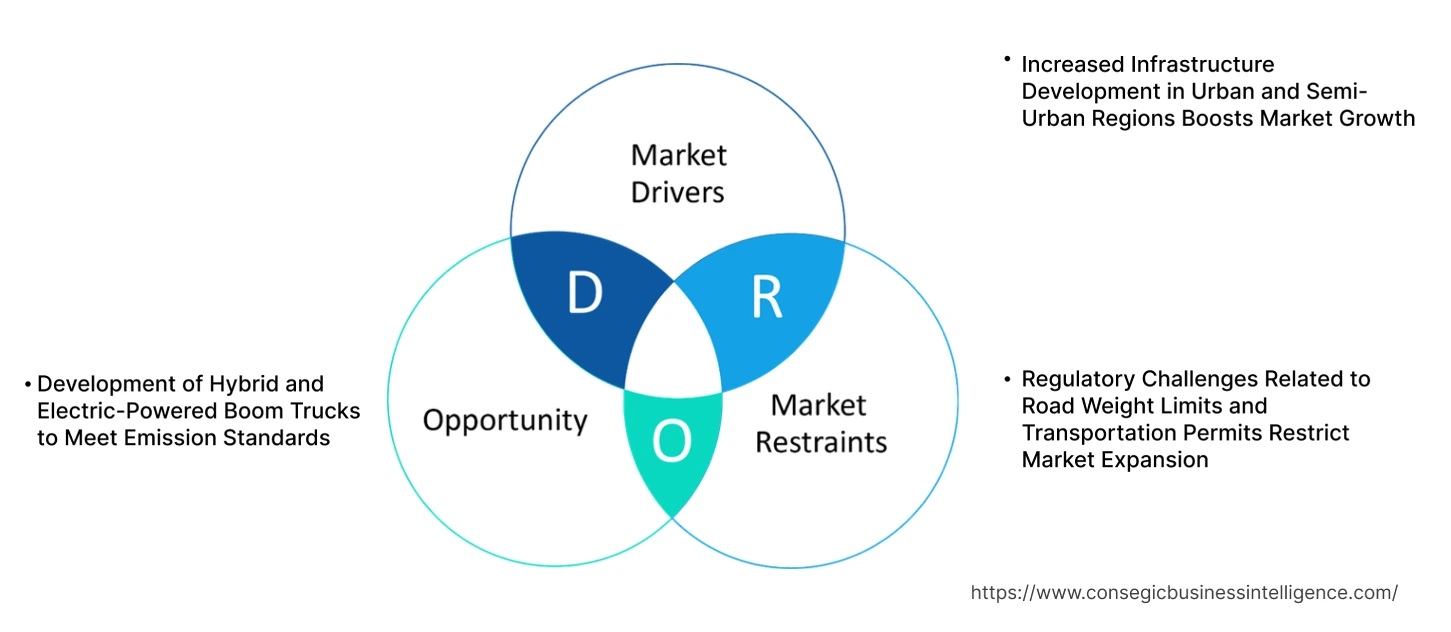
Increased Infrastructure Development in Urban and Semi-Urban Regions Boosts Market Growth
Rapid growth in public infrastructure, including roadways, bridges, utility lines, and urban construction projects, fuels the need for reliable lifting and hoisting equipment. Boom trucks are widely used for tasks such as pole setting, modular construction, concrete placement, and equipment positioning in confined work zones. In semi-urban developments, where mobility and multi-functionality are critical, these trucks provide a convenient alternative to fixed cranes or stationary lifts. Their ability to travel between job sites and operate on uneven terrain increases operational flexibility.
- For instance, in April 2022, National Crane introduced a new short chassis model, the NBT45127-2, for urban and suburban settings. The 79,500-pound vehicle is propelled by a 500-horsepower Cummins X15 engine and Allison 4500 RDS transmission. It features a 13,500-pound pusher axle, rather than a tag axle, with an existing 46,000-pound rear tandem arrangement for better navigation.
With rising investments in transport, energy, and telecom infrastructure across developing and developed regions alike, demand for versatile lifting equipment continues to rise, contributing to steady boom trucks market expansion.
Key Restraints:
Regulatory Challenges Related to Road Weight Limits and Transportation Permits Restrict Market Expansion
Compliance with regional transportation laws, particularly axle weight limits and on-road travel restrictions, presents operational challenges for fleet owners and contractors. Oversized boom truck configurations often require special permits, escort vehicles, or route planning, which adds time and cost to deployment. Municipal and interstate differences in regulations make cross-border equipment transfers complicated, especially for rental companies and logistics providers. In highly regulated urban zones, daytime operation of heavy vehicles is often limited, further reducing equipment availability during peak construction hours. These logistical and regulatory hurdles impact utilization rates and ownership appeal. Despite growing demand across sectors, these limitations continue to slow boom trucks market growth by affecting operational efficiency and job site flexibility.
Future Opportunities :
Development of Hybrid and Electric-Powered Boom Trucks to Meet Emission Standards
Environmental regulations are prompting manufacturers to rethink traditional diesel-powered equipment. Hybrid and fully electric boom trucks are gaining traction as operators seek to reduce emissions, noise, and fuel dependency, especially in urban job sites and enclosed environments. These newer models offer clean energy integration while maintaining performance metrics suitable for heavy lifting and aerial access. Demand is rising from utility providers, municipalities, and contractors committed to sustainability goals and low-carbon construction practices. Additionally, government incentives and green procurement policies are accelerating adoption across public sector projects.
- For instance, in March 2024, Hiab launched HIAB wspr, the next-generation electric hybrid solution. The emission-free, quiet electric vehicles run on both truck engines and separate electric power take-off (ePTO). Available in three different models, the vehicle comes with a two-year warranty.
As emissions regulations become more stringent, the shift toward electric and hybrid platforms is shaping the future of jobsite mobility, unlocking strong boom trucks market opportunities driven by sustainable growth and evolving fleet standards.
Boom Trucks Market Segmental Analysis :
By Type:
Based on type, the market is segmented into telescopic, articulating, hybrid, bucket, and others.
The telescopic boom trucks segment accounted for the largest revenue share in 2024.
- Telescopic vehicles are highly versatile and provide extended reach, making them ideal for a wide range of applications, including construction, utility work, and telecommunications.
- These trucks are designed for heavy lifting and can handle significant payloads, which is crucial for industries that require high lifting capacity.
- Their flexibility and ability to adjust the boom length make them suitable for various projects, including aerial work platforms and material handling in tough terrains.
- As per boom trucks market analysis, the segment remains dominant due to its widespread application across multiple industries, offering robust performance and safety.
The articulating boom trucks segment is projected to register the fastest CAGR during the forecast period.
- Articulating machines, or knuckle-boom trucks, are gaining popularity due to their ability to reach places that are difficult for traditional telescopic booms.
- These trucks feature a jointed arm design that provides better maneuverability and control, especially in confined spaces.
- They are increasingly used in industries like oil & gas, forestry, and telecommunications, where access to difficult locations is often required.
- According to boom trucks market trends, the need for articulating models is accelerating due to their compactness, ease of use, and superior flexibility in urban and industrial applications.
By Class:
Based on class, the market is segmented into Class 4, Class 5, Class 6, Class 7, and Class 8.
The Class 7 segment held the largest boom trucks market share in 2024.
- Class 7 types have a gross vehicle weight rating (GVWR) between 26,001 to 33,000 pounds, offering a balance of size, power, and payload capacity suitable for medium-duty construction and utility tasks.
- These trucks are preferred for commercial applications where both mobility and heavy lifting are required.
- The Class 7 trucks are commonly used for lifting materials and personnel to heights in commercial construction, utilities, and other infrastructure projects.
- As per boom trucks market analysis, this segment remains the leader due to its optimal balance between performance and operational flexibility for medium-sized jobs.
The Class 8 segment is expected to experience the fastest CAGR during the forecast period.
- Class 8 models, with a GVWR exceeding 33,000 pounds, are used for heavy-duty applications that require robust lifting power and larger payloads.
- These trucks are mainly used in industries like mining, construction, and oil & gas, where larger equipment and materials need to be moved across long distances or rough terrains.
- Class 8 boom trucks offer unmatched stability and can accommodate a variety of lifting attachments, making them ideal for high-demand industrial tasks.
- According to boom trucks market trends, the expansion of large-scale infrastructure projects and increased industrial activity is driving the requirement for Class 8 models.
By Power Source:
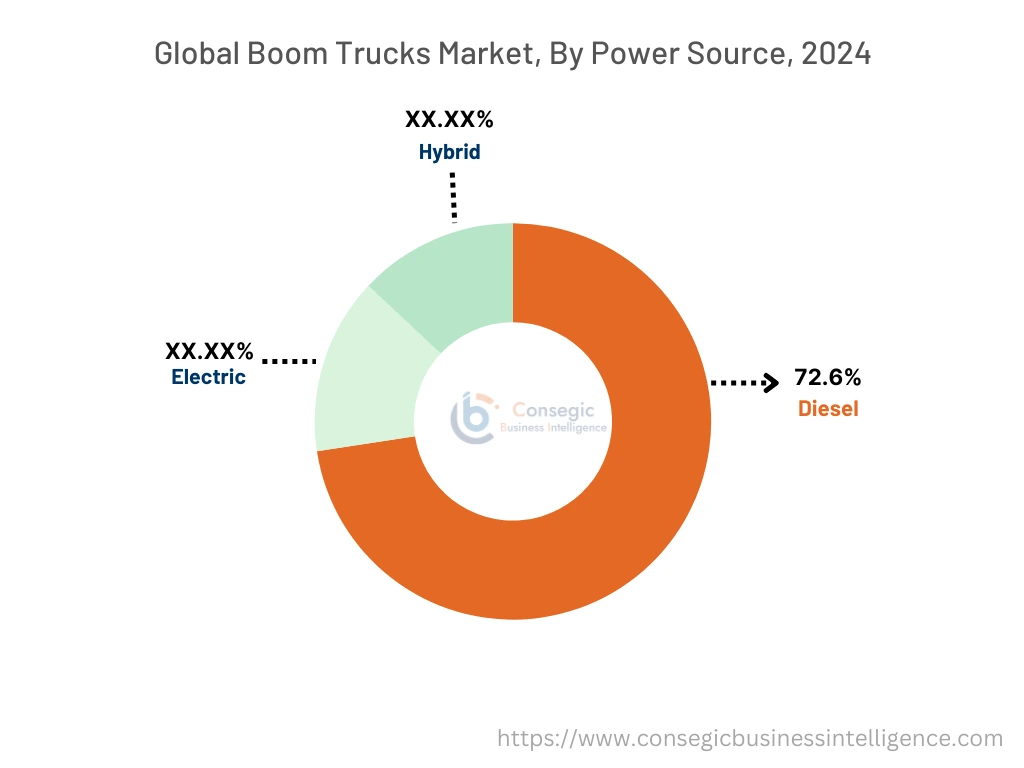
Based on power source, the market is segmented into diesel, electric, and hybrid.
The diesel-powered segment accounted for the largest revenue share of 72.6% in 2024.
- Diesel-powered machines remain the most popular due to their high power output, long operational hours, and ability to work in remote areas without access to electrical grids.
- Diesel engines provide the necessary torque to lift heavy loads efficiently, making them suitable for construction, mining, and large-scale utility applications.
- Despite environmental concerns, diesel trucks continue to dominate due to their ruggedness, versatility, and the established infrastructure supporting diesel fuel.
- Thus, diesel-powered models maintain their leadership position due to their reliability and proven performance across various heavy-duty applications, as well as satisfying the boom trucks market demand.
The hybrid-powered segment is projected to witness the fastest CAGR during the forecast period.
- Hybrid-powered models combine the power of diesel with the energy efficiency of electric systems, offering reduced emissions and lower fuel consumption.
- These systems are being adopted more widely due to stricter emission regulations in regions like Europe and North America.
- Hybrid trucks are also preferred in urban areas and for projects requiring eco-friendly solutions, like green building constructions and infrastructure development.
- Hence, the increasing necessity for sustainable and energy-efficient equipment is pushing the market toward hybrid power systems, offering both operational cost savings and environmental benefits, and driving boom trucks market growth.
By End-Use:
Based on end-use, the market is segmented into residential, commercial, and industrial.
The industrial segment held the largest boom trucks market share in 2024.
- Industrial vehicles are used for heavy lifting and materials handling in sectors like mining, oil & gas, and manufacturing.
- These trucks support large-scale construction projects, where they are used to move materials, equipment, and personnel to elevated areas.
- Their robust design, high lifting capacity, and ability to operate in harsh environments make them indispensable in industrial sectors.
- Thus, the growing global industrialization and infrastructure development contribute to the increasing boom trucks market demand.
The commercial segment is expected to grow at the fastest CAGR during the forecast period.
- Commercial applications, including telecommunications, utilities, and retail construction, are seeing an increasing need for them due to their flexibility in servicing a variety of tasks.
- In urban areas, where space and access are limited, articulating and compact machines are being favored for their ability to navigate tight spaces while offering efficient lifting solutions.
- The rise of smart cities and commercial real estate development is driving the need for advanced, multifunctional models that can meet complex urban project requirements.
- Furthermore, commercial sectors are adopting these machines for their versatility and eco-friendly features, especially in urban environments, resulting in boom trucks market expansion.
Regional Analysis:
The regions covered are North America, Europe, Asia Pacific, the Middle East and Africa, and Latin America.
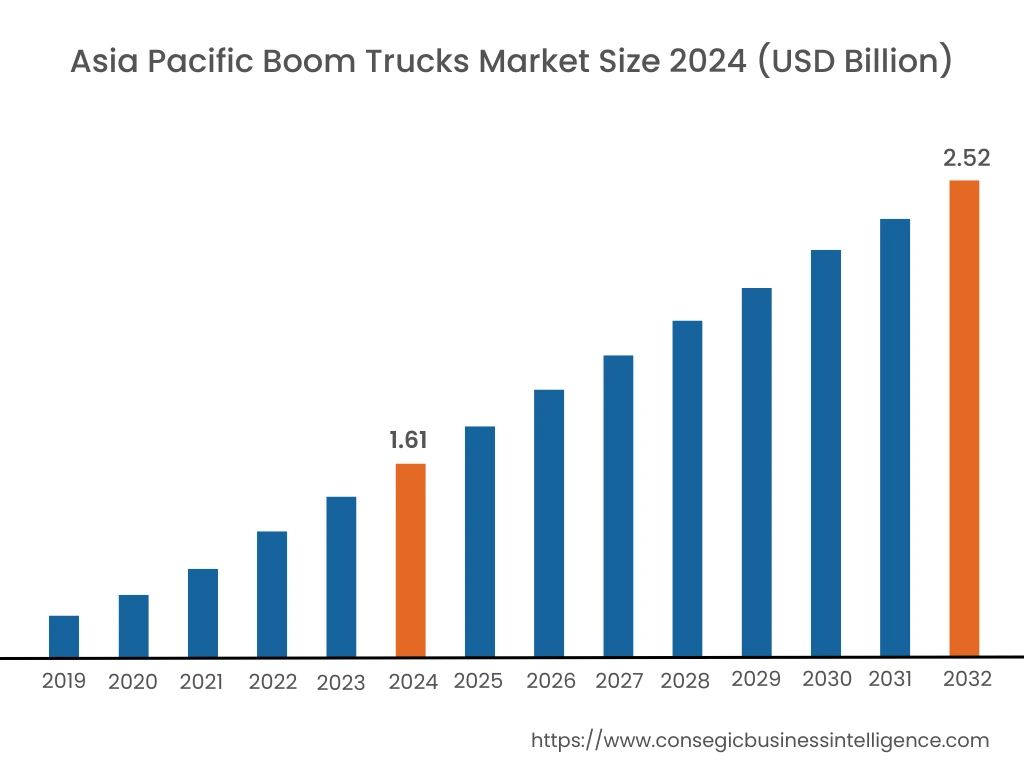
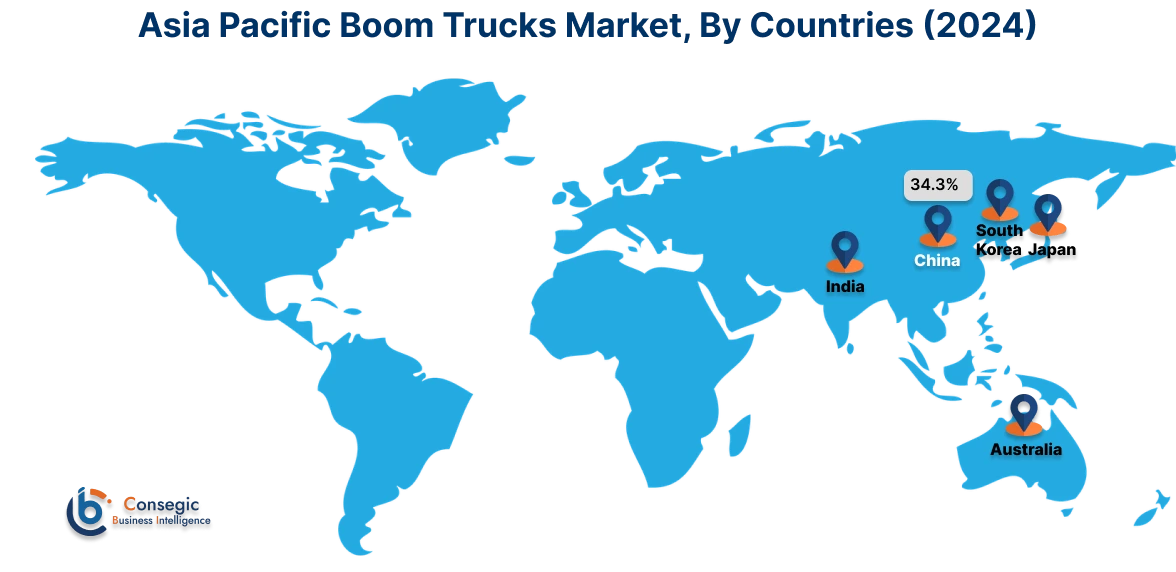
Asia Pacific region was valued at USD 1.61 Billion in 2024. Moreover, it is projected to grow by USD 1.67 Billion in 2025 and reach over USD 2.52 Billion by 2032. Out of this, China accounted for the maximum revenue share of 34.3%. Asia-Pacific is witnessing rapid growth in the boom trucks industry, supported by extensive construction activities, telecom expansion, and electrification projects across developing economies. In China, India, Japan, and South Korea, need is increasing for multi-purpose trucks with higher payload capacity and improved vertical reach. Market analysis highlights the trend toward domestic manufacturing and localization of key components, aimed at reducing cost and enhancing serviceability. Rising urbanization, together with the deployment of smart city infrastructure, is contributing to its greater utilization in both private and public sector projects. The region’s diversified industrial base and large-scale government investments are expected to fuel long-term necessity.
North America is estimated to reach over USD 2.68 Billion by 2032 from a value of USD 1.81 Billion in 2024 and is projected to grow by USD 1.87 Billion in 2025. North America holds a dominant position in the market, fueled by steady requirement in utility services, telecommunications, and construction sectors. In the United States and Canada, they are widely used for aerial operations such as power line maintenance, signage installation, and tree trimming. Market analysis indicates growing preference for lightweight models with advanced safety systems and remote-control capabilities. Adoption is also supported by regulatory standards for aerial lift safety and increasing investment in electric utility upgrades. Continued growth is anticipated as infrastructure modernization accelerates and rental fleet operators expand their high-reach equipment inventories.
Europe represents a regulation-focused market with stable demand across municipal services, building maintenance, and renewable energy sectors. Countries like Germany, France, and the UK are deploying them for both urban and rural infrastructure works, especially in sectors like wind farm servicing and road maintenance. Market analysis shows increased emphasis on eco-friendly vehicle platforms, including hybrid and electric models tailored for low-emission zones. The boom trucks market opportunity in Europe is further enhanced by public investments in transportation networks and digital infrastructure, which require efficient and compact aerial equipment capable of operating in constrained spaces.
Latin America presents an emerging market for boom truck adoption, particularly in Brazil, Mexico, and Chile, where energy, construction, and utility sectors are transforming. Market analysis reveals increasing reliance on aerial lift solutions for electricity distribution network upgrades and streetlight maintenance in urban centers. Fleet expansion in the rental segment is also contributing to accessibility among small to mid-sized contractors. As regional economies invest in roadways, public safety, and rural connectivity, demand for versatile and durable vehicles is expected to rise. Lastly, Latin America benefits from strengthening distribution networks and training programs offered to improve operational safety and equipment longevity.
The Middle East and Africa are gradually expanding their use of boom trucks, primarily in oil and gas, construction, and public utility projects. In the UAE and Saudi Arabia, high-reach trucks are utilized in smart city developments and large-scale infrastructure projects. South Africa and parts of East Africa are adopting them for electric grid expansion and telecom tower installation. Market analysis suggests that durable, all-terrain models are in want due to challenging site conditions and remote locations. While adoption is still at a nascent stage in some countries, regional growth is supported by infrastructure modernization plans and increasing interest in equipment leasing models.
Top Key Players and Market Share Insights:
The boom trucks market is highly competitive with major players providing products and services to the national and international markets. Key players are adopting several strategies in research and development (R&D), product innovation, and end-user launches to hold a strong position in the global boom trucks market. Key players in the boom trucks industry include -
- Palfinger AG (Austria)
- Liebherr Group (Germany)
- Tadano Ltd. (Japan)
- Zoomlion Heavy Industry Science & Technology Co., Ltd. (China)
- XCMG Group (China)
- SANY Group (China)
- Manitex Valla S.r.l. (Italy)
- Fassi Gru S.p.A. (Italy)
- Hyva Group (Netherlands)
- PM Group S.p.A. (Italy)
Recent Industry Developments :
Product Launch:
- In February 2025, Terex Utilities unveiled a new zero-emissions bucket truck with more range and payload capacity. The all-electric vehicle is equipped with the 3rd Eye® digital platform, which incorporates advanced camera systems, AI, and industry-leading technology to maximize safety and productivity by reducing blind spots when reversing, changing lanes, or operating in tight or high-traffic areas.
Acquisitions:
- In April 2025, Maxim Crane Works, L.P. completed the acquisition of Closing of Tower Crane from a wholly owned subsidiary of Sims Crane & Equipment Co., a prominent player in the Florida crane market.
- In January 2025, Tadano, a leading Japanese hydraulic truck firm, completed the acquisition of Manitex. The acquired product line consists of Manitex mobile truck cranes, PM knuckle boom cranes, Valla small electric cranes, and Oil & Steel aerial work platforms. Furthermore, Tadano gains five engineering and manufacturing locations throughout North America and Europe. Moreover, this acquisition includes Rabern Rentals.
Partnerships:
- In August 2024, Manitex International signed a dealership agreement with Bruckner’s Truck and Equipment in support of its North American PM crane sales expansion. This partnership enables Bruckner to sell and support the full product line of Manitex solutions throughout their network across the United States.
Boom Trucks Market Report Insights :
| Report Attributes | Report Details |
| Study Timeline | 2019-2032 |
| Market Size in 2032 | USD 8.28 Billion |
| CAGR (2025-2032) | 5.4% |
| By Type |
|
| By Class |
|
| By Power Source |
|
| By End-Use |
|
| By Region |
|
| Key Players |
|
| North America | U.S. Canada Mexico |
| Europe | U.K. Germany France Spain Italy Russia Benelux Rest of Europe |
| APAC | China South Korea Japan India Australia ASEAN Rest of Asia-Pacific |
| Middle East and Africa | GCC Turkey South Africa Rest of MEA |
| LATAM | Brazil Argentina Chile Rest of LATAM |
| Report Coverage |
|
Key Questions Answered in the Report
How big is the Boom Trucks Market? −
Boom Trucks Market size is estimated to reach over USD 8.28 Billion by 2032 from a value of USD 5.45 Billion in 2024 and is projected to grow by USD 5.65 Billion in 2025, growing at a CAGR of 5.4% from 2025 to 2032.
What specific segmentation details are covered in the Boom Trucks Market report? +
The Boom Trucks market report includes specific segmentation details for type, class, power source and end-use.
What are the end-use of the Boom Trucks Market? +
The end-use of the Boom Trucks Market are residential, commercial, and industrial.
Who are the major players in the Boom Trucks Market? +
The key participants in the Boom Trucks market are Palfinger AG (Austria), Liebherr Group (Germany), Tadano Ltd. (Japan), Zoomlion Heavy Industry Science & Technology Co., Ltd. (China), XCMG Group (China), SANY Group (China), Manitex Valla S.r.l. (Italy), Fassi Gru S.p.A. (Italy), Hyva Group (Netherlands) and PM Group S.p.A. (Italy).
Overview
Reputation & Certifications


Our Services
- Market Intelligence & Forecasting
- Custom Research Solutions
- Market Entry Strategy
- Competitive Intelligence
- Customer Insights
- Industry Innovation Analysis
- Investment Advisory